- The paper computes the renormalized scalar vacuum polarization using a Euclidean sum-over-modes and WKB regularization method.
- Results show that near-horizon polarization is enhanced linearly with the quantum parameter ε, with effects becoming negligible in realistic astrophysical settings.
- Non-conformal coupling induces a small negative polarization tail at large radii, consistent with predictions from the DeWitt–Schwinger expansion.
Scalar Vacuum Polarization in Loop Quantum Gravity Black Holes
Introduction and Motivation
The computation of quantum field effects on black hole spacetimes remains a central diagnostic tool for probing quantum gravitational corrections to classical geometries. Loop Quantum Gravity (LQG) offers a nonperturbative framework for quantizing geometry, predicting macroscopic modifications to the Schwarzschild solution. Specific LQG-inspired black hole metrics replace the classical singularity with a regular core and induce persistent, quantum-origin energy densities that fundamentally alter the asymptotic and near-horizon structure. The metric under study features a dimensionless quantum exponent, ϵ, which parametrizes the departure from classicality and vanishes in the Schwarzschild limit.
A significant open question is whether quantum vacuum fluctuations, particularly for massive scalar fields, exhibit pathological growth or other detectable imprints outside the horizon in these non-Ricci-flat, non-asymptotically flat backgrounds. Concretely, this work computes the renormalized scalar vacuum polarization, ⟨ϕ2⟩, employing the extended Anderson–Candelas–Christensen–DeWitt formalism, adapted for the LQG-modified black hole geometry. The analysis includes non-minimal curvature couplings and varying field masses, allowing for direct comparison to both the classical Schwarzschild limit and predictions from the DeWitt–Schwinger expansion.
Theoretical and Computational Framework
The metric under consideration is:
ds2=r2ϵf(r)dτ2+r−2u(r)dr2+r2dΩ22,
with ϵ≪1 for astrophysical black holes and f(r), u(r) as in the paper. The unique event horizon remains at rs=2M. Persistent quantum effects are encoded in a negative, quantum-origin energy density outside the horizon, leading to a confining potential for massive matter and loss of asymptotic flatness.
Vacuum polarization is computed using a Euclidean sum-over-modes representation for the Green function, regularized via the covariant point separation method. The divergent mode sums are handled through WKB-approximated counter-terms, leading to a renormalized, finite result for ⟨ϕ2⟩. Numerical integration of the radial Green function modes is implemented using a fourth-order Runge–Kutta scheme, with careful attention given to both near-horizon regularity and correct outer boundary asymptotics. The procedure is validated by reproducing known Schwarzschild results and confirming consistency of the subtraction scheme across grid refinements.
Results: Quantum-Gravity Corrections on Vacuum Polarization
The primary effect of the quantum exponent ϵ is an enhancement of the vacuum polarization peak near the horizon, with the magnitude of this enhancement scaling linearly with ϵ. For representative parameter choices (⟨ϕ2⟩0, ⟨ϕ2⟩1), increasing ⟨ϕ2⟩2 from 0 (Schwarzschild) to 0.2 more than doubles the horizon value of ⟨ϕ2⟩3.
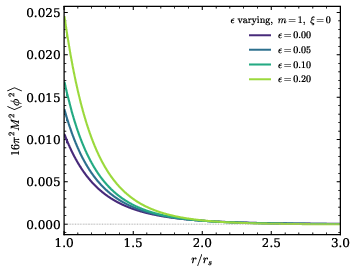
Figure 1: ⟨ϕ2⟩4 versus ⟨ϕ2⟩5 at fixed ⟨ϕ2⟩6, ⟨ϕ2⟩7, for varying ⟨ϕ2⟩8; ⟨ϕ2⟩9 gives the Schwarzschild reference curve.
The vacuum polarization profile is finite throughout, maximized at the horizon, and decays monotonically with radius. Heavier fields (ds2=r2ϵf(r)dτ2+r−2u(r)dr2+r2dΩ22,0) are suppressed in their polarization contribution, reflecting standard mass decoupling.
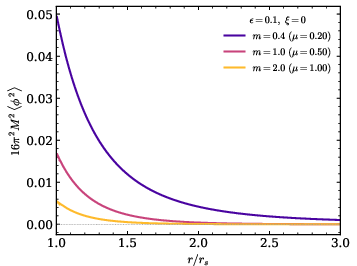
Figure 2: Suppression of vacuum polarization for increasing field mass ds2=r2ϵf(r)dτ2+r−2u(r)dr2+r2dΩ22,1 at ds2=r2ϵf(r)dτ2+r−2u(r)dr2+r2dΩ22,2, ds2=r2ϵf(r)dτ2+r−2u(r)dr2+r2dΩ22,3.
The curvature coupling parameter ds2=r2ϵf(r)dτ2+r−2u(r)dr2+r2dΩ22,4 modifies the polarization profile. Conformal coupling (ds2=r2ϵf(r)dτ2+r−2u(r)dr2+r2dΩ22,5) reduces the magnitude of near-horizon polarization relative to minimal coupling, consistent with conformal invariance suppressing curvature-induced effects.
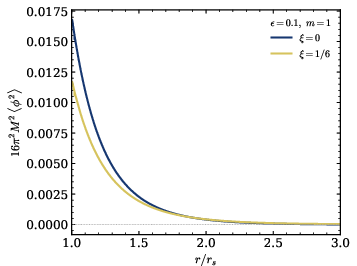
Figure 3: Comparison of minimal (ds2=r2ϵf(r)dτ2+r−2u(r)dr2+r2dΩ22,6) and conformal (ds2=r2ϵf(r)dτ2+r−2u(r)dr2+r2dΩ22,7) coupling at fixed ds2=r2ϵf(r)dτ2+r−2u(r)dr2+r2dΩ22,8, ds2=r2ϵf(r)dτ2+r−2u(r)dr2+r2dΩ22,9; conformal coupling reduces polarization near the horizon.
For astrophysically relevant values, ϵ≪10 is minuscule (ϵ≪11 for solar-mass black holes), rendering quantum-gravitational corrections numerically invisible outside the fluctuation noise floor. Direct comparison for extremely light fields reveals that the correction to the Schwarzschild profile is strictly linear in ϵ≪12 and, beyond ϵ≪13, subdominant to numerical uncertainty.
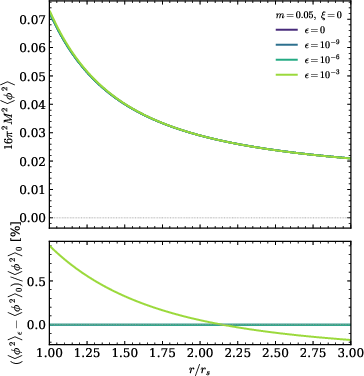
Figure 4: Vacuum polarization for a light field (ϵ≪14) at tiny ϵ≪15 demonstrates strict linear-in-ϵ≪16 scaling, with deviations from the Schwarzschild limit vanishing for realistic ϵ≪17.
Strikingly, for non-conformal couplings and ϵ≪18, the vacuum polarization develops a small negative tail at large ϵ≪19. This sign inversion is a direct response to the nonzero negative Ricci scalar present in the LQG background, as predicted independently by the local curvature terms in the DeWitt–Schwinger expansion. Numerical results and DeWitt–Schwinger analytic predictions agree in sign and within f(r)010% for f(r)1, with best agreement for heavier fields.
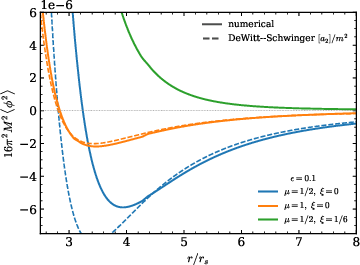
Figure 5: At f(r)2, non-conformal coupling produces a negative tail in the vacuum polarization at large radii, closely matching the DeWitt–Schwinger analytic prediction. Conformal coupling (f(r)3) preserves positivity, highlighting the role of curvature response.
Discussion and Implications
Strong numerical results confirm the following:
- The leading correction to quantum field vacuum polarization induced by LQG-inspired modifications is linear in the parameter f(r)4, and is absolutely negligible for all realistic astrophysical black holes.
- For non-zero f(r)5 and non-conformal coupling, the emergence of a negative tail in f(r)6 at large radius is a robust, scheme-independent curvature response effect, not present in Ricci-flat Schwarzschild backgrounds.
- There is no evidence for unbounded or anomalous quantum fluctuations in the black hole exterior, even though the background loses asymptotic flatness.
These findings represent a direct and highly nontrivial consistency check for the LQG black hole spacetime. Practically, they indicate that quantum field fluctuations in these geometries behave in a manner closely paralleling their classical counterparts, faithfully tracking local geometric invariants without pathological growth or instability. The presence of a negative quantum energy density in the background does not result in unphysical quantum fluctuations outside the horizon.
Theoretical implications suggest that curvature-induced quantum corrections are encapsulated in local curvature tensors and their derivatives, as manifested in the DeWitt–Schwinger asymptotics, with the effect switching off demonstrably at conformal coupling or for Ricci-flat backgrounds.
The methodology is readily extensible: the robust numerical and analytic machinery developed here can facilitate systematic computation of other vacuum expectation values—most notably the renormalized stress-energy tensor f(r)7, critical for assessing back-reaction, stability, and Hawking radiation spectra in more general quantum-corrected or regular black holes.
Conclusion
The scalar vacuum polarization has been rigorously evaluated for a massive, non-minimally coupled field in the Hartle–Hawking state outside an LQG-inspired quantum black hole geometry. Enhancements to near-horizon polarization due to quantum-gravity corrections are strictly linear in f(r)8, with all observable effects vanishing in astrophysical settings. Non-conformal coupling leads to a small, physically-intelligible negative polarization tail at large radius, attributed unambiguously to the Ricci curvature of the background. The absence of anomalous quantum effects in the exterior region supports the consistency of the underlying LQG framework for macroscopic black holes and motivates further studies of renormalized stress-energy in similar settings.

