Single-Rollout Asynchronous Optimization for Agentic Reinforcement Learning
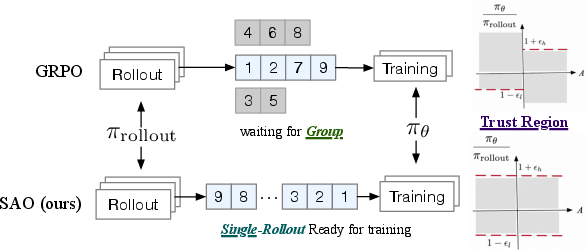
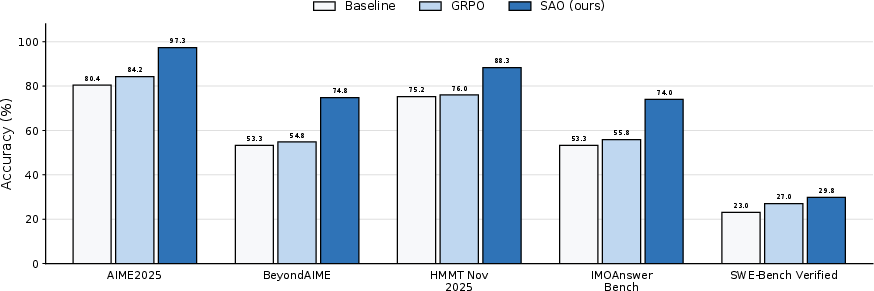
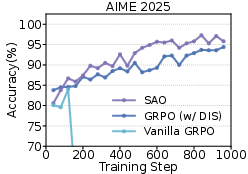
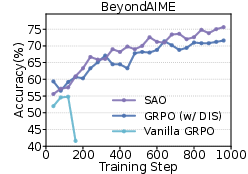
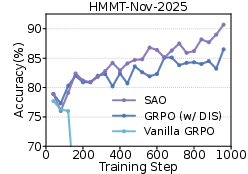
Abstract: Reinforcement learning (RL) is becoming increasingly important for post-training LLMs. Previous RL pipelines for LLMs were mostly synchronous and batch-interleaved, which is inefficient for long-horizon agentic tasks. Recently, asynchronous RL has emerged as a more efficient alternative by updating the model as rollouts arrive. However, existing asynchronous RL systems often emphasize throughput, while leaving training stability and task effectiveness largely underexplored. For example, a key challenge is that group-wise sampling in the widely-used GRPO framework does not naturally fit asynchronous agentic training. In this paper, we present Single-rollout Asynchronous Optimization (SAO) to address the stability and off-policy challenges in asynchronous RL. To reduce off-policy effects and improve generalization, we replace group-wise sampling with single-rollout sampling, that is, using one rollout per prompt. We further improve this single-rollout strategy with practical value-model training designs. To improve optimization stability, we introduce a strict double-side token-level clipping strategy. SAO is able to train stably for one thousand steps and consistently outperform GRPO and its variants on agentic coding and reasoning benchmarks, such as SWE-Bench Verified, BeyondAIME, and IMOAnswerBench. We also demonstrate that single-rollout RL is particularly effective in a simulated online learning setting, where the model must adapt to changing evolving environments. To this end, SAO is successfully deployed in the agentic RL pipeline for training the open GLM-5.2 model (750B-A40B).
Paper Prompts
Sign up for free to create and run prompts on this paper using GPT-5.
Top Community Prompts
Explain it Like I'm 14
What this paper is about
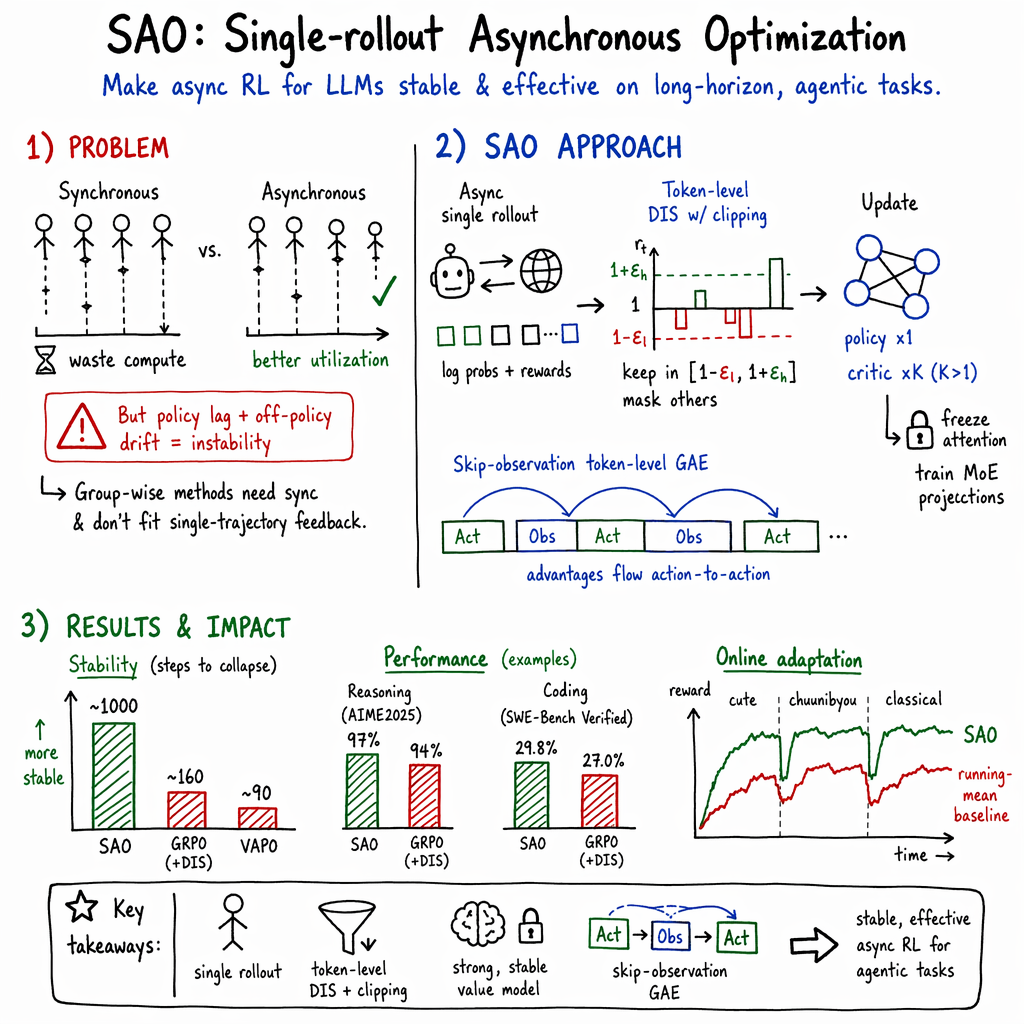
This paper is about teaching LLMs to do complex, multi-step tasks—like solving math problems with tools or fixing code—using reinforcement learning (RL). The authors introduce a new training method called SAO (Single-rollout Asynchronous Optimization) that makes this kind of training faster, more stable, and better at learning from real-time feedback.
What questions the authors asked
The researchers focused on a few simple questions:
- Can we make RL for LLMs more efficient by training as soon as results arrive, instead of waiting for everything at once?
- If we only use one try (one “rollout”) per question instead of a group of tries, can training still be stable and effective?
- How can we reduce crashes and instability that happen when the model is updated while new data is still being collected?
- How do we handle tasks where the model and the environment take turns (like the model writes code, the system runs it, then the model tries again)?
How they approached it (in simple terms)
Think of a classroom where students work at different speeds. In many RL systems, the teacher waits for every student to finish before giving feedback. That’s slow and wasteful, because fast students sit around waiting. This paper’s approach is different: as soon as one student finishes, the teacher reviews that work and updates the teaching plan right away. That’s “asynchronous” training.
Here are the main ideas they used to make this work:
- Single-rollout updates
- Instead of generating a group of answers per question and comparing them, SAO trains on just one answer per question as soon as it’s ready. This fits real-world, “one-shot” feedback and keeps the computers busy without waiting for slow examples.
- A “value model” as a coach
- In RL, the “policy” is the part that decides what to write next. The “value model” (or critic) is like a coach that estimates how good the current situation is.
- To keep training stable, they:
- Updated the value model more often than the policy (like giving the coach extra practice so their scores are reliable).
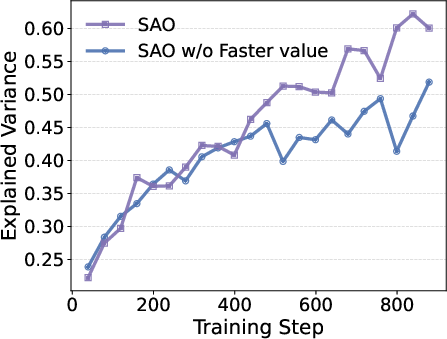
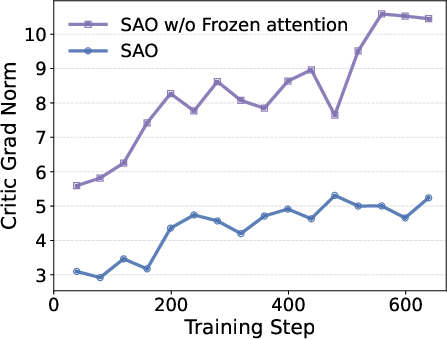
- “Froze” the attention parts of the value model and only trained specific parts, which made the value model’s learning calmer and less noisy.
- Guardrails against unstable updates (double-sided token clipping)
- Sometimes the model’s latest version is very different from the version that produced the example it’s training on. That can cause chaos.
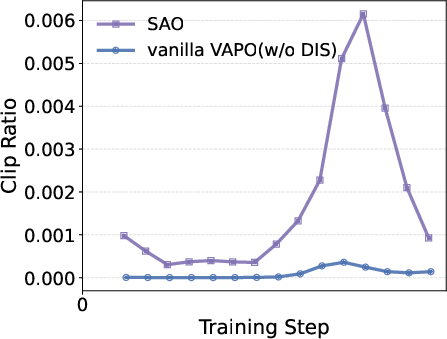
- The authors use the exact probabilities recorded when the model generated the text and compare them to the current model. If a token’s probability changed too much, they simply ignore that token for the update. This prevents wild swings.
- Handling multi-turn tasks cleanly (skip-observation advantages)
- In “agent” tasks, the model alternates between writing actions and receiving environment feedback (like tool outputs). The model didn’t write the feedback text itself, so learning across those tokens adds noise.
- Their fix: when computing the learning signal, they skip environment feedback tokens and connect one model action directly to the next. This keeps learning focused on what the model actually controls.
What they found and why it matters
- More stable training over time
- Their method stayed stable for around 1,000 training steps, while some common baselines tended to collapse earlier.
- Better performance on tough tasks
- On math reasoning tests (like AIME-style problems) and a coding benchmark (SWE-Bench Verified), SAO consistently beat widely used methods that rely on groups of samples.
- In short: higher scores across the board compared to their baselines.
- Adapts quickly to changing rules (simulated online learning)
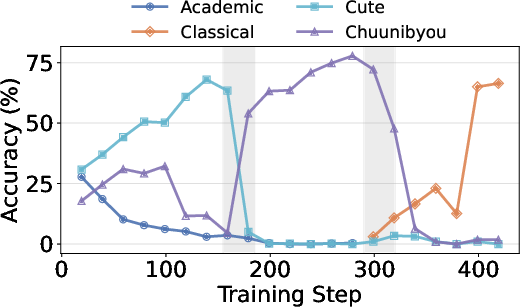
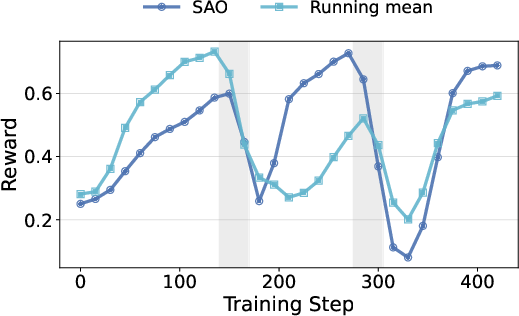
- They tested a writing task where the “preferred style” (e.g., cute, dramatic, or classical) keeps changing over time.
- SAO adjusted quickly after each change and recovered faster than a simple baseline that just averages recent rewards. This shows it can handle real-world situations where preferences or environments shift.
- Real deployment
- They used SAO in an actual training pipeline for a large open model (GLM-5.2 family), showing it works at scale.
Why this is important
- Faster learning without waiting
- Training starts as soon as any example is ready. That means less idle time and better use of computing power, especially when some tasks naturally take much longer than others.
- Better fit for real-world agents
- Many practical systems only give one piece of feedback per action (not a group). SAO matches this reality and still trains well.
- More stable and safer updates
- By ignoring tokens where the model has changed too much and by strengthening the value model, SAO avoids unstable learning that can crash training.
- Stronger, more adaptable AI assistants
- Whether it’s math reasoning, coding, or writing with changing styles, SAO helps models learn faster and adapt to new situations—key for useful, reliable AI agents.
In short: SAO is a smarter way to train LLMs with reinforcement learning. It stops wasting time, handles changing environments, and stays stable—leading to better results on real, complex tasks.
Knowledge Gaps
Knowledge gaps, limitations, and open questions
Below is a consolidated list of what remains missing, uncertain, or unexplored in the paper, phrased to guide concrete follow-up research:
- Theoretical bias of DIS: Quantify and bound the bias introduced by using rollout-policy log-probabilities ($\pi_{\text{rollout}$) instead of the true behavior policy when the rollout policy drifts mid-trajectory; compare against V-trace/IMPALA-style corrections and derive conditions under which DIS is consistent or provably stable.
- Clipping/masking trade-offs: Measure how double-sided token-level clipping with hard masking affects sample efficiency and credit assignment; assess whether soft-weighting alternatives (e.g., smooth clipping, tempering ratios) improve stability without discarding gradients.
- Trust-region sensitivity: Systematically study sensitivity to asymmetric trust-region bounds (, ), including adaptive or state-dependent schedules; report how clip/mask ratios evolve with policy lag and correlate with stability.
- Robustness to policy lag: Evaluate SAO under controlled staleness (vary rollout-learn synchronization delays), quantify performance and stability as a function of lag, and identify failure thresholds.
- Comparison to staleness-aware algorithms: Empirically compare SAO against IMPALA/V-trace, ACME variants, and recent asynchronous PPO/GRPO systems (e.g., AReaL) under identical asynchrony to assess effectiveness beyond GRPO-based baselines.
- Single-rollout vs group-wise sampling regimes: Characterize regimes (task difficulty, reward sparsity, horizon length) where single-rollout is superior/inferior to group-wise sampling; explore hybrid strategies (e.g., occasional multi-samples per prompt without global synchronization).
- Exploration under single-rollout: Investigate whether single-rollout reduces exploration diversity; test entropy bonuses, temperature schedules, or diversity-inducing sampling in asynchronous settings.
- Value model hyperparameters: Conduct rigorous ablations on critic update frequency (K), optimizer settings, learning rates, and regularization to determine robust defaults across tasks and models.
- Frozen-attention generality: Verify that “frozen attention” for the critic remains beneficial across architectures (dense vs MoE), parameter scales (7B–100B+), and domains (dialogue, web agents); analyze when attention updates are necessary.
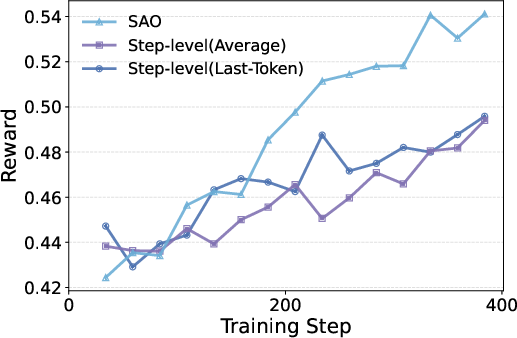
- Critic architecture alternatives: Compare separate critic heads vs shared backbones, step-level vs token-level critics, and Q-function learning; quantify variance reduction and compute costs.
- Skip-observation GAE validity: Provide a formal justification and empirical stress tests for skip-observation GAE across diverse agentic environments (e.g., non-textual observations, partial observability); evaluate boundary detection robustness for action/observation tokens.
- Step-level vs token-level value targets: Extend ablations to richer step-level value formulations (e.g., per-tool-call or per-turn returns) and assess when step-level models outperform token-level ones in long-horizon tasks.
- Stability horizon: The paper demonstrates stability for ~1k steps; evaluate longer training horizons to detect late-stage instabilities, overfitting, or drift and define convergence criteria.
- Sample efficiency: Report learning curves in tokens/rewards to target performance; compare SAO’s sample efficiency against PPO/GRPO/VAPO under matched compute and data budgets.
- Throughput and utilization: Quantify wall-clock speedups, GPU utilization, and cost-per-gain relative to synchronous pipelines; provide profiling (e.g., actor/learner bottlenecks) to substantiate efficiency claims.
- Scaling to larger models: Validate SAO on larger LLMs (70B–>100B) and different MoE densities; report memory footprint changes for the critic and implications for training throughput.
- Value pretraining scale and composition: Detail the value pretraining corpus (size, domains, reward types) and assess how pretraining size/quality affects cold-start stability and downstream performance.
- Rewarding and judging noise: Evaluate robustness to noisy or drifting reward signals (e.g., LLM judges vs human labels), and measure susceptibility to reward hacking or overfitting the judge.
- Generalization across tasks: Test SAO on additional agentic settings (e.g., web navigation, GUI control, retrieval-augmented tasks) and RLHF preference training to ensure broad applicability.
- SWE-Bench reward shaping: Explore shaped rewards (e.g., intermediate unit tests, linting) to improve credit assignment beyond binary pass/fail; measure impact on convergence and patch quality.
- Online learning realism: Replace the simulated style-shift judge with human-in-the-loop or logged propensity-weighted evaluations to validate SAO’s adaptability under real-world non-stationarity.
- Off-policy data reuse: Investigate whether a small replay buffer for critic training (with appropriate corrections) improves value estimates without destabilizing the policy updates.
- Decoding and sampling settings: Examine training sensitivity to temperature, top-p, and nucleus sampling under asynchrony; identify settings that minimize off-policy divergence while preserving exploration.
- Safety and alignment: Assess whether DIS and single-rollout exacerbate or mitigate harmful behaviors, and study how to incorporate safety constraints or penalties into asynchronous updates.
- Reproducibility and fairness: Provide or request detailed reproducibility artifacts (code, configs, seeds, compute budgets), and ensure baselines are equally tuned for asynchrony to enable fair comparisons.
Practical Applications
Immediate Applications
The following applications can be deployed with current tooling and modest integration effort, leveraging SAO’s single-rollout asynchronous RL, token-level double-sided clipping (DIS), value-model strategies (faster critic updates, frozen-attention), and skip-observation GAE.
- Higher-throughput RLHF/RLAIF training by replacing group sampling with single-rollout SAO
- Category: Industry; Academia
- Sectors: Software/AI, MLOps
- What: Swap GRPO-style group sampling for SAO in existing RL pipelines to reduce straggler effects and improve wall-clock efficiency and stability for long-horizon agentic tasks.
- Tools/workflows: SAO trainer integrated into Ray/RLlib or PRIME-RL; rollout-workers streaming logprobs; learner with DIS token clipping; critic updated at 2x policy frequency; monitoring of token clip ratios.
- Assumptions/dependencies: Access to rollout log-probabilities; batch size and context-length support (e.g., 128k) on inference hardware; a working reward signal (RM/LLM-judge/environment rewards); basic actor–learner infra for asynchrony.
- More reliable coding agents for issue triage and patching
- Category: Industry; Daily life (developer productivity)
- Sectors: Software engineering, DevTools
- What: Use SAO to fine-tune code agents that autonomously reproduce, localize, and patch issues (e.g., SWE-Bench Verified), then integrate into CI triage queues for candidate patch generation.
- Tools/workflows: OpenHands-like scaffolding, GitHub/GitLab bots, patch validation with unit/integration tests, gated auto-merge with human review; SAO-trained policy/value models.
- Assumptions/dependencies: Test coverage quality; repository permissions and security policies; reward definitions tied to reproducible test pass/fail; guardrails to prevent unsafe code suggestions.
- Tool-using reasoning assistants (math/science) with improved stability
- Category: Industry; Academia; Daily life (education)
- Sectors: Education technology, Research support
- What: Fine-tune reasoning-with-tools (e.g., Python) assistants using SAO to get stronger pass@1 and longer-context stability for tutoring, problem-solving, and analytical QA.
- Tools/workflows: TIR-style datasets, Python sandbox execution, SAO skip-observation GAE for multi-turn tool-use, curriculum schedules.
- Assumptions/dependencies: Safe code execution environments; reliable automatic grading signals; long-context inference nodes.
- Online preference adaptation for creative assistants (style/tone alignment)
- Category: Industry; Daily life
- Sectors: Content platforms, Productivity tools
- What: Deploy SAO for single-trajectory online learning to adapt writing style/tone to evolving user preferences without batch regrouping (as in the paper’s style-shift simulation).
- Tools/workflows: Lightweight LLM-judge rewards (style and quality), streaming user feedback, per-session or per-tenant personalization loops, rollback/decay policies.
- Assumptions/dependencies: Robust reward models with bias checks; safety filters; caps on daily policy updates; audit logs to detect reward hacking or drift.
- Cost and utilization optimization in distributed RL training clusters
- Category: Industry
- Sectors: Cloud/Infra, MLOps
- What: Use SAO’s asynchronous consumption of rollouts and strict token-level masking/clipping to reduce idle GPU time and collapse events in long-horizon RL training.
- Tools/workflows: Queue-based rollout ingestion (Kafka/RabbitMQ), autoscaling for actor/learner pools, clip-ratio dashboards, staleness telemetry.
- Assumptions/dependencies: Stable scheduling layer; per-rollout policy version tagging or logprobs; observability stack.
- Safer single-rollout RL for product A/B iterations
- Category: Industry; Policy (governance-by-design)
- Sectors: Consumer apps, Enterprise SaaS
- What: Run controlled online learning with SAO’s double-sided token masking to limit extreme updates, enabling faster iteration while mitigating catastrophic policy shifts.
- Tools/workflows: Feature flags, interleaved safety classifiers, update gates on clip ratios/EV metrics, holdout canaries.
- Assumptions/dependencies: Clear rollback procedures; human-in-the-loop approval stages; metric governance for fairness and safety.
- Research prototyping on off-policy corrections and value learning
- Category: Academia
- Sectors: Machine Learning research
- What: Study token-level importance sampling using rollout logprobs (no old-policy inference), frozen-attention value models, and skip-observation GAE on public reasoning/coding benchmarks.
- Tools/workflows: Open benchmarks (AIME, BeyondAIME, SWE-Bench Verified), ablation harnesses for critic frequency, gradient norm monitoring, explained variance tracking.
- Assumptions/dependencies: Access to strong base LLMs and long-context training; reproducible reward scripts.
- Enhanced human-in-the-loop workflows for complex tasks
- Category: Industry; Daily life (knowledge work)
- Sectors: Legal ops, Data labeling, Enterprise support
- What: Use SAO to quickly incorporate curated single-example feedback from subject-matter experts (SMEs) into ongoing agentic behaviors without waiting for group batches.
- Tools/workflows: SME annotation UI feeding rollouts and labels; gated SAO updates; incremental evaluation suites.
- Assumptions/dependencies: High-quality SME feedback; proper privacy/compliance handling; logging and auditability.
- LLMOps observability and safety telemetry extensions
- Category: Industry
- Sectors: Software/AI
- What: Add SAO-specific metrics (token clip ratio, per-token IS histograms, critic EV) to observability platforms to detect instability early.
- Tools/workflows: Metric exporters, Grafana/Prometheus dashboards, anomaly alerts tied to pause/resume of learners.
- Assumptions/dependencies: Instrumented trainers; metric budgets; escalation playbooks.
Long-Term Applications
These applications require additional research, scaling, validation, or ecosystem maturation before broad deployment.
- Continual learning for production assistants with tight safety/quality guarantees
- Category: Industry; Policy
- Sectors: Productivity, Customer support, Regulated industries
- What: Always-on SAO loops that incorporate live feedback to adapt agents in minutes/hours, with formal guardrails for bias, privacy, and safety.
- Tools/products: “Online RL Control Plane” with policy versioning, automatic safety evaluations, constitutional constraints, and regulatory audit trails.
- Assumptions/dependencies: Robust evaluation suites, red-teaming at update boundaries, legal guidance on online model changes, reliable reward sources resistant to gaming.
- Domain-specialized autonomous coding co-maintainers at scale
- Category: Industry
- Sectors: Software engineering (large codebases)
- What: SAO-trained agents that continuously fix regressions, refactor, and keep dependencies updated across thousands of services, learning from each commit’s outcomes.
- Tools/products: Patch generators with SAO online learning, dependency risk analyzers, integration with code ownership and approval workflows.
- Assumptions/dependencies: Very high test coverage; multi-repo coordination; robust isolation/sandboxing; clear escalation to human owners.
- Adaptive research assistants for fast-changing domains
- Category: Industry; Academia
- Sectors: Finance (research support), Security threat intel, Biomed research (non-clinical)
- What: SAO-supported assistants that track non-stationary information regimes and adjust reasoning/weighting (e.g., new financial narratives, emerging vuln classes, evolving literature).
- Tools/products: Domain-specific reward models, streaming knowledge graphs, periodic self-evaluation with benchmark shifts.
- Assumptions/dependencies: High-quality, unbiased, and timely reward signals; careful separation from decision-making systems (e.g., no direct trading/clinical decisions); oversight.
- Multi-agent and robotics-adjacent agentic controllers with skip-observation credit assignment
- Category: Industry; Academia
- Sectors: Robotics, Autonomy, Simulation
- What: Extend skip-observation GAE to multimodal agent loops where actions and exogenous observations interleave, improving credit assignment without destabilizing updates.
- Tools/products: Language-planner + low-level policy stacks; simulators that expose per-action rewards; token/step hybrid advantage estimators.
- Assumptions/dependencies: Reliable sim-to-real transfer; multimodal value models; safety envelopes for real-world actuation.
- Privacy-preserving on-device continual learning
- Category: Industry; Policy; Daily life
- Sectors: Mobile, Edge AI
- What: Asynchronous single-rollout updates locally on device for personalization, with federated aggregation to preserve privacy.
- Tools/products: On-device SAO learners with DIS; federated averaging of value/policy deltas; local reward proxies (implicit signals).
- Assumptions/dependencies: Efficient, memory-lean value models; energy and thermal constraints; privacy accounting; robust aggregation against poisoning.
- Standardized “asynchronous RL for LLMs” platform components
- Category: Industry; Academia
- Sectors: MLOps, Open-source ecosystems
- What: Common reference implementations for rollout-logprob recording, token-level clipping/masking, critic TTUR, and online evaluation harnesses.
- Tools/products: SAO SDKs, logprob recorders, clip-mask kernels, EV/clip dashboards, reproducible benchmark suites.
- Assumptions/dependencies: Community consensus on APIs; shared datasets and judges; sustained maintenance.
- Safety-constrained optimization with structured clipping and guarantees
- Category: Policy; Academia
- Sectors: Safety & alignment, Governance
- What: Formalize double-sided token-level masking into safety-aware update rules with theoretical guarantees under policy lag and off-policy drift.
- Tools/products: Verified training loops, certifiable update bounds, compliance reports for auditors.
- Assumptions/dependencies: Advances in theory and verification; standardized safety objectives and auditing practices.
- Long-context, tool-rich classroom AI with individualized mastery trajectories
- Category: Education; Daily life
- Sectors: EdTech
- What: SAO-powered tutors that adjust tool-use and reasoning strategies per student over long curricula, learning from single-trajectory feedback (assignments, rubric judgements).
- Tools/products: Rubric-aligned reward models, per-student pace controllers, teacher dashboards for oversight and intervention.
- Assumptions/dependencies: Reliable grading signals; fairness and accessibility safeguards; parent/teacher control and transparency.
- Enterprise-wide “learning agents” for knowledge management
- Category: Industry
- Sectors: Knowledge management, Enterprise search
- What: Agents that continually refine retrieval, summarization, and decision support from single interactions and human edits, without waiting for batch updates.
- Tools/products: SAO-enhanced RAG pipelines, edit-to-reward converters, lineage tracking of updates.
- Assumptions/dependencies: Data governance and access controls; accurate feedback capture; resistance to feedback loops and echoing errors.
Cross-cutting assumptions and dependencies
- Reward signal quality: Many applications rely on LLM judges or heuristic rewards that must be validated for bias, stability, and resistance to gaming.
- Compute and infra: Asynchronous actor–learner setups, long-context inference, and value pretraining scale are required; observability and rollback are essential.
- Safety and compliance: Online learning needs update gating, human oversight, audits, and clear rollback paths; regulated domains require extra validation.
- Model capabilities: Benefits are strongest with tool-use, long-context models; value models need careful initialization and TTUR-style training.
- Data and IP: Using external code/data (e.g., GitHub issues) requires license compliance and secure handling of private information.
Glossary
- Actor-Critic: An RL architecture that pairs a policy (actor) with a value estimator (critic) to guide updates. "Standard PPO typically adopts an Actor-Critic architecture"
- Advantage function: A baseline-adjusted measure of how much better an action is than expected, used to reduce variance in policy gradients. "The fundamental distinction between PPO and GRPO lies in whether to estimate the advantage function "
- Asynchronous RL: A training paradigm where rollouts and updates proceed concurrently without waiting for full batches, improving utilization. "asynchronous RL has emerged as a more efficient alternative"
- Calibration function: A gating function applied to importance ratios to enforce stability by clipping or masking updates outside a trust region. "Stability is further enforced via the calibration function "
- Clipped surrogate objective: A PPO-style objective that limits policy update size by clipping the advantage-weighted probability ratio. "maximizing a clipped surrogate objective that encourages stable policy updates."
- Critic: The value function component in actor–critic methods that estimates expected returns for baseline subtraction. "value function (Critic) "
- Decoupled PPO: A PPO setup where rollout generation and training use decoupled policy snapshots, necessitating off-policy correction. "In decoupled PPO for LLM, importance sampling is employed"
- Direct Double-Sided Importance Sampling (DIS): A token-level importance sampling and masking scheme that uses rollout log-probs directly and enforces two-sided clipping. "Stabilizing Asynchronous RL via Direct Double-Sided Importance Sampling (DIS)"
- Double-side token-level clipping: A stricter clipping approach that masks tokens whose importance ratios lie outside both lower and upper bounds. "we introduce a strict double-side token-level clipping strategy."
- Explained Variance: A statistic measuring how well the value model explains return variance; higher indicates better fit. "Explained Variance assesses the alignment between the predicted values"
- Frozen-Attention: A value-model training strategy that freezes attention layers and updates only other modules to stabilize optimization. "we employ a ``Frozen-Attention'' training strategy"
- Generalized Advantage Estimation (GAE): A method to compute advantages by exponentially weighting multi-step temporal-difference errors, trading bias and variance. "PPO employs Generalized Advantage Estimation (GAE)."
- Group Relative Policy Optimization (GRPO): A critic-free RL objective that normalizes rewards within a group of samples for each prompt to form advantages. "GRPO samples a group of responses for each prompt"
- Group-wise sampling: Collecting multiple responses per prompt and aggregating them for training, often increasing latency and staleness. "group-wise sampling induces latency-driven off-policy behavior"
- IcePop mechanism: A related clipping/masking approach mentioned as similar to the paper’s DIS strategy. "This shares similarities with the IcePop mechanism"
- Importance sampling: A correction technique that reweights updates using the ratio of current-policy to behavior-policy probabilities. "importance sampling is employed to relieve off-policy bias"
- Mixture-of-Experts (MoE): A sparsely activated architecture with expert sub-networks, often stabilized here by freezing attention during value training. "the Mixture-of-Experts (MoE) layers remain relatively stable."
- Off-policy: A setting where data is generated by a different policy than the one being updated, potentially causing bias or instability. "to address the stability and off-policy challenges in asynchronous RL."
- Policy lag: The staleness between the rollout (behavior) policy and the current training policy in asynchronous setups. "the ``policy lag'' that emerges between rollout models and the training models."
- Proximal Policy Optimization (PPO): A popular on-policy RL algorithm using clipped surrogate objectives to constrain update size. "Proximal Policy Optimization (PPO)."
- REINFORCE: A basic policy-gradient algorithm that estimates gradients from returns without a critic, typically high-variance. "similar to REINFORCE"
- Running-mean baseline: A simple baseline that uses a sliding-window average of recent rewards per prompt to reduce gradient variance. "single-rollout with Running-mean baseline."
- Single-rollout Asynchronous Optimization (SAO): The proposed method that updates from one rollout per prompt with stabilization via DIS and improved value training. "we propose Single-rollout Asynchronous Optimization (SAO) for agentic RL."
- Single-rollout sampling: Using exactly one trajectory per prompt for updates, enabling immediate training without waiting for groups. "we replace group-wise sampling with single-rollout sampling"
- Skip-Observation GAE: An advantage estimator for agentic settings that skips environment tokens and links advantages from one action to the next. "we derive a ``Skip-Observation'' GAE."
- Token-level clipping: Applying clipping or masking per token based on importance ratios, rather than at the sequence level. "with a simple token-level clipping strategy"
- Tool-Integrated Reasoning (TIR): A setting where the model interleaves natural-language reasoning with external tool calls (e.g., Python). "Tool-Integrated Reasoning (TIR) data"
- Trust region: The bounded interval of acceptable importance ratios within which updates are allowed to prevent instability. "we restrict the trust region to the interval "
- TTUR (Two-Time-Scale Update Rule): A training scheme that updates different model components (e.g., critic vs. actor) at different frequencies. "single-rollout and TTUR mechanisms"
- Value function: A function estimating expected returns from states (or tokens), used for computing advantages and baselines. "value function (Critic) "
- Value model pretraining: Pretraining the value network on large data to avoid cold-start instability and improve early training. "scale the data used for value model pretraining."
- VAPO: A referenced baseline method for RL in reasoning tasks against which SAO is compared. "Vanilla VAPO (w/o DIS)"
Collections
Sign up for free to add this paper to one or more collections.

