Constrained Decoding for Diffusion Language Models via Efficient Inference over Finite Automata
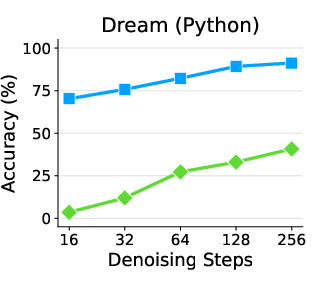
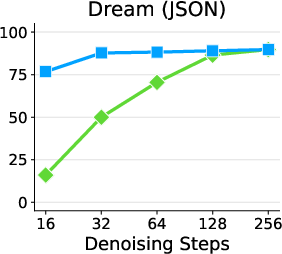
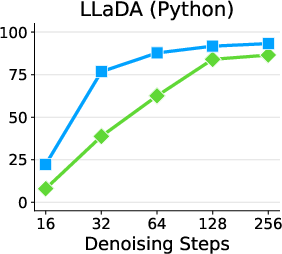
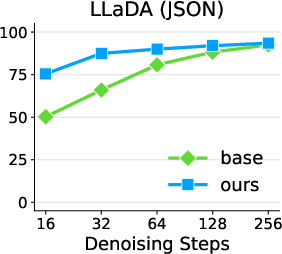
Abstract: Constrained decoding is essential for serving LLMs, ensuring that generated outputs follow specific structures such as JSON schema-formatted function calls. Existing systems are designed for autoregressive models and assume left-to-right generation, masking out invalid next tokens at each step. Diffusion LLMs, however, break this assumption: they sample multiple positions simultaneously from a fully-factorized mean-field distribution at each denoising step. In this paper, we present an exact and tractable algorithm for sampling from the constrained mean-field posterior under any constraint expressible as a finite automaton. Viewing finite automata as graphical models, we obtain tractable representations of the constrained distribution that enable efficient inference. The approach guarantees constraint satisfaction by construction, supports both greedy and sampling-based decoding, and is compatible with parallel and block-wise decoding under arbitrary remasking schedules. Applying depth-reduction techniques from arithmetic circuit theory, we further reduce sampling depth from linear to logarithmic in the sequence length. Empirical evaluations on Dream-7B and LLaDA-8B show substantial accuracy gains across various tasks including function calling (xLAM, BFCL), planning (Sudoku, Countdown), text-to-SQL (Spider), and math reasoning (GSM-Symbolic), with little inference overhead relative to unconstrained decoding. For example, on BFCL-Live, our approach improves Dream-7B's greedy decoding accuracy from 63.9% to 71.5%, and stochastic sampling accuracy from 22.3% to 69.0%, where the unconstrained baseline collapses, with under 5% wall-clock overhead.
Paper Prompts
Sign up for free to create and run prompts on this paper.
Top Community Prompts
Explain it Like I'm 14
What is this paper about?
This paper is about making sure AI LLMs that generate text all at once (called diffusion LLMs) always produce outputs that follow strict rules, like valid JSON or correct function-call formats. The authors present a new, fast way to guarantee these rules are followed during generation, without slowing things down much.
What questions did the authors ask?
- How can we force diffusion LLMs (which fill many positions at once) to always follow a given set of rules, like a JSON schema or SQL syntax?
- Can we do this exactly (no approximations) and efficiently (fast and parallel), not just for simple left-to-right models?
- Will this improve accuracy on real tasks like function calling, planning puzzles, text-to-SQL, and math reasoning?
How does their method work?
The core problem (in simple terms)
- Autoregressive models write text one token at a time. It’s easy to check each next token and block illegal ones (like a spell-checker for structure).
- Diffusion LLMs don’t write left-to-right. They guess many positions at once—like filling in all blanks of a crossword simultaneously. A token that looks okay by itself can still create an illegal overall output when combined with other tokens.
Example: You want a valid number. “1.” is okay. “.1” is okay. But if the model picks “.” for both positions, you get “..”, which is invalid. Checking positions one-by-one isn’t enough—you must check the whole sequence together.
Turning rules into a “state machine”
- The paper represents rules using a finite automaton (think of it as a flowchart or a simple state machine).
- This state machine encodes what sequences are allowed. If you follow its arrows (transitions) by reading tokens, you end up in an “accept” state if and only if the sequence is valid under the rules.
Combining the model with the rules (exactly)
- The model gives, for each position, a probability for each token (its “mean-field” prediction).
- The state machine says which full sequences are allowed.
- The authors combine them into a single probabilistic model that only allows legal sequences and weighs them by the model’s token probabilities.
- This lets them sample whole sequences that are guaranteed to be valid, and also compute “how confident” the constrained system is about each position.
Analogy: Imagine rails (the state machine) laid down to only allow valid paths, and a wind map (the model’s probabilities) that pushes trains along some routes more strongly than others. The train can only travel on rails, and among those rails, it tends to follow the windy (high-probability) paths.
Making it fast with parallel sampling (log-depth)
- A simple way to sample through the state machine is still sequential (step 1, then 2, … up to L), which can be slow.
- The authors use a divide-and-conquer trick: sample a midpoint first, then sample left and right halves independently, and keep splitting. This reduces the number of sequential steps from linear in length (L) to logarithmic (log L), which is much faster on GPUs.
- This “tree” approach unlocks parallel computation without changing the exact distribution they sample from.
Analogy: Instead of walking a path one step at a time, you first pick the middle checkpoint, then pick middle checkpoints of the left and right halves, and so on. You decide many pieces in parallel.
Smarter position selection during diffusion (“remasking”)
- Diffusion models repeatedly pick which positions to “lock in” and which to keep guessing.
- The authors compute confidence using the constrained probabilities (with the rules included), not the unconstrained ones. This helps the model lock in the right tokens earlier and improves accuracy.
What did they find?
Across several tasks and two open diffusion models (Dream-7B and LLaDA-8B), the method:
- Guarantees 100% rule-following by construction. Outputs always follow the given format or grammar (like valid JSON function calls).
- Improves accuracy on many benchmarks:
- Function calling (xLAM, BFCL): Big gains, especially when sampling with randomness (temperature > 0), where unconstrained models often break the format.
- Example on BFCL-Live (Dream-7B): Greedy accuracy improved from 63.9% to 71.5%. With random sampling, the baseline collapsed to 22.3%, while the constrained method achieved 69.0%.
- Planning tasks (Sudoku, Countdown): Large improvements with the enforced formats.
- Text-to-SQL (Spider): Maintains or improves accuracy while enforcing SQL grammar/schema constraints.
- Math reasoning (GSM-Symbolic): Keeps the structure of symbolic expressions correct.
- Stays efficient: The log-depth (tree) sampler adds under 5% wall-clock time overhead compared to unconstrained decoding on a key setup, while delivering large accuracy gains.
- Handles both greedy decoding and random sampling, parallel and block-wise decoding, and works with deterministic or nondeterministic automata.
Why it matters
- More reliable structured outputs: The method ensures that outputs like function calls, JSON, or SQL are valid every time. This is crucial when AI tools call APIs, control systems, or query databases.
- Better performance where structure matters: It boosts accuracy on tasks where format errors can ruin the whole answer, especially under sampling where unconstrained models struggle.
- Fast and scalable: The log-depth algorithm brings exact constrained sampling to diffusion models with little overhead and lots of parallelism, making it practical for real systems.
Limitations and outlook
- Scope of rules: This method covers rules that can be expressed as finite automata (regular languages). Some richer structures (like full programming languages defined by complex grammars) go beyond that and would need future extensions.
- Safety note: While this makes outputs structurally valid, it can also make it easier to produce syntactically correct but harmful tool calls if the system is misused. Good policy and safeguards are still necessary.
In short, the paper shows how to bolt a strong “rule-following engine” onto diffusion LLMs, guaranteeing valid outputs, improving accuracy across many structured tasks, and keeping things fast by parallelizing the sampling process.
Knowledge Gaps
Knowledge gaps, limitations, and open questions
The paper advances constrained decoding for diffusion LMs under finite-automata constraints and introduces a log-depth sampler. The following concrete gaps and open questions remain:
- Expressivity beyond finite automata
- Extending the approach to context-free grammars, attribute grammars, or richer semantic constraints without exponential determinization.
- Handling global combinatorial constraints (e.g., full Sudoku row/column/box uniqueness, graph or set cardinality constraints) that cannot be compactly represented by a finite automaton.
- Supporting ε-transitions and weighted/regex extensions common in practical grammars while retaining tractable inference.
- Correctness of the constrained target distribution
- Characterizing the discrepancy between per-step constrained mean-field sampling and the true dLLM generative distribution conditioned on the constraint; providing bounds or conditions under which the gap is small.
- Studying whether repeated stepwise conditioning leads to bias accumulation across denoising steps and whether particular remasking schedules mitigate it.
- NFA path-multiplicity bias
- Eliminating the bias that weights sequences by their number of accepting paths when using NFAs; designing path-normalized sampling or on-the-fly determinization that avoids exponential blowup.
- Quantifying how much this bias affects accuracy and calibration on NFA-based tasks like Spider; testing corrections (e.g., importance weighting or stochastic path marginalization).
- Scalability and efficiency
- Memory and FLOP scaling of the log-depth sampler for very large automata (|S| ≫ 10k) and long sequences (L ≫ 1k), especially the O(L|S|3) bottom-up phase; exploring sparse kernels, block-sparse transitions, low-rank approximations, or pruning.
- Amortization across denoising steps: reusing or incrementally updating multi-step transitions/messages when only emission weights change between steps.
- Efficient emission reweighting when |V| is large (e.g., 100k tokens); developing sparse emission factoring, top-k/token-trie pruning, or label-set compaction without changing the target distribution.
- Numerical stability (underflow/overflow) of messages for long sequences; establishing stable log-domain or scaled message-passing implementations on GPUs.
- Variable-length outputs
- Handling variable-length generation and termination (EOS) within the finite-automaton framework for diffusion decoding, including dynamic length selection and padding effects.
- Efficiently supporting constraints that accept multiple lengths without pre-fixing L or building per-length automata.
- Tokenization and constraint alignment
- Systematic construction of token-level automata from character-level constraints (JSON/SQL), especially for subword or byte-pair tokenization where token boundaries do not align with grammar terminals.
- Empirical analysis of tokenization-induced constraint slack or over-restriction and its effect on accuracy.
- Remasking strategies under constraints
- Theoretically and empirically comparing remasking policies (e.g., entropy vs constrained marginals) under constraints; designing optimal or adaptive policies with provable properties.
- Investigating interactions between block size, remasking schedules, and constrained marginals on convergence speed and accuracy.
- Generalization across architectures and distributions
- Applicability to non-mean-field or non-factorized diffusion LMs; extending the tractable product construction when pθ(x0|xt) includes inter-position couplings.
- Robustness to out-of-distribution constraints and inputs; characterizing failure modes when the model assigns negligible mass to the constrained language.
- Diversity, calibration, and decoding controls
- Integrating temperature scaling, top-k/nucleus filtering, and diversity-promoting sampling within the constrained distribution while preserving exactness.
- Studying the calibration of constrained marginals and their usefulness for uncertainty estimation or abstention.
- Comparative baselines and ablations
- Head-to-head comparisons with DINGO and recent CFG-based dLLM methods under matched settings (speed/accuracy/constraint satisfaction), including ablations isolating tree vs chain sampling.
- Detailed profiling of wall-clock, memory, and FLOPs across sequence lengths, automaton sizes, and batch sizes; hardware sensitivity (A100/H100 vs consumer GPUs).
- Construction cost of per-instance automata
- Measuring and optimizing the time/memory to build DFAs/NFAs from JSON schemas and database schemas at inference time; caching, incremental updates, and reuse across requests.
- Integration with semantic validators and solvers
- Combining automata-based decoding with external semantic checks (e.g., SQL execution simulators, CSP/ILP solvers) without incurring rejection-sampling collapse; hybrid factor-graph formulations with bounded treewidth.
- Security and robustness
- Defending against adversarial prompts that exploit the constraint language (syntactically valid but malicious outputs); incorporating semantic constraints or policy filters without harming tractability.
- Measuring constraint satisfaction and safety under prompt injection or tool-use scenarios at scale.
- Theoretical guarantees for the log-depth sampler
- Formal proof (beyond appendix) that the tree sampler exactly preserves the chain sampling distribution under finite precision; sensitivity analysis to floating-point errors.
- Tight bounds on parallel depth vs FLOPs trade-offs and conditions for speedups with realistic sparsity patterns.
- Training-time synergies
- Exploring training objectives that align mean-field predictions with constraints (e.g., constraint-aware finetuning, RL with structured rewards) to reduce inference-time computation and bias.
- Jointly learning compact automata or weighted automata tailored to model tokenization and domain constraints.
- Multi-constraint composition
- Efficiently intersecting or composing multiple constraints on-the-fly (schema + formatting + value-range) without DFA blowup; incremental product constructions with tractable inference.
- Streaming and incremental decoding
- Supporting streaming generation where constraints or inputs evolve (e.g., tool responses update the schema mid-generation); incremental message updates as the sequence grows.
- Broader evaluation
- Testing on more domains (code generation, multimodal prompts, longer programs), larger/closed dLLMs, and multilingual settings; studying how constraint complexity affects gains.
- Assessing effects on downstream reliability metrics (factuality, executability, and end-to-end tool-task success), not just exact-match accuracy.
Practical Applications
Immediate Applications
Below are specific use cases that can be deployed today by integrating the paper’s constrained decoding algorithm and log-depth sampler into diffusion LLM (dLLM) serving stacks.
- Reliable function calling for LLM assistants — Sectors: software, enterprise SaaS, developer tools
- Use case: Guarantee that tool invocations strictly conform to JSON schemas or Python call syntax (e.g., OpenAPI-like function calls), preventing malformed arguments and brittle downstream parsing.
- Tools/products/workflows: dLLM inference middleware that compiles per-call schemas to DFAs/NFAs; drop-in adapters for SGLang/Guidance/XGrammar-like frameworks to support dLLMs; “function-calling gateway” that enforces format on every denoising step and exposes constrained marginals as confidence scores for tool arbitration.
- Assumptions/dependencies: Function schemas and tokenization can be compiled to a finite automaton (FA); semantics are not guaranteed (only structure); per-invocation FA construction/caching; GPU availability for the log-depth sampler; NFA weighting differs slightly from uniform over accepted strings.
- Schema-safe text-to-SQL assistants — Sectors: data/analytics, BI, enterprise IT
- Use case: Ensure SQL outputs respect syntax and the target database schema (table/column names), reducing runtime errors and improving execution accuracy.
- Tools/products/workflows: A “DB copilot” that builds an NFA from a database schema on-the-fly; server-side constrained dLLM that returns only executable SQL; pre-execution checks integrated with DB drivers.
- Assumptions/dependencies: SQL grammar coverage is limited to regular-language encodings; equivalent DFA may be intractable (use NFA); does not guarantee semantic correctness or optimality of queries.
- Structured planning DSLs and simple action sequences — Sectors: robotics, RPA, operations
- Use case: Emit valid sequences in simple planning languages or operator chains (Countdown-like arithmetic scripts, templated command pipelines), reducing invalid-plan failure modes.
- Tools/products/workflows: Robots/RPA agents with FA-gated action strings; “plan skeletons” compiled to FAs; real-time constrained sampling for low-latency control loops.
- Assumptions/dependencies: The planning language must be representable as a regular language (many rich constraints—like Sudoku row/column uniqueness—are not regular and require external validators).
- Robust stochastic decoding without loss of structure — Sectors: chatbots, content generation, customer support
- Use case: Maintain format correctness (e.g., JSON envelopes, tagged segments) at higher temperatures for diversity, avoiding the collapse seen in unconstrained dLLMs.
- Tools/products/workflows: Production decoding profiles that switch on constrained sampling for high-temperature responses; telemetry that tracks constrained-marginal confidence per field.
- Assumptions/dependencies: Per-prompt FA compilation and caching; constraint coverage matches expected output structure.
- Low-latency, high-throughput dLLM serving — Sectors: platform infrastructure, cloud AI services
- Use case: Reduce the sequential depth of constrained sampling from O(L) to O(log L) for latency-sensitive endpoints while guaranteeing constraints.
- Tools/products/workflows: CUDA/ROCm kernels or Triton implementations of the log-depth sampler; autoscaling policies keyed to FA size (state/edge counts) and sequence length.
- Assumptions/dependencies: GPU/accelerator availability; FA sizes moderate enough for per-step message passing; amortized FA construction over many requests sharing schemas.
- Confidence-driven remasking for better decoding heuristics — Sectors: model serving, MLOps
- Use case: Use constrained per-token marginals as the commit heuristic during denoising to boost accuracy and stability over mean-field confidence.
- Tools/products/workflows: Serving-time plugin that replaces entropy/probability heuristics with constrained marginals; monitoring dashboards comparing unconstrained vs constrained confidence.
- Assumptions/dependencies: Extra pass to compute marginals; small wall-clock overhead; careful tuning of remasking schedules.
- Compliance and formatting gates for regulated outputs — Sectors: finance (FIX messages), insurance, healthcare administration, government forms
- Use case: Enforce that generated messages adhere to strict regular formats (IDs, timestamps, EDI segments, field delimiters), reducing parsing errors and compliance violations.
- Tools/products/workflows: FA libraries for domain standards (regex/JSON schema-to-FA compilers); “format guardians” in ETL/export pipelines; guardrails on tool-use agents.
- Assumptions/dependencies: Many industry standards have structure beyond regular languages; FA will enforce only the regular subset; downstream validators still required.
- Safer tool-use against prompt injection via structure enforcement — Sectors: agent frameworks, security
- Use case: Ensure only syntactically well-formed tool calls are ever executed, reducing attack surface from free-form generations.
- Tools/products/workflows: A “structured-call sandbox” that rejects nonconforming calls before execution; allow-list constraints per tool.
- Assumptions/dependencies: Structural validity ≠ semantic safety; additional policy checks and authorization layers still necessary.
- Synthetic data and logs that always validate — Sectors: data engineering, QA, testing
- Use case: Generate large volumes of schema-correct JSON/CSV logs or templated strings for testing and simulation.
- Tools/products/workflows: Constrained dLLM generators in CI pipelines; FA libraries derived from JSON Schema/Avro/OpenAPI; sampling at higher temperatures with structure guarantees.
- Assumptions/dependencies: Dataset schemas available; FA compilation stable under tokenization; semantic plausibility may still require post-filters.
- Academic evaluation and reproducibility — Sectors: academia, benchmarking
- Use case: Run controlled studies where outputs are guaranteed to satisfy target formats (e.g., math scratchpads with tagged spans, canonical function-call formats).
- Tools/products/workflows: Evaluation harnesses that ship constraints (DFAs/NFAs) alongside prompts; standardized constrained decoding for dLLM baselines.
- Assumptions/dependencies: Benchmark organizers provide machine-readable constraints; shared tokenizers.
Long-Term Applications
These opportunities require further research, engineering scale-up, or broader ecosystem adoption.
- Beyond finite automata: full grammar and semantic constraints — Sectors: software engineering, data systems, web
- Vision: Extend constrained dLLM decoding from regular languages to context-free grammars (CFGs) and beyond (attributes, semantic actions), enabling guaranteed-correct code blocks, HTML/LaTeX, and richer SQL.
- Potential products: CFG-to-dLLM constrained decoders; hybrid FA/CFG pipelines; integration with SAT/SMT or symbolic executors for semantic checking.
- Dependencies/risks: Algorithmic advances to avoid rejection sampling collapse; tractable message passing in richer formalisms; careful latency control.
- Training-time integration and distillation of constrained posteriors — Sectors: foundation models, applied ML
- Vision: Fine-tune or RL-train dLLMs using samples from the constrained posterior (teacher) to internalize structure, reducing need for heavy decoding-time inference.
- Potential products: “Constrained distillation” toolkits; loss terms that reflect constraint satisfaction; curriculum of gradually richer automata.
- Dependencies/risks: Stability of training with structured targets; diversity preservation; generalization beyond seen constraints.
- Certified tool-use in safety-critical domains — Sectors: healthcare (CPOE), aviation, industrial control, finance
- Vision: End-to-end pipelines where every tool invocation is provably well-formed and aligns with safety policies (e.g., medication order format + policy checks).
- Potential products: Certification-grade guardrails combining FA constraints with policy engines, audit trails, and runtime monitors.
- Dependencies/risks: Formal verification for semantics, not just syntax; regulatory approval; rigorous incident response plans.
- Hardware and systems acceleration for structured sampling — Sectors: cloud AI, edge AI
- Vision: Specialized kernels/operators and possibly hardware primitives for FA message passing and log-depth sampling to make constraints “free” at scale.
- Potential products: ONNX/TensorRT ops for automata inference; Triton kernels; FPGA/ASIC blocks for sequence-graph DP.
- Dependencies/risks: Standardization of constraint IRs; cost/benefit vs. general-purpose GPUs; memory footprints for large NFAs.
- Agentic systems with plan-level constraints and verification — Sectors: automation, robotics, enterprise orchestration
- Vision: Use automata (and successors) to constrain multi-step agent plans, enforce action schemas, and enable compositional safety checks across steps.
- Potential products: Planner-compilers that emit per-step FAs; interop with PDDL/behavior trees; cross-tool constraint composition.
- Dependencies/risks: Scaling constraints across long horizons; handling non-regular dependencies (resources, uniqueness, temporal logic).
- Dynamic, prompt-derived constraints as a first-class API — Sectors: developer platforms, no-code/low-code
- Vision: Automatic compilation of user-provided forms, OpenAPI specs, or UI field definitions into per-request constraints that travel with the prompt.
- Potential products: “Constraint-as-code” SDKs; OpenAPI/JSON Schema to FA/NFA compilers with caching; IDE/server plugins for constraint visualization and debugging.
- Dependencies/risks: Tokenization drift; very large constraints (e.g., large APIs) cause state blow-ups; need robust minimization and pruning.
- Standards and policy for structured AI outputs — Sectors: governance, compliance, procurement
- Vision: Best practices and procurement requirements that mandate structure-guaranteeing decoders for tool-use, data export, and system integration.
- Potential products: Compliance checklists; assurance reports including constraint satisfaction rates and constraint-aware evaluation.
- Dependencies/risks: Industry consensus on acceptable constraint coverage; mapping standards (OpenAPI, JSON Schema, SQL dialects) to machine-enforceable automata.
- Multimodal structured generation — Sectors: web, documentation, design
- Vision: Apply constrained decoding to multimodal diffusion models for producing valid markup (Markdown/HTML fragments), diagrams (DSLs), or UI blueprints with strict structure.
- Potential products: Structured HTML/Markdown renderers for knowledge bases; diagram-DSL copilot with guaranteed syntax.
- Dependencies/risks: Many formats require CFG/attribute grammars; careful coupling with vision encoders/decoders; usability under partial observability.
- Ultra-low-latency mobile/edge inference via fewer steps — Sectors: mobile apps, IoT
- Vision: Combine constrained decoding with aggressive step reduction (fewer denoising steps) while maintaining reliability for on-device assistants and controllers.
- Potential products: “Fast-path” constrained decoders for short structured outputs (commands, settings, short forms).
- Dependencies/risks: Accuracy vs. step count trade-offs; memory constraints; model compression.
Notes on Feasibility and Common Dependencies
- Constraint expressivity: The method guarantees exact structure only for constraints representable as finite automata. For richer languages (CFGs, semantic constraints), additional research or hybrid checks are required.
- Tokenization alignment: Constraints must be defined over the same tokenization as the dLLM’s vocabulary; mismatches can invalidate guarantees or inflate automata.
- Automata size management: Very large DFAs can be impractical (state explosion). Use NFAs, minimization, pruning, or per-field/windowed constraints; cache compiled automata across requests when possible.
- Performance trade-offs: The log-depth sampler increases total FLOPs but reduces sequential depth, typically improving latency on GPUs. Wall-clock overhead is small for moderate automata.
- Guarantees are syntactic: The algorithm enforces structure by construction but does not ensure semantic correctness, safety, or policy compliance; combine with validators, policy engines, and authorization.
- Model quality still matters: Constrained decoding cannot compensate for severely misaligned or undertrained dLLMs; best results occur when semantics are broadly correct and structure is the primary failure mode.
Glossary
- Ancestral sampling: A sequential sampling procedure for chain models where variables are sampled in order using conditional distributions. "and then draw samples via ancestral sampling."
- Arithmetic circuit theory: A field studying computation with arithmetic circuits; used here to apply depth-reduction to inference computations. "Applying depth-reduction techniques from arithmetic circuit theory"
- Chain-structured graphical model: A probabilistic model where variables form a chain, allowing efficient inference via dynamic programming. "(b) The induced chain-structured graphical model over length- sequences, with edge-valued latents emitting observed tokens ."
- Constrained decoding: Enforcing structural constraints during generation so outputs adhere to specified formats or grammars. "Constrained decoding is essential for serving LLMs, ensuring that generated outputs follow specific structures"
- Constrained mean-field posterior: The distribution obtained by restricting a mean-field prediction to sequences that satisfy a global constraint. "sampling from the constrained mean-field posterior"
- Context-free grammars (CFGs): A class of grammars that can generate nested structures; used to specify richer constraints than finite automata. "target richer constraints expressed as context-free grammars~(CFGs)."
- Depth reduction: Transforming a computation to have lower sequential depth (e.g., from linear to logarithmic) to increase parallelism. "Applying depth-reduction techniques"
- Denoising step: In diffusion models, a step that predicts clean tokens from a noisy sequence and optionally re-masks some positions. "A denoising step from time to "
- Deterministic finite automaton (DFA): A finite automaton where each state and input symbol has exactly one transition. "Constraints are encoded as finite automata (DFA or NFA)"
- Diffusion LLM (dLLM): A LLM that generates text via a discrete diffusion (noising and denoising) process rather than autoregression. "discrete diffusion LLMs (dLLMs)"
- Dynamic programming: An algorithmic technique that solves problems by combining solutions to subproblems; applied here for automaton-based inference. "leverages a dynamic programming algorithm to perform MAP inference"
- Emission factor: In HMM-like models, the factor that links a latent state to the probability of emitting a specific observation. "(d) The emission factor , nonzero when is in the label set of edge ."
- Evidence lower bound: A training objective (ELBO) providing a lower bound on log-likelihood, commonly optimized in probabilistic models. "trained by maximizing an evidence lower bound on the data log-likelihood"
- Finite automaton (FA): An automaton with a finite set of states and transitions over an alphabet, accepting or rejecting strings. "A (nondeterministic) finite automaton (FA) is a tuple"
- Forward–backward algorithm: A message-passing algorithm for chains that computes marginals efficiently via backward and forward passes. "We give the standard forward--backward algorithm"
- Forward corruption process: The noising process in diffusion that stochastically corrupts clean tokens into a noisier version. "reverse a forward corruption process "
- Generative distribution: The overall distribution over clean sequences induced by the model’s iterative sampling procedure. "we refer to as the dLLM's generative distribution"
- Greedy decoding: A decoding strategy that deterministically picks the most probable option at each step without sampling. "supports both greedy and sampling-based decoding"
- Hidden Markov model (HMM): A probabilistic model with latent Markovian states emitting observations; used to view automata as graphical models. "can also be viewed as a hidden Markov model"
- Indicator function: A function that is 1 when a condition holds and 0 otherwise; used to enforce constraints in probabilities. "$1{dst(z_L) \in \mathcal{F}$"
- Kernel-launch overhead: The fixed cost of launching GPU kernels, which can dominate when many small kernels are used. "synchronization and kernel-launch overhead"
- Log-depth sampling: A sampling scheme whose number of sequential steps grows logarithmically with sequence length, enabling parallelism. "we introduce a log-depth sampling algorithm"
- Lookahead: A verification step that checks proposed tokens against future constraints or predictions before accepting them. "additionally introduce a lookahead step"
- MAP inference: Maximum a posteriori inference; finding the most probable configuration under a model and constraints. "perform MAP inference"
- Marginal (probability): The probability distribution of a subset of variables obtained by summing/integrating over others. "computes per-token marginals under the constrained distribution"
- Mean-field distribution: A fully factorized approximation to a joint distribution, assuming independence across positions. "fully-factorized mean-field distribution"
- Message passing: Propagating information (messages) along edges of a graphical model to compute marginals or posteriors. "performing message passing over the states"
- Multi-step transition: A transition across multiple positions/time steps, often computed by composing single-step transitions. "Compute -step transitions"
- Nondeterministic finite automaton (NFA): A finite automaton where multiple transitions may exist for the same state and input symbol. "Constraints are encoded as finite automata (DFA or NFA)"
- Partition function: The normalization constant that sums over all configurations to make a distribution sum to one. "the partition function of the suffix"
- Prefix–suffix state pairs: Pairs of states at segment boundaries used to decompose chains into independent subproblems. "a binary tree of prefixâsuffix state pairs"
- Product construction: Building a tractable product of distributions by reweighting factors, here combining mean-field predictions with automaton constraints. "Tractable product construction."
- Rejection sampling: A sampling method that proposes candidates and accepts only those satisfying a criterion. "adopt a per-step rejection-sampling scheme"
- Remasking: Re-applying masks to uncertain positions during diffusion sampling to defer their commitment. "arbitrary remasking schedules"
- State-space formulation: An inference approach that operates over automaton states (not edges) to reduce computational cost. "we use the state-space formulation"
- Support (of a distribution): The set of values where a probability distribution is nonzero; used here to encode valid strings. "encoded as its support"
- Transition factor: In a chain model, the factor giving the probability of moving between consecutive latent states. "(c) The transition factor "
- Transition matrix: A matrix collecting transition probabilities between states in a Markov model. "as required by the transition matrix"
- Unnormalized factors: Factors that do not individually sum to one and require global normalization. "These are unnormalized factors rather than conditional probabilities"