- The paper demonstrates that leveraging the full spin-zero manifold significantly expands the accessible Hilbert space compared to traditional qubit encoding.
- It introduces adapted benchmarking protocols, such as XEB and MRB, to accurately assess circuit performance despite coarse-grained projective readout limitations.
- The study highlights improved error resilience and strong potential for quantum supremacy in semiconductor quantum dot arrays using robust exchange-only control.
Spin Singlets and the Computational Utility of the Spin-Zero Manifold
Introduction
This paper presents a comprehensive study on the computational utility of the spin-zero (S0) manifold in exchange-coupled arrays of electron spins, with a focus on semiconductor quantum dot platforms. The authors demonstrate that leveraging the full S0 manifold—rather than partitioning spin arrays into modular encoded qubits—substantially increases the accessible Hilbert space, thereby maximizing computational resources under exchange-only control. The work navigates both the architectural and benchmarking implications of this approach, introducing adaptations of benchmarking protocols to the S0 sector, and discussing prospects for quantum advantage and supremacy.
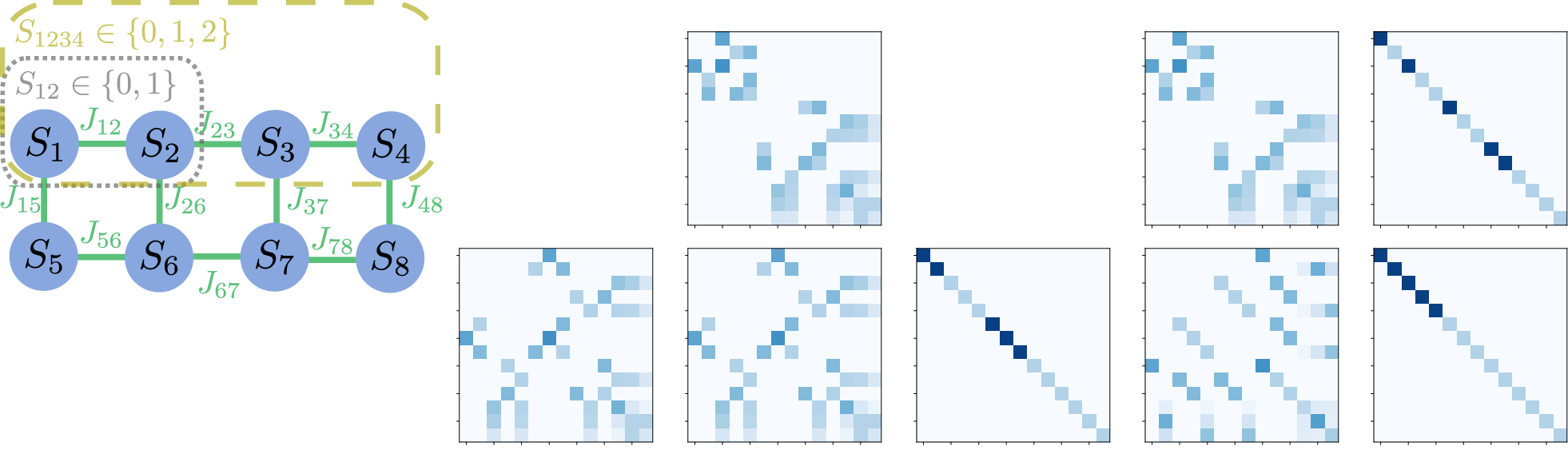
Figure 1: Layout of a 2×4 spin array and coupling with quantum numbers labeling the spin-zero manifold.
The Spin-Zero Manifold: Structure and Implications
The spin-zero manifold consists of all total spin-zero states in an array of N spins, accessible via initialization to singlet pairs and manipulation through exchange interactions. The S0 manifold's Hilbert space dimension grows as the L-th Catalan number for N=2L spins, scaling asymptotically as 2N/(N/2)3/2, which nearly saturates the full 2N dimensionality of the system.
A crucial advantage highlighted is the elimination of leakage outside the computational manifold during exchange operations, since all exchange Hamiltonians commute with total spin. This contrasts with traditional exchange-only encoding approaches that partition the system into smaller qubit modules, which dramatically restrict the active Hilbert space and are susceptible to leakage errors during multi-qubit gating.
The use of fusion-tree representations to construct the S0 basis allows formal characterization of available states and the action of exchange unitaries.
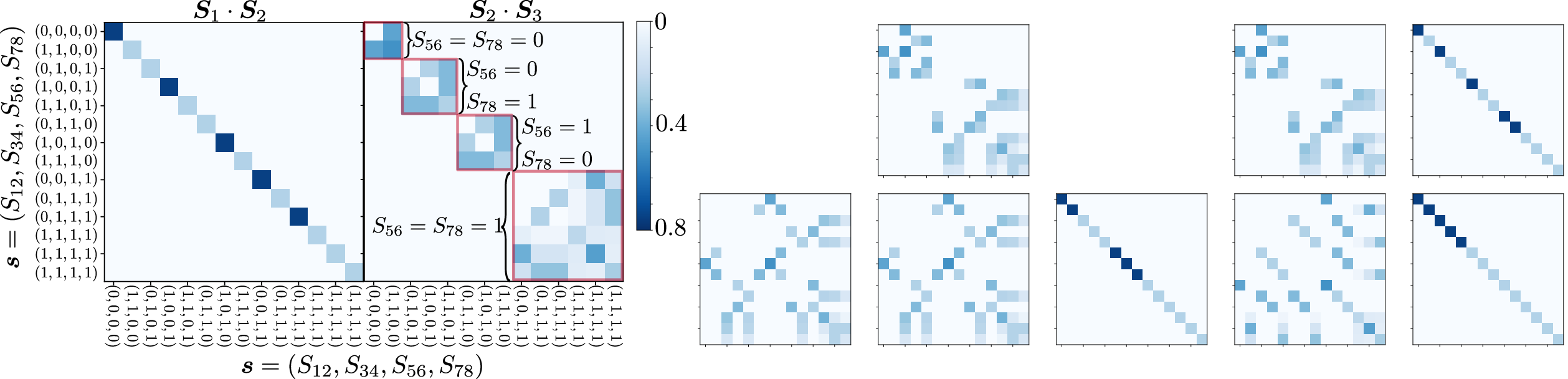
Figure 2: Magnitude of the elements of the unitary matrices S1⋅S2 (left) and S2⋅S3 (right) in the fusion-tree basis of a 2×4 array of spins.
Measurement Constraints: Coarse-Grained Projective Readout
One of the principal trade-offs for working within the S0 manifold lies in measurement limitations. Current protocols employ Pauli spin blockade, which only resolves whether each pair is in a singlet or triplet state, not the full spectrum of quantum numbers. As a result, the number of resolvable outcomes is restricted to 2L for N0 spin pairs, which becomes an exponentially vanishing fraction of the full S0 Hilbert space as N1 increases. This severe coarse-graining motivates the adaptation and development of benchmarking protocols that can nonetheless reliably characterize quantum circuit fidelity and complexity in the presence of highly degenerate measurement outcomes.
Random Circuit Benchmarking under Coarse-Grained Readout
The authors generalize key benchmarking protocols—cross-entropy benchmarking (XEB), mirror randomized benchmarking (MRB), and out-of-time-ordered correlators (OTOCs)—to address the coarse-grained measurement inherent to the S0 manifold.
For random circuits of sufficient depth, the distribution of measurement probabilities (post-PSB) follows an Erlang distribution, with its shape parameter set by sector multiplicity, replacing the conventional Porter-Thomas distribution. This result is quantitatively and visually validated by the simulation of random exchange circuits on N2 spin arrays.
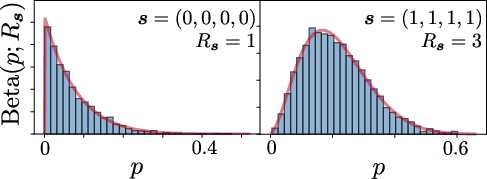
Figure 3: Simulated probability distributions of the all-singlet readout (left panel) and all-triplet readout (right panel) of a N3 array using 2000 circuits each with 100 randomly chosen exchange gates. Red envelopes show the exact Beta distribution.
The linear XEB fidelities remain faithful estimators of circuit quality, but with increased statistical overhead due to multiplicity-induced concentration of probabilities. MRB is shown to be an effective complementary protocol, as its return probability is sharply defined and not degeneracy-limited for initial all-singlet states, making it particularly robust for scaling to larger system sizes.
The protocol's resilience and accuracy are quantitatively assessed under a Gaussian charge-noise model, showing predictable decay of XEB fidelity with circuit depth and noise, and providing a calibration tool for extracting the average gate error per exchange pulse.
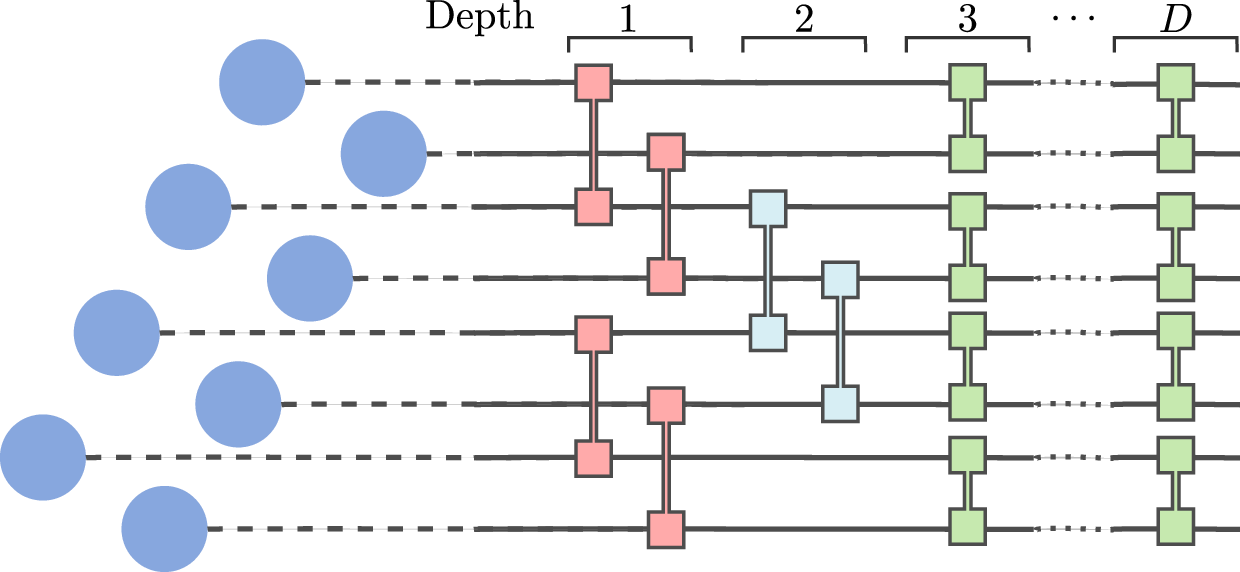
Figure 4: Sketch of the brickwork circuit of depth N4 used to generate a random unitary matrix. Each two-spin interaction is an exchange gate N5 with N6 randomly drawn from a set of fixed angles.
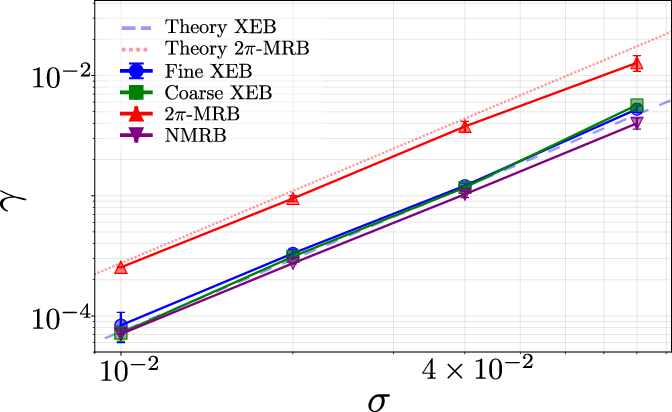
Figure 5: Average error per gate, N7, as a function of charge noise variance, N8, extracted from numerical simulations using fine XEB (circles), coarse XEB (squares), N9-MRB (up-triangles), and NMRB (down-triangles). Theoretical prediction of L0 for fine XEB, coarse XEB, and NMRB (dashed curve) and L1-MRB (dotted curve).
Quantum Supremacy and Quantum Advantage in the S0 Manifold
The paper investigates the conditions for quantum supremacy and quantum advantage using the S0 manifold. While XEB has been a standard metric for demonstrating quantum computational supremacy, the exponential growth of outcome degeneracies under coarse-grained PSB readout weakens the statistical separability between quantum and reference distributions, demanding prohibitive numbers of circuit samples at scale.
To circumvent these measurement limitations, the authors advocate the use of OTOC protocols, which can be tailored to the S0 context using exchange-only operations and Weyl–Heisenberg operator bases. OTOCs, especially of higher order, can probe many-body scrambling, butterfly velocities, and spectral gap measurements in frustrated spin Hamiltonians, which are computationally intractable classically and thus relevant for quantum advantage demonstrations.
The practical realization of quantum simulators for Heisenberg-type models is discussed, emphasizing Trotterization strategies to implement arbitrary interaction graphs using SWAP networks and the necessity of high-fidelity, parallelizable exchange gates to mitigate error accumulation. The scaling of Trotter error and simulation circuit depth is explicitly considered, noting the stringent fidelity demands as system size increases.
Experimental Context and Outlook
Recent progress in silicon quantum dot arrays enables the preparation and manipulation of spin arrays with dimensions up to L2, corresponding to over 47 effective qubits when utilizing the spin-zero manifold. Exchange gate fidelities reported in such systems are approaching and in some cases surpassing those in leading superconducting platforms.
The presented analysis underlines both the present and potential competitiveness of semiconductor spin-based processors for both quantum supremacy and quantum advantage tasks, particularly in scenarios where deep circuit execution is possible and measurement granularity is not the limiting factor.
Furthermore, the paper opens the field to future hardware and measurement advances, such as iterative PSB reading or ancilla-enabled subspace discrimination, as well as to the modularized operation of higher-dimension qudits and generalizations beyond electron spins (e.g., holes in germanium).
Conclusion
The authors establish that the spin-zero manifold of exchange-coupled quantum dot arrays provides a nearly maximal Hilbert space with robust operational advantages under exchange-only control, despite measurement constraints inherent to PSB readout. They generalize and validate benchmarking techniques to reliably evaluate circuit performance in this regime and propose protocols for demonstrating quantum supremacy and advantage. The work implies that with continued improvements in control and measurement fidelity, spin-based quantum processors will be able to efficiently harness the full computational potential of their physical Hilbert space.
Reference: "Spin singlets are useful" (2607.06672)