- The paper demonstrates that quasi-zero pulses offer a tunable trade-off between pulse duration, fidelity (up to 99.93%), and calibration complexity.
- It employs simulations and hardware benchmarks on Intel’s Tunnel Falls device to show that intermediate gamma values (e.g., ~0.7) optimize distortion compensation compared to traditional methods.
- The study implies that quasi-zero pulses can enable scalable, automated control in semiconductor spin qubits by reducing experimental overhead and tuning requirements.
Driving Exchange Interaction in Spin Qubits with Quasi-Zero Pulses
Introduction and Motivation
High-fidelity gate operations in semiconductor spin qubits, particularly those leveraging exchange-only architectures, are critically constrained by pulse distortions in electrical control signals. Exchange interactions, which serve as the entanglement mechanism in these devices, depend exponentially on gate voltages; even modest distortions lead to significant over- or under-rotations, thereby reducing fidelity. Traditional approaches to distortion mitigation either require finely tuned pre-distortion filters with numerous parameters or exploit net-zero pulses, which cancel linear-dynamical distortions via a net-zero time integral but commonly over-correct signal perturbations.
This work introduces and systematically analyzes "quasi-zero" pulse families—generalizations of net-zero pulses featuring reduced but nonzero net time integrals. These pulses enable a tunable trade-off between pulse duration, fidelity, and experimental complexity. The method's impact is demonstrated via both simulation and hardware benchmarks on Intel’s Tunnel Falls six-dot device, a commercial-scale exchange-only qubit array.
Net-Zero and Quasi-Zero Pulse Design
The exchange interaction dynamics are driven by tailored electric pulses. Standard rectangular or reference pulses correspond to γ=0, i.e., an all-positive amplitude; net-zero pulses strictly enforce γ=1, yielding a net-zero integral by pairing positive and negative segments of identical area. Quasi-zero pulses generalize this by permitting 0<γ<1, allowing a partial—but not total—compensation Figure 1.
Figure 1: Illustration of an atomic barrier pulse as a function of time. γ=0 corresponds to a rectangular pulse, γ=1 is net-zero, and quasi-zero pulses interpolate between these regimes.
Empirically, device step responses exhibit multi-timescale exponential relaxations, with calibration indicating both nanosecond and microsecond distortion components. These distortions are aggravated for pulses with long memory effects, requiring robust compensation schemes. The flexibility provided by quasi-zero pulses allows for a direct optimization of the amplitude ratio γ, as well as segment durations, to eliminate both undercorrection (seen with reference pulses) and overcorrection common to strict net-zero approaches.
Experimental Validation and Simulation
The elimination of time-dependent distortions was validated by applying multiple sequential N(ψ) pulses—each inducing a well-defined qubit rotation—and measuring the ensuing fringe patterns in the spin-up probability as a function of pulse repetition and rotation angle Figure 2. Reference pulses yield visible curvature of the fringe center, manifesting as systematic over-rotations due to cumulative charge accumulation or related effects. Implementing net-zero pulses suppresses these systematic drifts, flattening the fringe pattern and demonstrating successful cancellation of long-time distortions.
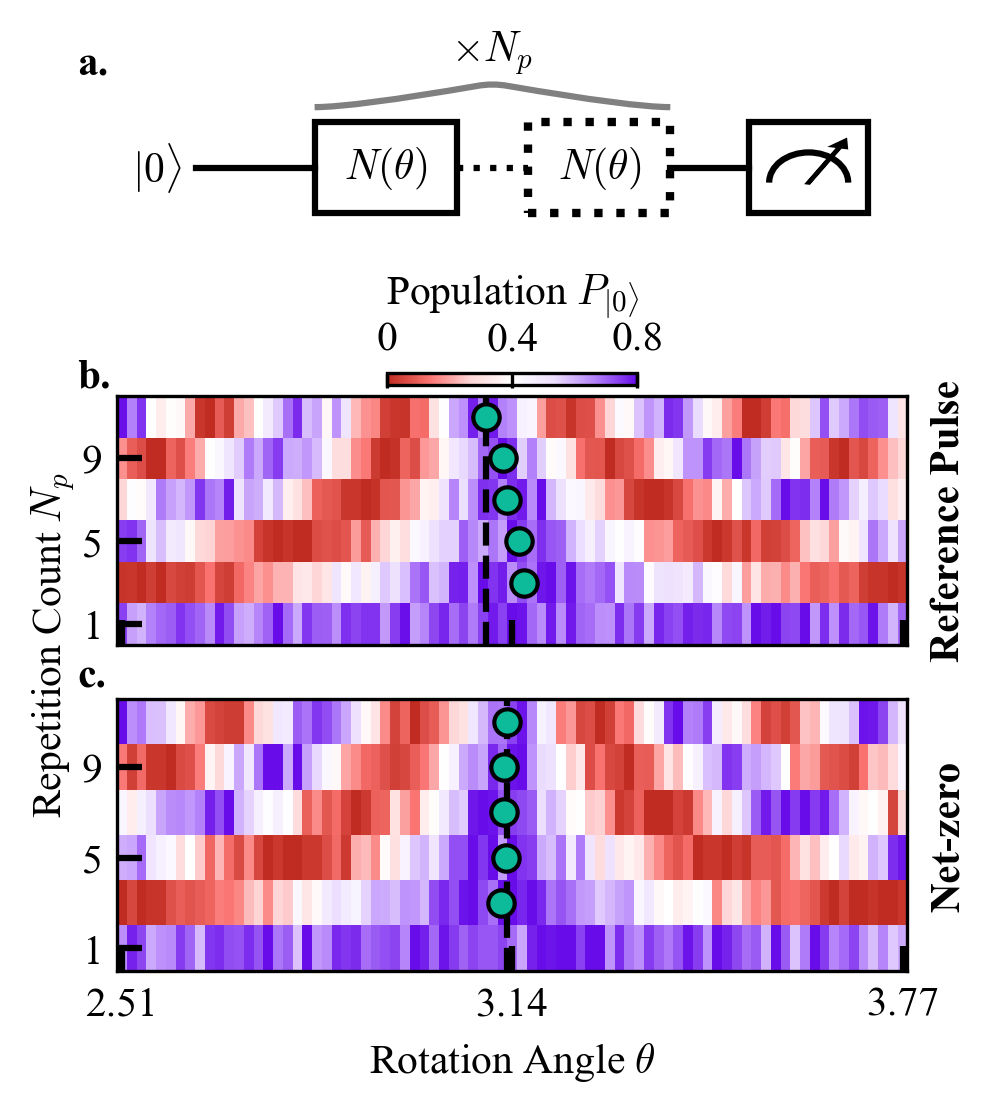
Figure 2: Rabi fringe patterns for reference and net-zero pulses; net-zero eliminates curvature induced by charge accumulation and other memory effects.
However, numerical simulations using device-calibrated transfer functions revealed that net-zero pulses (γ=1) can overcompensate for distortions, reversing fringe curvature Figure 3. Optimal fidelity was obtained not at γ=1, but rather for quasi-zero configurations (γ≈0.7), where positive and negative curvatures are balanced, resulting in maximum linearity of the central fringe.
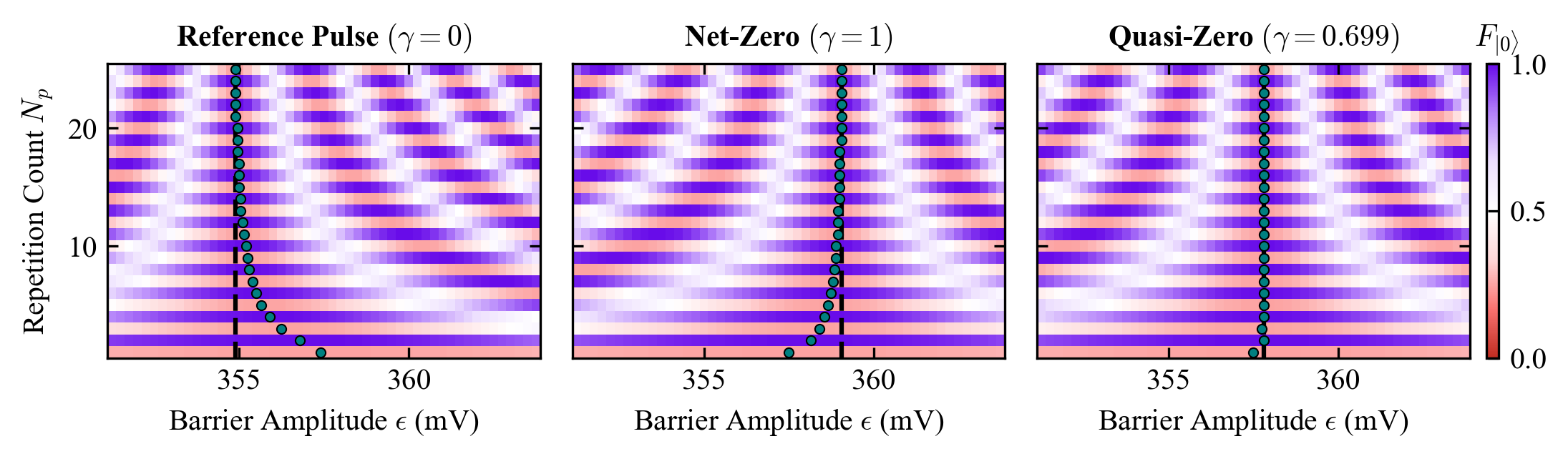
Figure 3: Simulated ground-state fidelity vs. pulse sequence for reference, net-zero, and quasi-zero pulses, demonstrating improved compensation at intermediate γ=10.
Blind randomized benchmarking on Tunnel Falls hardware quantified the operational fidelity of distinct pulse schemes across multiple parameterizations, with and without pre-distortion filtering. Reference pulses, even in the absence of filters, achieved γ=11 fidelity. Fully filtered reference pulses increased fidelity to γ=12 but required tuning 12 parameters. By contrast, quasi-zero pulses (optimized γ=13) achieved γ=14 fidelity at identical gate durations but without any additional tuning, underscoring the efficiency of the quasi-zero approach.
Notably, increasing segment durations or using longer spacers between pulse segments could further improve fidelity (up to γ=15) but at the expense of increased susceptibility to hyperfine noise. Conversely, shorter, higher-amplitude pulses suffer from amplified charge noise due to the exponential voltage-exchange relation.
The combination of quasi-zero pulses with limited pre-distortion filtering (targeting only longer timescale components) achieved fidelities up to γ=16 with only two tuning parameters, a significant reduction in experimental overhead relative to full filter schemes.
Theoretical and Practical Implications
The systematic mapping of pulse-induced tradeoffs indicates that quasi-zero pulses uniquely balance distortion mitigation with calibration simplicity. By reducing parameter count while preserving high-fidelity operation, this scheme facilitates scalable, automated control essential for large-scale quantum processors. The results directly inform hardware and software calibration strategies for devices sensitive to both low-frequency (e.g., charge accumulation) and high-frequency (e.g., hyperfine) noise sources.
Quasi-zero and related pulse-shaping methods are broadly applicable to systems where exchange coupling is voltage-controlled, encompassing not only exchange-only but also singlet-triplet and Loss-DiVincenzo qubits. Given emerging trends toward cryogenic controller integration and miniaturization, the robustness and automation-friendly nature of quasi-zero pulse protocols will become increasingly consequential as calibration stability and device yield dominate quantum hardware engineering challenges.
Future Directions
Further improvements are anticipated by characterizing charge configurations associated with negative pulse segments, quantifying crosstalk and spurious coupling effects, and extending the approach to multi-qubit and two-qubit gates. Comparative studies across diverse cryogenic and room-temperature control architectures will clarify the limits of pulse shaping versus filtering as device scales and integration demands escalate.
Conclusion
This work demonstrates that quasi-zero pulses provide a low-complexity, highly effective framework for mitigating pulse distortions in exchange-coupled spin qubits. Through both simulation and experiment, it is shown that quasi-zero pulses match the performance of extensively filtered reference pulses while drastically simplifying calibration requirements. These findings pave the way for scalable, automated control in semiconductor quantum processors and hold promise for broad adoption across diverse solid-state qubit platforms.