- The paper introduces a novel approach for scalable phonon lasers using locally-controlled quantum spin chains coupled with mechanical oscillators.
- Site-selective resonance enables on-demand phonon lasing, with theoretical and numerical validation confirming coherent amplification and a clear lasing threshold.
- Self-organized synchronization is demonstrated through robust phase locking, paving the way for advanced applications in quantum sensing and many-body quantum simulation.
Scalable Phonon-Laser Arrays via Local Control in Driven Spin Chains
Introduction
The paper "Scalable phonon-laser arrays with self-organized synchronization" (2603.29099) presents a modular, locally-controlled approach for realizing scalable arrays of mechanical phonon lasers using quantum spin chains coupled to mechanical oscillators (MOs). Traditional phonon-laser architectures generally rely on a collective coupling through a shared bus, which restricts individual addressability and hinders scalability—major limitations for applications requiring flexible control such as quantum acoustics, many-body quantum simulation, and quantum sensing. The authors introduce a protocol enabling on-demand activation of site-selective lasing via precisely engineered local resonance conditions, leading to robust mechanical amplification and distinct self-organized synchronization phases.
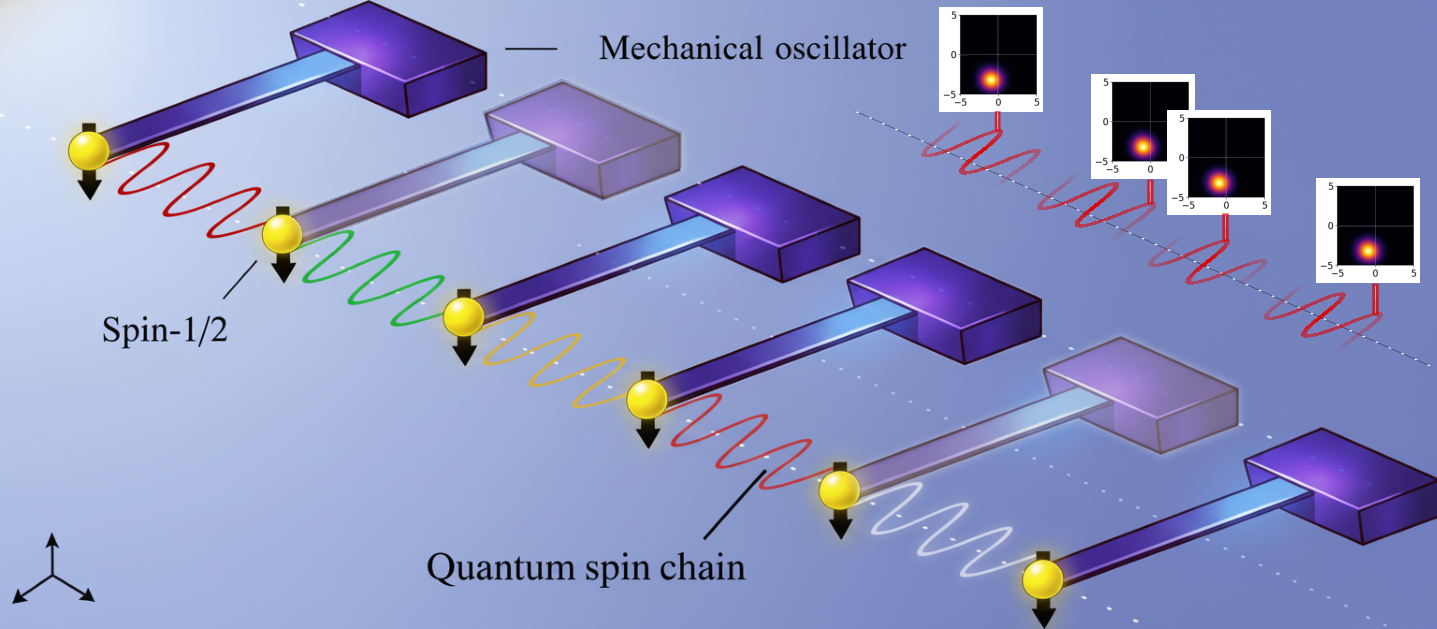
Figure 1: Mechanical oscillators (MO) individually coupled to sites of a spin chain; site-resolved control enables arbitrary, on-demand phonon-laser arrays.
Theoretical Framework
System Hamiltonian and Local Control
The core architecture consists of an Ising-like quantum spin chain, with each spin site potentially coupled to a site-specific MO. The Hamiltonian incorporates both local spin-phonon interactions and locally-controlled, time-dependent nearest-neighbor exchange (XX) couplings: H^=j=1∑N2Δjσ^jz+ωjb^j†b^j−λjσ^jz(b^j†+b^j)+j=1∑N−1Jjcos(Ωjt)σ^jxσ^j+1x
This structure allows for strict modularity: the gain/loss balance required for lasing is achieved via local spin-boson couplings, while phonon lasing and synchronization arise only at sites where resonance conditions are imposed. The flexibility of this construction bypasses common-bus limitations and allows individual MOs to be dynamically included or decoupled in arbitrary patterns.
Phonon Lasing Mechanisms
Single-Mode Lasing: Elemental Two-Spin Prototype
To elucidate the lasing mechanism, the authors first consider a minimal instance: two driven spins with one MO. With judicious local driving (i.e., tuning Ω1), blue-sideband transitions σ^1+σ^2+b^1† dominate, causing population inversion and mechanical gain. Both the full and effective Hamiltonian treatments quantitatively match, including pump-induced phonon number saturation and a lasing threshold with respect to the drive amplitude J1—unambiguous signatures of phonon lasing.
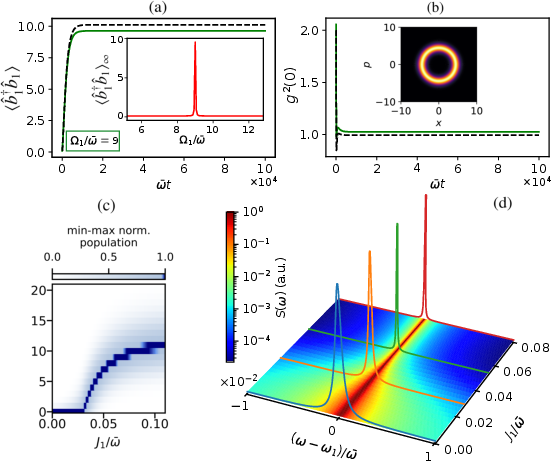
Figure 2: Dynamics for two spins, one coupled MO, at resonance: phonon amplification and phase transition in g(2)(0) from thermal to coherent limit.
The second-order correlation function g(2)(0), evaluated at steady state, transitions from $2$ (thermal) to ∼1 (coherent), confirming single-mode lasing. The steady-state Wigner distribution further displays displaced coherence akin to optical lasers, while the frequency-domain power spectrum sharpens markedly above threshold, indicating the emergence of a long-lived phase-coherent phonon field.
Many-Body Generalization: Scalable Site-Selective Lasing
Extending to N spins and arbitrary MO configurations, the formalism yields an effective Hamiltonian that captures all relevant manifold transitions: H^Neff=j=1∑N−12Jjσ^j+σ^j+1+−ij=1∑N−1k=j∑j+1ωkJjλkσ^j+σ^j+1+b^k†+h.c.
Resonance is tightly controlled via the frequencies of the local drives (Ω10), allowing for on-demand activation: only MOs with parameters precisely matching the resonance condition participate in lasing.
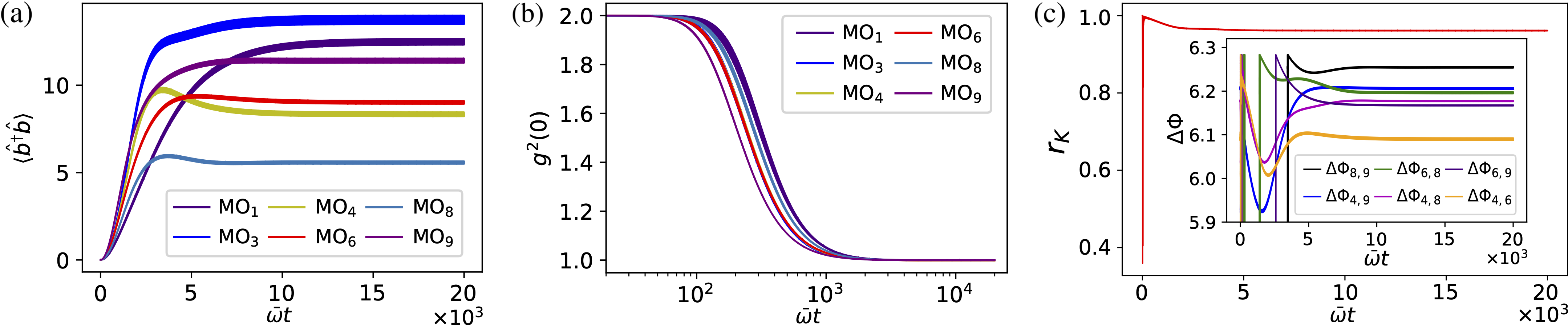
Figure 3: Spin-mechanical array with MOs at selected sites; resolved phonon amplification and Ω11 showing selective coherent lasing.
The theory is confirmed numerically for an array of Ω12 spins, with MOs coupled at an arbitrary subset of sites. Each lasing MO achieves saturation, and Ω13, confirming independent coherent amplification—establishing universal applicability and full site addressability.
Self-Organized Synchronization Phenomena
A fundamental observation is that, even under realistic parameter deviations, the lasing MOs exhibit robust mutual synchronization. This is captured by the Kuramoto order parameter Ω14 and the pairwise phase-difference dynamics, which demonstrate the emergence of both pairwise and global phase locking among the lasing oscillators.
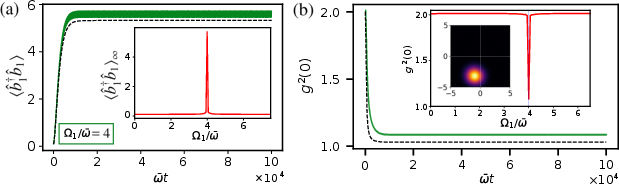
Figure 4: Time evolution of phonon numbers (a) and Ω15 (b) in a large MO array; lasing takes place only when resonance is achieved.
Importantly, the system supports two contrasting lasing regimes: a phase-locked regime with macroscopic coherence, and a random-phase/doughnut regime, controllable by the specific structure of applied resonance conditions and the underlying Floquet engineering.
Experimental Feasibility
The protocols rely on control primitives—site-local modulation of qubit frequency and strong spin-phonon dispersive coupling—that have demonstrable feasibility in various platforms, including circuit quantum acoustics, trapped ions, and solid-state hybrid quantum devices. Contemporary superconducting circuits (e.g., fluxoniums) already achieve relevant frequency ranges and coupling strengths for the required Hamiltonian engineering. The detailed analysis includes realistic driving amplitudes, thermal occupations, and dissipative rates in alignment with state-of-the-art experimental benchmarks.
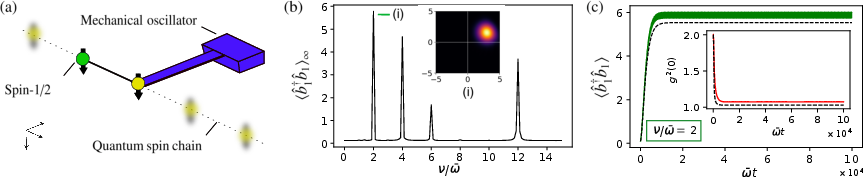
Figure 5: Schematic of experimentally feasible implementation: local driving of one spin, stationary phonon population as function of drive frequency, and time-domain lasing signature.
Implications and Future Directions
The paper's architecture unlocks several avenues:
- Quantum-Acoustic Many-Body Physics: The site-resolved nature and synchronization dynamics facilitate studies of non-equilibrium many-body phonon phases and transport phenomena inaccessible to previous monolithic phonon-laser designs.
- Site-Selective Quantum Sensing: The ability to configure, for instance, quantum-enhanced sensors only at desired nodes within larger arrays can improve spatial resolution and system adaptability, directly leveraging coherent phonon lasing for ultrasensitive force or displacement measurements [(2603.29099), 16.044007].
- Quantum Simulation and Communication: Robust phase locking over scalable distances is a prerequisite for distributed quantum communication protocols using mechanical degrees of freedom.
Technically, the findings motivate further investigation into disorder effects, Floquet engineering of higher-order transitions, integration with waveguide-QED, and hybrid coupling to photonic bus modes.
Conclusion
This work provides a universal, modular framework for scalable, site-resolved phonon-laser array generation and synchronization using only local control within quantum spin chains. Through analytical and numerical demonstration, the approach circumvents previous collective-coupling constraints, realizes robust synchronization, and is compatible with state-of-the-art experimental platforms such as superconducting devices. The results propel the frontier in scalable phonon-based quantum technologies and open new possibilities in coherent quantum many-body acoustics.

