- The paper reveals that positional encoding schemes yield distinct spectral fingerprints influencing attention head functions in Transformers.
- It employs non-Hermitian and random-matrix theory to map spectral metrics to specific roles like previous-token and induction circuits.
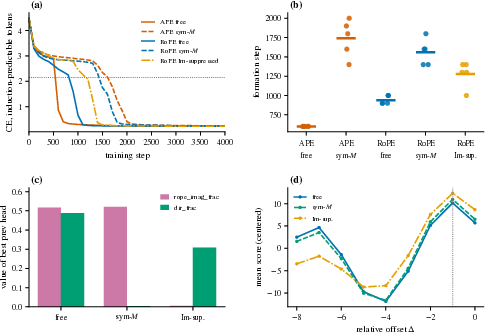
- Ablation studies show that altering spectral channels delays function formation, highlighting architecture-dependent defaults and flexibility.
Spectral Fingerprints in Attention: A Systematic Dissection of Positional Scheme Effects on QK Spectra
Introduction
This work rigorously dissects how positional encoding schemes—learned-absolute, ALiBi, and RoPE—influence the spectral “algebra” of the attention QK operator M=Wq⊤Wk in Transformer architectures. By adopting tools from non-Hermitian and random-matrix theory, it seeks to clarify: To what extent do complex-valued spectral properties of M carry or constrain behaviorally-causal information for specific attention head functions, especially previous-token and induction circuits? This question is systematically analyzed through static cross-model comparisons, dynamic checkpoint analyses, and dissective interventions in controlled training settings, yielding an architecture-dependent landscape of spectral necessity, default, and functional fingerprinting.
Spectral Decomposition Framework and Null Models
A central analytic contribution is the establishment of matched-rank, random-orientation null models for spectral metrics. M is generally non-symmetric and thus supported on complex eigenspectra with non-orthogonal eigenvectors. Decompositions—SVD, symmetric/antisymmetric splits, real Schur forms, and full complex eigendecompositions—anchor novel and existing metrics: (i) the “directionality metric” dir=∥MA∥F/∥M∥F; (ii) a complex directionality score Dhead, the normalized sum over imaginary parts of eigenvalues, and (iii) a “content” score from the symmetric sector. Crucially, these metrics are always referenced to model-specific random orientation nulls, as the spectral baseline for “directionality” is already high in generic low-rank M (e.g., dirnull≈0.707).
Static Function–Spectrum Mapping Across Positional Schemes
A clear dissociation emerges between attention head function and spectral profile, but one that is conditional on the positional encoding scheme.
- Previous-token heads: Under RoPE, these are robustly spectrally rotational (high Dhead percentile within the model), while under learned-absolute and ALiBi, they are non-rotational and content-like (low Dhead, symmetric, positive content score). This model-level segregation is perfect at all tested k (Figure 1).
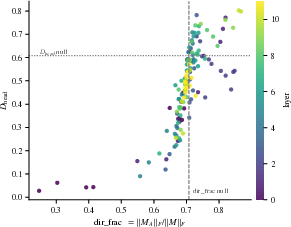
Figure 2: The content--direction plane (GPT-2). Each point is a head; dashed lines mark the random-orientation null M0.
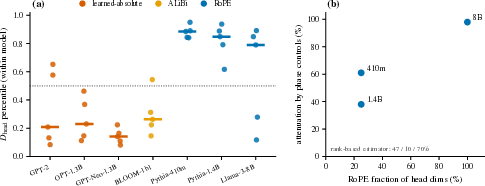
Figure 1: Within-model M1 percentiles for each model's top-5 previous-token heads: bottom-quartile for learned-absolute (red) and ALiBi (orange), top-quintile for RoPE (blue).
- Induction heads: Contradicting preregistered expectations, induction heads are generally symmetric, content-like, and not spectrally directional.
The statistical claim is robust: model-level permutation M2 for the segregation of M3 percentiles. In all RoPE models, the incremental predictive power of M4 (complex directionality) over the plain antisymmetric norm M5 is positive and statistically significant.
Causal Ablations and Structure-Function Disentanglement
Ablation studies on GPT-2 and RoPE models reveal:
- Symmetric sector dominance: For generic heads, only the symmetric part of M6 is load-bearing for per-token cross-entropy, with the antisymmetric part (M7) inert except in a discrete subset of heads implementing precise circuits (e.g., canonical induction/prev-token heads).
- Functional specificity: Targeted ablation of M8 (the RoPE phase channel) in high M9 heads destroys induction behavior (up to M0 increase in induction loss) and symmetrizes the relative-position kernel, but has negligible effect elsewhere.
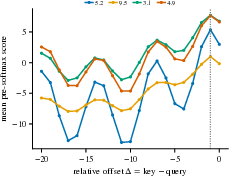
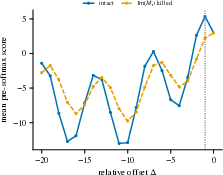
Figure 3: Left: Corpus-averaged relative-position score kernels of top previous-token heads (Pythia-410m) maximize at M1 with RoPE-induced periodicity.
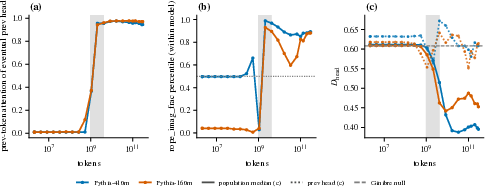
Figure 4: Checkpoint natural history, Pythia-410m (blue) and 160m (red); formation window shaded. (a) Previous-token behavior forms sharply and identically in both models. (b) The prev head's rope percentile locks in with behavior formation, not before. (c) Population median M2 is suppressed below the Ginibre null post-formation.
Mechanistic Tethering: RoPE Phase and Spectral Signature
Decomposition of M3 into per-frequency complex sub-operators M4 shows that the imaginary part, M5, is the carrier of directionality for previous-token attention under RoPE:
- High correlation (M6) between “rotary directional fraction” (rope score) and functional headness (prev-detection score).
- Regressing out per-frequency phase features eliminates the incremental predictive association of M7 on prev-token behavior in full-RoPE models, but not in learned-absolute models, confirming the architecture specificity.
Tracking Pythia checkpoints, all heads begin at the Ginibre random-matrix null—function and spectral imprint emerge synchronously during the formation window (M81–4B tokens), with post-formation suppression of M9 in the population but its retention in the principal previous-token head(s). Importantly, spectral “fingerprints” consolidate only after function arrives; they do not prospectively identify circuit formation.
Constrained Training Interventions: Necessity and Default
Directly manipulating the spectral sector during from-scratch training answers questions of necessity versus default:
Implications and Future Directions
This study’s architecture-dependent view of QK spectral structure reconstructs a more granular theoretical and operational taxonomy:
- Spectral structure as fingerprint, not blueprint: The complex eigenstructure is not a “hard constraint”: it arises as the path-of-least-resistance (default) solution imprinted during circuit formation. The “non-Hermitian transformer” framing is only functionally anchored under RoPE, where phase-channel routing is truly utilized.
- Interpretability and circuit analysis: RoPE-phase content (or dir=∥MA∥F/∥M∥F2 percentile) robustly flags positional-routing heads post hoc in RoPE models—an efficient triage tool for weight-space analysis.
- Causality versus correlation in interpretability: Post hoc ablation severity is not predictive of developmental necessity; spectral sectors can be fully bypassed at finite search cost.
- Generalization: Points to the importance of scaling such constrained pretraining experiments, analysis of path patching and interaction between multiple heads, and deeper investigation of latent grouping in alternate architectures (e.g., Qwen, Mistral families).
Conclusion
The spectral algebra of the QK attention operator is determined by the model’s positional scheme, providing distinct “fingerprints” for default solutions but imposing no hard “blueprints.” While complex spectral signatures are causally load-bearing in RoPE-based architectures and serve as efficient post hoc markers for crucial circuits, every spectral channel analyzed is ultimately degenerate—circuit formation can reroute with altered search costs when constraints are imposed. Hence, the non-Hermitian perspective on attention is architecture-conditional: essential and causal in RoPE, decorative in learned-absolute, and always subject to developmental economy and trainability constraints. This framework raises important operational and theoretical questions for the field as model architectures and interpretability techniques evolve.