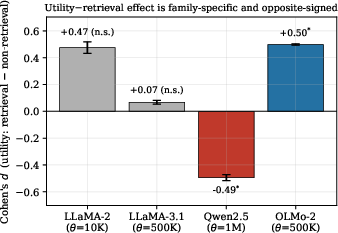
- The paper demonstrates that a higher RoPE base does not prevent retrieval heads, contradicting initial hypotheses.
- Using paired-seed NIAH protocols and activation patching, the study validates retrieval head functionality across various LLM architectures.
- The research reveals that retrieval depends on low-frequency RoPE dimensions, highlighting the need for architecture-specific tuning.
Introduction
This essay provides a technical synthesis of the paper "Does RoPE Prevent or Degrade Retrieval Heads? A Mechanistic Analysis Across Model Families" (2606.21249), which interrogates the interaction between Rotary Position Embeddings (RoPE) and retrieval heads in transformer-based LLMs. The research addresses two core mechanistic hypotheses: whether RoPE (particularly its base parameter, θ) suppresses or degrades retrieval heads, which are crucial for long-context recall. The investigation spans four open-weight 7–8B LLMs (including both Multi-Head and Grouped-Query architectures) and exploits both paired-seed needle-in-a-haystack (NIAH) protocols and population-level activation patching.
Retrieval Heads, RoPE, and Hypothesis Framing
Retrieval heads are specialized attention heads that enable models to copy information from distant context positions, essential for maintaining factuality and long-range memory [wu2025retrieval]. RoPE encodes token position by rotating query and key vectors with frequencies determined by the base θ parameter. Current model scaling practices increase θ to extend context, but this impacts how RoPE’s frequency channels encode information, potentially leading to "inefficient" dimensions [chiang2025dimension].
The paper frames two hypotheses:
- H1 (Prevention): Higher θ reduces the formation of retrieval heads.
- H2 (Degradation): Retrieval depends specifically on high-utility RoPE dimensions as measured by the L1 norm of query-projection weights; low-utility dimensions are dispensable.
Experimental Approach and Statistical Validation
Mechanistic interpretability is addressed through careful protocol design. Detection of retrieval heads relies on an attention-argmax proxy, with robustness validated against teacher-forced copy-score metrics. Key methodologies include:
- Paired-Seed Needle-in-a-Haystack (NIAH): Context lengths up to 8192 tokens, cross-model input normalization for tokenizer independence.
- Layer-Clustering for Statistics: Avoids pseudoreplication via permutation tests within layers, as heads are not independent.
- Causal Masking and Activation Patching: Both head-level and dimension-level interventions are deployed.
Static Multi-Model Analysis and Utility Heterogeneity
Retrieval heads consistently emerge as a minority (~4–9%) of all heads across LLaMA-2, LLaMA-3.1, Qwen2.5, and OLMo-2 models, regardless of attention regime or RoPE base.
This heterogeneity refutes the existence of a universal "RoPE degrades retrieval" law; the sign and magnitude depend on architecture, data, and possibly tokenizer, but not solely on θ0.
Training Dynamics: Emergence of Retrieval Heads
OLMo-2’s released checkpoints allow temporal analysis. Retrieval heads crystallize abruptly after ~2 trillion tokens, jumping from nearly absent to a plateau (300–449 heads). This onset correlates strongly (Pearson θ1) with a decrease in mean query-projection utility.
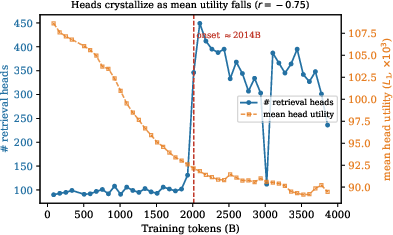
Figure 2: Retrieval-head count and mean head utility across OLMo-2 pretraining checkpoints; abrupt emergence of retrieval heads accompanied by utility decrease.
This dynamic evidences retrieval heads as emergent, learned subcircuits, not artifacts of initialization.
Causal Validation: RoPE Frequency Axis Dominates Retrieval Mechanistic Function
Whole-head knockouts demonstrate causal necessity: masking all detected retrieval heads in OLMo collapses recall (NIAH accuracy θ2), while random head masking leaves recall unaffected. Qwen2.5 shows a partial collapse (θ3).
Population-level RoPE dimension patching shows that retrieval depends specifically on the low-frequency (long-wavelength) RoPE dimensions. Zeroing these across top retrieval heads dose-dependently collapses recall (from θ4 to θ5 when 32 of 128 dimensions are zeroed), while random or high-frequency dimension interventions have negligible effects.
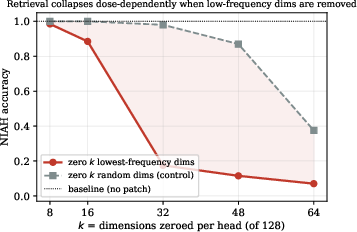
Figure 3: Dose-response in OLMo-2: Zeroing θ6 lowest-frequency RoPE dimensions across retrieval heads collapses recall; random dimension removal has minimal effect.
Controls confirm the effect is retrieval-head-specific and task-specific (minimal impact on perplexity in general LM tasks).
Replication across Qwen2.5, Gemma-2, and Mistral—with coverage-matched patches—establishes the universality of the frequency axis’s causal role. The effect size grows with context length and retrieval-head coverage, with copy-score detectors confirming robustness and specificity.
Practical and Theoretical Implications
The findings have several implications:
- Context Window Extension Practices: Increasing RoPE base (e.g., NTK-aware, YaRN extensions) remains mechanistically justified, as it reshapes the low-frequency channels essential for retrieval heads but does not reduce their count.
- Retrieval Circuit Design: Optimization and architectural variants (e.g., partial RoPE, hybrid attention strategies) may benefit from targeting the frequency axis and tuning head allocation for retrieval functionality.
- Mechanistic Interpretability: Model-specific heterogeneity points to the need for broader panels and more granular circuit-level analyses to understand cross-family distinctions.
- Evaluation and Methodology: Results underscore the necessity of cluster-aware statistics, detector validation, and population-level causal interventions in mechanistic interpretability.
Outlook for Future AI Research
A larger, more diverse model panel would clarify utility–retrieval coupling taxonomy and inform retraining strategies. Expanding mechanistic activation patching to real-world tasks beyond synthetic NIAH probes is warranted, as is exploring distributed versus concentrated retrieval circuit patterns in various architectures. The robustness of retrieval heads to RoPE geometric manipulation and their abrupt emergence during training suggest new directions for modular interpretability and controlled circuit engineering.
Conclusion
The causal substrate for long-context recall in LLMs is a minority of specialized retrieval heads, which emerge late in pretraining and can be ablated to collapse recall. Contrary to intuitive hypotheses, neither RoPE’s base nor dimension utility straightforwardly prevents or degrades these heads; instead, retrieval depends critically on the low-frequency RoPE dimensions. This causal dependence is robust to architecture, attention regime, and detection metric, but heterogeneous in utility correlation across model families. The findings refine mechanistic accounts of transformer recall and contextual memory, and substantiate practices for context extension via RoPE base scaling. The study also advances methodological rigor in mechanistic interpretability, setting standards for statistical validation and causal intervention.