Robust Topologically Protected Edge Transport in Doubly Chiral Active Particles
Published 7 Jul 2026 in cond-mat.soft and cond-mat.stat-mech | (2607.06193v1)
Abstract: Using theory, simulation, and experiment, we introduce a new class of active particle which we term doubly chiral active Brownian particles (dcABPs), which show robust topologically protected transport along boundaries without backscattering at corners. Their double chirality stems from the coexistence of an intrinsic angular velocity, which can cause rotation independently of translation, and a translation-rotation coupling inducing cross-alignment to the instantaneous velocity, which causes rotation only concomitantly with translation. A mechanically detailed model shows that the latter effect can arise from an asymmetric friction distribution in the direction perpendicular to the self-propulsion direction. We show that topologically protected modes emerge when the two sources of chirality have opposite sign and the intrinsic rotation is weaker than the translation-rotation coupling. In the deterministic limit, we characterize the emergence of these modes not only along straight boundaries, but also along curved boundaries and during interparticle interactions. We provide a proof-of-principle experimental realization by building a doubly chiral vibrobot. While setting the work into context, we moreover show that the topologically protected boundary-induced transport of dcABPs stands in contrast to the edge currents observed for simple chiral ABPs, which we demonstrate are not associated with boundary-induced transport, as well as to those observed for chiral active rods or self-aligning chiral ABPs, which we show to be associated with boundary-induced transport but to backscatter at corners, implying lack of topological protection.
The paper establishes that doubly chiral active Brownian particles achieve robust edge-sliding modes when translation-rotation coupling dominates intrinsic rotation.
Rigorous simulations reveal distinct current inversion and plateau effects, differentiating genuine boundary-induced transport from bulk behavior.
An experimental vibrobot design validates the theoretical framework, offering a practical approach for defect-insensitive active matter systems.
Topologically Protected Edge Transport in Doubly Chiral Active Particles
Introduction and Background
Topological protection in non-equilibrium active matter is an area of increasing importance, particularly for understanding robust transport along system boundaries. This paper introduces doubly chiral active Brownian particles (dcABPs), a new class of single-particle models that explicitly realize robust, topologically protected edge currents, a phenomenon previously elusive in continuum soft-matter systems despite clear demonstration in discrete stochastic lattice models (2607.06193).
The core concept is based on active particles that exhibit two distinct sources of chirality: (i) an intrinsic angular velocity (simple rotation independent of translation), and (ii) a translation-rotation coupling—essentially a cross-alignment that only generates rotation during translation, as could arise from spatially asymmetric friction perpendicular to the propulsion direction. The regime of interest is when these two chiralities are oppositely signed and the translation-rotation coupling dominates.
Absence of True Edge Transport in Standard Chiral Active Brownian Particles
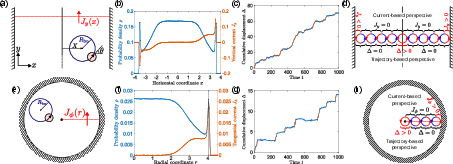
The manuscript rigorously reassesses claims of edge currents in simple chiral active Brownian particles (cABPs, i.e., circle swimmers), where azimuthal current is observed in the vicinity of boundaries. By analyzing both channel and confined circular geometries, the authors demonstrate that the apparent edge currents recorded near boundaries do not correspond to genuine boundary-induced transport. Instead, the nonzero integrated probability current can be attributed purely to bulk orbits near the channel center, with no physical particle transport induced by boundaries themselves.
Figure 1: Contrasting local edge currents and true integrated displacement in cABPs, highlighting the non-boundary origin of integrated current Φ.
This assertion is quantitatively supported through a comparison of steady-state current profiles and cumulative displacement statistics. The distinction parallels the well-known difference between magnetization and transport currents in electronic systems, highlighting the subtlety of interpreting non-equilibrium steady-state currents in active matter.
Lack of Topological Protection in Chiral Rods and Self-Aligning cABPs
Simple chiral active rods (and analogously, self-aligning cABPs) do exhibit genuine boundary-induced transport: these particles can lock into deterministic sliding modes along boundaries, realizing edge currents of opposite chirality to the bulk. However, stochastic and deterministic simulations in geometries with sharp corners reveal that these edge states are not topologically protected—backscattering occurs at corners, rerouting particles into the bulk and destroying the edge state, as made explicit through trajectory tracking and occupancy mapping.
Figure 2: Boundary-sliding and corner-induced backscattering for chiral rods, precluding topological protection of edge currents.
This deficiency—lack of robustness to boundary defects—means such systems cannot support topologically protected edge transport analogous to quantum Hall edge modes.
Theoretical Construction: From Lattice Models to Doubly Chiral ABPs
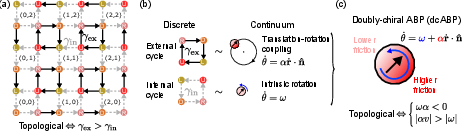
Discrete classical stochastic lattice models, characterized by the competition between independent internal and externalcycles of opposite chirality and distinct rates, robustly support topologically protected edge modes [Tang2021TopologyProtectsChiralCurrents]. The authors draw a direct analogy, mapping these discrete transitions to (i) intrinsic angular velocity and (ii) translation-rotation coupling in the continuum limit.
Figure 3: Discrete stochastic lattice model and its mechanistic mapping to continuum doubly chiral active Brownian particle dynamics.
This motivates the introduction of the dcABP with the following overdamped dynamics: r˙=vu+μF,θ˙=ω+αr˙⋅u⊥+2Drη,
where ω is the intrinsic angular velocity, α quantifies translation-rotation (cross) coupling, and u⊥ is the orientation orthogonal to propulsion.
Sliding Modes and Topological Protection
A key analytical result is that robust, deterministic boundary-sliding modes occur if and only ifω and α are of opposite sign and the translation-rotation coupling exceeds the intrinsic rotation (∣αv∣>∣ω∣). This condition mirrors the mathematical structure dictating topological protection in the lattice model.
Stochastic and deterministic simulations confirm that dcABPs, when in this regime, exhibit persistent, directed sliding along both straight and sharply curved boundaries, without backscattering at corners. Trajectories do not exhibit the loss of boundary adherence seen for chiral rods, even in highly non-convex domains.
Figure 4: dcABPs show strong boundary localization, persistent sliding, and absence of backscattering even at sharp corners, indicating genuine topological protection.
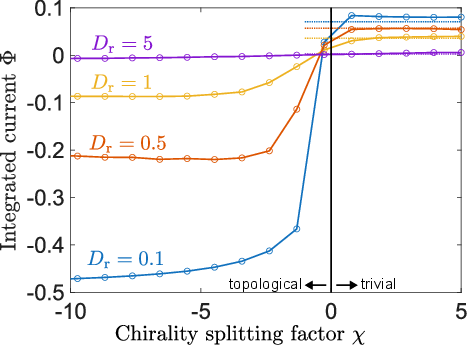
The transition from trivial to topologically protected regime is further quantified by measuring the integrated current Φ as a function of the ratio of intrinsic to translation-rotation angular velocity, for fixed bulk orbit radius and multiple noise levels. In the topological regime, Φ inverts sign (relative to bulk chirality) and plateaus, even at vanishing noise.
Figure 5: Integrated current r˙=vu+μF,θ˙=ω+αr˙⋅u⊥+2Drη,0 transitions sharply at the topological regime boundary, with robust negative plateau in dcABPs for r˙=vu+μF,θ˙=ω+αr˙⋅u⊥+2Drη,1 and r˙=vu+μF,θ˙=ω+αr˙⋅u⊥+2Drη,2.
Edge Modes Along Curved Boundaries and Interparticle Effects
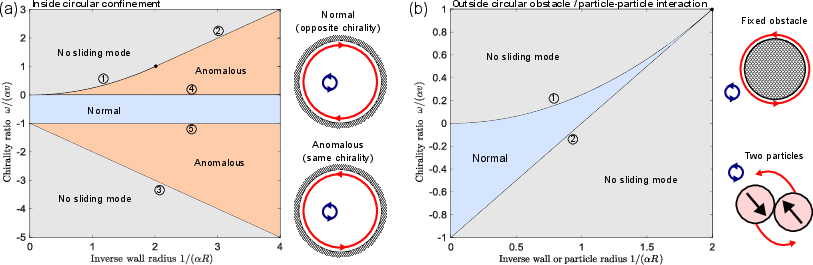
Analytical treatment of sliding along curved (circular) boundaries and for two-particle interactions yields comprehensive phase diagrams. Notably, for interior confinement, sliding is robust to boundary curvature in the normal regime but new anomalous sliding modes emerge as curvature increases or the ratio r˙=vu+μF,θ˙=ω+αr˙⋅u⊥+2Drη,3 is tuned. For obstacles (exterior contacts), only a restricted sliding regime exists.
Figure 6: Phase diagrams for normal and anomalous sliding modes inside and outside circular confinement, and spinning modes for two bound dcABPs.
In multi-particle settings, stable bound spinning states appear, further underscoring the richness of collective phenomena associated with double chirality.
Experimental Realization of Doubly Chiral Edge Transport
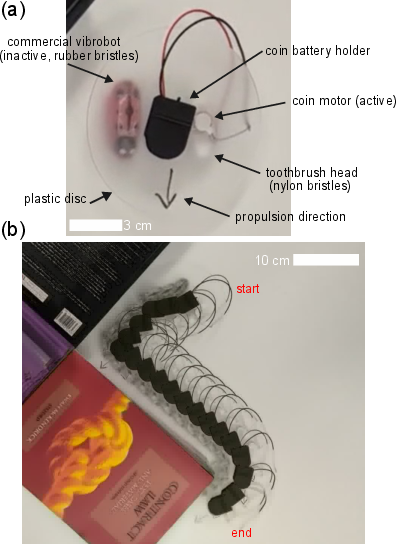
A detailed mechanical model reveals that double chirality emerges naturally from an active sphere with an asymmetric friction distribution perpendicular to propulsion. The torque term arises when friction is unbalanced, and boundary interactions do not contribute to angular dynamics unless the center of friction is offset.
The conditions required for robust sliding modes are directly mapped to mechanical parameters (e.g., offset-induced torques vs. intrinsic torques).
This framework directly motivates an experimental design: a vibrobot platform with frictional asymmetry is assembled, validating the persistent boundary-following and absence of backscattering in real systems.
Figure 7: Schematic and experimental implementation of a doubly chiral vibrobot robustly traversing boundaries and turning sharp corners.
The design demonstrates the low barrier to physical realization, enabling robust dcABPs using commodity and ad hoc components.
Implications, Outlook, and Conclusion
This work provides the first systematic demonstration of topologically protected single-particle edge transport in a continuum active matter model, bridging the gap between discrete lattice formalisms and mechanical realizability. The identification of clear dynamical conditions for topological robustness, and their correspondence to underlying mechanical parameters (frictional distribution), both illuminates the design principles for synthetic active matter and raises critical questions about their existence in biological microswimmers or artificial microrobotic swarms.
Practically, dcABPs provide a strategy for creating swarm systems capable of environment mapping, boundary following, and defect-insensitive transport without requiring complex sensory architectures—a key advantage for micro- and nanoscale robotics.
Theoretically, this work extends the correspondence between non-equilibrium statistical mechanics, topological phases of matter, and real-space dynamical features in soft active materials. Future work may explore richer collective effects, extensions to turbulent and high-density regimes, and analogues in biological systems where mechanical asymmetry and active chirality are prevalent.
Conclusion
The introduction and mechanistic analysis of doubly chiral active Brownian particles establishes a robust framework for topologically protected edge transport in active matter. By combining theory, simulation, and experimental implementation, the work lays critical groundwork for both fundamental understanding and practical exploitation of topological phenomena in classical, stochastic, and living systems.