- The paper demonstrates that passive environmental modifications and 3D-printed housings induce stable self-aligning torque in chiral bristlebots.
- Using controlled experiments and a Langevin-type model, the study quantifies key dynamics including speed, chirality, and alignment torque.
- The findings reveal that matching intrinsic and environmental chirality optimizes transport rectification and minimizes jamming in active matter.
Environmental Control of Self-Aligning Chiral Bristlebots: Technical Analysis
The study presents a robust, tunable experimental platform based on commercial Hexbug nano bristlebots, custom-housed to realize controllable self-alignment torque and stable chiral drift. Augmenting the bristlebots with 3D-printed circular housings and elastic lids induces a persistent self-aligning torque and allows tailoring the degree of chirality and motility, thereby generating an "active gas" of weakly interacting, non-aggregating particles. The particle dynamics are mapped to a Langevin-type model parameterized by self-propulsion speed v0, self-aligning torque strength ζ, chiral drift ω, and orientational/spatial noise. The model predicts that regimes with γ=ζ/ω≳1 and weak rotational diffusion (D≪1) yield persistent, memory-rich dynamics accessible to passive environmental control.
Design iterations focused on the housing geometry and lid material reveal that soft elastic covers (polyethylene foil) optimize for chiral active dynamics while avoiding wall-jamming and over-persistence. Automated video tracking and Hough-circular detection provide quantitative trajectory data for up to 8 particles in a R=25 cm arena, with careful preprocessing to mitigate wall effects and individual bristlebot heterogeneity.
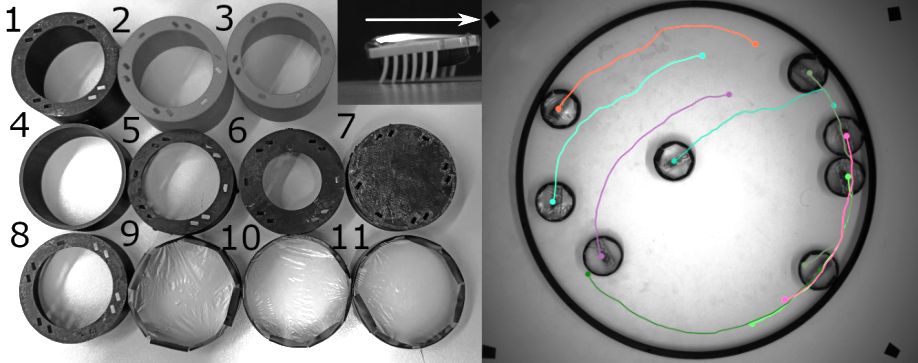
Figure 1: Candidate housing designs (left) and experimental setup with particle tracks overlaid (right), enabling systematic investigation of geometric and dynamical effects.
Characterization of Free and Confined Dynamics
Individual particles exhibit speeds v0≈15.75 cm/s, chirality ω≈1.11 s−1, and self-alignment ζ≈5 sζ0, yielding a chiral length ζ1 cm—comparable to system size. Rotational decorrelation times ζ2 s (ζ3 cm) indicate that memory effects and epicyclic trajectories dominate. The velocity autocorrelation, corrected for chiral drift, decays exponentially, and the observed MSD (ζ4) departs from pure ballistic scaling, consistent with theoretical stochastic analyses. Notably, the self-alignment torque ζ5 is inferred from forced reorientation experiments, strengthening parameter identifiability.
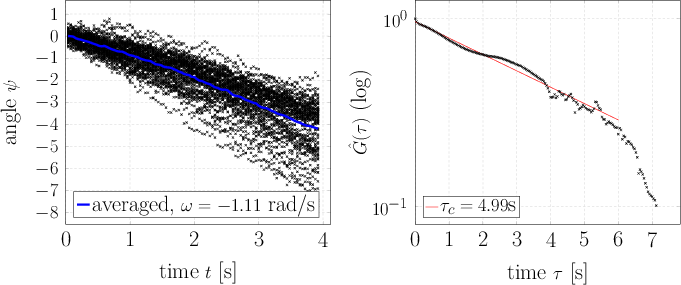
Figure 2: Empirical angular drift and velocity autocorrelation analysis—quantitative separation of chiral drift and rotational noise.
When confined in a circular arena, bristlebots accumulate near system boundaries, mirroring motility-induced phase separation. The interplay between chirality and boundary confinement generates persistent edge currents, with the preferred direction determined by the relative chirality of propulsion and orbital motion. If particle motility opposes the boundary-induced current, edge accumulation intensifies, accentuating the impact of self-alignment.
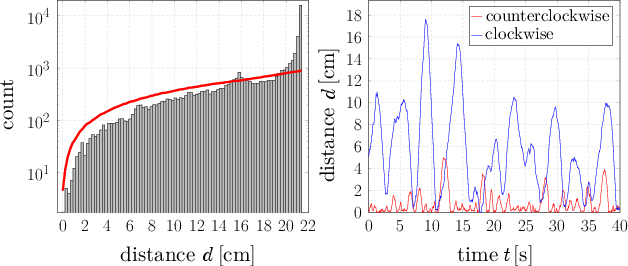
Figure 3: Radial concentration near the wall (left) and time-resolved distance to boundary for opposite chiralities (right), demonstrating the emergence and stability of edge currents.
Environmental Chirality and Geometric Ratcheting
A central contribution is the demonstration of doubly chirality-sensitive rectification using a 3D-printed nautilus-shaped obstacle. The obstacle imposes a controlled bottleneck whose efficacy is a sensitive function of both the particle’s intrinsic chirality and the handedness of the environmental geometry. The experimental protocol explores all permutations of particle and environmental chirality, revealing that global transport is maximized—jamming minimized—when the chiralities are matched. Conversely, opposed chiralities amplify bottleneck-induced fluctuations and particle jamming, as evidenced by pronounced peaks in the low-velocity distribution.
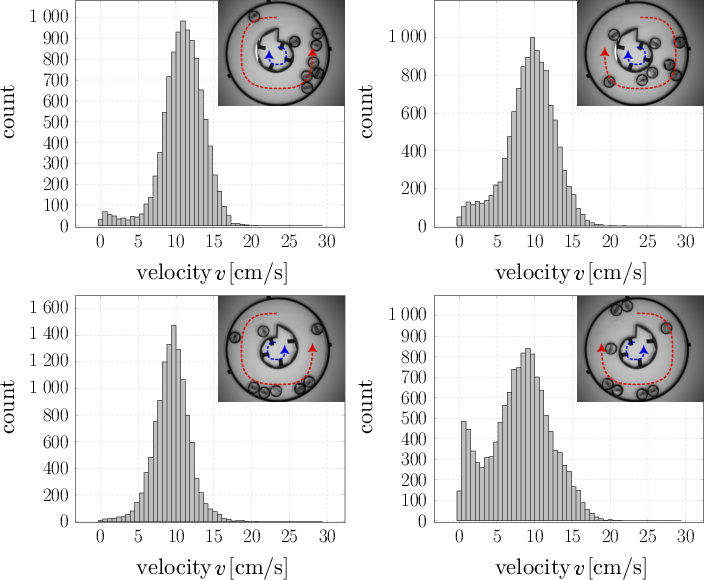
Figure 4: Four environmental/particle chirality scenarios—demonstrating that transport and jamming are governed by the interplay of intrinsic and extrinsic handedness.
This demonstrates a strong claim: transport rectification arises from the mutual interaction of environmental and particle chirality, rather than from pure geometric asymmetry, highlighting an entropic enhancement of directionality unattainable in achiral or non-aligning active systems.
Collective Dynamics Under Rigid Constraints
Extending the experimental paradigm, small groups of particles are rigidly connected in an equilateral triangle via printed linkages, transforming the system into a minimal "active solid." The assembly exhibits spontaneous mode-switching between collective translation and rotation: translational epochs correspond to fixed orientation and high center-of-mass speed, while rotational epochs are marked by rapid angle variation and suppressed translation. Critically, the intrinsic particle chirality is decoupled from collective motility due to geometric constraints, indicating that the phase space structure is governed primarily by the imposed connectivity rather than the single-particle torque.
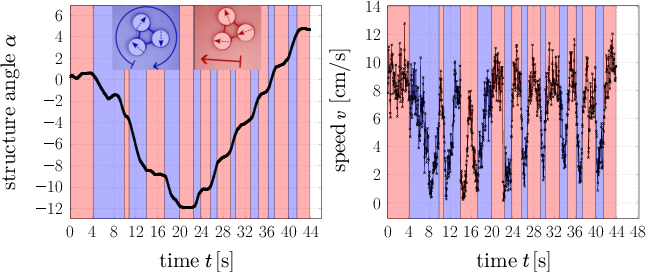
Figure 5: Time series illustrating bistable transitions between translational and rotational states in a triangular assembly, quantitatively linked to the underlying phase-space structure.
Theoretical Implications and Prospects for Active Matter Design
The work demonstrates that environmental geometry and active particle design can be tightly coupled to realize externally programmable, passively controllable active matter systems. The results validate theoretical predictions on chirality-induced edge currents, transport rectification via geometric ratchets, and collective phase-space bottlenecks. The experimental platform is sufficiently general to permit direct mapping onto kinetic theory models, as all relevant dynamical parameters are experimentally measurable and design-tunable.
Practical implications include the potential for chirality-based sorting and filtering in microfluidic or robotic swarm contexts, leveraging the entropic and dynamical differentiation fostered by geometric–dynamical interplay. The realization of rigidly constrained "active solids" suggests a foundation for engineering adaptive motile structures with switchable zero-modes, directly relevant to the design of autonomous materials that exploit collective phase transitions.
Scaling up the system to higher density or richer connectivities may yield emergent phases—active turbulence, large-scale patterning, or oscillatory motility—where chirality and dynamic alignment serve as control parameters for emergent functionality.
Conclusion
This study provides an experimental and analytical framework for the passive, geometric control of chiral, self-aligning active matter. By tuning both intrinsic particle properties and environmental geometry, the platform achieves programmable transport, direction-selective ratcheting, and the physical realization of topological mode-switching in small collectives. The findings underscore the central role of chirality and structural memory in active matter, highlighting new avenues for the rational design of programmable, adaptive active materials and micro-robotic systems.