- The paper demonstrates that non-reciprocity in active solids underpins odd elasticity and emergent collective behaviors.
- It employs non-equilibrium statistical mechanics and symmetry breaking to differentiate between design, programming, and real-time control.
- It argues that incorporating learning mechanisms paves the way for materials that autonomously adapt and evolve their functionalities.
From Active to Odd to Smart Matter: A Technical Synthesis
Introduction
The paper "From Active to Odd to Smart Matter" (2607.06051) establishes a unified conceptual trajectory organizing the evolution of condensed matter systems from active matter (far-from-equilibrium assemblies exhibiting collective behavior due to persistent microscopic energy injection) to emergent classes of programmable and learning matter—termed “smart matter.” The perspective structure is anchored along two axes: the classic gas–liquid–solid sequence and a continuum from spontaneous to task-driven, learned functionality. The author systematically identifies the roles of non-reciprocity, programmability, adaptability, and learning in extending the theoretical scope and technological relevance of collective matter.
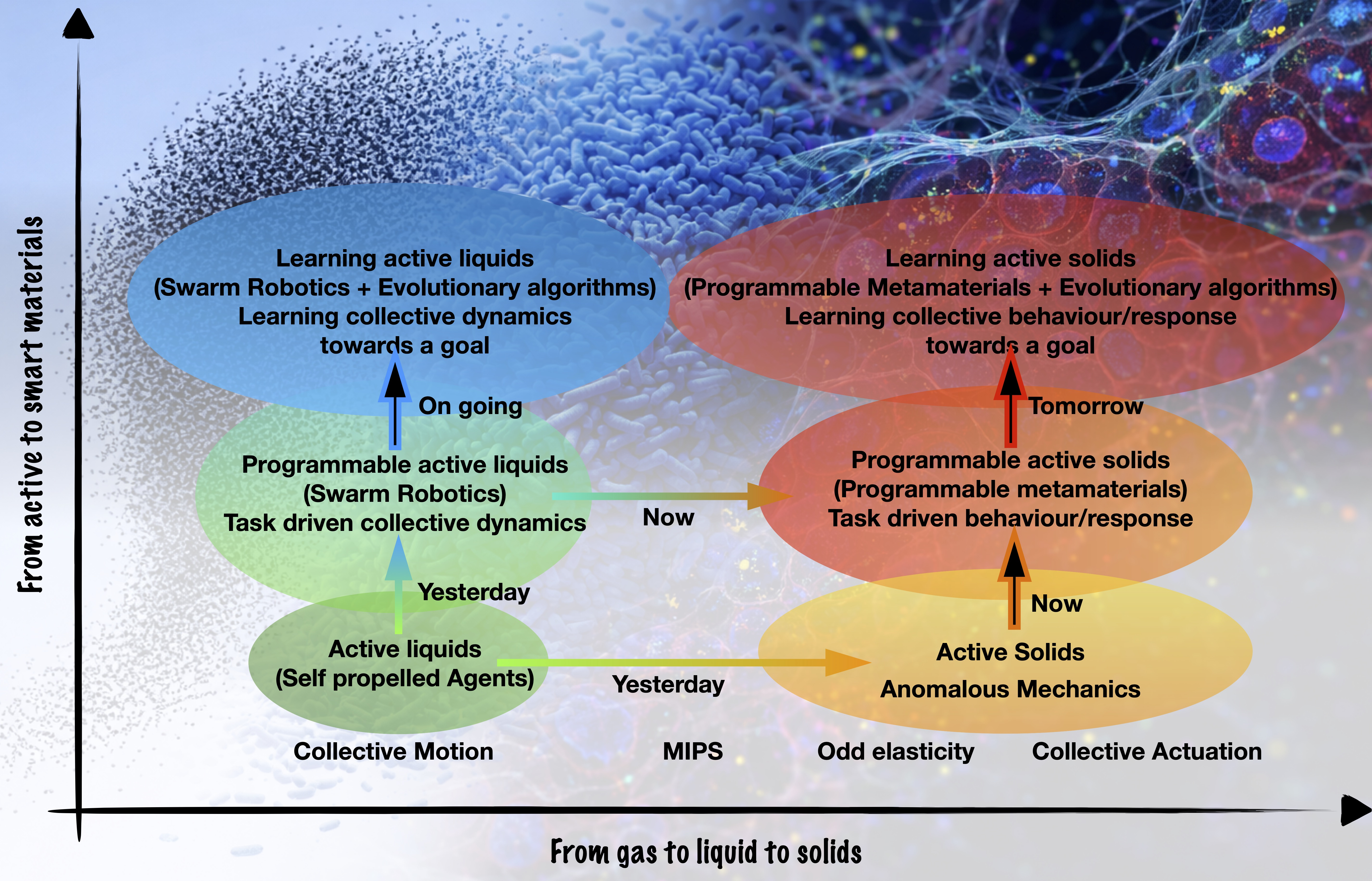
Figure 1: Conceptual map from active to smart matter along material phase and functional axes.
Active Matter: Beyond Equilibrium Paradigms
Active matter's defining feature is persistent local energy consumption resulting in macroscopic order that cannot be captured by equilibrium thermodynamics or free-energy landscapes. Early models, such as the Vicsek and Toner-Tu flocking frameworks, established that collective phenomena like flocking transitions and motility-induced phase separation (MIPS) are generic consequences of symmetry-allowed, activity-driven terms that violate time-reversal invariance.
Attempts to characterize active matter using equilibrium concepts (e.g., effective temperature) have proved analytically limited due to non-conservative driving and irreversible dissipative currents. Instead, the focus has shifted to detailed non-equilibrium statistical mechanics, e.g., entropy production and emergent steady states, refining our understanding of irreversibility and thermodynamic consistency in active systems.
The Emergence of Active Solids and Odd Elasticity
Active solids represent a progression where energy-consuming microstates yield not only collective motion but also collective actuation within rigid, load-bearing settings. Two convergent theoretical branches are highlighted:
- Microscopic origin via self-alignment: Nonreciprocal coupling of orientation and displacement enables embedded polar agents to generate coherent stresses, select elastic modes, and exhibit macroscopic oscillatory behavior (Figure 2, left).
- Abstract symmetry and odd elasticity: The presence of nonreciprocal (antisymmetric) components in the constitutive elastic tensor enables conversion of cyclic deformations into work—phenomena forbidden at equilibrium but natural once time-reversal symmetry is broken (Figure 2, right).
These approaches converge at the realization that self-alignment generically induces nonreciprocity at the coarse-grained level, providing the microscopic underpinning of odd elasticity. Experimental realization at the macro-scale remains an open challenge.
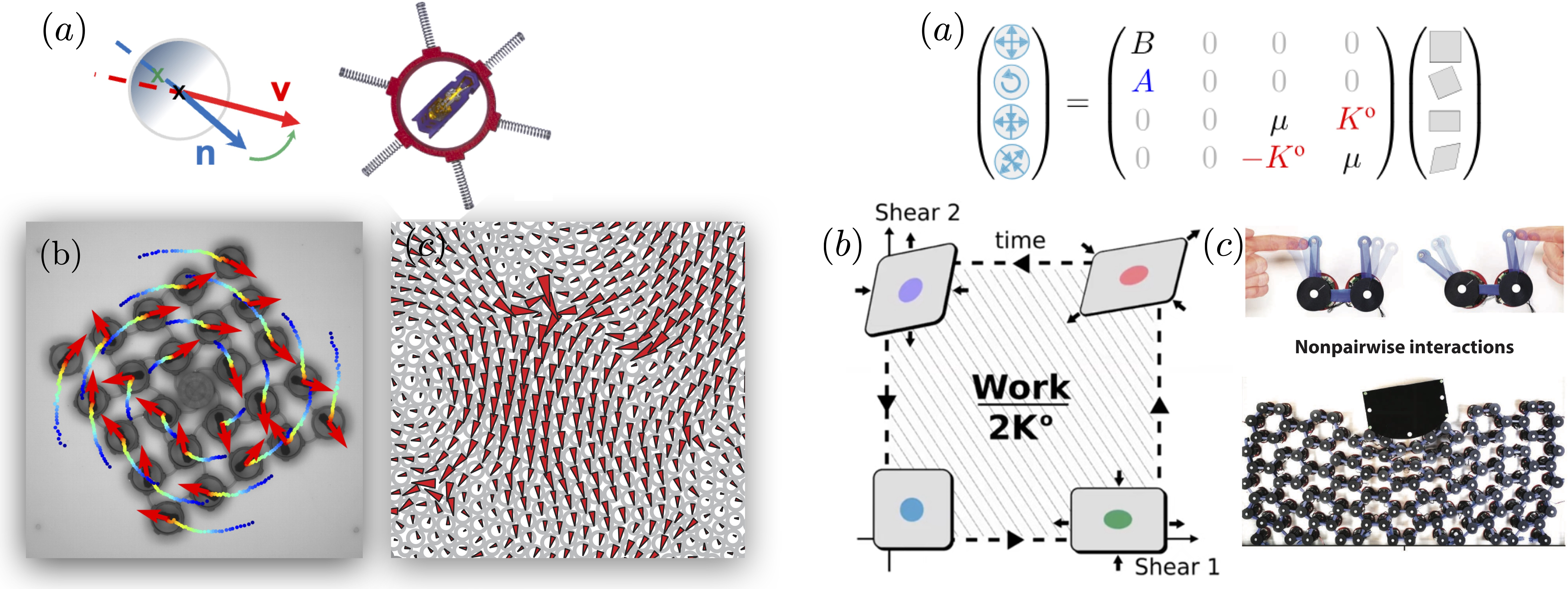
Figure 2: Schematic of nonreciprocity in active solids, from self-alignment to engineered odd elasticity.
Programmable Matter: Distinguishing Design, Programming, and Control
The trajectory toward smart matter requires distinguishing between different strategies for imparting and steering function:
- Design: Encodes target behaviors in fixed material structure or local rules (e.g., architected metamaterials for prescribed mechanical response).
- Programming: Imposes conditional, externally specified rules (e.g., state machines, lookup tables) that enable multiple functions for the same substrate, but are immutable at runtime.
- Control and Feedback: Real-time, possibly decentralized adjustment of system parameters based on external or internal monitoring; feedback can stabilize or regulate but—absent adaptive modification—does not constitute learning.
The demarcation between these regimes is essential for the conceptualization and synthesis of genuinely adaptive systems. The lack of autonomous generation or real-time modification of rules in these strategies is noted as the threshold to be crossed for the realization of smart matter.
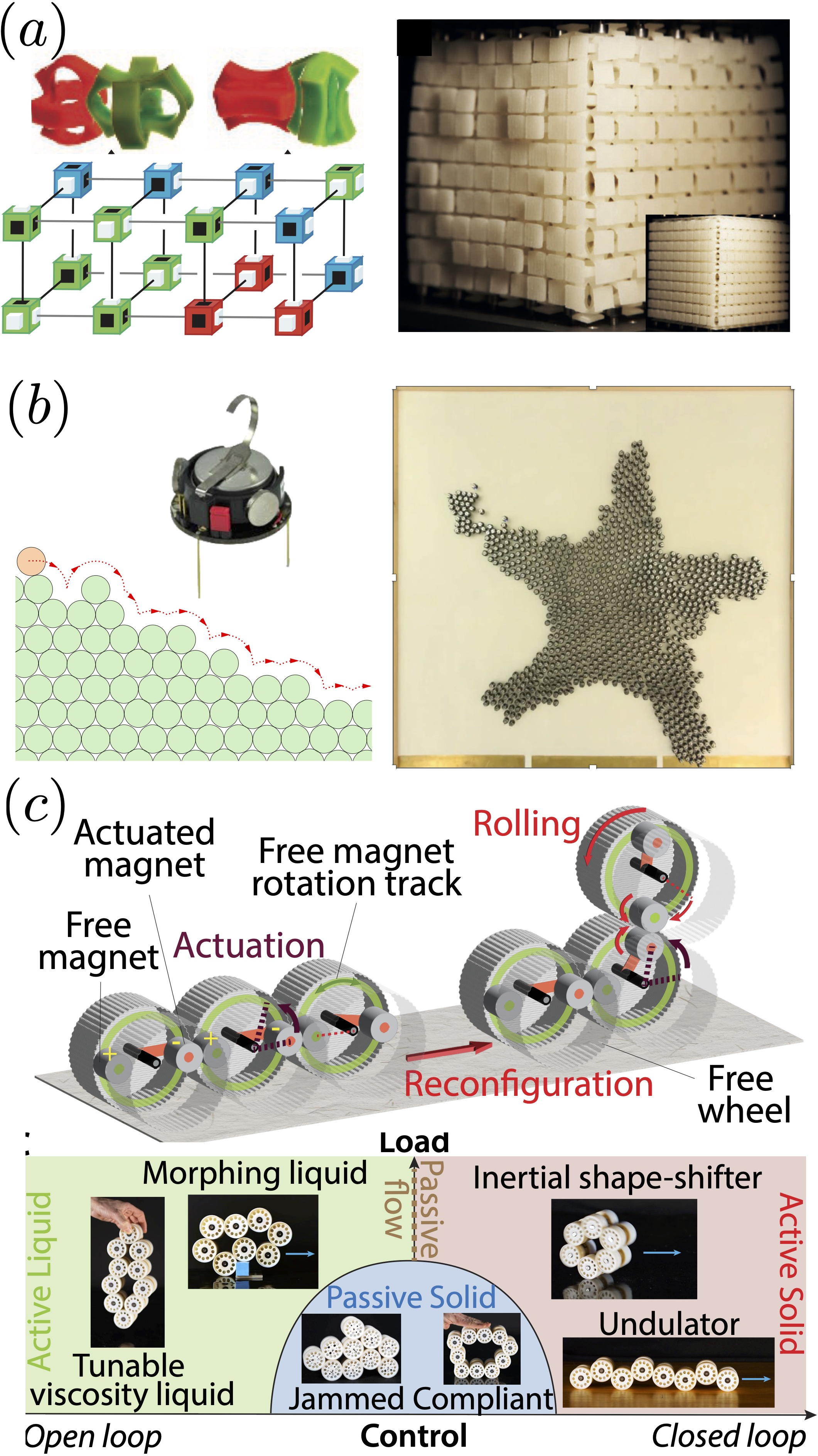
Figure 3: Hierarchy from combinatorial design and programming through controlled/feedback-based adaptation in programmable active matter.
Learning Matter: Architecture and Mechanisms
A central thesis is that learning, rather than externally specified control, provides a natural and physically grounded route to robust, high-dimensional adaptation in non-equilibrium materials. Learning matter is analyzed along three technical axes:
- Substrate: Ranging from physical learning (direct adaptation of material or constitutive parameters, e.g., adaptive spring networks, mechanically trained structures) to logical learning (algorithmic modification of control or policies housed on programmable/robotic agents).
- Learning Mode: Incorporating supervised (error signal-driven), unsupervised (self-organization via internal correlations), and reinforcement (performance-optimized exploration without detailed labels) paradigms. Reinforcement learning is emphasized for materials where direct optimization based on scalar reward landscapes is feasible.
- Locus: Individual versus social learning, the latter involving propagation, averaging, or evolutionary selection of policies—raising statistical physics problems involving robustness, noise, and distributed memory.
This organizational framework stresses that in “learning matter” the equations governing collective behavior themselves become dynamical state variables subject to adaptation. This breaks the time-translation invariance inherent in traditional statistical mechanical models.
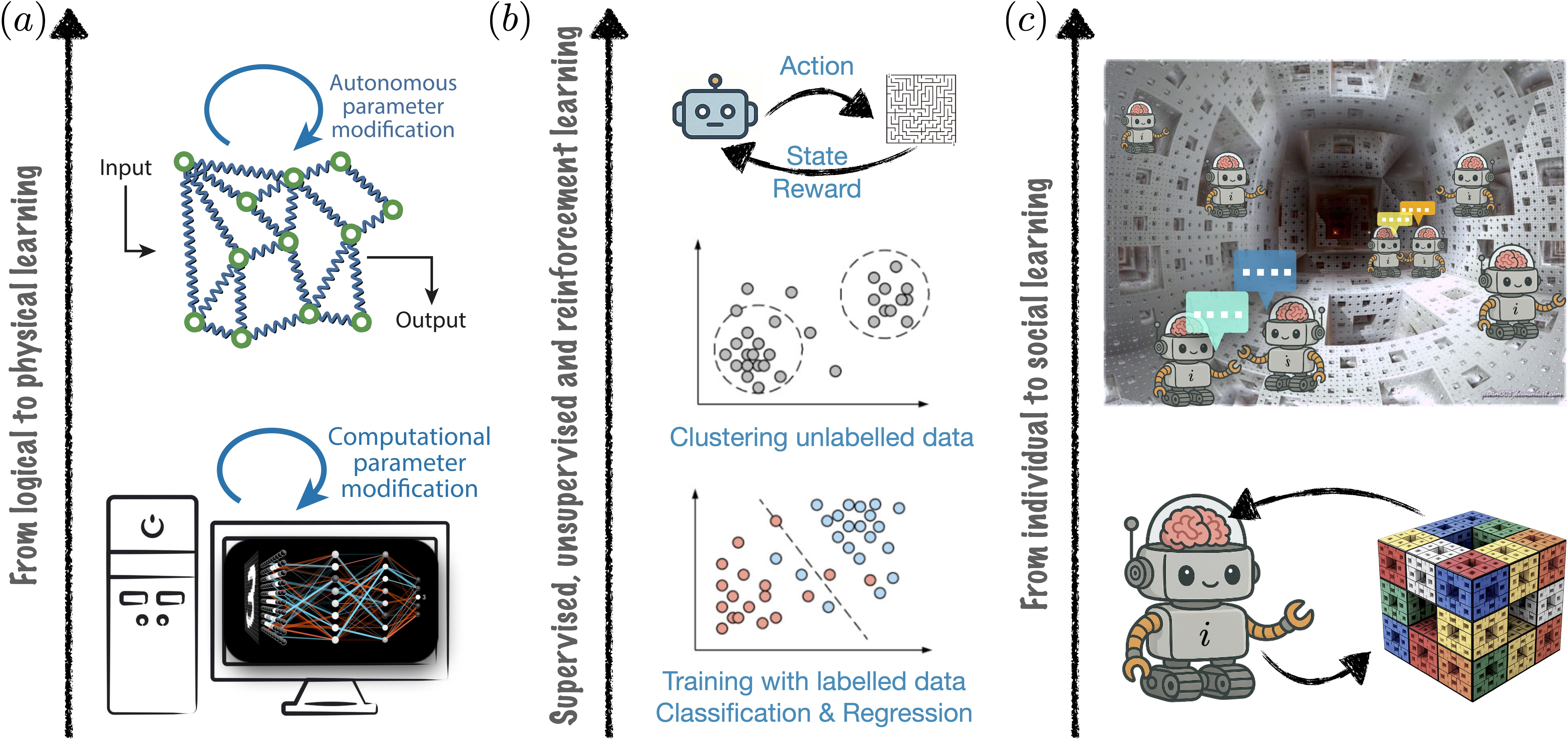
Figure 4: Organizational axes of learning matter—substrate, mode, locus—delineating adaptive physical systems.
Implications and Future Questions
The perspective underscores that as active matter systems scale in complexity, central or even decentralized control is likely intractable due to high-dimensional phase spaces, emergent attractors, and incomplete microscopic information. Learning—at both the physical and logical level—becomes superior in such settings by distributing computation, memory, and rule adaptation within the material itself.
Open questions include:
- The theoretical interplay of learning dynamics and non-equilibrium statistical physics, including entropy production, coarse-graining protocols, and emergent universality classes.
- The extent to which “learning matter” can autonomously generate new functionalities, adapt to changing targets, or even participate in forms of material evolution.
The emergence of learning matter motivates potentially radical reconsideration of design and synthesis strategies; instead of specifying function in advance, materials can be designed to adapt and discover optimal collective behaviors through interaction with their environment.
Conclusion
"From Active to Odd to Smart Matter" constructs a rigorous conceptual framework linking nonequilibrium statistical physics, symmetry breaking, programmability, and learning for the study and synthesis of adaptive physical systems. By precisely delineating the boundaries between design, programming, control, and learning, and organizing learning matter along physically and algorithmically salient axes, the paper provides a technical roadmap for future research into materials that are not only active and responsive but capable of self-modification and autonomous functional discovery (2607.06051). The emergence of learning as a distinct form of physical adaptation holds foundational implications for soft materials, robotics, and the physics of distributed high-dimensional systems.