- The paper demonstrates a unifying framework with MASBots to experimentally control nonreciprocal phases, including odd elastic solids, odd viscous liquids, and parity-violating active gases.
- It reveals sharp phase transitions driven by tuning magnetic repulsion and hydrodynamic attraction, providing clear signatures through oscillatory strain waves and altered transport dynamics.
- The methodology offers insights into designing robotic materials with emergent functions, bridging advanced swarm engineering with nonequilibrium statistical mechanics.
Multiphase Odd Robotic Active Matter: Experimental Framework, Mechanisms, and Tunability
Introduction
The study "Three phases of odd robotic active matter" (2603.09897) establishes a unifying experimental platform for the realization and control of nonreciprocal phases in macroscopic active matter. Through the design of Magnetomechanically Augmented Spinning roBotic (MASBot) collectives, the work bridges odd elasticity, odd viscosity, and active vortex gas phases via direct symmetry manipulation at the particle level. This enables systematic exploration of phase transitions, odd mechanical responses, and programmable emergent states in active matter by fine-tuning interactions often inaccessible in natural or classical synthetic analogs.
MASBot Architecture and Self-Organization
The MASBot is engineered as a floating cylindrical robot actuated by a submerged propeller capable of inducing axial spinning (chirality), paired with magnetically tuned repulsive interactions and optional polar symmetry breaking (e.g., through a flow-directing slat). This configuration allows for independent control over rotation, hydrodynamic attraction, transverse nonreciprocal forcing, and repulsion strength between particles.
MASBots recapitulate essential features of microscopic biological chiral crystals such as those formed by starfish embryos, but at centimeter scale and inertial Reynolds number Re∼4000, yielding robust, highly tunable, and easily visualized collective phenomena. The collective can readily transition between hexagonally ordered clusters, fluidized ensembles, and dilute, self-attracting gases with strong parity violation.
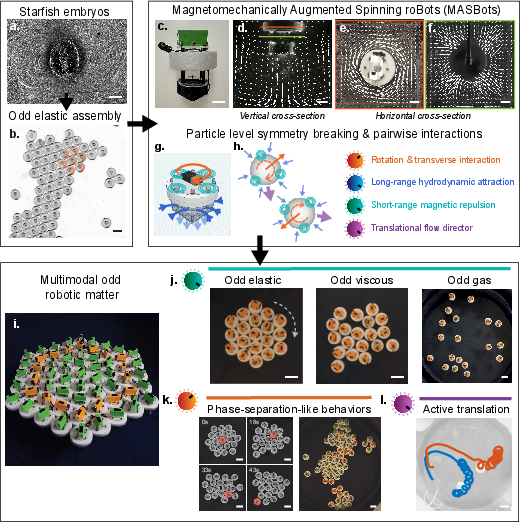
Figure 1: MASBot design: from bioinspired chiral assembly to tunable collective phases achieved by modulating hydrodynamics, magnetism, and symmetry breaking at the robot level.
Experimental Phase Diagram: Solid, Liquid, and Chiral Active Gas
By systematically increasing the strength of magnetic repulsion relative to hydrodynamic attraction, MASBot collectives undergo sharp transitions across three nonreciprocal phases:
- Odd Elastic Solid: At minimal repulsion, MASBots self-assemble into a rigid, chiral hexagonal lattice. Wave-like oscillatory pairwise displacements (MSPD) indicate collective strain waves and are signatures of nonreciprocal (odd) elasticity.
- Odd Viscous Liquid: With intermediate repulsion, the system fluidizes, maintaining local hexagonal order but allowing for enhanced structural fluctuations and superdiffusive dynamics. Parity-violating boundary wave spectra and hydrodynamic stress correlations reveal a strong odd viscous response.
- Parity-Violating Active Gas: At strong repulsion, MASBots form a dilute, non-space-filling gas stabilized by long-range hydrodynamic attraction. The system displays ballistic transport, loss of orientational order (vanishing ψ6), and a power-law radial distribution g(r)∼r−1, matching the statistics of a 2D self-gravitating point vortex gas.
These experimental regimes are quantitatively recapitulated by coarse-grained inertial simulations incorporating the relevant interaction modes.
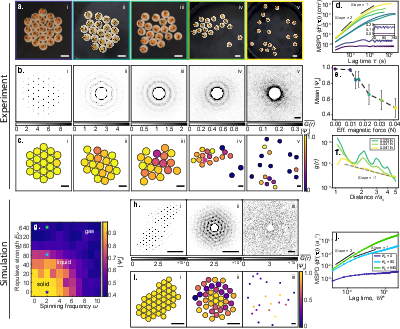
Figure 2: Phase transitions in MASBot collectives, with structural and dynamical order parameters tracking solid, liquid, and gas states as a function of magnetic repulsion.
Characterization of Odd Hydrodynamics and Parity Violation
Odd stresses and nonreciprocal forces are directly measured at the two-body and collective levels. Two-body scattering experiments evidence strong chirality-induced parity violation in angular deflection distributions. Temporal velocity autocorrelations, C(τ), break time-reversal and parity symmetry individually, but remain PT-symmetric, confirming the theoretical expectation for nonreciprocal chiral fluids.
Separation-conditioned velocity fields and spectral analyses of collective boundary fluctuations further quantify the extent of parity violation and the frequency dependence of hydrodynamically mediated odd flows. These phenomena persist into the dilute chiral active gas, marking the first experimental realization of a parity-violating, inertial, self-attracting active gas phase.
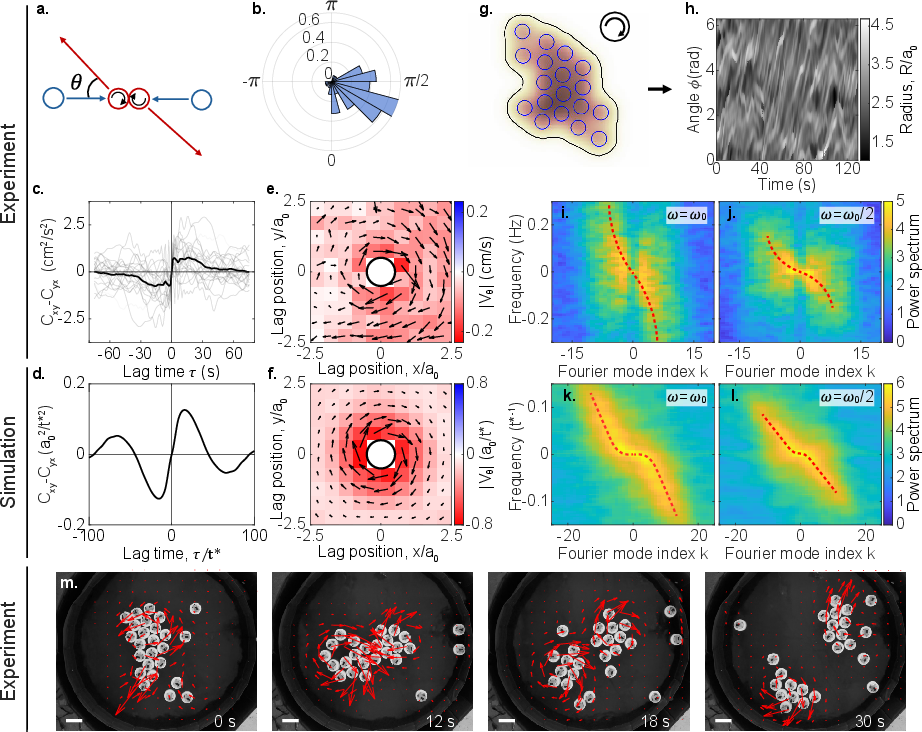
Figure 3: Quantification of odd viscosity and parity violation: two-body collisions, chiral velocity correlations, and frequency-asymmetric spectral power in both experiment and simulation.
Odd Elasticity: Strain Waves and Mode Coupling
In the odd elastic solid regime, MASBots exhibit robust, spontaneously propagating strain waves across all principal deformation modes (dilation, rotation, and two orthogonal shears). Space-time kymographs reveal chiral, unidirectional propagation at the cluster boundary. Statistical analysis of trajectory-derived strain cycles shows closed, handed loops, indicative of continuous energy cycling between modes—a hallmark of odd elasticity.
Programmable tuning of the MASBot lattice (e.g., through layered spinning frequencies or custom magnet placement) generates secondary peaks in the strain-wave spectra, enabling control over the excitation of specific vibrational modes and the overall chirality content of the solid.
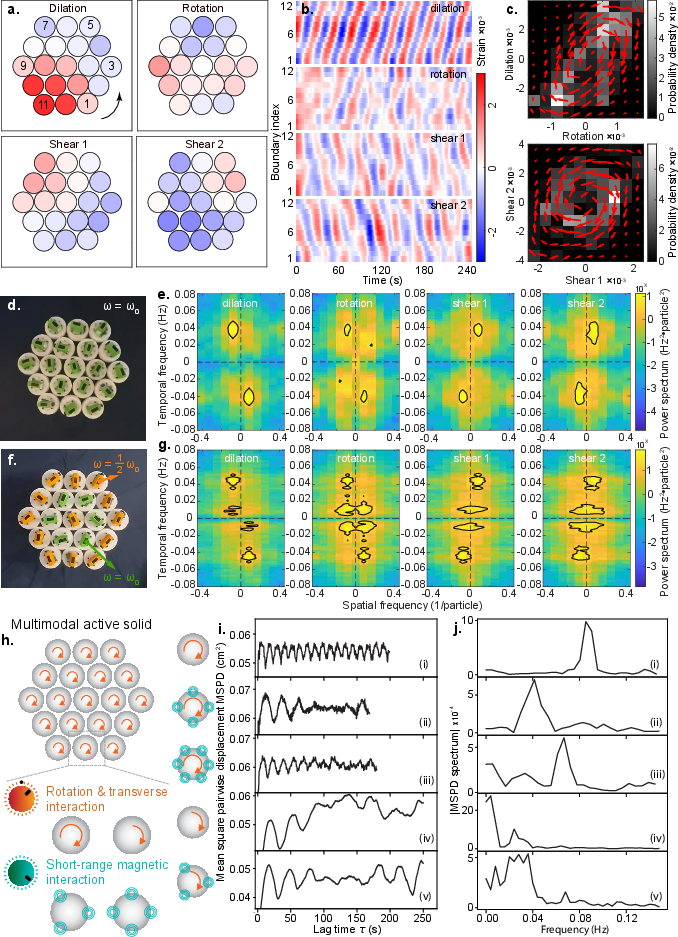
Figure 4: Strain field decomposition and programmable spectral features of the odd elastic solid; space-time maps and power spectra demonstrate handed strain cycling and mode selectivity.
Programmable Symmetry Breaking and Emergent Interaction Modes
The MASBot platform affords additional control via engineered symmetry-breaking:
- Hydrodynamic Attraction + Chirality: Pairs of MASBots exhibit orbital motion, with non-classical, nonlinear oscillatory dynamics emergent under shallow water constraints.
- Polar Symmetry Breaking: Attaching a flow-directing slat induces helical, self-propelled trajectories and neighbor alignment, driving the collective toward structured, topologically nontrivial assemblies (e.g., +1 defects).
- Chirality Diversity: Oppositely spinning pairs produce net directed motion, while frequency mismatches and polarity differences enable escape and defect dynamics within a collective.
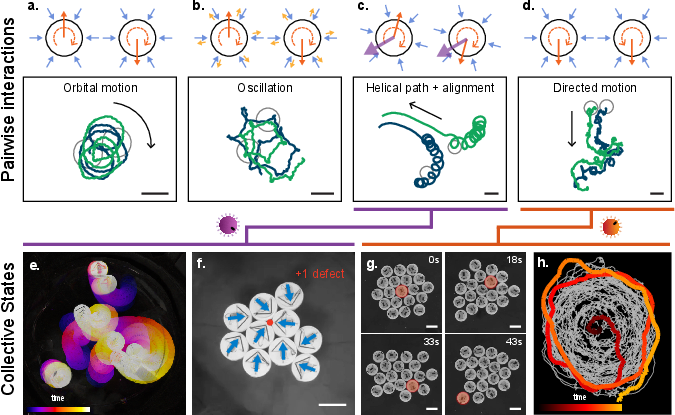
Figure 5: Demonstration of tunable interaction rules: orbital pairing, self-propulsion, chirality-induced translation, and collective reconfiguration via engineered symmetry breaking.
Implications and Prospects
By unifying previously disparate odd matter regimes (odd elasticity, odd viscosity, and nonreciprocal chiral active gases) in a single, experimentally accessible and highly tunable macroscopic model, MASBots provide a versatile arena for exploring the fundamental physics of nonreciprocal many-body systems. The precise control over symmetry, activity, and interaction character, unattainable in most natural systems, enables systematic study of emergent functionality, topological defect dynamics, and phase-separated behaviors.
From a robotics viewpoint, this approach challenges the paradigm of centralized or sensor-mediated control in swarm systems. Instead, MASBots capitalize on physical nonreciprocity and engineered interaction rules, pointing toward realizable "robotic materials" with emergent resilience, adaptive reconfiguration, and programmable collective functions. Moreover, the platform sets the stage for advanced control protocols leveraging sparse actuation and automatic feedback, linking statistical mechanics with swarm engineering.
Conclusion
"Three phases of odd robotic active matter" (2603.09897) details a synthetic, macroscopic testbed that unifies odd elasticity, odd viscosity, and chiral active gas phases through systematic, programmable tuning of symmetry and interaction at the elemental robot level. The work establishes the MASBot collective as a canonical system for investigating and exploiting the physics of nonreciprocal active matter, with broad theoretical and applied ramifications for materials science, soft robotics, and nonequilibrium statistical mechanics.