- The paper introduces coil-fem, a novel framework integrating differentiable FEA and automatic differentiation for simultaneous optimization of coil geometries and support clamp placements.
- It achieves a 2.4× reduction in RMS von Mises stress and displacement by jointly optimizing mechanical loads along with magnetic field constraints.
- Benchmarking reveals near machine-precision accuracy and significant GPU-accelerated speedups, enabling efficient gradient-based optimization in stellarator design.
Joint Optimization of Stellarator Coils and Support Structures: A Technical Analysis of coil-fem
Introduction
The challenging three-dimensional (3D) geometry of stellarator fusion devices demands both precise magnetic field shaping and robust structural integrity. Traditional design workflows in stellarator engineering sequentially optimize coil geometries for magnetic field quality, deferring the placement and sizing of mechanical supports to a labor-intensive, iterative post-processing step. Such processes often rely on closed-source finite element analysis (FEA) software and limit the ability to conduct holistic optimizations that jointly consider stress, deformation, and field error.
"Towards joint optimization of stellarator coils and support structures" (2607.05749) introduces coil-fem, the first open-source, fully differentiable FEA framework for performing integrated optimization of stellarator coil geometries and cage-type support clamp locations. The methodology leverages automatic differentiation (AD) through the entire coil optimization loop, implemented with JAX-FEM, and establishes a flexible platform suitable for gradient-based optimization.
Technical Framework
coil-fem addresses the linear elasticity problem on coil meshes derived from sweeping rectangular cross-sections along parameterized centerlines. The governing equations consist of a standard linear elasticity balance
∇⋅σ(u)+Fbody=0,in Ω,
supplemented by a spring foundation (Robin-type) boundary condition that emulates discrete support clamps:
σ(u)n=−k(x)u,on ∂Ω.
Here, k(x) is constructed as a sum of analytic sigmoid functions, each centered at the parametric location of a support clamp; these locations are themselves treated as optimization variables.
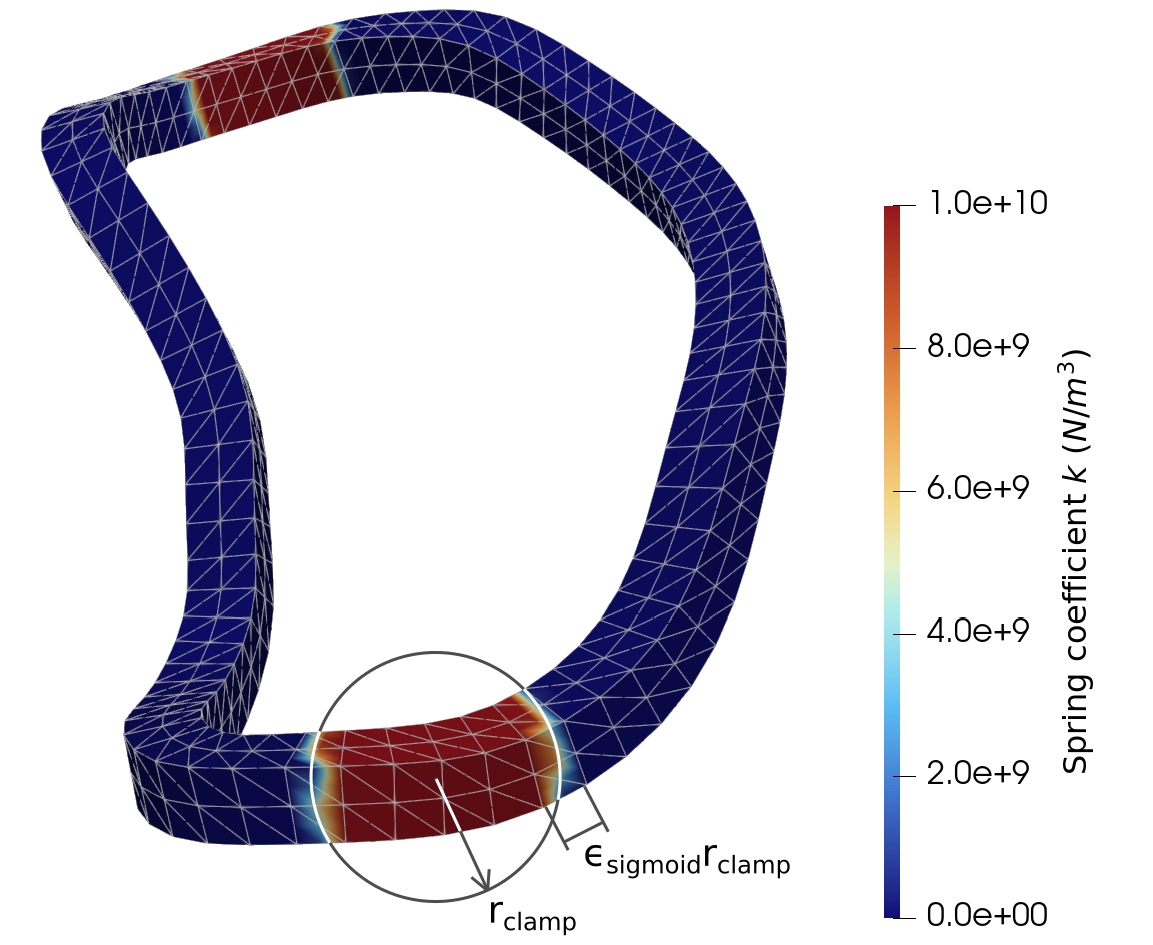
Figure 2: Spring coefficient function k(x,ϕi) that emulates two support clamps on the top and bottom of a W7-X coil.
The volumetric force term Fbody incorporates gravitational effects, as well as Lorentz forces arising from both self and mutual coil fields, with efficient reductions enabled by the Landreman-Hurwitz formalism for rectangular cross-sections.
Physical modeling assumptions include linear isotropic elasticity, uniform properties, and a "cage-type" support structure where clamps exhibit high stiffness but flexible locations (Dirichlet BC is approximated in a manner compatible with AD). Meshing strategies enforce consistent mesh topology to facilitate differentiability, while the coil geometry and support variables are parameterized and represented with Fourier expansions and parametric angles, respectively.
Numerical Benchmarking and Validation
coil-fem's accuracy is benchmarked against DOLFINx, a well-established Python FEA framework. Results show near machine-precision agreement (errors <10−8) with DOLFINx when using identical physical and mesh assumptions, and sub-5% error when approximating magnetic forces with the analytic proxy. The benchmarking covers von Mises stress and nodal displacements.
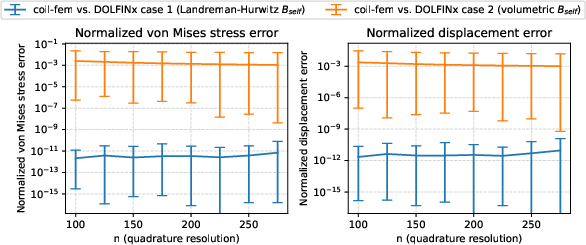
Figure 4: The point-wise error in von Mises stress and displacement between coil-fem and DOLFINx, normalized by means.
Convergence studies as a function of spatial discretization confirm robust agreement for both primary mechanical metrics (von Mises stress, displacement) across solvers.
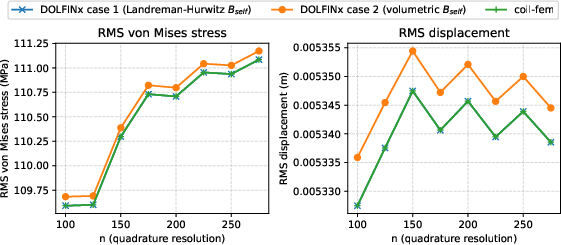
Figure 1: RMS von Mises stress and displacements from coil-fem and DOLFINx, indicating convergence across simulation settings.
A notable computational achievement is the full GPU acceleration of coil-fem. Profiling demonstrates orders-of-magnitude speedup versus CPU-based solvers, making large gradient-based optimization campaigns practical.
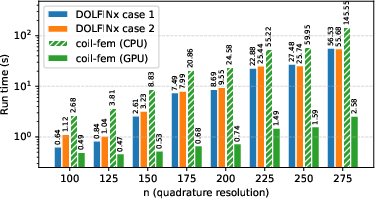
Figure 3: Forward-solve time of coil-fem and DOLFINx; coil-fem on GPU achieves significantly reduced run time.
Joint Coil and Support Clamp Optimization
A compositional penalty function is introduced, incorporating field error, von Mises stress, geometric complexity, and constraint terms common in the stellarator literature. The key innovation is the inclusion of mechanical load objectives based on differentiable FEA outputs. Four distinct cases are evaluated:
- Case A: Clamp location optimization only (fixed coil geometry).
- Case B: Coil geometry optimization only (fixed clamps).
- Case C: Simultaneous optimization of coil geometry and clamp locations.
- Case D: Conventional (non-FEA) optimization of coil geometry targeting only force proxies.
Critical results include:
- Cases with optimized clamp locations (A, C) realize more than a twofold reduction in RMS von Mises stress compared to baseline or force-only optimized designs (B, D).
- Case C achieves a 2.4× reduction in both RMS von Mises stress and displacement with minimal compromise in magnetic field error, demonstrating a fundamental advantage of joint optimization.
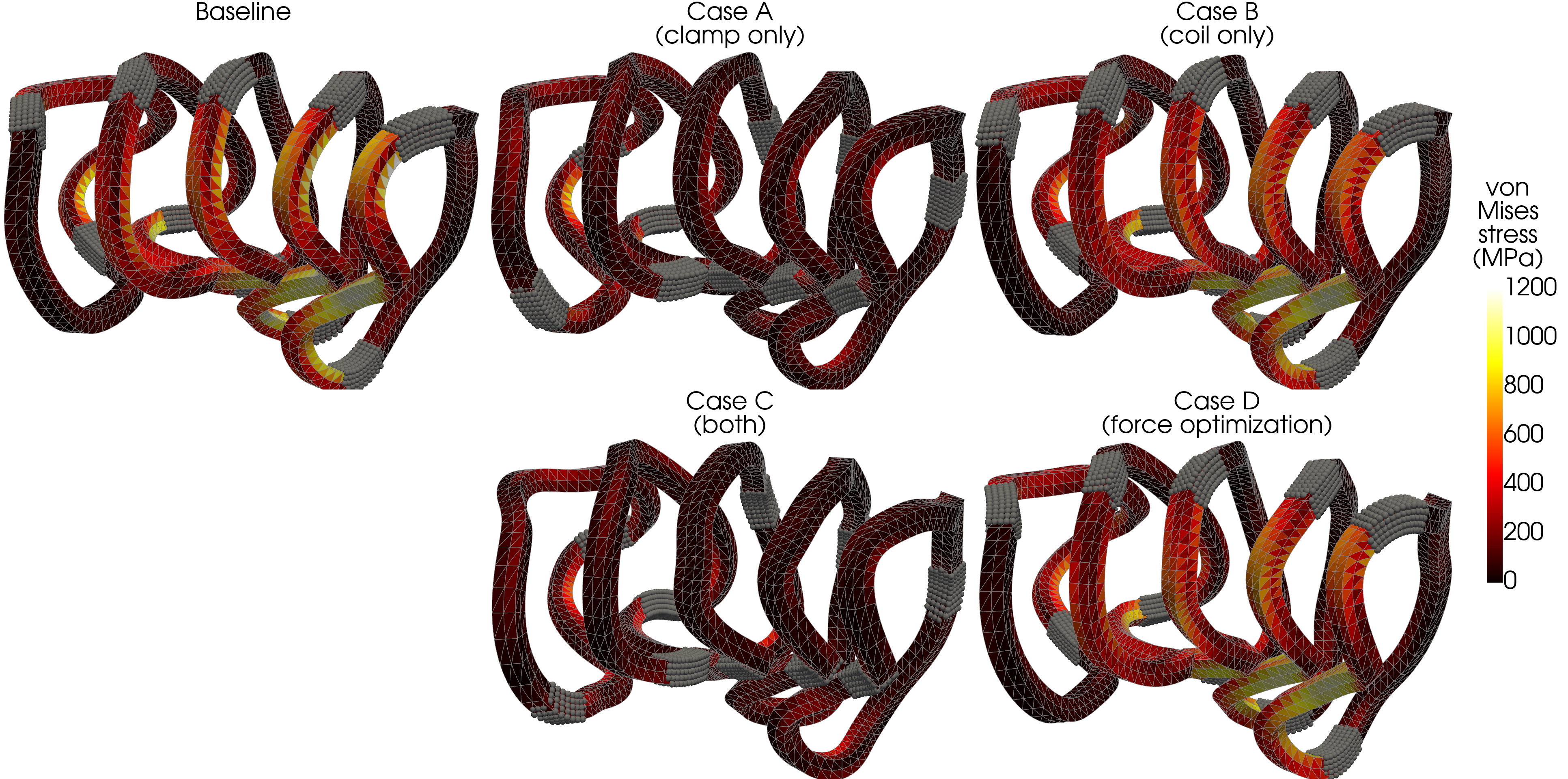
Figure 5: Comparison of von Mises stress and support clamp locations across all cases; optimized clamp placement yields lower stress concentrations and improved metrics.
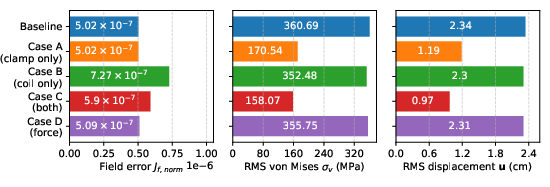
Figure 6: Global metrics for all configurations; clamp placement has a pronounced effect on von Mises stress and overall displacement.
A further analysis of stress components reveals Lorentz force density as the dominant mechanical load (exceeding gravitational loads by three orders of magnitude). Thermal contraction effects are non-negligible, introducing up to 17% variation in peak von Mises stress, underscoring their relevance in HTS coil design.
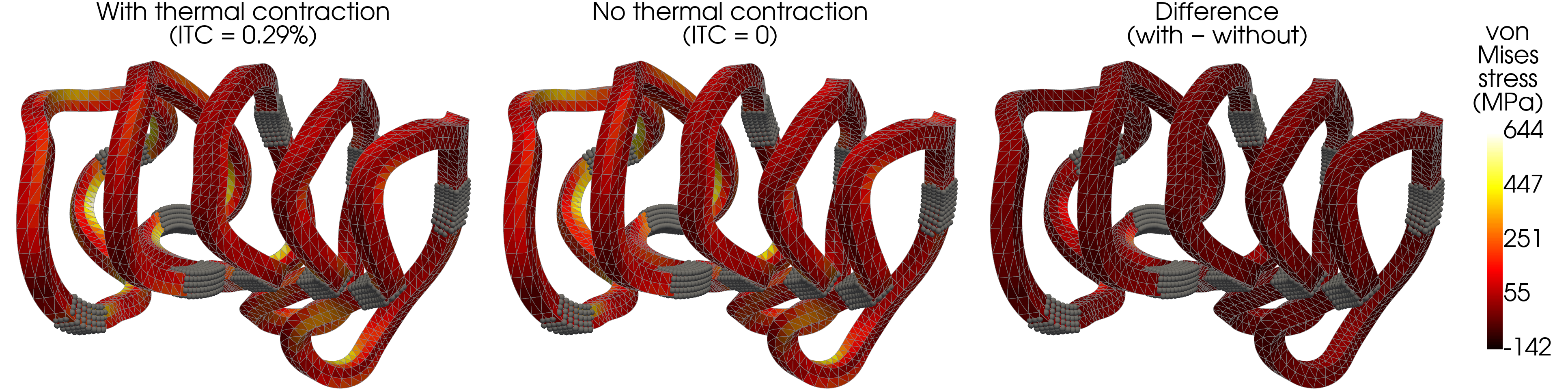
Figure 7: Distribution and differences in von Mises stress for optimized coils with and without thermal contraction; maxima shift by 17%.
Practical and Theoretical Implications
This work demonstrates that support clamp location is a critical and hitherto under-optimized degree of freedom in stellarator coil design, a claim numerically validated by measurable reductions in stress under fixed field error constraints. Existing analytic proxies for coil mechanics lack the expressive capacity to capture support-dependent stress localization informatively.
The differentiable FEA loop, GPU acceleration, and analytic representations of clamp boundary conditions introduced here enable gradient-driven search in a domain previously dominated by heuristic and surrogate approaches. The methodology is extensible to more complex support topologies (e.g., full shell-type supports, anisotropic spring/flexural elements), anisotropic materials, and coupled elastothermo-mechanical optimization. This flexibility opens pathways for:
- Database-driven mechanics proxies: Surrogates, either data-driven or analytic, can be trained on coil-fem simulations to accelerate conceptual designs.
- Direct error field mitigation leveraging mechanical deformations: By feeding deformed coil geometries directly into field optimization, iterative correction for field errors induced by static and dynamic loads is realizable.
- Expanded design space exploration: With support variables in the loop, coil geometry can be co-designed with manufacturing constraints and support accessibility in mind.
Conclusion
coil-fem constitutes a significant technical advance in the integrated optimization of non-planar stellarator coil winding packs and their mechanical supports. By embedding a fully differentiable FEA solver in the optimization workflow and efficiently parameterizing clamp locations, the work establishes a new standard for simultaneous field and structural optimization.
The immediate numerical results highlight the importance of combined coil-support design and enable more efficient, manufacturable, and robust configurations. Future work outlined by the authors—encompassing refined material models, realistic support geometries, and machine learning surrogates—holds the potential to further reduce the gap between high-fidelity numerical optimization and practical stellarator engineering design.