- The paper introduces a versatile hybrid device that explores over 1.66 million magnetic configurations using programmable dipole-field currents.
- It demonstrates optimized QA, QH, and QI stellarator modes and advanced tokamak 3D field control, reducing collisionless α-particle losses to below 1%.
- The study decouples plasma confinement optimization from hardware constraints, paving the way for rapid empirical studies and theoretical refinements in fusion research.
A Programmable Stellarator–Tokamak Hybrid: Million-Scale Magnetic-Configuration Discovery
Introduction
This work introduces a highly flexible magnetic confinement device—the programmable stellarator–tokamak hybrid—capable of accessing a vast range of optimized plasma confinement configurations. Leveraging a fixed set of planar coils and programmable dipole-field currents, the same hardware supports both advanced stellarator and tokamak operating regimes. The platform supports million-scale exploration of magnetic configurations spanning quasi-axisymmetry (QA), quasi-helical symmetry (QH), quasi-isodynamicity (QI), and advanced tokamak 3D field control, providing a separation between hardware design and magnetic-configuration discovery.
Device Architecture and Coil Flexibility
The proposed device augments a conventional tokamak coil set (toroidal field, poloidal field, and central solenoid) with 288 dipole-field (DF) coils. These coils are distributed in a 24×12 toroidal-poloidal grid on a toroidal support structure, with only six unique geometries by virtue of inherent symmetry. High-temperature superconducting (HTS) tape fabrication is adopted to enable large, individually programmable currents.
In stellarator mode, only the TF and DF coils are energized, and 3D shaping is achieved entirely via DF current programming; the PF and CS sets are not required. By appropriately specifying coil currents, the hardware is shown to cover a broad space of magnetic surfaces and topologies. The discrete and symmetric nature of the coil set enables field periodicities of 2, 3, and 4, facilitating access to both traditional and nontraditional stellarator regimes.
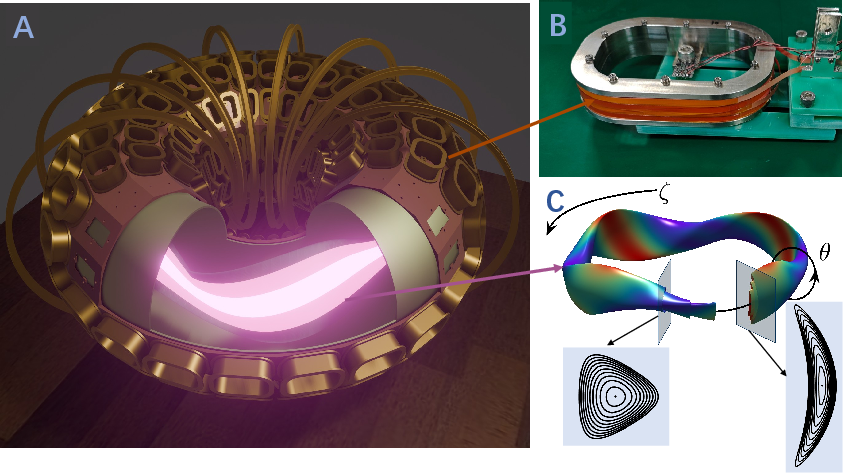
Figure 1: Schematic of the programmable hybrid, HTS dipole-field coil, and nested magnetic surfaces for a representative four-period QH configuration.
Large-Scale Magnetic-Configuration Optimization
Stellarator optimization is conducted in a high-dimensional coil-current space to minimize neoclassical transport and maximize energetic-particle confinement while adhering to engineering constraints. The degrees of freedom correspond to the TF and DF coil currents. The objective leverages symmetry and regularization penalties, targeting QA, QH, or QI, aspect ratio, rotational transform, and current constraints.
Key numerical results include:
- Over 1.66 million optimized stellarator configurations generated and filtered for effective neoclassical transport (ϵeff3/2<10−2) and aspect ratio (Ap<15).
- The QA, QH, and QI databases span a broad range in rotational transform (ιedge) from 0.1 to 1.3.
- For reactor-relevant scaling, collisionless α-particle loss fractions in the optimized four-period QI configuration are suppressed to below 1%, indicating sharp improvements over traditional designs.
- The optimization identifies configurations where inboard-side DF coils bear larger currents, with QH configurations requiring denser deployment of high-current coils.
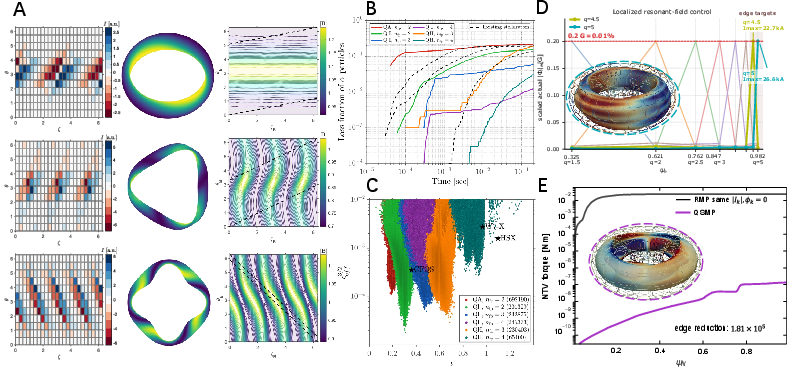
Figure 2: (A) Representative QA, QI, and QH configurations (current profiles, magnetic surfaces, ∣B∣ in Boozer coordinates). (B) α-particle loss fractions for new and existing devices. (C) Distribution of million-scale optimized configurations in ι vs ϵeff3/2. (D) Isolated ϵeff3/2<10−20 resonant field tailoring. (E) Suppression of NTV via QSMP.
Advanced Tokamak 3D Field Control
The same device facilitates systematic studies of non-axisymmetric field control in the tokamak regime. Crucial features include the capacity for highly selective application of 3D resonant fields (e.g., for edge-localized mode control) while minimizing deleterious core responses such as neoclassical toroidal viscosity (NTV).
Strong numerical results are demonstrated:
- Individual ϵeff3/2<10−21 resonant field harmonics can be highly isolated, an ability surpassing present-day tokamak coil sets.
- Application of quasi-symmetric magnetic perturbations (QSMP) enabled by DF currents produces a five-order-of-magnitude reduction in NTV, offering new pathways for decoupled resonant and non-resonant field responses.
These results suggest that the platform can thoroughly test response theories and optimize 3D field-control protocols relevant to devices such as ITER.
Implications and Future Perspectives
The major conceptual advance is in decoupling the plasma-confinement optimization problem from the engineering challenge of coil set modification. Once constructed, the programmable hybrid enables:
- Rapid experimental survey of a vast magnetic-configuration space—from high quality QA/QH/QI stellarators to fully axisymmetric and advanced 3D tokamak states—without hardware changes.
- Empirical exploration of theoretical constructs such as piecewise-omnigenity and quasi-symmetric perturbations, accelerating validation and refinement of modern stellarator theory (Liu et al., 12 Mar 2026), [133.185101].
The architecture’s flexibility may also facilitate access to reversed-field-pinch-like or intermediate toroidal configurations, pending further optimization. Variants of the coil set—adjusting number, geometry, or conductor technology—may be engineered for specific confinement, power, or stability goals.
Notably, the optimized QH and QI configurations realized here are not exact but manifest dominant QH/QI features combined with piecewise-omnigenous (pwO) structure, achieving confinement quality beyond what strictly symmetric fields would admit. This reveals a broader domain of viable, experimentally accessible island-free equilibria than previously recognized.
On a theoretical level, the vast data generated in million-scale configuration sweeps will likely inform machine intelligence approaches to magnetic optimization, topology classification, and transport prediction—potentially yielding further unforeseen optimizations or novel confinement regimes.
Conclusion
The programmable stellarator–tokamak hybrid establishes a technological foundation for high-throughput, hardware-agnostic magnetic-configuration discovery in toroidal confinement systems. Its demonstrated ability to span and optimize across the principal domains of QA, QH, QI, and advanced 3D tokamak control, with strong confinement and low ϵeff3/2<10−22 loss, marks a significant milestone in fusion-research infrastructure. The platform is poised to drive both rapid empirical testing and theoretical refinement of advanced magnetic-confinement concepts.