- The paper presents a generative framework that integrates view-sequential autoregression with a persistent 4D geometric prior to ensure multi-view consistency over extended durations.
- The methodology employs distribution matching distillation with spatio-temporal self-forcing, effectively mitigating exposure bias during training.
- Empirical evaluations demonstrate superior cross-view synchronization and spatial consistency, outperforming baselines on key metrics such as Mat. Pix., RotErr, and TransErr.
MV-Forcing: Long Multi-View Video Generation via 4D-Grounded Spatio-Temporal Self-Forcing
Motivation and Context
The task of generating long, geometrically consistent videos from multiple viewpoints is pivotal for applications in immersive environments, virtual simulations, and video-centric content creation. Despite recent advances, prior paradigms have been constrained by an inability to jointly synchronize temporal and spatial consistency across arbitrary camera trajectories and extensive temporal horizons. Existing methods have either relied on bidirectional attention mechanisms for short multi-view clips or on single-view temporal autoregression for longer videos, with neither achieving scalable multi-view consistency for unbounded durations. MV-Forcing (2607.05376) introduces a generative framework that explicitly composes temporal and view-wise autoregression, grounded by a persistent 4D geometric prior, overcoming the architectural bottlenecks of former approaches.
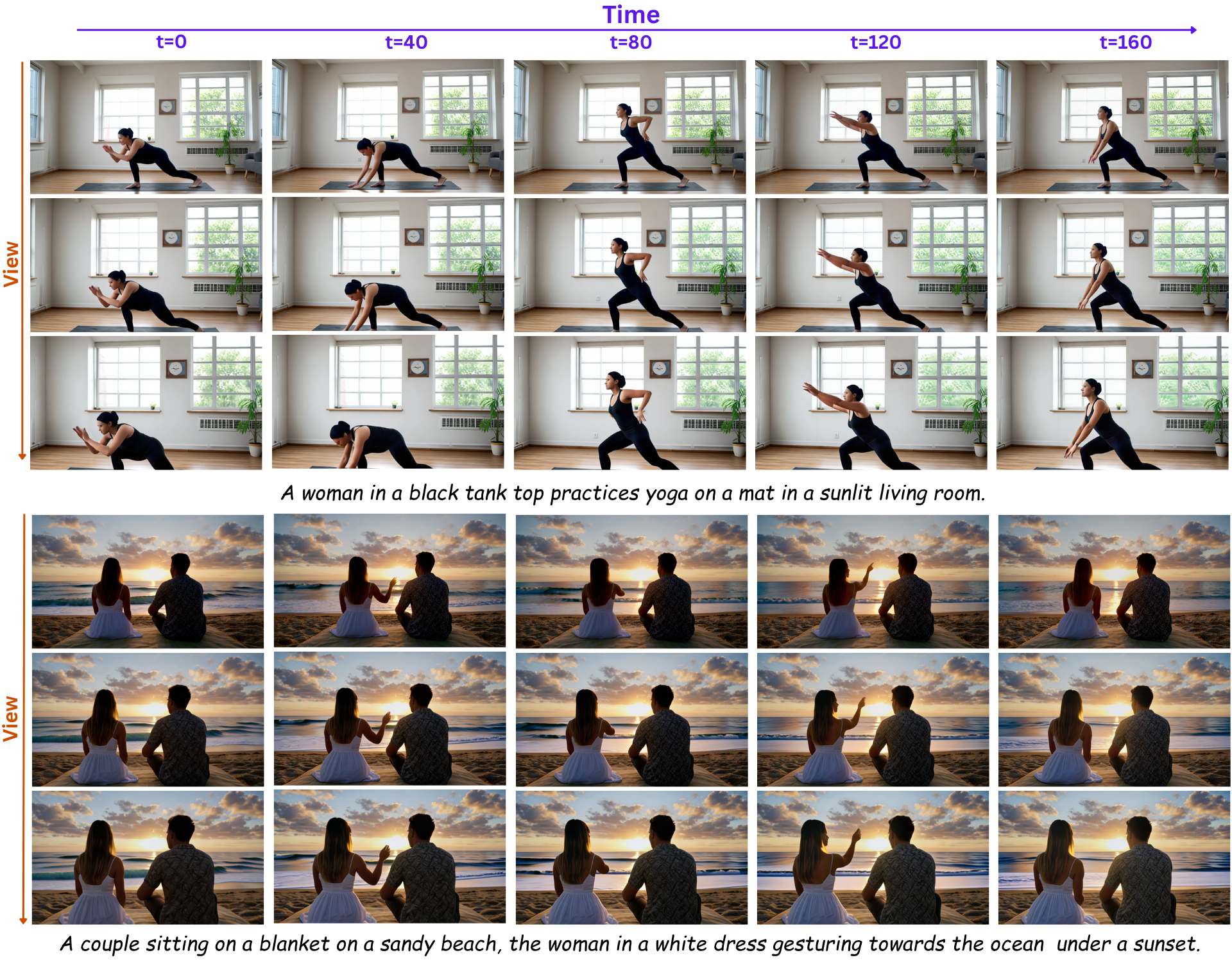
Figure 1: MV-Forcing generates temporally coherent, multi-view videos at arbitrary lengths and viewpoints, maintaining global appearance, motion, and geometry consistency over extensive horizons.
Framework Overview: Spatio-Temporal Self-Forcing and 4D-Grounded Priors
MV-Forcing integrates three core innovations:
- View-Sequential Autoregression: Generation proceeds sequentially across both time and viewpoints, utilizing causal temporal attention and cross-view conditioning.
- 4D-Grounded Geometric Prior: A recurrent feed-forward 3D reconstruction model (CUT3R) maintains a persistent state encoding the accumulated geometric context from all previously generated views/timesteps. Each new viewpoint is conditioned on a geometric prior rendered from this state, ensuring spatial consistency as the view chain grows.
- Distribution Matching Distillation with Spatio-Temporal Self-Forcing: The model is distilled from a bidirectional teacher via an asymmetric DMD loss, unrolling generation along both axes during training. This closes the train-inference exposure bias gap and enables robust generation for arbitrary duration/viewpoint configurations.
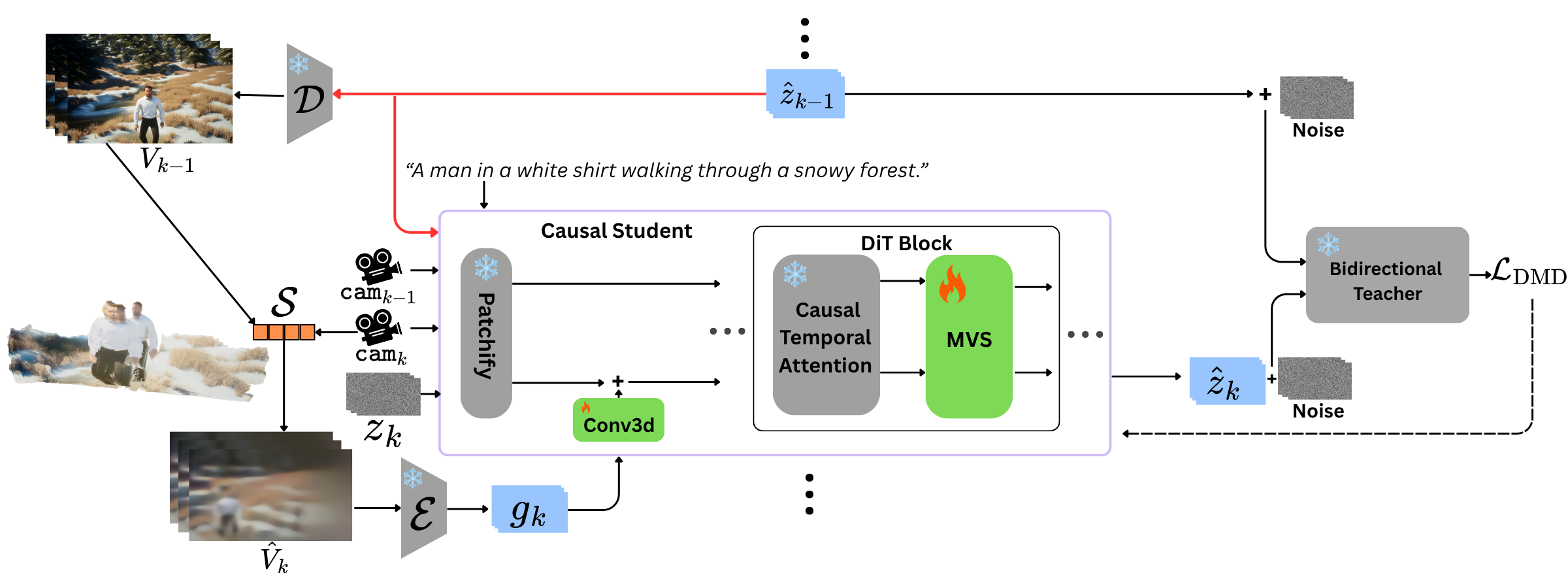
Figure 2: MV-Forcing architecture integrates text/camera prompts, preceding view outputs, geometric prior renders, and autoregressive attention for causal video synthesis across both axes.
Methodology
Given a text prompt and a set of camera trajectories, generation begins with joint denoising from pure noise for the first view, then advances view-by-view, conditioned on previously generated views and a geometric prior derived by querying the CUT3R persistent state. The student model replaces bidirectional temporal attention with causal attention under a blockwise mask, and cross-view attention operates only between consecutive views. During training, view-sequential unrolling is performed to mitigate exposure bias; outputs from previous steps serve as conditioning for subsequent views, with the DMD objective applied to each pair.
CUT3R's accumulated geometric prior provides an explicit conditioning signal (via a zero-initialized Conv3d) that encodes both RGB reconstructions and pixel-wise confidence maps, progressively enhancing as more views and timesteps are integrated. This geometric pathway, absent in the teacher, is acquired entirely through distillation.

Figure 3: Progressive enrichment of the CUT3R geometric prior (RGB + confidence maps) as additional views are accumulated, providing increasingly accurate spatial anchoring.
Empirical Evaluation
MV-Forcing is evaluated on both synthetic (SynCamVideo) and real-world (Open-Sora Mixkit) datasets. Metrics include FID/FVD (visual quality), CLIP-T/CLIP-F (text/frame similarity), camera pose error (RotErr, TransErr), and cross-view synchronization (Mat. Pix., CLIP-V, FVD-V).
Strong numerical results:
- MV-Forcing consistently outperforms baselines (SF+ReCamMaster, SF+ReCamMaster+SF) on cross-view synchronization and camera accuracy, with notable improvements in Mat. Pix. (>239k vs. <147k), RotErr, and TransErr metrics at 3 views/162 frames.
- Visual quality metrics remain competitive relative to the bidirectional teacher, despite the reduction to a few-step causal student.
- Robustness is observed up to 5 views and 648 frames, with negligible degradation in spatial consistency and synchronization (see scaling analysis).
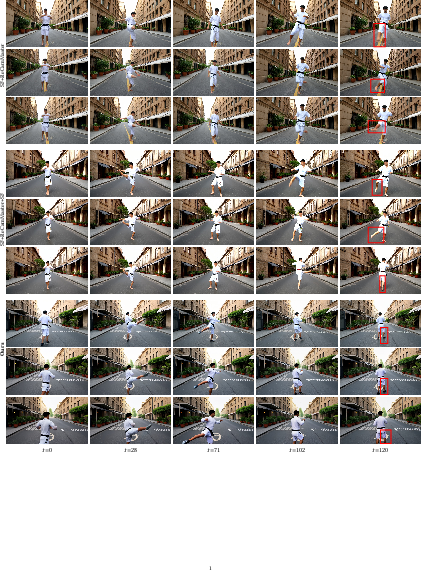
Figure 4: MV-Forcing maintains temporal and cross-view geometric consistency across long sequences, outperforming baselines that exhibit drift and artifacts beyond their training window.
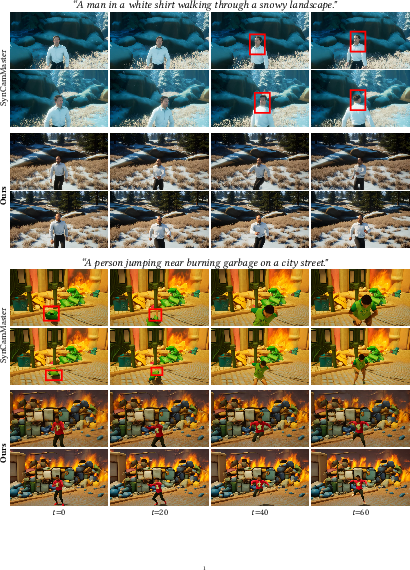
Figure 5: MV-Forcing demonstrates superior cross-view consistency versus bidirectional methods even on short sequences, overcoming spatial inconsistencies highlighted in red.
Ablation and Scaling Analyses
Component ablations reveal that removal of view-unrolling or the CUT3R prior substantially degrades spatial consistency and cross-view metrics. Manual geometric warping or elimination of state accumulation further diminishes performance, but to a lesser extent. Scaling experiments show near-constant cross-view metrics as the number of views increases (2-5) at fixed length or duration increases (81-648 frames) at fixed view count, substantiating the geometric prior's effectiveness in grounding the generation process.
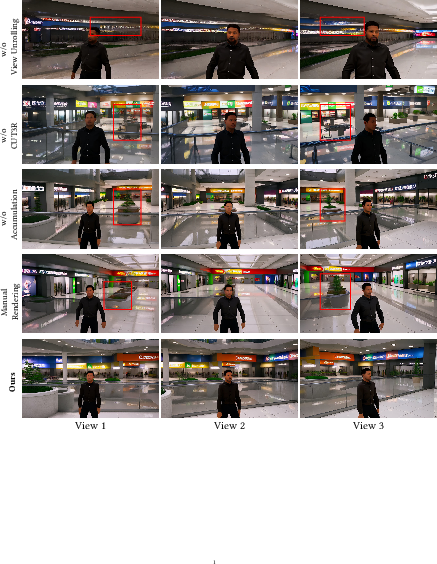
Figure 6: Cross-view consistency is most sensitive to the geometric prior and autoregressive training; ablated variants show marked drift and inconsistency.
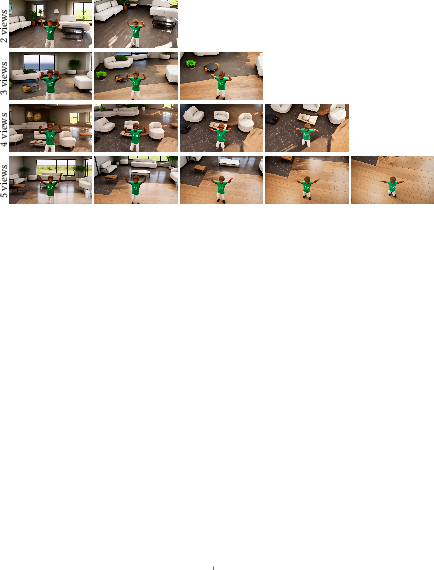
Figure 7: Scene geometry remains stable as the multi-view generation scales from 2 to 5 viewpoints at fixed sequence length.
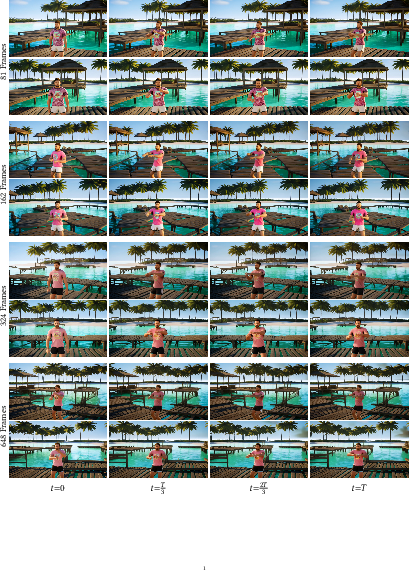
Figure 8: Cross-view synchronization persists over a temporal range of 81–648 frames, indicating resilience of the MV-Forcing structure.
Limitations and Failure Analysis
Main limitations include dependency on synthetic data for initial training, incremental degradation in visual quality for minute-scale durations, and lack of direct supervision for tuples of more than two views. Failure cases center on propagation of first-view artifacts, ambiguities under extreme camera displacements or motion, and limitations in CUT3R's geometric reconstruction for occluded or rapid dynamic regions.
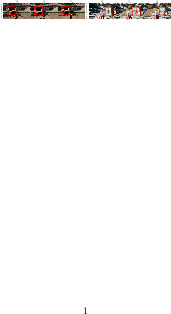
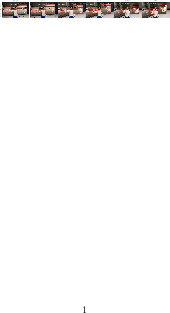
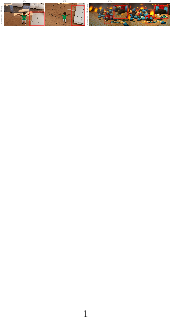
Figure 9: Typical failure modes—propagation of first-view artifacts, depth ambiguity under extreme viewpoints, and inconsistent limb geometry under extreme motion.
Implications and Future Directions
MV-Forcing demonstrates that persistent geometric priors—acquired through dynamic reconstruction and structured self-forcing distillation—can overcome the scaling and consistency limitations inherent in prior bidirectional or single-view autoregressive approaches. Its framework is readily extensible: integrating rolling-forcing paradigms for even longer horizons, training with large-scale real-world multi-view datasets, and incorporating more advanced geometric anchoring (e.g., neural fields or volumetric memory) could further enhance scene diversity, realism, and robustness.
The theoretical implication is an explicit alignment between generative modeling and geometric state accumulation, grounding autoregressive generation in 4D spatial-temporal structure. Practically, MV-Forcing enables efficient, scalable, and consistent generation of multi-view videos—critical for interactive simulation and real-time content creation—and sets the stage for hybrid multi-modal generative models capable of spatially consistent manipulation and synthesis.
Conclusion
MV-Forcing establishes a principled, scalable method for long-horizon, multi-view video synthesis, leveraging explicit geometric conditioning and spatio-temporal self-forcing to achieve robust appearance and motion consistency across arbitrary trajectories and durations. Its architectural advances demonstrate both practical and theoretical value for generative modeling, with significant potential for extension in dataset diversity, geometric representation, and interactive control.

