The Burau representation of the braid group is faithful for n = 4
Abstract: In this paper we use ideas introduced earlier by Moody, Long, Long-Paton, and Bigelow to prove the theorem of the title, that the Burau representation of the classical braid group is faithful for n = 4. An immediate corollary is that the Jones representation of the braid group is also faithful for n = 4.

Paper Prompts
Sign up for free to create and run prompts on this paper using GPT-5.
Top Community Prompts
Explain it Like I'm 14
What is this paper about?
This paper solves a long-standing puzzle about braids. Imagine n points on a disk and you move them around each other without letting any two collide—this is a “braid.” Mathematicians have a way to turn these braids into matrices (arrays of numbers with a variable t) called the Burau representation. The big question is: does this method ever mix up two different braids and give them the same matrix? If it never mixes them up, we call it faithful.
For n = 4 strands, the authors prove the Burau representation is faithful. As a bonus, this also means a famous related construction, the Jones representation, is faithful for 4-strand braids.
What are the main goals?
- Prove that for 4-strand braids (written B4), the Burau representation is faithful.
- Give a new, simple, topological proof that the Burau representation is faithful when there are 3 strands (B3).
- Develop practical tools (like a special polynomial and a “parity” rule) to detect whether a braid could be “invisible” to the Burau representation.
- Use these tools to analyze special types of braids built by “pushing” a point around loops.
How do they approach the problem?
Think of the disk with marked points (punctures) as a playground for arcs (curves) and loops:
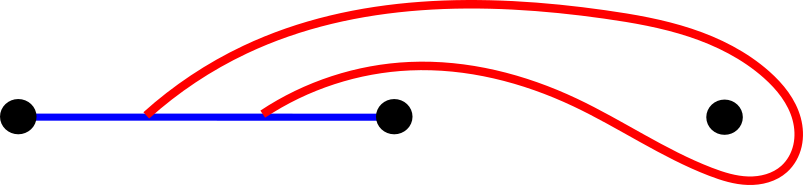
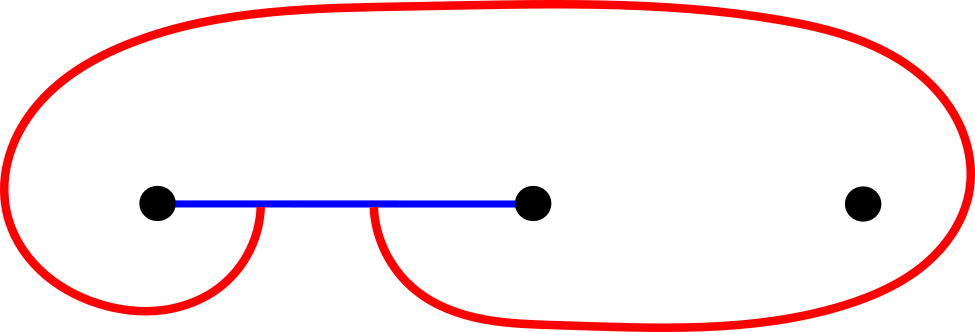
- The authors fix two special arcs:
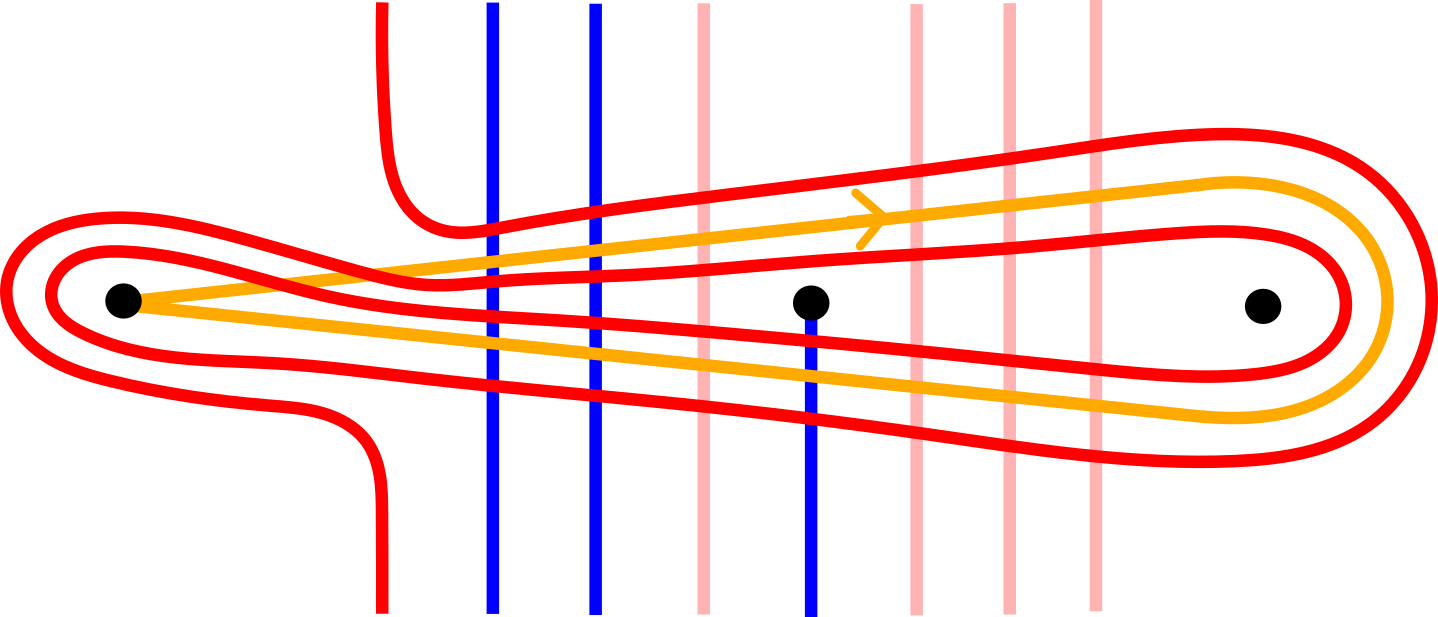
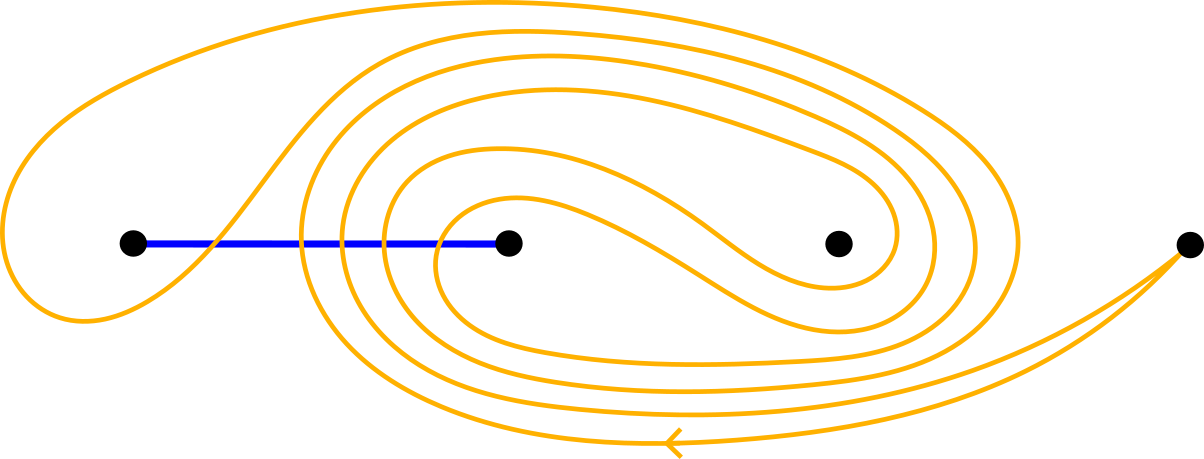
- A blue arc α between two punctures.
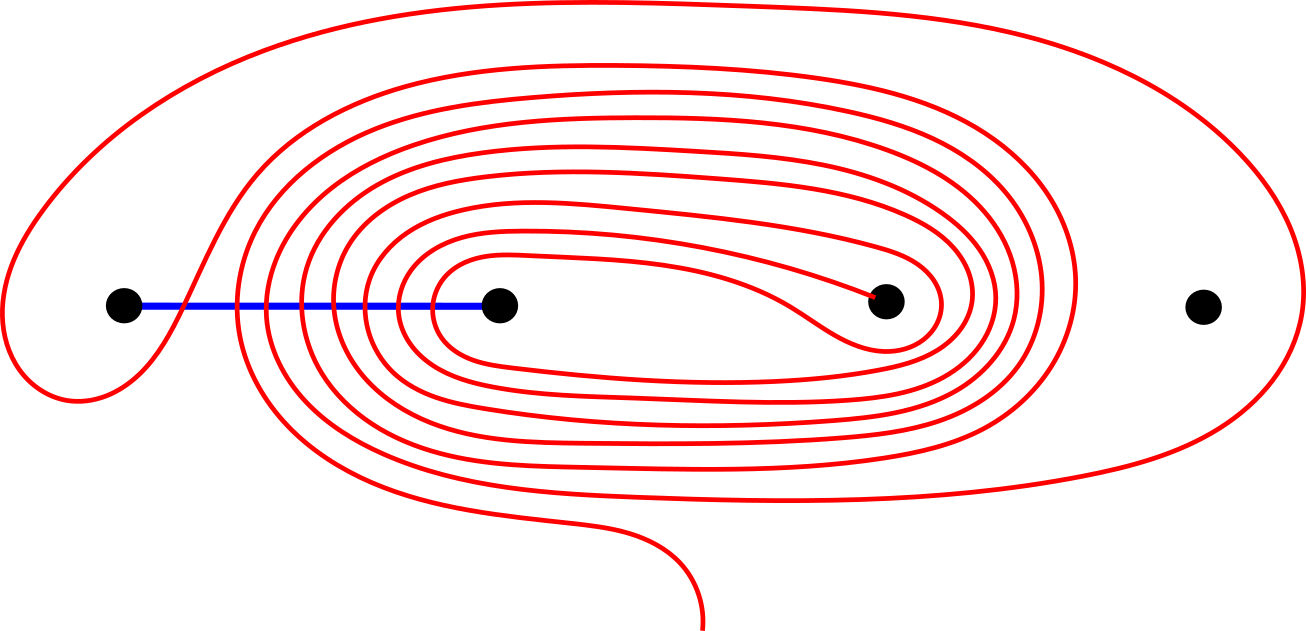
- A red arc β from the boundary of the disk to another puncture.
- A braid moves the red arc around. Where the red and blue arcs cross, each crossing contributes a term to a special polynomial.
Here are the key tools and ideas, translated into everyday language:
- The Burau representation:
- This turns each braid into a matrix whose entries are expressions in t and t⁻¹.
- “Faithful” means different braids always give different matrices.
- The Moody polynomial:
- Think of it like a scorecard that adds one term for each crossing between your blue and red arcs.
- Each term looks like ±tk. The sign (±) comes from whether the crossing goes “up” or “down.” The exponent k is determined by how the red arc winds around the punctures between consecutive crossings with the blue arc.
- If this polynomial is not zero, then the braid is not “invisible” to Burau. So, a nonzero Moody polynomial helps show faithfulness.
- Disk sequences and winding numbers:
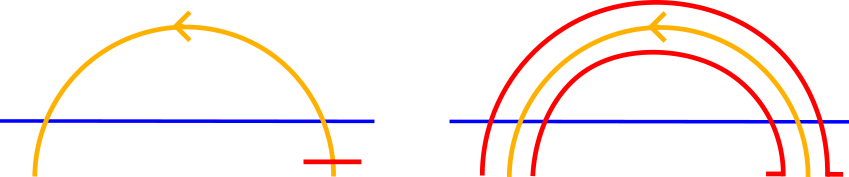
- Between each pair of consecutive crossings, the blue and red arcs enclose a small region (a disk) that contains some number of punctures.
- The “winding number” records how many punctures sit inside and which way the red arc travels around them.
- The authors show a simple rule: if that disk contains an odd number of punctures, the signs of adjacent crossing terms flip; if it’s even, they don’t. They call this the parity condition.
- Point-pushing maps:
- Pick one puncture and “push” it once around a loop. That move is a special kind of braid.
- Products of such moves, chosen carefully (they call these proper products), can be analyzed using the Moody polynomial.
- Reducing the problem:
- A theorem of Long says: to prove faithfulness for all 4-braids, it’s enough to prove it on certain important subgroups (like the Brunnian subgroup and point-pushing subgroup).
- The authors focus on those, where their tools work best.
- A clever trick when parity “almost” works:
- For 4 strands, the parity condition doesn’t always hold. The authors show how to fix this by temporarily adding a 5th point (embedding into 5 strands), applying a theorem of Moody, and then deducing information back in 4 strands. This helps prevent cancellation in the Moody polynomial.
What are the main results and why do they matter?
- Main Theorem: The Burau representation for 4-strand braids is faithful. So no two different 4-braids are sent to the same matrix by Burau.
- Corollary: The Jones representation for 4-strand braids is also faithful.
- A new, simple proof for 3 strands: They give an easy topological proof (using parity and winding ideas) that the Burau representation is faithful for 3 strands, originally proved by Magnus and Peluso using algebra.
Why this matters:
- This settles the last open case about faithfulness of the Burau representation for small numbers of strands (it’s known to fail for 6 or more, and 5 was previously handled).
- It strengthens the link between braid theory, knot theory, and algebraic representations.
- Since the Jones representation is connected to knot invariants and even ideas in quantum topology, confirming faithfulness for 4 strands is a clean and useful fact.
What could this lead to?
- Better understanding of how braids are represented by matrices, which is important in knot theory and low-dimensional topology.
- The methods (Moody polynomials, disk sequences, parity checks, and point-pushing products) give new tools that might help describe the “kernel” (what gets sent to the identity matrix) and the “image” (which matrices you can get) more generally.
- This could influence how mathematicians compute or reason about invariants of braids and links, and it may inform future work in areas related to the Jones polynomial and its applications.
Knowledge Gaps
Knowledge gaps, limitations, and open questions
Below is a focused list of unresolved issues and opportunities for further research that emerge from the paper’s results, methods, and scope.
- Kernel and image characterization: Although faithfulness of the Burau representation for n=4 is established, the paper does not characterize the image subgroup of GL₄(ℤ[t, t{-1}]) nor provide a structural description of the kernel for n≥5. A concrete program to describe generators, relations, or algebraic invariants distinguishing the image remains open.
- Specialization in t: The analysis is conducted over ℤ[t, t{-1}] with “generic” t. Faithfulness under specialization t↦q∈ℂ (especially at roots of unity) is not addressed. Determining for which values of t the unreduced (and reduced) Burau representation for n=4 remains faithful is an actionable open problem.
- Reduced vs unreduced Burau: The paper works “mainly” with the unreduced Burau representation but concludes “the Burau representation is faithful for n=4” without fully disentangling implications for the reduced version. A precise statement and proof for the reduced Burau at n=4, along with explicit matrix descriptions, would close this gap.
- Jones representation parameters and image: The corollary about faithfulness of the Jones representation for B₄ does not specify parameter regimes (e.g., values of q) nor characterize the image. A detailed analysis of parameter dependence and image structure for the Jones representation at n=4 is left unexplored.
- Algorithmic computation of Moody polynomials: While disk sequences and winding numbers provide combinatorial tools, no explicit algorithm (with correctness proof and complexity bounds) is given to compute Moody polynomials or decide membership in the kernel for arbitrary braids in B₄ (or in K₄). Designing an implementable procedure is a concrete task.
- Parity condition scope and intrinsic characterization: For n=4, the parity condition is shown to “almost” hold in special cases via embedding into B₅ and proper products. It remains unclear whether there exists an intrinsic (non-embedded) characterization of parity for broader classes in B₄, and whether necessary and sufficient conditions for parity can be formulated directly in B₄.
- Proper products: The paper indicates that any element of K₄ is conjugate to a proper product of push-maps, but constructive details are not provided. Developing an explicit algorithm to find such a conjugating element, controlling the number and type of factors, and determining uniqueness or normal forms are open and actionable.
- Classification of bigon-forming polygons: The proof sketch introduces generalized bigons, trigons, and rectangles as the only local configurations that create bigons, but a complete and general classification (including rigorous handling of degenerate cases, triple points, and higher-sided polygons) is not fully presented. Formalizing this classification and extending it to other surfaces is a clear next step.
- Dependence on chosen arcs/basepoint: The analysis fixes specific arcs (α from p₁ to p₂ and β*3 from p* to p₃) and relies on the change-of-coordinates principle, but a formal invariance result showing independence of arc choice and puncture labeling (with controlled transformations of Moody polynomials) is not proved. Making this independence precise would strengthen the framework.
- Extension beyond K₄ and Brun₄: The method reduces faithfulness to the Brunnian subgroup and especially to K₄. Whether the Moody/disk-sequence/proper-product machinery can be applied directly to general elements of B₄ without reduction, and whether it can produce explicit kernel elements or obstructions for n≥5, is not explored.
- Quantitative pseudo-Anosov data: The use of pseudo-Anosov properties of Brunnian braids is qualitative. Incorporating quantitative invariants (stretch factors, intersection growth, train-track data) to sharpen Moody polynomial obstruction criteria is unexplored and could lead to stronger or more general results.
- Normalization/invariance of Moody polynomials: The Moody polynomial is defined up to multiplication by tᵏ with a convention to fix lifts. A more canonical normalization or an invariant formulation (e.g., via Fox calculus, covering space homology, or pairing with a preferred basis) would eliminate ambiguity and improve comparability.
- Behavior under embeddings and cabling: The paper uses the standard inclusion Bₙ→Bₙ₊₁ to transfer kernel information. A broader study of how Moody polynomials and disk sequences behave under various embeddings (e.g., cabling, satellite operations) could reveal structural stability or new obstructions.
- Minimal position assumptions: Many arguments assume curves are in pairwise minimal position and exclude triple intersections. A systematic procedure to achieve minimal position in general (with guarantees and complexity) and a robust treatment of edge cases where minimality fails would make the methods more broadly applicable.
- Software and data: No computational tools or datasets are provided to experiment with examples, compute disk sequences, or evaluate Moody polynomials. Building and releasing software and a catalog of explicit K₄ and Brun₄ examples (with computed invariants) would facilitate reproducibility and further exploration.
- Broader applicability to other surfaces/representations: The methods are specialized to punctured disks and Burau/Jones representations. Investigating extensions to mapping class groups of punctured spheres or higher-genus surfaces, and connections to other representations (e.g., Gassner, Lawrence–Krammer) is a natural but unexplored direction.
- Minimal normal subgroup criterion: The proof leverages Long’s theorem on faithfulness on a nontrivial noncentral normal subgroup. Identifying minimal such subgroups (e.g., whether Brun₄ is minimal for the criterion) and understanding how this interacts with the Moody polynomial framework remains open.
- Systematic families of examples: Beyond a single illustrative example (appendix), the paper does not provide systematic families of point-pushing braids with analyzed disk sequences and Moody polynomials. Developing these families (including negative/edge cases) would test limits of the technique and generate new hypotheses.
Practical Applications
Immediate Applications
The results and methods in this paper yield several deployable tools and workflows across computational mathematics, robotics/motion planning, cryptography, and quantum information, particularly for systems that can be modeled with 4-strand braids.
- Fast linear tests for 4-braid distinctness and nontriviality (software, academia)
- Use case: Implement the faithful Burau representation for B4 and the Moody-polynomial–based obstructions to quickly determine whether two 4-braids are distinct or whether a 4-braid is nontrivial.
- Tools/products/workflows:
- Add a Burau4 module to computer algebra systems (e.g., SageMath) that:
- Computes the unreduced/reduced Burau matrices for B4 elements.
- Computes Moody polynomials from planar arc data via disk sequences and winding numbers.
- Checks the “parity condition” and flags guaranteed non-kernel elements with no cancellations.
- CLI/Library stubs: Burau4.is_injective(), Burau4.matrix(word), MoodyPolynomial(beta, alpha), ParityConditionValidator(beta, alpha).
- Sectors: software, academia (computational group theory, low-dimensional topology).
- Assumptions/dependencies: Requires reliable geometric encodings of braids as planar arc data or word forms in Artin generators; numerical stability if substituting t by complex values must be managed separately.
- Deduplication and indexing in link and braid databases restricted to 4-strand closures (software, academia)
- Use case: When constructing/linking databases of knots/links arising as closures of 4-braids, the faithful Burau and Jones representations give canonical, collision-free fingerprints for 4-braid elements.
- Tools/products/workflows:
- Index 4-braid words via their Burau/Jones matrices over Z[t, t{-1}] for canonical hashing.
- Pre-filter for isomorphism/equivalence checks before heavier topological simplifications.
- Sectors: software, academia (knot tables, 3-manifold/link recognition pipelines).
- Assumptions/dependencies: Applicable to 4-braids; care needed when passing from braids to closures (distinct braids may yield equivalent closures).
- Motion planning and multi-agent path signature features for 4 agents (robotics, software)
- Use case: Encode multi-robot or multi-agent planar avoidance paths as 4-braids; use faithful Burau/Jones matrices as fast, discriminative features to compare/cluster paths, detect equivalences, and reject spurious “same-path” claims.
- Tools/products/workflows:
- A BraidPathSignature module for path planners that:
- Lifts path data to B4 words.
- Computes Burau/Jones signatures as invariants for path comparison and logging.
- Uses “bigon-forming polygon” detection (generalized bigons/trigons/rectangles) to simplify path homotopies and ensure minimal intersection representations.
- Sectors: robotics, autonomy, logistics (4-agent scenarios), software (trajectory analytics).
- Assumptions/dependencies: Paths must be planar or planar-embedded with labeled agents; 4-agent cap—extensions to >4 agents may lose the same guarantees.
- Cryptographic guidance: avoid 4-braid-based protocols susceptible to linearization (security policy, industry)
- Use case: Security reviews of braid-based cryptography should treat B4 as unsafe for obfuscation/hardness assumptions, since the Burau (and hence Jones) representation is injective and computable, enabling linear-algebraic attacks.
- Tools/products/workflows:
- Policy notes and code checkers that flag use of B4 in proprietary protocols.
- Automated scanning of protocol descriptions for use of small-n braid groups.
- Sectors: cybersecurity (policy, audits), finance/industry (secure comms).
- Assumptions/dependencies: Many braid-based schemes are already considered insecure; this narrows risk specifically for constructions using n = 4.
- Educational and visualization modules for mapping class groups and braids (education, academia, software)
- Use case: Interactive teaching tools illustrating disk sequences, winding number sequences, Moody polynomials, and the parity condition; students can “push” punctures and see bigon-forming polygons and minimal-position corrections.
- Tools/products/workflows:
- Web applets that animate push-maps, generalized bigons/trigons/rectangles, and compute Moody polynomials on the fly.
- Sectors: education (undergrad/grad topology), software (edtech).
- Assumptions/dependencies: Requires careful UI for drawing arcs in minimal position; correctness depends on avoiding numerical/graphical degeneracies.
- Validation and debugging of 4-strand braid encodings in topological quantum computing prototypes (quantum information, software)
- Use case: Use the faithfulness of the Jones representation of B4 to verify that two 4-strand braid words represent distinct operations at the representation level, aiding unit-test suites for early-stage compilers or simulators using 4-anyon gates.
- Tools/products/workflows:
- A consistency checker that compares Jones matrices of 4-braid circuits to detect unintended cancellations or redundancies.
- Sectors: quantum software, quantum simulation.
- Assumptions/dependencies: Practical quantum models often use specialized unitary specializations (e.g., at roots of unity); mapping from the abstract Jones representation to the physical model must be validated for the parameter regime used.
- Microfluidic mixing protocols with four stirrers/tracers (engineering, daily life via diagnostics)
- Use case: In lab-on-a-chip designs using four moving stirrers or tracer paths, encode protocols as 4-braids and use faithful linear representations to distinguish protocols unambiguously and to optimize mixing sequences without collisions.
- Tools/products/workflows:
- Protocol designer that:
- Encodes candidate stirrer motions as 4-braids.
- Uses Burau/Jones fingerprints to ensure distinctness and track complexity during optimization.
- Sectors: microfluidics, healthcare diagnostics, chemical engineering.
- Assumptions/dependencies: Valid under planar/laminar flow approximations; physical efficacy requires coupling with fluid dynamics metrics (stretching/entropy), not just topological distinctness.
Long-Term Applications
The techniques introduced (disk sequences, parity condition, proper products of push-maps, Brunnian reduction) and the faithfulness result for B4 suggest broader, but development-intensive, applications.
- General-purpose braid and mapping class diagnostics via combinatorial coverings (academia, software)
- Vision: Extend the disk-sequence/winding-number/“parity condition” toolkit to automated certification that a braid does not lie in kernels of other representations; leverage “proper products” to normalize arc configurations algorithmically.
- Potential tools/products:
- A generalized ArcHomologyEngine that:
- Converts geometric representatives into relative homology classes in cyclic covers.
- Automates bigon-elimination via detection of bigon-forming polygons.
- Produces machine-checkable certificates of nontriviality for various representations.
- Sectors: academia (geometric group theory), software (proof assistants, CAS).
- Assumptions/dependencies: Requires theoretical generalization beyond B4; careful handling of combinatorial explosion for larger n.
- Improved algorithms for braid-based motion planning and concurrency control with >4 agents (robotics, distributed systems)
- Vision: Use representation-theoretic signatures as scalable path invariants for multi-agent systems, extending “proper product” decompositions to reduce intersection complexity and compare equivalence classes of motions.
- Potential tools/products:
- Planner modules that compress multi-agent path histories into robust invariants for conflict detection, rollback, and reproducibility in automated warehouses or swarms.
- Sectors: robotics, logistics, distributed systems.
- Assumptions/dependencies: For n ≥ 5, Burau is not faithful, so alternative faithful invariants/representations (e.g., higher homological or quantum representations) will be needed.
- Enhanced models for entanglement in soft matter and biophysics (materials science, biology)
- Vision: Combine faithful braid invariants (for small strand counts) with stochastic models of polymer/DNA entanglement; use Jones/Burau fingerprints to classify topological states and transitions in controlled experiments.
- Potential tools/products:
- Analytics pipelines that detect topological changes in time-series microscopy (tracked as braids), providing features for machine learning models of material behavior.
- Sectors: materials science, biotech.
- Assumptions/dependencies: Requires robust trajectory extraction and noise-tolerant lifting to braid words; often >4 strands, so must extend beyond B4 or decompose into 4-strand subsystems.
- Compiler correctness and synthesis in anyonic/topological quantum computing (quantum information)
- Vision: Use faithful Jones representations as ground-truth oracles for small modules and as building blocks for compositional correctness proofs in larger circuits; integrate disk-sequence methods to design braids avoiding undesirable cancellations.
- Potential tools/products:
- Formal verification pipelines where subroutines are reduced to 4-strand components with certified uniqueness, aiding end-to-end correctness arguments.
- Sectors: quantum computing (compiler toolchains).
- Assumptions/dependencies: Physical realizations involve specific categories and parameter choices; faithfulness at the abstract level must align with the physical representation used.
- Secure design principles for braid-based schemes (policy, cybersecurity)
- Vision: Develop formal guidelines that exclude low-strand settings with faithful, low-dimensional linearizations; encourage designs that provably avoid known faithful representations or are resilient to linear-representation attacks.
- Potential tools/products:
- Standards drafts and auditing checklists for post-quantum or protocol designers considering topological constructs.
- Sectors: policy, cybersecurity.
- Assumptions/dependencies: The broader cryptographic community currently disfavors braid-based constructions; this would formalize and refine risk assessments rather than advocate new deployments.
- Automated pseudo-Anosov detection and complexity certification (academia, software)
- Vision: Build on the Brunnian reduction and push-map machinery to algorithmically detect pseudo-Anosov behavior in mapping class subgroups and to quantify complexity growth, aiding research workflows and educational tools.
- Potential tools/products:
- A PseudoAnosovDetector that uses point-pushing decompositions and disk-sequence analytics as prefilters before more expensive train-track or Teichmüller-theoretic computations.
- Sectors: academia (dynamical systems, Teichmüller theory), software (math tooling).
- Assumptions/dependencies: Reliability depends on generalizing current combinatorial techniques and proving completeness/precision bounds.
- Design of topologically-informed microfluidic mixers and protocol optimization (engineering)
- Vision: Couple topological invariants (braid complexity, mixing entropy proxies) with CFD to co-optimize 4-stirrer (and beyond) devices; use faithful invariants to ensure protocol distinctness during multi-objective optimization.
- Potential tools/products:
- CAD-integrated optimization loops that alternate between topological and physical objectives with constraint handling via braid invariants.
- Sectors: microfluidics, energy/chemical processing.
- Assumptions/dependencies: Requires validated links between topological complexity and mixing performance for specific device geometries.
Notes on cross-cutting assumptions:
- The core faithfulness result is specific to B4; for n ≥ 5, the Burau representation is not faithful, so direct generalization is nontrivial.
- The Jones representation being faithful for B4 (as a corollary) is abstract; practical use in quantum settings requires parameter specialization and model matching.
- Many workflows rely on accurate planar embedding and minimal-position preprocessing (eliminating bigon-forming polygons), which can be automated but must be robust to numerical/graphical noise.
Glossary
- Algebraic intersection number: An oriented count of crossings between two curves, taking signs into account. "where denotes the algebraic intersection number of the lift with in the cover ."
- Artin generators: The standard generating set for the braid group introduced by Artin. "While Burau originally defined his representation by giving its values on the standard Artin generators of $\B_n$"
- Bigon-forming polygons: Specific configurations of arcs/loops whose presence forces bigons after pushing, used to detect non-minimality. "Hence we will refer to these configurations collectively as {\it bigon-forming polygons}."
- Birman exact sequence: A short exact sequence relating mapping class groups and point-pushing subgroups for punctured surfaces. "as the kernel of the Birman exact sequence for the disk "
- Braid group: The group of n-strand braids under concatenation, modeled as mapping classes of punctured disks. "the braid group $\B_n$"
- Brunnian group: The subgroup of braids trivial upon forgetting any one strand. "is known as the {\it Brunnian group} $\Brun_n$"
- Burau representation: A linear representation of the braid group into matrices over Laurent polynomials. "we refer to simply as the Burau representation."
- Change of coordinates principle: A tool ensuring any appropriate arc configuration arises from some braid. "by the change of coordinates principle"
- Covering space: A space that maps onto another so that locally it looks like a product with a discrete fiber. "let denote the covering space associated with its kernel."
- Disk sequence: The ordered collection of disks bounded by consecutive subarcs of two intersecting arcs, capturing combinatorial data. "as the {\it disk sequence} of "
- Geometric intersection number: The minimal number of intersections between two curves up to isotopy. "we let denote their geometric intersection number."
- Generalized bigon: A polygon formed by a piecewise arc of the pushing loop and an arc that behaves like a bigon for pushing. "We will refer to such an -gon as a {\it generalized bigon}."
- Generalized rectangle: Two (possibly piecewise) parallel arcs of the pushing loop between two arcs forming a rectangle that can create bigons upon pushing. "we refer to any such configuration as a {\it generalized rectangle}"
- Generalized -to- trigon: A multi-segment version of a trigon where a piecewise loop arc runs from β to α, leading to a bigon after pushing. "we refer to any such configuration as a {\it generalized -to- trigon}."
- Group of covering transformations: The deck transformation group acting on a covering space. "The group of covering transformations of is isomorphic to "
- Jones representation: A representation of the braid group related to the Jones polynomial, containing the reduced Burau as a summand. "The Jones representation of $\B_n$ is faithful for ."
- Kernel (of a representation): The set of group elements acting trivially under the representation. "attempts to detect elements in the kernel of the remaining case "
- Mapping class group: The group of isotopy classes of orientation-preserving homeomorphisms of a surface. "as the mapping class group $\Mod(D_n)$."
- Minimal position: A configuration of curves realizing the fewest possible intersections within their isotopy classes. "simply by assuming that all curves are in pairwise minimal position."
- Moody polynomial: A Laurent polynomial computed from intersections of lifted arcs, obstructing membership in the Burau kernel. "We define the {\it Moody polynomial $\Moody(\alpha, \beta) \in \Z [t, t^{-1}]$ of the oriented arcs and }"
- Normal subgroup: A subgroup invariant under conjugation by the ambient group. "and it is a normal subgroup of $\B_n$."
- Parity condition: A criterion relating the parity of punctures in disks to sign changes in Moody coefficients. "satisfies a certain {\it parity condition}"
- Point-pushing subgroup: The subgroup obtained by pushing a chosen puncture along loops in the punctured surface. "Let denote the point-pushing subgroup of $\B_n$"
- Proper product: A product of push-maps satisfying specific minimality and endpoint conditions to avoid creating bigons. "admits a factorization as a {\it proper product} of certain push-maps."
- Pseudo-Anosov: A type of mapping class with invariant measured foliations and stretch factor, indicating chaotic dynamics. "all nontrivial Brunnian braids are pseudo-Anosov"
- Reduced Burau representation: Burau’s original (n−1)-dimensional representation of the braid group. "now known as the reduced Burau representation"
- Relative homology group: Homology computed relative to a specified subset, here the preimage of the basepoint. "the relative homology group "
- Total winding number: The signed count of punctures in a disk between consecutive intersections, weighted by the orientation. "We define the {\it total winding number} "
- Universal cyclic cover: The cyclic covering corresponding to the abelianization map assigning total exponent sum. "the universal cyclic cover "
- Unreduced Burau representation: The n-dimensional version of the Burau representation acting on relative homology. "the unreduced Burau representation "
- Winding number sequence: The sequence of total winding numbers associated to consecutive intersection disks. "as the {\it winding number sequence} of "
Collections
Sign up for free to add this paper to one or more collections.

