- The paper introduces a minimal, energy-dependent phenomenological correction that captures crucial medium effects missing in ab initio microscopic optical potentials.
- It employs a hybrid Monte Carlo algorithm and a truncated series expansion to self-consistently compute the correction parameter λ(E), thereby improving predictions for scattering observables.
- Numerical results show rapid convergence at N_tr=3, accurately reproducing elastic scattering cross sections and analyzing powers for both light and medium nuclei.
Phenomenological Corrections in Microscopic Optical Potentials for Nucleon-Nucleus Scattering
Introduction
The optical model has played a central role in describing nucleon–nucleus (NA) and nucleus–nucleus scattering by providing an effective complex potential that encodes both elastic and inelastic channels. Traditional phenomenological parametrizations of the optical potential have succeeded in fitting a wide range of data but lack connection to underlying nucleon–nucleon (NN) dynamics. Contemporary approaches prioritize microscopic optical potentials constructed from realistic NN interactions, often derived from chiral effective field theory (EFT) and many-body nuclear theory. However, first-principles formulations—typically employing truncated multiple-scattering expansions—consistently underpredict absorption and fail to fully account for angular distributions and polarization observables at low and moderate energies, due to neglected medium effects, dynamical correlations, and multi-step scattering contributions.
"A Phenomenological Extension for Microscopic Optical Potentials" (2607.05080) systematically addresses these deficiencies by introducing a minimal, physically motivated, energy-dependent phenomenological correction designed to capture these missing effects. The scheme preserves the predictive and microscopic quality of the optical potential while incorporating medium and higher-order scattering phenomena. This essay provides a comprehensive technical analysis of the paper's framework, numerical strategy, and implications for nuclear reaction theory.
Microscopic Optical Potentials and the Spectator Expansion
Microscopic optical potentials are grounded in multiple-scattering theory, typically utilizing Watson's formalism in which the transition matrix for NA scattering is constructed by systematically projecting the full Lippmann–Schwinger equation onto elastic (P) and inelastic (Q) subspaces. The resulting expansion for the optical potential operator, U, is expressed as a sum over effective NN interactions involving target nucleons, often truncated after the first nontrivial (single-scattering) term:
U=i=1∑Aτi+i=j∑τij+⋯
Here, τi represents the in-medium two-body scattering operator between the projectile and the ith target nucleon. Practical calculations, however, usually restrict to first order, which corresponds to folding the free NN t matrix with the target ground-state density (impulse approximation, IA). The truncation neglects medium modifications encoded in Wi (the mean field due to other target nucleons) and higher-order rescattering processes.
Limitations and Need for Phenomenological Extensions
Despite significant advances, even calculations combining state-of-the-art chiral NN forces and no-core shell model (NCSM) densities, such as those by Vorabbi et al., suffer from systematic underestimation of absorption and qualitative deficiencies in angular observables at low and moderate incident energies. The missing physics includes, but is not limited to, dispersive couplings, virtual excitation channels, and the energy-density-momentum dependencies of medium corrections. Full multiple-scattering theory is formally available but computationally prohibitive and dependent on inputs (e.g., Wi) that are hard to constrain microscopically.
The discrepancy is evident in model comparisons between theory and data. As shown in the order-by-order expansions for 12C(n,n), IA-based calculations fail to capture secondary diffraction minima and underestimate cross-sections at large angles.
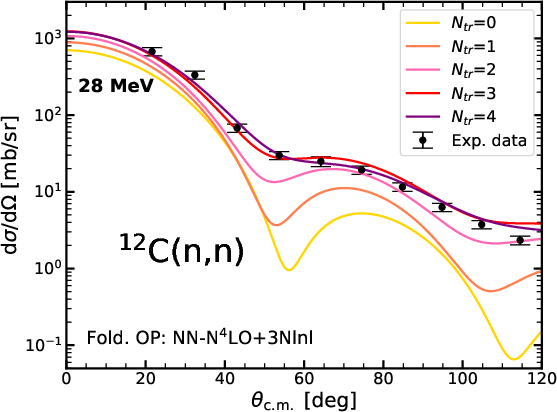
Figure 2: Differential cross sections for 12C(U=i=1∑Aτi+i=j∑τij+⋯0) at 28 MeV highlighting progressive improvement from leading-order IA (U=i=1∑Aτi+i=j∑τij+⋯1) towards higher order expansions with the phenomenological correction.
The Phenomenological Correction Scheme
Ansatz and Implementation
To circumvent the impracticality of direct higher-order calculations, the paper introduces a phenomenological scaling correction that emulates medium effects. The principal innovation is to approximate the nontrivial propagator term U=i=1∑Aτi+i=j∑τij+⋯2—responsible for rescattering and medium corrections—by a simple, negative, energy-dependent scaling factor U=i=1∑Aτi+i=j∑τij+⋯3:
U=i=1∑Aτi+i=j∑τij+⋯4
This reduces the in-medium U=i=1∑Aτi+i=j∑τij+⋯5 operator to a truncated series:
U=i=1∑Aτi+i=j∑τij+⋯6
The parameter U=i=1∑Aτi+i=j∑τij+⋯7 is computed through a hybrid Monte Carlo algorithm combining free NN cross sections, NCSM-based densities, and semiclassical trajectory sampling, yielding a probability of additional scattering encounters. No empirical fitting is used; U=i=1∑Aτi+i=j∑τij+⋯8 is determined self-consistently from fundamental nuclear properties.
Theoretical Assessment
The use of a single scalar U=i=1∑Aτi+i=j∑τij+⋯9 compresses the complexity of in-medium physics and neglects explicit density, momentum, and spin dependencies. The truncation order τi0 is not controlled by a formal small parameter and must be empirically tested for convergence in each case. Nonetheless, the expansion enables practical inclusion of multi-step effects and systematically improves agreement with experiment.
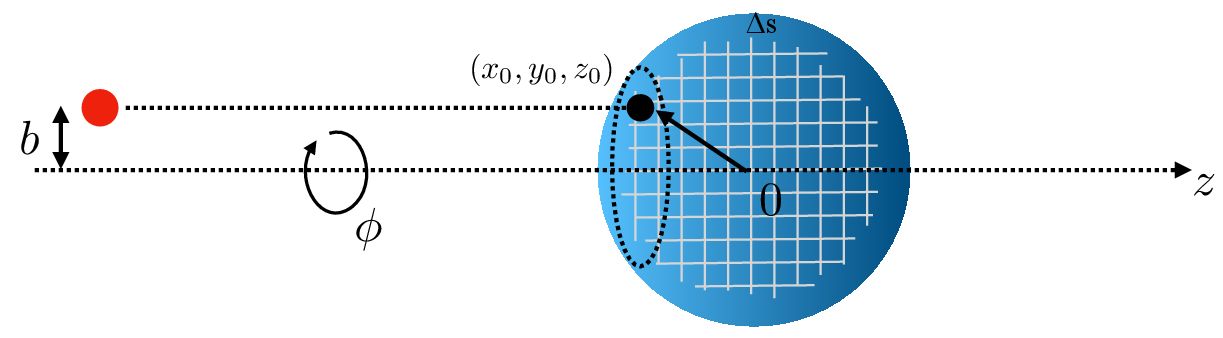
Figure 1: Schematic geometry and trajectory sampling approach underlying the Monte Carlo algorithm to estimate the probability of rescattering and compute the correction parameter τi1.
Numerical Results
Systematics and Convergence
Elastic scattering of protons and neutrons on τi2C and τi3O at incident energies ranging from τi4 to τi5 MeV are used as benchmarks. Differential cross sections and analyzing powers are computed for increasing truncation orders τi6. For cross sections, rapid convergence is observed: typically, τi7 is sufficient for quantitative agreement with experimental data across the energy range considered.
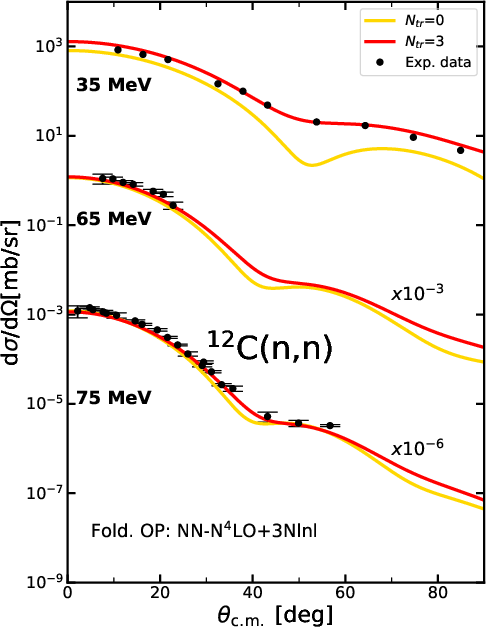
Figure 3: Elastic τi8C(τi9) cross sections at several energies, demonstrating substantial improvement of angular distributions using the phenomenological extension (red), especially in reproducing the diffraction pattern.
Notably, the inclusion of the phenomenological term at i0 restores both amplitude and phase of diffraction minima lost in the IA, yielding accurate cross section predictions over several orders of magnitude. Similar improvements are observed for i1O(i2) at 26 MeV.
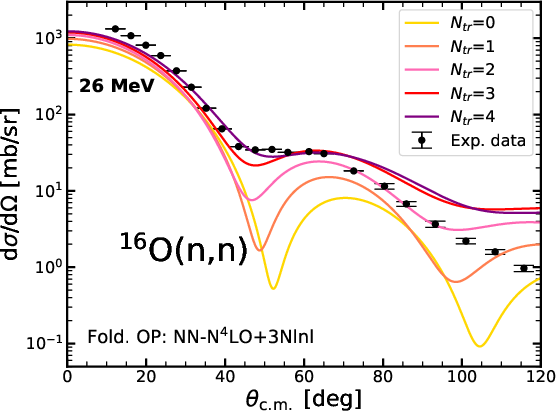
Figure 4: i3O(i4) cross sections at 26 MeV, showing convergence and substantial correction for large scattering angles as higher orders are included.
Proton Scattering and Spin Observables
For i5C(i6) and i7O(i8), the phenomenological extension is seen to have the greatest impact at low energies (e.g., 30–45 MeV), significantly improving cross section agreement, whereas its effect diminishes at higher energies, consistent with reduced relevance of multi-step rescattering.
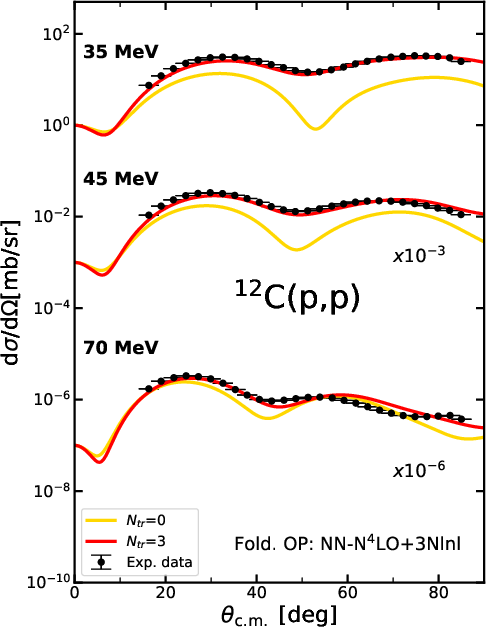
Figure 5: Elastic i9C(t0) cross sections at 35, 45, and 70 MeV: the phenomenological correction (red) greatly enhances fidelity at low energies.
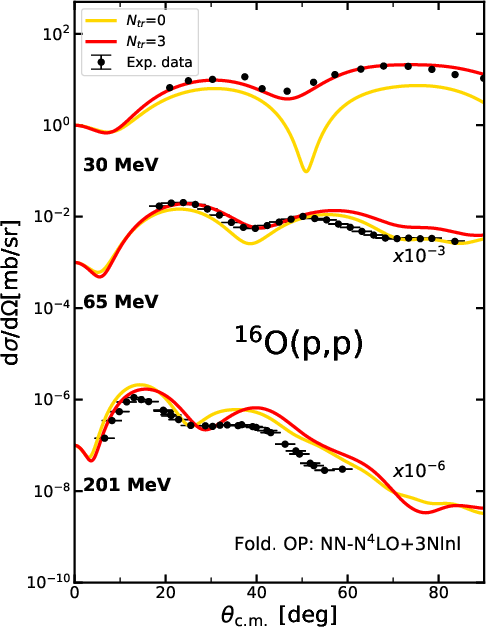
Figure 6: Elastic t1O(t2) cross sections at 30, 65, and 201 MeV underline decreasing correction importance at high energy.
Polarization observables, such as the analyzing power t3, also benefit from the extension at moderate energies, with higher orders smoothing unrealistic oscillations and improving the overall trend, though fine structure remains only qualitatively reproduced.
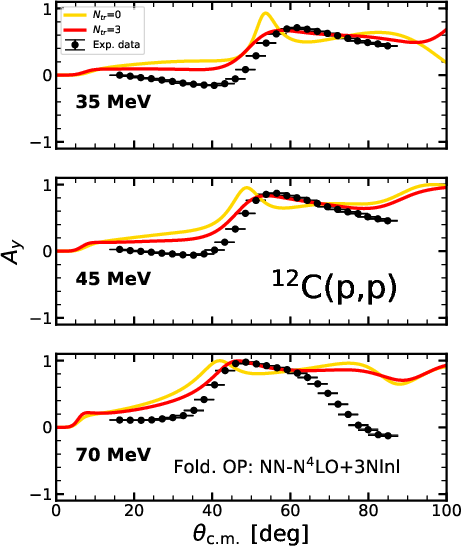
Figure 7: Analyzing power t4 for t5C(t6), where higher-order phenomenological corrections moderate unphysical oscillations and improve overall trend.
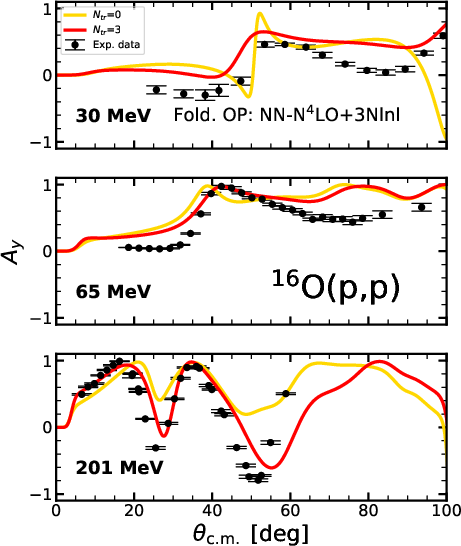
Figure 8: t7 for t8O(t9), showing qualitative improvement but limited quantitative agreement, reflecting the limits of a scalar correction.
Implications and Future Prospects
The proposed scheme offers a pragmatic strategy for bridging the gap between predictive microscopic hadronic potential models and phenomenological constraints from scattering data. Its model-independent, non-fit, and transferable nature is especially suited for applications where data are lacking, notably for exotic nuclei. The approach can be viewed as a foundation for more sophisticated dispersive and nonlocal optical potentials, or as a controlled initial extension before engaging in computationally demanding second-order scattering calculations.
On a theoretical level, encoding medium corrections as a simple scaling parameter is a significant simplification and motivates future work involving more elaborate, possibly density- and momentum-dependent extensions, or complex-valued Wi0 to address the full analytic structure of the potential. Integration with dispersive optical models or more rigorously derived in-medium NN amplitudes is a natural next step.
Conclusion
The paper establishes that a minimal, physically motivated phenomenological correction to the microscopic optical potential, parametrized by an energy-dependent term estimated via a Monte Carlo sampling of nuclear geometry and NN cross sections, yields substantial improvement in the description of nucleon–nucleus elastic scattering cross sections, especially at lower energies where purely ab initio models systematically fail. The approach does not involve empirical fitting, is robustly convergent for modest truncation orders, and is broadly transferable across nuclei and energies. Extensions of this approach may open practical avenues for reliable reaction modeling in regimes not accessible to parameter-rich empirical potentials.