CollabEval: Statistically Efficient Collaborative Model Evaluation via Matrix Completion
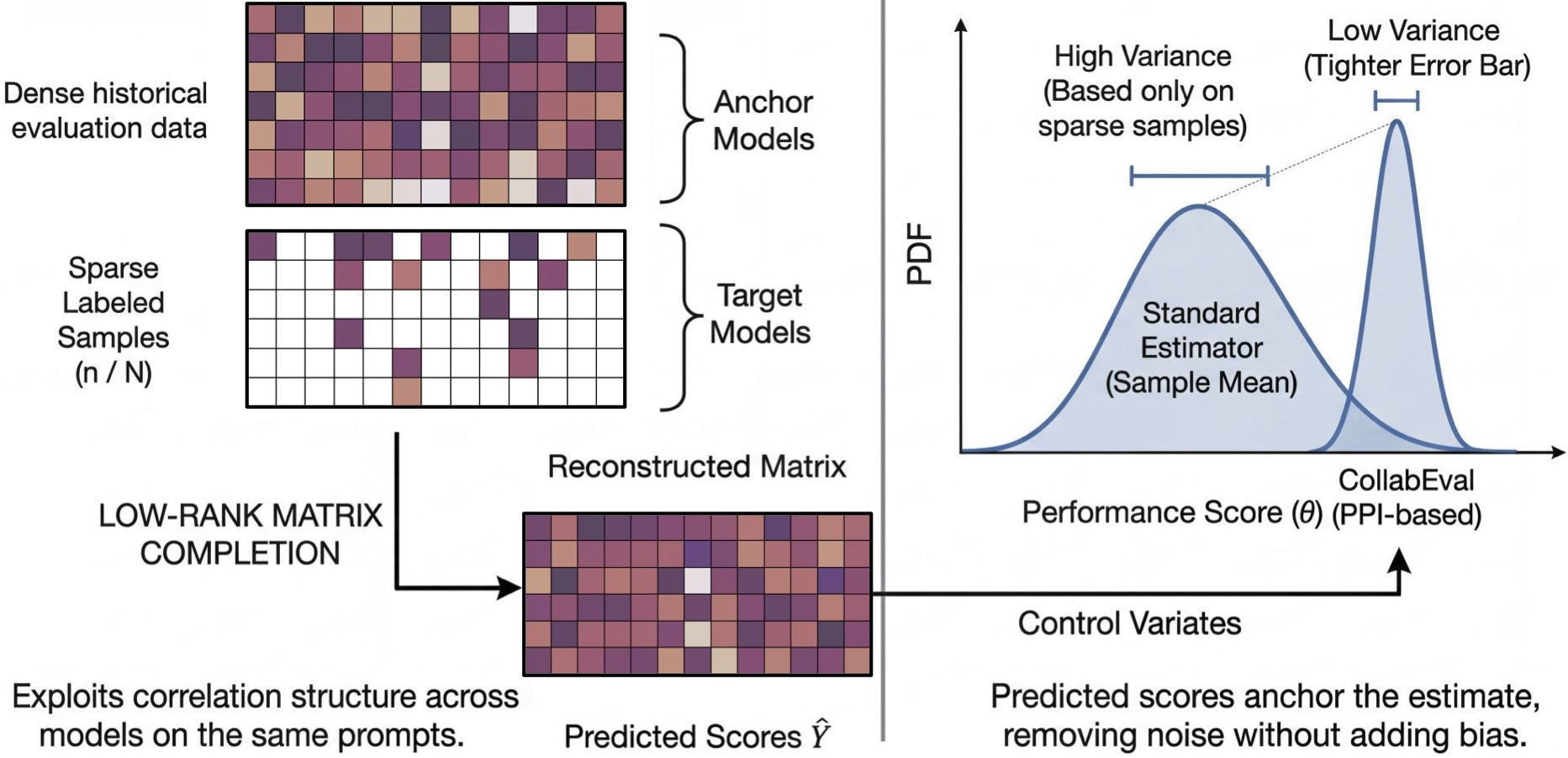
Abstract: Evaluating generative AI models is a routine, but resource-intensive, process that is conducted over and over again during the course of model development. In this work, we propose Collaborative Evaluation (CollabEval), a simple, effective, and principled method for exploiting dependencies between historical runs of different models on the same tasks to improve statistical efficiency. Specifically, our approach treats model evaluation as a matrix completion problem over an $M \times N$ matrix of evaluation scores, where $M$ is the total number of models and $N$ is the total number of evaluation prompts. We assume that a subset of these $M$ models are targeted for evaluation. For these target models only a small fraction, $p$, of prompts has been annotated with evaluation scores. Leveraging recent results in prediction-powered inference, we build a low-rank approximation of the score matrix, and use the reconstructed values as control variates in a manner that guarantees unbiased estimates of the true evaluation metric mean, in addition to statistically valid confidence intervals. Empirically, across a wide range of datasets, models, and sparsity levels $p$, we find that CollabEval substantially reduces the mean confidence interval size, and the mean squared error of the point estimate, compared to baseline methods at the same annotation budget.
Paper Prompts
Sign up for free to create and run prompts on this paper using GPT-5.
Top Community Prompts
Explain it Like I'm 14
What is this paper about?
The paper introduces CollabEval, a new way to check how well AI models perform without spending so much time and money. It uses past evaluation results from older models to help estimate how a new model would do on many prompts, even if you only test that new model on a small portion of them. The trick is to predict the missing scores smartly and then correct those predictions so the final results are fair and trustworthy.
What questions did the researchers ask?
- Can we reuse past evaluation data from other models to evaluate new models more efficiently?
- Can we skip running a lot of expensive tests and still get accurate results with honest error bars (confidence intervals)?
- Will this work both for a model’s overall score and for comparing two models’ scores?
How did they try to answer them?
Here’s the approach in everyday language.
The big idea: a “score grid”
Imagine a big grid (a table). Each row is a model, each column is a prompt (a question or task), and each cell is the score that model got on that prompt. For new models, most of their cells are empty because we didn’t test them on every prompt. The question is: can we fill in those empty cells well enough to help us evaluate the new model?
Filling in the blanks like a movie recommender
This is similar to how streaming services recommend movies. If people with tastes like yours loved Movie X, the system will guess you might like it too. Here:
- Old models with lots of known scores act like “people whose ratings we already know.”
- The new model is like a new user with only a few ratings.
- The method, called matrix completion, learns patterns in the grid so it can guess the missing scores for the new model.
A common pattern is “low-rank structure,” which means a few hidden factors explain most of the scores (for example, some prompts focus on math, others on writing; some models are better at math, others at writing). With just a few known scores from the new model, the system can place it in this hidden-factor space and predict the rest.
Training without cheating (cross-fold)
To avoid “peeking” at the true scores when learning to predict, the method uses cross-fold training. It repeatedly hides some known scores, trains on the rest, and tests on the hidden ones. Doing this in folds means we use all the data without cheating.
Getting honest numbers (bias correction)
Predictions are helpful, but they can be biased (systematically too high or too low). CollabEval never trusts predictions by themselves. Instead, it uses a technique called prediction-powered inference:
- Step 1: Use the predictor to guess all the missing scores.
- Step 2: On the small set of prompts where we did run the new model, measure how far the predictions were off on average.
- Step 3: Correct the overall estimate using that measured error.
This way, the final estimate is unbiased—on average, it is right—even if the predictions aren’t perfect.
This is similar to having a “helper guess” and then using a small amount of real checking to fix any consistent mistake in the guess.
Confidence intervals you can trust
A confidence interval is a range that likely contains the true average score (for example, “we’re 90% sure the true score is between 72 and 75”). CollabEval computes confidence intervals that remain statistically valid. Even if the predictions aren’t great, the math ensures the intervals still honestly reflect uncertainty.
Saving effort: skipping prompts entirely
Unlike many methods that still need you to run the model on every prompt and then use a cheap auto-grader, CollabEval can skip prompts completely (no generation, no grading). It fills in those results via prediction and then corrects for prediction error using the few prompts you did label.
What did they find?
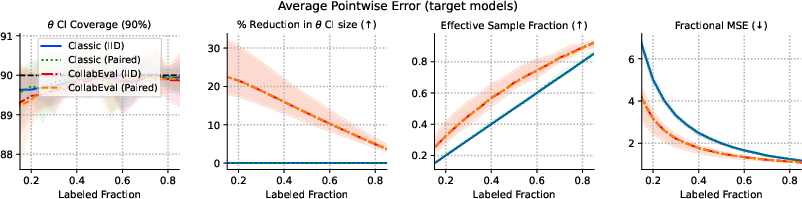
Across five different benchmarks (instruction following, multiple-choice exams, fact-grounded Q&A, machine translation, and software bug fixing):
- Confidence intervals got tighter without losing honesty:
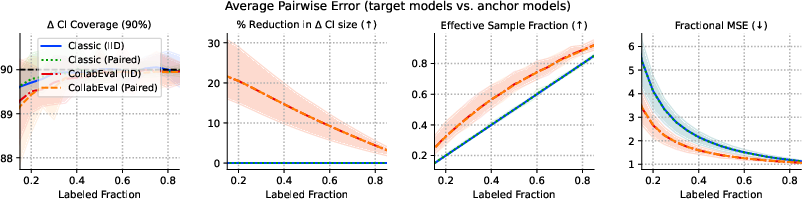
- CollabEval reduced confidence interval widths by up to about 30%, especially when only a small fraction of prompts were labeled. Tighter intervals mean you can be more certain about who’s better with less testing.
- More accurate estimates for the same budget:
- Point estimates had lower error than standard methods that ignore past data.
- Works for both single-model scores and head-to-head comparisons:
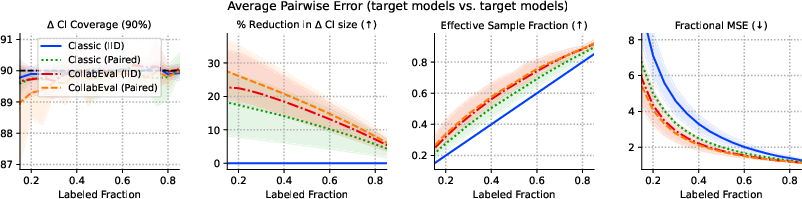
- It improved estimates of a model’s average score and the difference between two models’ scores.
- Strongest gains when labels are scarce:
- The biggest benefits came when you only labeled about 10–20% of the prompts—exactly when saving effort matters most.
- Robust even if predictions aren’t perfect:
- Because the method corrects prediction bias and uses proper uncertainty estimates, it stays reliable even when the “fill-in” guesses are noisy.
- Paired sampling helps comparisons:
- When directly comparing two new models, evaluating them on the exact same small set of prompts (paired sampling) plus CollabEval gave the best precision.
Why does this matter, and what’s the impact?
- Faster, cheaper evaluation: Teams can evaluate more often and at lower cost, which helps catch regressions and compare many model versions during development.
- Honest and reliable: The results are unbiased on average, and the confidence intervals are statistically valid. That means you can trust the reported uncertainty.
- Flexible and future-proof: It works with many scoring types and many ways to fill in missing scores (including classic methods or neural ones). If better prediction methods come along, CollabEval can plug them in and often get even better.
- Safe fallback: If predictions don’t correlate with reality, the method “falls back” toward standard evaluation—it doesn’t make things worse.
- Broader use: The idea of “collaborative” evaluation could extend to other domains where many systems are tested on many items (like educational testing or recommendation tasks), saving effort while keeping results trustworthy.
In short, CollabEval turns past evaluation data into present-day savings. By using predictions to reduce noise—then correcting them to remove bias—it delivers accurate, confident evaluations with far fewer labeled prompts.
Knowledge Gaps
Knowledge gaps, limitations, and open questions
Below is a concise, actionable list of what the paper leaves missing, uncertain, or unexplored, grouped by theme to aid future work.
Methodological assumptions and statistical guarantees
- Dependence on i.i.d. prompts and MCAR sampling: The method assumes prompts are sampled i.i.d. and that the observation mask Ω is independent of prompts. In practice, prompt selection can be adaptive, difficulty-based, or MNAR (e.g., failures/timeouts on hard prompts). How do bias and coverage behave under MNAR or adaptive selection, and can the framework be extended (e.g., with inverse-probability weighting or selection models) to retain validity?
- Stability assumptions of matrix completion: Asymptotic normality and CI coverage rely on “mild stability” of the completion algorithm, but the paper does not formalize checkable conditions or diagnostics. What concrete stability conditions (e.g., Lipschitz continuity, uniform convergence) suffice for common completion methods, and how can practitioners verify them?
- Finite-sample guarantees: Coverage guarantees are asymptotic and empirically “approach nominal” at small p, but there are no finite-sample bounds. Can non-asymptotic CIs (e.g., self-normalized or betting-based bounds for bounded scores) be developed for CollabEval?
- Power tuning safety in finite samples: While asymptotically variance is never worse than classical, finite-sample estimation of scaling weights λ can be noisy. What shrinkage or regularization strategies for λ minimize finite-sample variance inflation, and how do they affect CI validity?
- Multiple comparisons and simultaneous inference: The paper reports marginal CIs for means and pairwise differences, but evaluation workflows frequently compare many models simultaneously. How to control FWER/FDR with CollabEval-based estimates while leveraging the estimated covariance structure?
- Beyond means and differences of means: The framework targets and . Many evaluations require quantiles, CVaR, pass@k, worst-case metrics, or stratified/weighted means. How can prediction-powered control variates be adapted for non-linear or non-additive estimands with valid uncertainty?
Scope, generalizability, and robustness
- Modality and task breadth: Experiments cover text-heavy tasks (including code). Do gains persist for other modalities (vision, speech), RL/human-in-the-loop tasks, or settings with tool-use latencies and stochastic metrics (e.g., pass@k requiring multiple runs)?
- Labeler shift and noise: Validity relies on unbiased ground-truth labels for the labeled subset. In real pipelines, “ground truth” may vary (e.g., different LLM judges or changing human guidelines). How robust is CollabEval to labeler shift/noise, and can joint modeling of labeler noise be integrated?
- Distribution shift across time/tasks: Anchors are historical; target distributions may drift (new prompt genres, policies, capabilities). How does performance degrade with anchor–target shift, and can one detect and mitigate it (e.g., via anchor refreshing, weighting, or covariate shift correction)?
- Cold-start and minimal labels: The method requires some labeled prompts per target to debias predictions. What are the minimal for reliable CIs given varying correlations and noise levels, and can priors or hierarchical modeling reduce cold-start needs?
- Rare-event/imbalanced metrics: Tasks with sparse positives (e.g., safety violations) can have high variance. How does CollabEval perform in highly imbalanced settings, and can variance be further reduced via stratification or importance sampling integrated with control variates?
Matrix completion and algorithmic design
- Dependence on anchor density and coverage: CollabEval implicitly assumes anchor rows are relatively dense on the same prompt set. How sparse can anchors be (or how misaligned can prompts be across anchors and targets) before imputations stop helping, and what are the minimal coverage thresholds?
- Rank selection and hyperparameters: The SVD-based completion requires rank and other hyperparameters; the paper does not detail selection procedures or sensitivity. What data-driven criteria (e.g., CV, information criteria, stability selection) best balance bias and variance for completion in this setting?
- Contextual/feature-augmented completion: The authors note that side information (prompt embeddings, categories, lengths; model metadata) could be incorporated but do not test it. How much additional variance reduction can contextual completion yield, and what features are most predictive?
- Robust completion under outliers: Real evaluation matrices can contain outliers (e.g., judge errors, spurious spikes). Can robust matrix/tensor factorization (Huberized losses, trimmed SVD) improve residual variance and CI tightness without biasing estimates?
- Online/streaming updates and scalability: Industrial settings may have large M, N and continuous arrivals. How does runtime/memory scale, and can incremental or streaming factorization (or sketching) maintain performance with low computational overhead?
- Tensors and richer data structures: Many evaluations are multi-view (prompt × metric × domain × version). Can tensor factorization or multi-task models further reduce variance, and how should CrossPPI be generalized to these structures with valid CIs?
Sampling and evaluation design
- Optimal sampling beyond IID/paired: The paper evaluates IID and paired sampling only. Can CollabEval be combined with optimal/active selection of prompts (e.g., leverage-score sampling, adaptive exploration) to maximize variance reduction subject to budget constraints, while preserving valid inference?
- Paired sampling trade-offs: Paired sampling boosts pairwise differences but reduces diversity for completion. What is the optimal mix of shared vs disjoint labeled prompts across targets, given anchor strength and correlation structure?
- Handling MNAR due to operational issues: Real pipelines can have prompt-specific failures (timeouts, tool errors) correlated with difficulty, violating Ω ⟂ prompt. How to adjust estimation and CIs to correct for MNAR missingness in both anchors and targets?
Practical deployment and decision-making
- Minimal anchor sets and selection policies: The anchor ablation explores size and heuristic choices (Top-k, Bottom-k, Random-k) at one p value. What principled anchor-selection strategies (e.g., maximize predictive coverage/diversity) yield the best trade-offs across tasks and time?
- Guardrails for negative transfer: When predictions are weakly correlated with true scores, power tuning should prevent harm asymptotically, but finite-sample degradation is possible. What diagnostics (e.g., residual variance checks, cross-validated R² thresholds) should trigger fallback to classical estimation?
- Workflow integration with stratified evaluations: Many benchmarks use stratified reporting (by topic, difficulty, language). How to integrate CollabEval with stratified means and ensure overall and per-stratum CIs remain valid under differing correlations and sample sizes?
- Simultaneous model ranking and selection: Teams often need reliable rankings over many models. How to extend CollabEval to produce ranking CIs, top-k identification with error control, or Bayesian decision rules that incorporate the estimated covariance structure?
These gaps outline concrete directions for theoretical strengthening, algorithmic refinement, broader validation, and deployment-ready tooling.
Practical Applications
Immediate Applications
Below are concrete ways teams can deploy CollabEval today to cut evaluation cost, increase statistical power, and add decision-grade confidence intervals to model comparisons.
- Continuous evaluation and regression monitoring in MLOps
- Sectors: software, finance, e-commerce, gaming, media
- What: Replace full re-evaluations of every new checkpoint with sparse, paired sampling plus CollabEval over an anchor pool of prior runs to detect regressions with valid confidence intervals.
- Tools/workflows: CI/CD gate that computes CollabEval deltas (Δ) vs last release; “anchor store” of historical results; dashboard showing mean, Δ, CI width, and effective sample size.
- Assumptions/dependencies: Target model behavior is correlated with anchors on the same prompts; prompts are sampled independently of outcomes; evaluation metric is consistent across runs.
- Release gating and A/B testing with fewer labels
- Sectors: software, consumer apps, enterprise SaaS
- What: Run A/B comparisons (new vs old model) on a small, paired subset; use CollabEval to infer the remaining matrix and report Δ with valid CIs for launch decisions.
- Tools/workflows: Paired sampling planner; “power-tuned” estimator for deltas; launch dashboards with CI-based decision rules.
- Assumptions/dependencies: Strong item-level correlation across the two variants; shared prompt distribution; anchor data drawn from comparable settings.
- Vendor benchmarking and procurement due diligence
- Sectors: finance, healthcare, public sector, telecom
- What: Evaluate multiple vendors on a reduced prompt set, imputing the rest from anchors to compare vendors with auditable CIs at a fraction of labeling cost.
- Tools/workflows: Vendor evaluation portal; spreadsheet/BI plugin to import partial scores and compute CollabEval estimates and intervals.
- Assumptions/dependencies: Anchors must be relevant to vendor systems; fixed, agreed-upon metrics; stable prompt distributions across vendors.
- Leaderboard maintenance and benchmark hosting
- Sectors: academia, non-profits, platform operators
- What: Keep leaderboards fresh by sparsely scoring new submissions; impute with prior systems as anchors while preserving unbiasedness and CI validity.
- Tools/workflows: CollabEval backend for evaluation servers; policy to refresh anchor set periodically; public CIs for transparency.
- Assumptions/dependencies: Item-level low-rank structure or at least predictive anchors; consistent judging (human or LLM-as-judge) and metrics over time.
- Cost-effective multilingual and domain evaluations
- Sectors: localization/MT, legal, medical, customer support
- What: For expensive domains (multilingual translation, long-context QA, legal/medical tasks), evaluate only a slice per language/domain; CollabEval recovers precision.
- Tools/workflows: Domain- and language-specific anchor catalogs; sampling scripts to ensure IID or paired strategies; CI-based reporting by segment.
- Assumptions/dependencies: Cross-language/domain correlations exist; anchors span relevant subspaces; judging consistency across segments.
- Human-in-the-loop evaluation with fewer labels
- Sectors: all sectors using human raters
- What: Combine a small set of human annotations with large unlabeled pools and matrix-imputed predictions inside prediction-powered inference to reduce human hours without biasing results.
- Tools/workflows: Rater assignment that prioritizes paired sampling; CrossPPI folds; audit logs for label/prediction independence.
- Assumptions/dependencies: Independence between label availability and prompt content; clear rater guidelines to ensure metric stability.
- Safety and compliance monitoring at lower cost
- Sectors: finance, healthcare, public sector, social platforms
- What: Monitor harmful content, factuality, and policy compliance by sparsely sampling red-team prompts; track Δ vs anchor models with valid CIs.
- Tools/workflows: Safety evaluation scheduler; risk thresholding using CI bounds; anchor set curated for risky categories.
- Assumptions/dependencies: Safety metrics are stable; anchors reflect risk regimes; pairing improves precision on critical categories.
- Academic model sweeps and ablation studies
- Sectors: academia, industrial research
- What: Run wide hyperparameter/model sweeps but label only a small fraction per model; use CollabEval to rank configurations and report uncertainty.
- Tools/workflows: Experiment tracker integration; fold-aware matrix completion; automatic “effective sample fraction” readouts.
- Assumptions/dependencies: Family of models shares structure; consistent evaluation harness; enough overlap with anchors to yield predictive imputations.
- Code generation and tool-using model QA
- Sectors: software engineering, DevOps, platform tooling
- What: Evaluate patch generation or tool-call chains on a subset of repos/tasks; impute remaining scores from anchors to speed up release QA for developer tooling.
- Tools/workflows: SWE-bench style task pools; paired sampling; CI plugin for CollabEval to gate model rollouts in IDEs/platforms.
- Assumptions/dependencies: Similar repository/task patterns across models; stable scoring infrastructure (tests/builds) across runs.
- Education and assessment of AI tutors/content
- Sectors: education, edtech
- What: Periodically evaluate tutors on question banks with limited costly human grading; impute missing scores and publish CIs for learning outcomes claims.
- Tools/workflows: Anchor sets spanning curricula; paired sampling on overlapping question pools; dashboards by skill strand.
- Assumptions/dependencies: Cross-model correlations on the same items; consistent rubrics and graders or LLM-as-judge.
- Multimodel portfolio routing and selection
- Sectors: contact centers, productivity suites, marketplaces
- What: For systems that route traffic across several models, use CollabEval to estimate each model’s strengths cheaply and retune routing with confidence.
- Tools/workflows: Periodic sparse evals; routing optimizer using CollabEval means and Δs; alerting when CI-overlaps suggest retuning.
- Assumptions/dependencies: Comparable prompts across routed traffic; anchor histories per task category; no major distribution shift.
- Evaluation budget planning and sample allocation
- Sectors: PM/ops teams across industries
- What: Use “effective sample fraction” to plan how many labels are needed for desired CI width; prioritize paired sampling for pairwise comparisons.
- Tools/workflows: Budget calculator using CollabEval variance estimates; autoscheduler for folds and sampling mode.
- Assumptions/dependencies: Future data similar to current anchors; compliance with cross-fold independence to avoid leakage.
Long-Term Applications
These opportunities require additional research, scaling, standardization, or infrastructure.
- Cross-organization evaluation consortia and federated CollabEval
- Sectors: public sector, healthcare, finance, standards bodies
- What: Pool anchor matrices across organizations (possibly via federated/secure aggregation) to raise predictive power while preserving privacy.
- Tools/workflows: Privacy-preserving matrix completion; secure multiparty analytics; shared evaluation registries with governance.
- Assumptions/dependencies: Legal data-sharing frameworks; metric standardization; stability under distributional heterogeneity.
- Regulatory reporting and standardized audits with valid CIs
- Sectors: policy/regulation, critical infrastructure
- What: Adopt CI-backed, bias-corrected evaluations as a compliance baseline; use CollabEval to reduce audit burden while improving rigor.
- Tools/workflows: Audit templates; certification pipelines; reference anchor sets for mandated tasks.
- Assumptions/dependencies: Regulator acceptance of PPI/CrossPPI; standardized prompts/metrics; guidance on anchor refresh and drift monitoring.
- Active, cost-optimal evaluation planners
- Sectors: platform operators, large ML orgs
- What: Combine CollabEval with active selection/cost-aware strategies to choose which prompts/models to label for maximal variance reduction per dollar.
- Tools/workflows: Adaptive samplers, per-metric power tuning, item-selection policies that target high-residual regions.
- Assumptions/dependencies: Reliable uncertainty estimates; online stability of matrix completion; operations support for adaptive labeling.
- Multi-metric and multi-aspect evaluation via tensor factorization
- Sectors: safety, quality, product analytics
- What: Extend from matrices (model × prompt) to tensors (model × prompt × metric/aspect), capturing interactions across tasks, languages, and criteria.
- Tools/workflows: Tensor completion libraries; aspect-aware CI estimation; dashboards for multi-criteria tradeoffs.
- Assumptions/dependencies: Low effective tensor rank; consistent scoring across aspects; scalable computations.
- Real-time, drift-aware evaluation and anchor refresh
- Sectors: high-velocity product environments
- What: Continually refresh anchors and detect when cross-model correlations erode (distribution shift), triggering re-labeling or anchor replacement.
- Tools/workflows: Drift monitors on residuals; automatic anchor selection/retirement; guardrails for CI validity under shift.
- Assumptions/dependencies: Robust drift tests; policies for anchor turnover; budget reserves for re-anchoring.
- Cross-modality and embodied AI evaluation
- Sectors: robotics, autonomous systems, multimodal assistants
- What: Apply CollabEval to expensive trials (robot tasks, AV scenarios) by sparsely running trials and imputing with anchors to estimate success rates with CIs.
- Tools/workflows: Scenario catalogs as prompts; simulator/hardware anchors; safety-focused paired designs.
- Assumptions/dependencies: Sufficient cross-policy/task correlation; consistent scoring (pass/fail) across trials; safe reduction in trial volume.
- Safety red-teaming coverage estimation
- Sectors: all sectors deploying LLMs
- What: Estimate coverage of red-team prompts across evolving models with fewer executions; prioritize high-risk areas via residual analysis.
- Tools/workflows: Risk-weighted anchors; adaptive sampling into uncovered regions; CI-aware release criteria.
- Assumptions/dependencies: Stable definitions of harm; anchors representative of risk surface; careful handling of non-IID adversarial data.
- Privacy-preserving healthcare evaluation at scale
- Sectors: healthcare, biotech
- What: Evaluate clinical NLP/assistant systems with minimal exposure of sensitive data by labeling a small subset and imputing the rest using institutional anchors.
- Tools/workflows: On-prem CollabEval; private anchor stores; deidentification plus strict auditing of folds and access.
- Assumptions/dependencies: Institutional correlational structure holds; IRB/compliance approvals; robust governance.
- Model marketplaces and procurement scorecards
- Sectors: cloud platforms, model hubs
- What: Provide listings with CI-backed performance and pairwise Δs computed from sparse vendor submissions plus platform anchors.
- Tools/workflows: Marketplace evaluation backend; standardized anchor suites; consumer-facing confidence indicators.
- Assumptions/dependencies: Vendor participation; metric harmonization; trust in anchor representativeness.
- Consumer-facing “try-few-prompts” model picker
- Sectors: daily life, SMBs
- What: Let users try a small prompt set and get CI-backed recommendations leveraging public anchor matrices (community benchmarks).
- Tools/workflows: Lightweight SDK/app; community anchor repositories; explanation of CIs and delta overlap.
- Assumptions/dependencies: Availability of public anchors close to user tasks; user consent to share prompt outcomes; UI clarity around uncertainty.
Common assumptions and dependencies across applications
- Correlation/low-rank structure: Benefits grow when target models’ item-level scores correlate with anchors; if uncorrelated, CollabEval gracefully reverts to classical performance.
- Stationarity: Prompt distribution and metrics should be comparable across anchors and targets; material distribution shift reduces gains and requires anchor refresh or re-labeling.
- Independence and leakage controls: Cross-fold predictions must be independent of held-out labels; sampling must not depend on unobserved outcomes.
- Metric consistency: Same scoring rubric/judge across models and time; changes invalidate historical comparability.
- Sufficient labeled seeds: Very small labeled fractions can undercut completion quality; gains often strongest around 10–50% labeled fractions depending on task.
- Governance and reproducibility: Anchor set provenance, fold splits, and CI computation should be logged for audits and scientific reproducibility.
Glossary
- Anchor models: Models with dense historical evaluation data used to help predict or correct estimates for new target models. "We partition the models into two disjoint sets: anchor models"
- Anchor Points: A coreset-based baseline that selects a small representative subset of prompts for evaluation. "Anchor Points"
- Asymptotic covariance matrix: The large-sample limit of the covariance of an estimator, used to form confidence intervals. "converges to the true asymptotic covariance matrix"
- Asymptotically valid confidence intervals: Confidence intervals whose coverage approaches the nominal level as sample size grows. "asymptotically valid confidence intervals"
- Basic stability condition: A mild requirement that the prediction procedure’s outputs converge as data grows, ensuring CI validity. "as long as the matrix completion algorithm satisfies a basic stability condition"
- Collaborative filtering: Using correlations across users/items (here, models/prompts) to predict missing entries in a score matrix. "as a collaborative filtering task"
- Confidence interval coverage: The empirical frequency with which a CI contains the true parameter. "Confidence interval coverage."
- Control variates: Auxiliary predictions used to reduce the variance of an estimator without introducing bias. "control variates"
- Coresets: Small, carefully chosen subsets of data that approximate full-dataset computations. "coresets"
- Cross-fold matrix completion: A K-fold scheme that withholds observed entries when imputing to enable unbiased bias-correction. "cross-fold matrix completion"
- Cross-prediction-powered inference: A cross-fitting variant of PPI that uses all labeled data for both prediction and estimation. "Cross-prediction-powered inference"
- Effective Sample Fraction: The baseline labeling fraction needed to match a method’s MSE at a given budget. "Effective Sample Fraction"
- Exchangeable folds: Random data partitions whose joint distribution is invariant to permutation, used in cross-fitting. "exchangeable folds"
- Item Response Theory: A latent-variable modeling framework that factors item difficulty and model (ability) to explain responses. "Item Response Theory"
- IterativeSVD: An imputation algorithm that repeatedly applies low-rank SVD to fill missing matrix entries. "IterativeSVD (default)"
- Latent space: A low-dimensional representation where models and prompts have vectors whose interactions predict scores. "shared latent space"
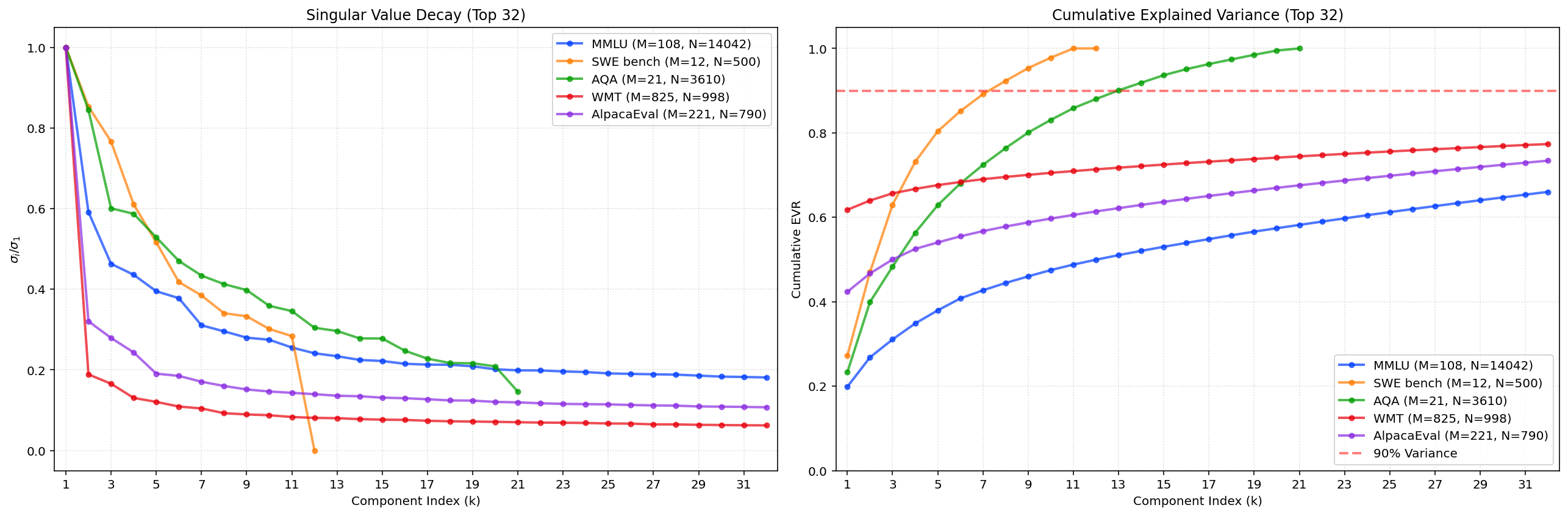
- Low effective rank: A property where most variance is explained by a few singular components despite large matrix size. "low effective rank"
- Low-rank approximation: Representing a matrix by a product of low-dimensional factors to capture dominant structure. "low-rank approximation of the score matrix"
- Matrix completion: Predicting missing entries of a partially observed matrix using structure like low rank. "matrix completion"
- Matrix factorization: Decomposing a matrix into low-dimensional factors whose product approximates the original. "low-rank matrix factorization"
- Mean squared error: The average squared difference between an estimator and the true parameter, measuring accuracy. "mean squared error"
- Nuclear norm minimization: A convex relaxation technique for low-rank matrix recovery via minimizing the sum of singular values. "nuclear norm minimization"
- Paired sampling: A design where the same prompts are labeled across multiple models to exploit correlation in comparisons. "Paired sampling"
- Power tuning: Scaling control-variates to guarantee variance no worse than classical estimation. "power tuning"
- Prediction-powered inference: A framework that combines cheap predictions with a small set of labels to obtain unbiased, efficient estimates. "prediction-powered inference"
- Singular vectors: Directional components from SVD that capture principal structure in data matrices. "singular vectors"
- SVD: Singular Value Decomposition, a matrix factorization into singular vectors and singular values. "based on SVD"
- Variance reduction: Decreasing estimator variability, often by leveraging correlated auxiliary information. "variance reduction scales with the squared covariance"
Collections
Sign up for free to add this paper to one or more collections.