- The paper introduces MRMS, a memory substrate that pre-generates control for agent actions by synchronizing structured records, vector embeddings, and directed memory graphs.
- The evaluation shows MRMS achieves 98.8% overall accuracy with superior revision, stale suppression, and boundary control in controlled synthetic benchmark tasks.
- The work establishes a traceable, auditable, and scope-aware memory system, offering both practical deployment for AI agents and theoretical insights for long-lived autonomy.
MRMS: A Principled Substrate for Multi-Resolution Agent Memory
Motivation and Background
Long-lived AI agents require continuity across interactions, an ability not achieved by simply expanding prompt windows or storing conversation transcripts. Such agents must preserve goals, preferences, decisions, and unresolved tasks, maintaining a balance between stability and plasticity. Typical transcript-based memory systems fail to distinguish durable preferences from volatile instructions, external evidence from personal context, or outdated facts from current realities. Memory errors in agentic settings are propagated, affecting future interactions adversely—a false positive, such as a stale preference, can contaminate subsequent reasoning indefinitely.
This paper introduces MRMS (Multi-Resolution Memory Substrate), aiming to shift memory systems from passive storage to pre-generation control, focusing on whether retrieved items should influence agent actions and how provenance, scope, and revision are managed. The paper situates MRMS within broader research on neural and agentic memory architectures, contextualizing its design against retrieval-augmented approaches, knowledge graphs, and memory benchmarks in conversational and lifelong AI.
MRMS is constructed as a two-axis memory substrate: one axis encodes representational diversity, the other temporal commitment. The representational axis integrates structured records (authoritative state), dense vector embeddings (semantic recall), and directed memory graphs (relational validity). The temporal axis spans short-term traces, medium-term abstractions, and long-term semantic commitments, with external evidence handled distinctly.
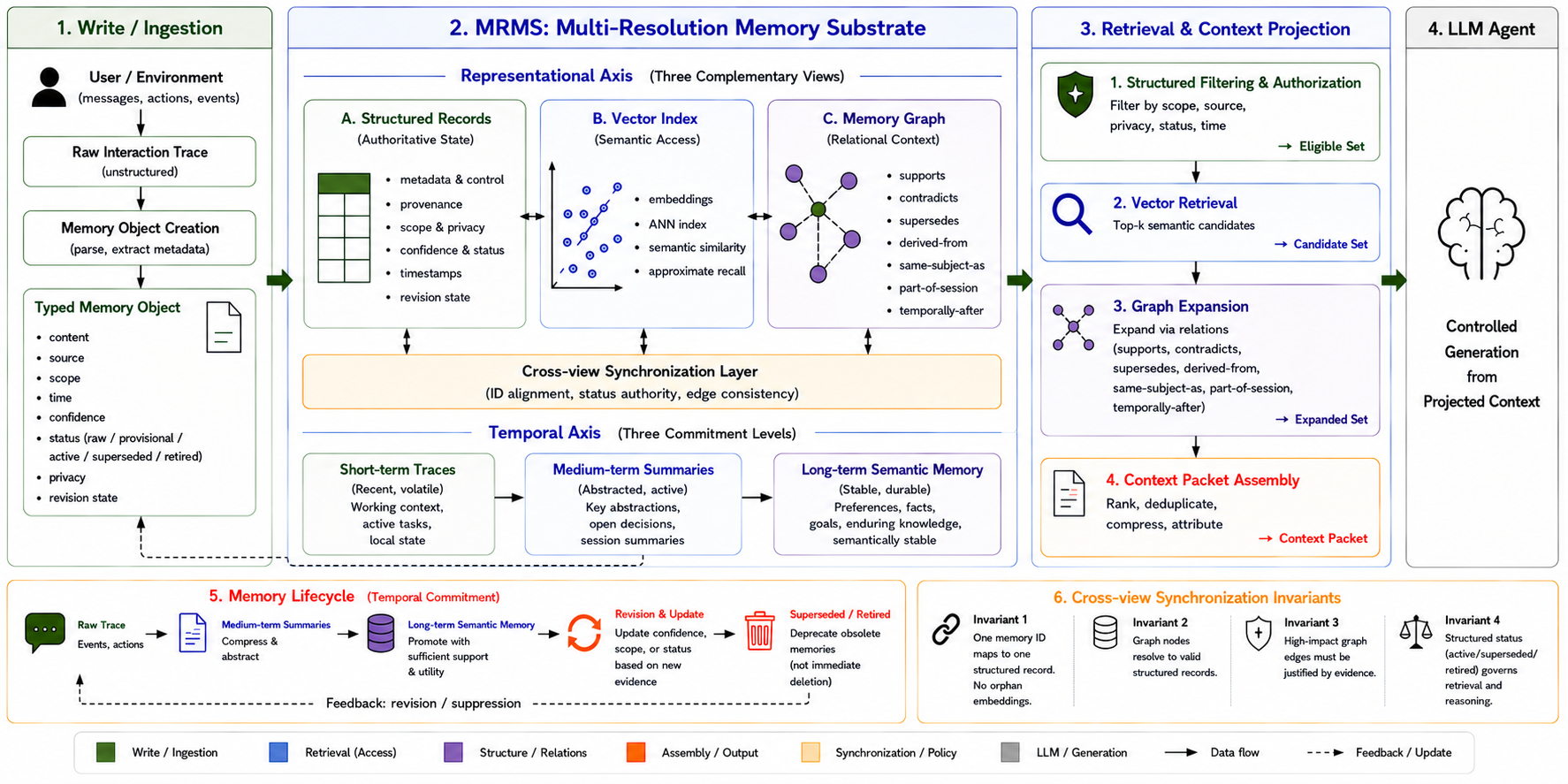
Figure 1: MRMS architecture: write/ingestion, synchronized memory views, retrieval, lifecycle, and cross-view invariants.
Each memory object is explicitly structured with fields for layer, claim, vector representation, source, attribution, scope, confidence, and revision history. The structured component not only stores memory but governs its eligibility and lifecycle. The three representational views—structured, vector, graph—are synchronized via stable identifiers, ensuring that semantic retrieval cannot bypass scope boundaries, ignore revision history, or reintroduce obsolete or superseded memories.
Temporal commitment is managed conservatively: rapid capture in lower layers is possible, but promotion to durable status demands repeated evidence and task utility, controlling the stability-plasticity trade-off. MRMS thus decouples storage from influence: memory objects may persist as evidence but are restricted from guiding generation unless actively authorized.
Substrate Operations and Mechanism
MRMS operates through a five-stage cycle:
- Write: Records an interaction trace with low temporal commitment, updating the structured store, vector index, and initial graph edges.
- Select: Projects memory into the generation context, applying structured gates, semantic ranking, graph evidence expansion, and boundary constraints. Selection is decomposed into eligibility sets, semantic candidates, evidence subgraphs, and compact context packets.
- Consolidate/Revise: Transforms traces into summaries, facts, and relations, promoting objects based on support, utility, and risk. Revision handles contradiction, decay, and correction via status updates, splitting, or supersession.
- Boundary Projection: Restricts memory exposure according to subject, task, mode, privacy, and scope, supporting negative context to suppress stale or misleading evidence.
- Context Packet Assembly: Generates structured packets for the LLM, separating local state, episodic evidence, semantic claims, graph-derived relation notes, external evidence, and negative context.
The synchronization invariants guarantee correctness: structured status dominates context projection, suppressing stale or retired memories even if semantically retrievable or graph-adjacent. High-impact graph edges are always backed by evidence records. This architecture enables robust, inspectable memory governance and mitigates common failure modes such as unauthorized retrieval, silent overwrite, and unresolved contradiction.
Evaluation Protocol and Numerical Results
The substrate is evaluated using a synthetic benchmark encompassing six criteria: continuity, specificity, parsimony, revision, non-interference, and attribution. The controlled protocol includes 800 tasks covering delayed recall, boundary control, revision, stale suppression, evidence attribution, contradiction handling, and temporal commitment.
Diagnostic ablations isolate the contribution of each substrate mechanism. The results are quantitatively emphatic: full MRMS achieves 98.8% overall accuracy (95% bootstrap interval 98.0--99.4), with perfect scores in revision, stale suppression, boundary control, and abstention, and 95% attribution success. Structured and vector retrieval improves recall and boundary filtering, but only temporal policy and graph expansion yield high revision and contradiction handling. MRMS selects 1.11 memory objects after scoring 1.8 scoped candidates per context, demonstrating concise, high-confidence context projection.
Qualitative analysis supports the architectural premise: vector-only retrieval favors semantically similar but obsolete memories; structured filtering enforces authorization; graph expansion resolves contradiction and supports evidence attribution. Residual errors in full MRMS are limited to evidence attribution misses in noisy cases.
Practical and Theoretical Implications
MRMS formalizes the substrate-level contract between structured control, semantic retrieval, relational validity, temporal commitment, and boundary-aware reasoning. The explicit synchronization invariants and controlled join across representational views differentiate it from prior retrieval-augmented generation, memory networks, or transcript-based systems.
Practically, MRMS supports traceable pre-generation decisions, enabling auditability and explainability in agentic memory. It is backend-agnostic and compatible with learned retrievers, conversational benchmarks, and real-world agent deployments. The diagnostic protocol ensures that evaluation is tied to memory substrate correctness, not only downstream answer quality.
Theoretically, MRMS reframes agent memory as a governed influence substrate rather than an extension of prompt windows or persistent transcript logs. This conceptual separation is essential for robust, long-lived agency. Future directions include integration with LLM agents, optimization of learned embeddings, expanded conversational error analysis, and attachment of memory traces to downstream answer evaluation.
Conclusion
MRMS proposes a rigorous, synchronized substrate for agent memory, jointly organizing structured, vector, and relational views along temporal axes. It is distinguished by explicit architectural invariants, conservative temporal commitment, and scope-aware context projection. Strong diagnostic results validate that reliable agent memory requires more than recall—it must enforce structured eligibility, relational reasoning, and revision. The framework advances agentic memory systems toward robust, auditable, and controllable substrates for long-lived autonomy (2607.04617).