- The paper introduces a two-pillar XAI protocol that probes encoder constraint structure and attributes decoder decisions for interpretable neural combinatorial solvers.
- It demonstrates that graph-based encoders (Unimp, UnimpMoe) outperform the Att baseline by effectively organizing constraint information with higher NMI and macro-F1 scores.
- The study highlights that Recourse decoders yield actionable counterfactual explanations while balancing performance and explanation stability in operational VRP settings.
Interpretability Protocols for Neural Multi-Attribute VRP: Encoder Probing and Decoder Attribution
Introduction
The paper "Two Black Boxes, One Solver: Encoder Probing and Decoder Attribution for Neural Multi-Attribute VRP under Hard-Mask and Recourse Decoders" (2607.04487) addresses the challenge of interpreting neural combinatorial solvers for the Multi-Attribute Vehicle Routing Problem (MAVRP), a combinatorial optimization variant where instances activate arbitrary combinations of canonical routing constraints (capacity, time-windows, route distance, open routes, backhaul, etc.). While recent neural policies such as Transformer-based or graph-structured autoregressive solvers are competitive on MAVRP benchmarks, their step-by-step decisions are opaque, rendering them challenging to validate and compare in operational dispatch settings.
This paper proposes a comprehensive two-pillar explainability (XAI) protocol: (i) probing the encoder’s representations for constraint structure, and (ii) attributing decoder actions to input features through multiple complementary attribution methods. The analysis evaluates six solver variants—three encoders (Att, Unimp, UnimpMoe) paired with two decoders (Hard-Mask, Recourse)—along five explicit XAI criteria. The results reveal both representational and decision-layer interpretability effects, identifying architectural and training-regime factors that drive actionable explanations in neural combinatorial optimization.
Encoder Analysis: Probing Constraint Structure
The first protocol pillar interrogates encoder representations, specifically the per-node latent vectors that summarize the input instance. Linearly supervised probes, unsupervised cluster metrics, effective rank computations, and alignment with constraint-concept banks collectively quantify how well constraint information is encoded and organized.
Graph-based encoders (Unimp, UnimpMoe) distinctly outperform the Att baseline on cluster organization and label recovery, with higher NMI, macro-F1, and richer representation occupancy. Notably, UnimpMoe achieves competitive informativeness but distributes constraint information across subspaces, as opposed to the more axis-aligned Unimp. This distributed coding is only revealed by considering both axis-unique and subspace probe scores, underscoring the importance of geometric diagnostics beyond linear axis alignment.
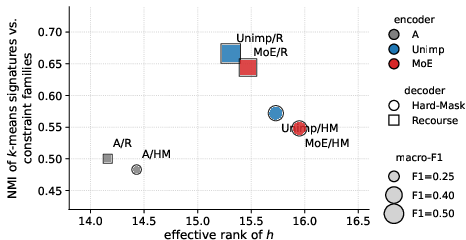
Figure 2: Joint reading of the encoder pillar: effective rank (x-axis), NMI (y-axis), and macro-F1 (size) show Unimp/Recourse at the upper-right, UnimpMoe maximizing rank, and Att concentrated at bottom-left.
The detailed PCA/ICA alignment analysis demonstrates that leading encoder PCs correlate strongly with individual constraint indicators (e.g., Att's PC1 with route openness, Unimp’s PC1 with time-windows). However, time-window information remains distributed across several components in GNN-based latents, reflecting GNNs' capacity for compositional representations.
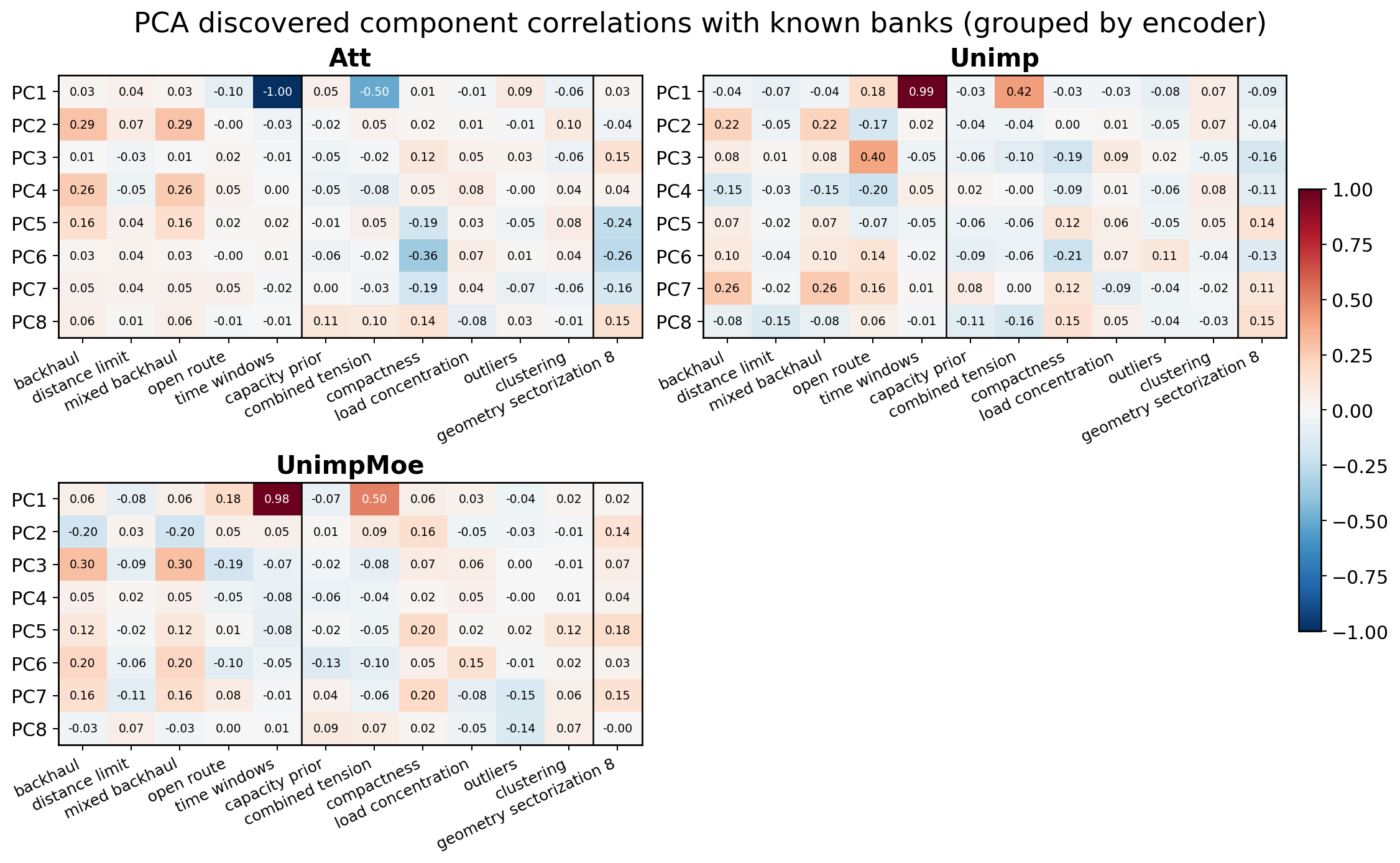
Figure 1: Alignment of leading PCA components with constraint and concept indicators for each encoder; Unimp family PCs align with time-windows, Att’s with route openness.
Intervention validation confirms that pushing along these aligned axes in latent space causally modulates the targeted constraint dimensions in the decoded solutions. Concept-level interventions succeed across all model variants, but direction-level success rates are lower for graph-based models, supporting the distributed coding hypothesis.
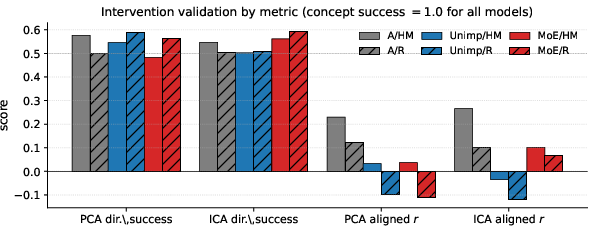
Figure 3: Intervention validation: the rate at which perturbations aligned with principal components yield desired concept changes across encoder-decoder variants.
Decoder Attribution: Decision Explanations and XAI Criteria
The second protocol pillar attributes per-step decoder decisions to input features using three attribution techniques (gradient, integrated gradients, DeepLIFT) and three analytic “reading angles” (abductive, contrastive, counterfactual). These are evaluated under five XAI criteria: fidelity (faithfulness), concentration, stability, sanity, and actionability.
The explicit separation between a Hard-Mask decoder (unconditionally enforces feasibility at inference via masking) and a Recourse decoder (learns feasibility, exposed to infeasible states and penalized via recourse cost) is central. Only Recourse decoding enables counterfactuals that cross the feasibility boundary: perturbing inputs to turn infeasible alternatives feasible.
Attribution shares, aggregated by constraint family, show that Recourse decoders shift significant explanatory mass into dynamic decoder-state features (“other”), and the dominant constraint family shifts between capacity, geometry, and time-windows depending on the encoder and attribution method. The family most responsible for decisions is not static.
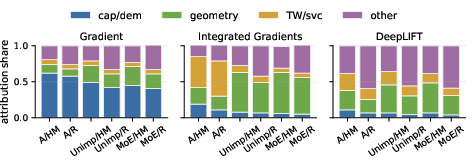
Figure 4: Attribution mass share by constraint family and decoder; Recourse amplifies dynamic decoder-state features and diffuses mass across families.
Contrastive attribution demonstrates that Recourse substantially increases the rate of feasible alternatives at decoding steps, yielding more granular “why not this” explanations and a denser contrastive landscape. The average logit margin between the chosen and best alternative remains small, supporting the claim that many decisions are near-ties, in which contrastive attributions are maximally informative.
Deletion and flip tests for faithfulness reveal that perturbing top-attributed nodes flips model decisions in up to 52% of steps for the best graph encoder/Recourse combinations, with consistently higher log-probability drops relative to the Att baseline. Attribution faithfulness is robust to the choice of method, though qualitative explanations differ.
Sanity checks, using randomized-weight controls, substantiate that graph-based encoders produce substantially more meaningful attributions than Att, which displays some architectural saliency independent of learned parameters. Stability is moderate at node level but high at family level for Hard-Mask decoders; Recourse explanations, while richer and more actionable, are less stable in the dominant family dimension.
The counterfactual switch and make-feasible search exposes an essential property: only Recourse policies admit make-feasible counterfactuals. Hard-Mask policies, even when externally unmasked, fail to provide input perturbations that render infeasible alternative actions feasible. This demonstrates that the training regime—not merely the decoder mask—determines the presence of actionable, recourse-oriented counterfactuals.
XAI scorecard aggregation over eight metrics consistently ranks Unimp/Recourse highest, especially on faithfulness and actionability, while Att/Hard-Mask is never dominant. Recourse decoders trade off some explanation stability for increased actionable richness.
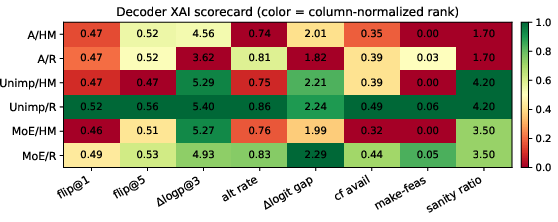
Figure 5: Scorecard aggregating eight XAI metrics (columns) across encoder-decoder variants (rows): Unimp/Recourse is consistently top-ranked.
Implications, Theoretical Insights, and Future Directions
Architectural choices that embed graph inductive bias improve both the predictability and stability of constraint representations. MoE augmentations alter not the amount but the geometry of information, promoting distributed (non-axis-aligned) coding. These findings extend to problem sizes up to n=100.
Decoder design fundamentally alters the type of explanations the solver can produce. Recourse-trained decoders enable make-feasible counterfactuals and more actionable, dynamic state-based attributions without severe performance cost (approximately 1% optimality gap relative to Hard-Mask). This raises the possibility of jointly optimizing for inference cost and interpretability by tuning the recourse training regime and mask tightness.
Practical deployment in logistics contexts can directly leverage these advances: richer, validated, and actionable explanations support diagnosis, compliance auditing, and operator override, addressing longstanding barriers to neural policy adoption in sensitive operational environments.
Theoretical prospects include developing stability-regularized or multi-family attributions to further reconcile the stability–richness trade-off, extending make-feasible counterfactuals to other recourse-style policies (scheduling, bin packing), and growing the XAI evaluation grid and controls to set benchmarks for neural combinatorial optimization explainability.
Conclusion
This work establishes a rigorous, multi-criterion XAI protocol for neural CO solvers, demonstrating that both encoder architecture and decoder training regime are critical determinants of interpretability in MAVRP policies. Recourse decoding with graph-based encoders yields policies that balance performance with actionable and faithful explanations, revealing representational and decision-making phenomena invisible to inference cost alone. The methodologies and findings in this paper lay the foundation for future research on explainability standards and practical deployment of neural solvers in combinatorial operations.