- The paper introduces a novel ISA-based architecture with reconfigurable mCores that separate processing domains to improve DNN efficiency.
- It employs dynamic precision with configurable operand bit-widths via custom instructions and achieves 5.14–10.47 TOPS/W on 22-nm ASICs.
- It utilizes RNS and flexible dataflow control to optimize resource utilization, outperforming comparable FXP accelerators by up to 1.2×.
A Reconfigurable and Representation-Adaptive ISA-Based Architecture for Efficient DNN Acceleration
Architectural Overview
The proposed architecture aims to address the inflexibility of domain-specific accelerators and the inefficiency of general-purpose ISA-based solutions by introducing a machine-learning-oriented instruction set architecture (ISA) and a reconfigurable hardware platform. The design prioritizes high computational efficiency, low control overhead, and flexibility in data representation and precision management.
A defining feature of the architecture is the strict separation of four processing domains: data-fetching, pre-processing, tensor processing, and post-processing. These are orchestrated by lightweight programmable mCores, which operate via custom instruction streams and synchronize data movement through structured data streams (DSs). The tensor processing arrays (TPAs) adopt an integer SIMD model, supporting dynamic precision and flexible operand broadcast.
Figure 1: The architecture integrates four processing domains, orchestrated by lightweight programmable mCores and structured data streams, achieving reconfigurability via virtual register files.
ISA and Control Microarchitecture
The custom ISA is designed specifically for DNN workloads, with 32-bit instructions supporting essential data movement, arithmetic, SIMD, and synchronization operations. The ISA decouples control flow, memory access, computation, and post-processing, facilitating high utilization across various DNN layers—including convolutions, matrix multiplications, and transformer primitives.
Three mCore types are defined: a master core (Type-I) for global control, a memory control core (Type-II) for memory banking and data movement, and an arithmetic core (Type-III) for domain-specific pre-processing. All mCores feature pipelined datapaths, configurable register file depths, and optional shared registers, supporting scalability and extensibility.
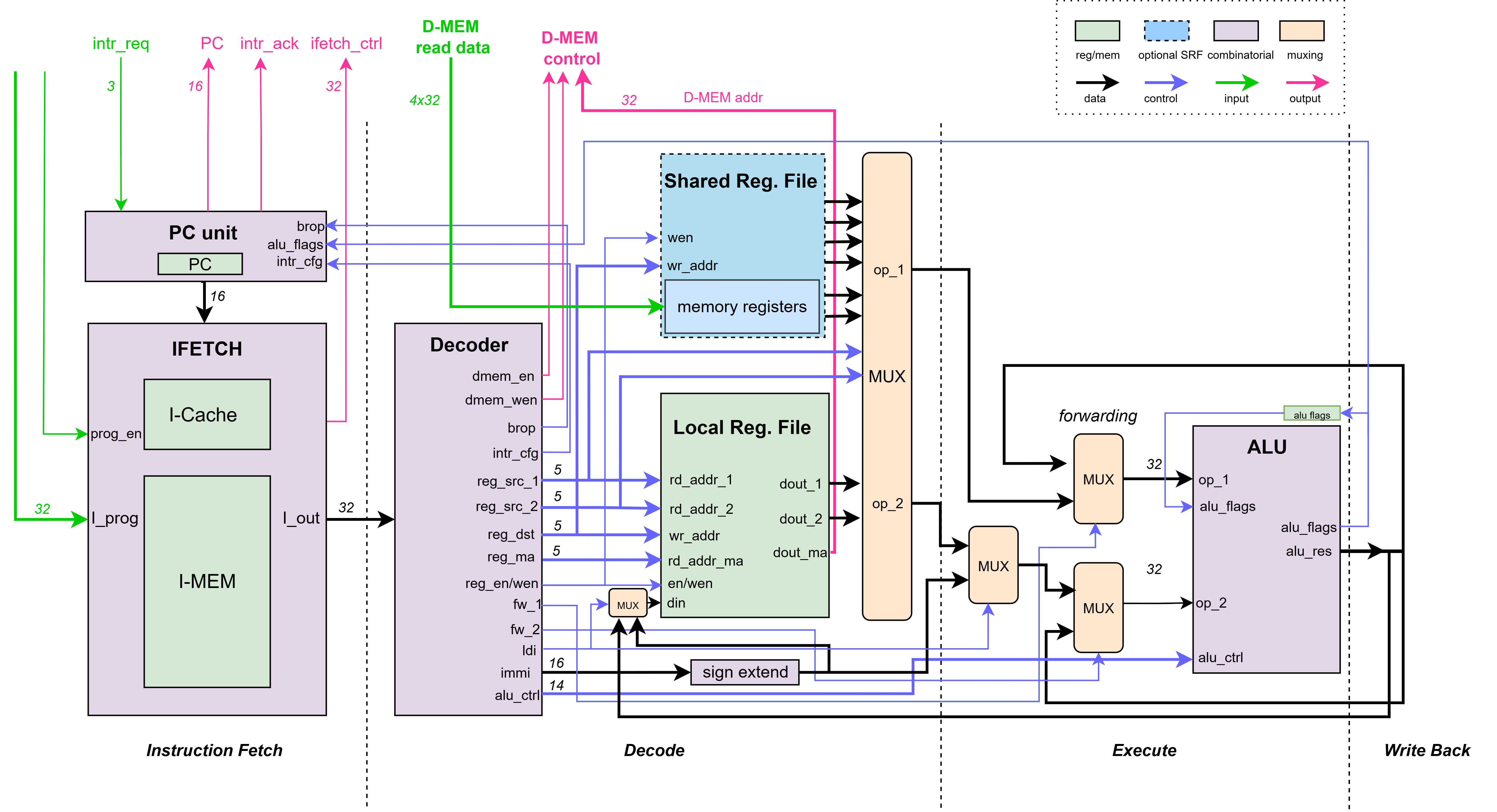
Figure 2: mCore block diagram, showing register files, ALU, instruction decoding, and configurable interfaces for controlled data movement.
Memory Hierarchy and Dynamic Precision
The memory subsystem is organized into multiple hierarchies (OP1MEM/OP2MEM/OP1CACHE), each supporting distinct access patterns and precision modes. Operand precisions are set via ISA instructions, enabling both coarse-grained (4/8-bit) and fine-grained (3–8-bit) quantization.
A novel aspect is the ISA-level support for half-precision operations, utilizing custom instructions (add_hpl/add_hph) to process multiple narrow operands per memory access, which streamlines bandwidth and storage demands.
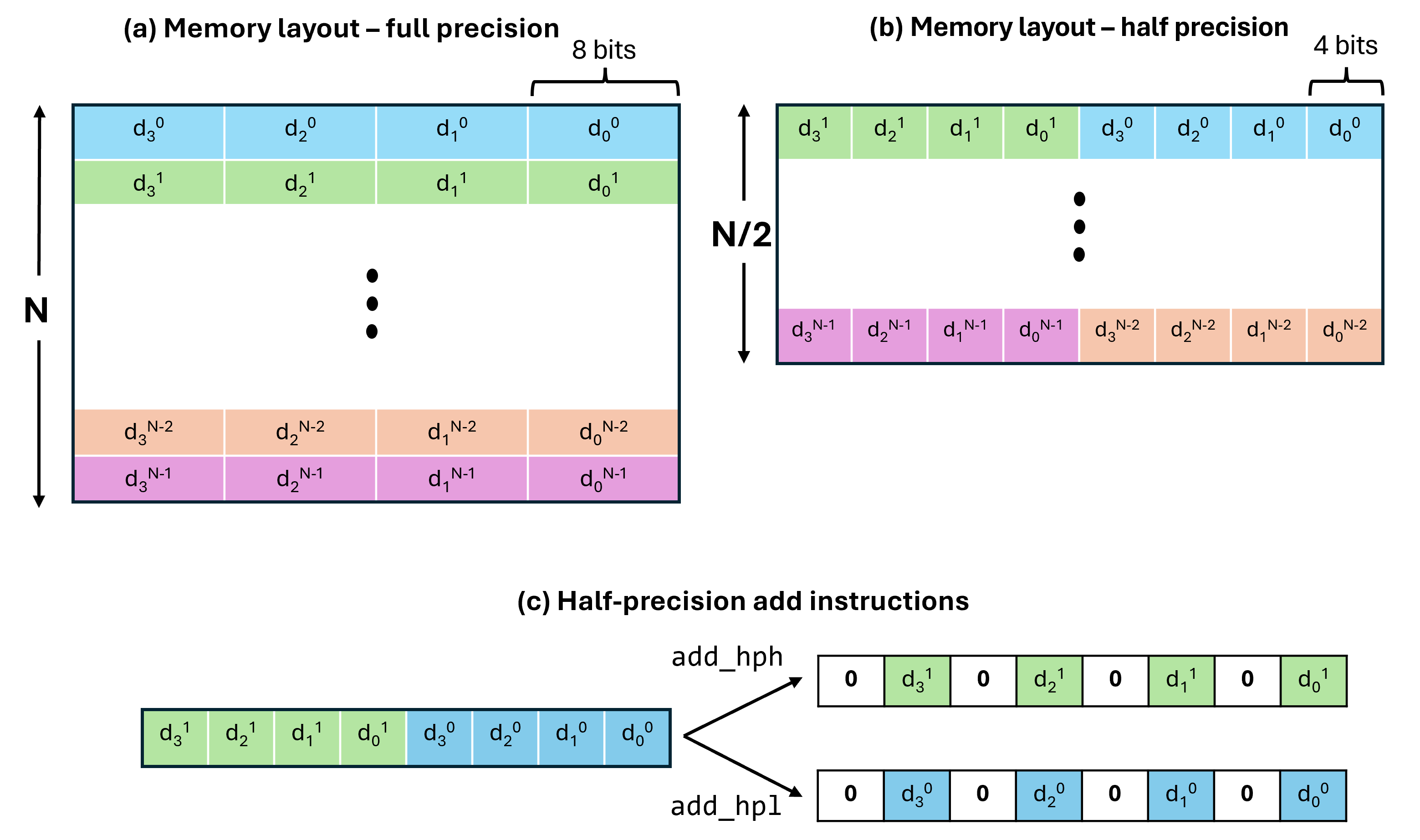
Figure 4: Memory layouts and operand manipulation via add_hpl/add_hph enables efficient dynamic precision at memory and register stages.
Post-Processing and Non-Linear Function Support
Post-processing units (PPUs) are decoupled from the main compute pipeline and execute activation functions—including ReLU, GeLU, sigmoid, and tanh—using piecewise-linear (PWL) approximations to balance performance and numerical fidelity. The architecture provides flexible instruction-level support for reduction, quantization, and normalization.
RNS-Based Accelerator Instantiation
The architecture is instantiated in a Residue Number System (RNS), leveraging base subsets dynamically to match application- and layer-level precision demands. RNS arithmetic is exploited for its carry-free addition/multiplication, yielding improved energy efficiency and parallelism, especially in wide or mixed-precision contexts. Fixed-point to RNS conversion is handled transparently in hardware, exposing a data-representation-agnostic ISA to software.
The paper systematically explores RNS base selection, optimizing for accuracy–cost trade-offs across multiple DNN benchmarks using a hardware-aware quantization framework. Energy cost modeling incorporates both TPA residue channel selection and power breakdowns from full post-layout ASIC analysis.
Numerical Results and Evaluation
The 22-nm RNS-based accelerator achieves 5.14–10.47 TOPS/W under typical DNN workloads with activation/weight precisions configurable from 3 to 8 bits. The RNS instantiation outperforms both fixed-point (FXP) and state-of-the-art mixed-precision ASIC/RISC-V accelerators by 1.15–1.20× under equal accuracy constraints, with RNS evidencing greater gains in quantization-sensitive models (e.g., Yolov5).
PE utilization consistently exceeds 90% even for complex dataflows and non-standard layers via ISA and mCore control, as verified by block-level templates spanning convolutions, attention, and transformers.
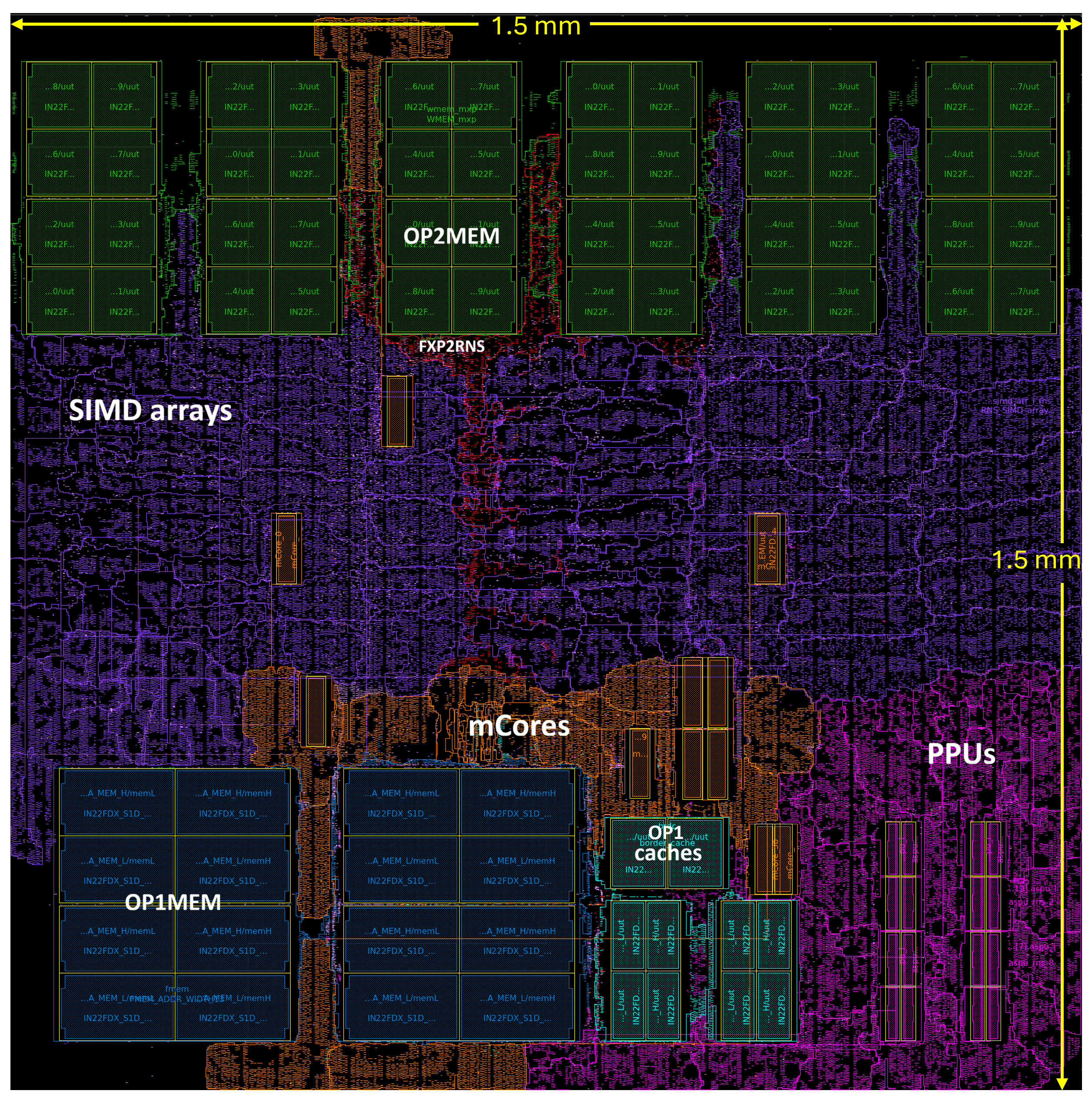
Figure 6: Placed-and-routed 22-nm accelerator layout with hierarchical domains annotated.
Base utilization statistics show adaptive base selection according to quantization sensitivity: for models tolerant to aggressive quantization (e.g., ResNet-18 under 2% accuracy loss), minimal base sizes dominate, whereas sensitive models (e.g., Yolov5-m) require larger dynamic ranges, favoring RNS.
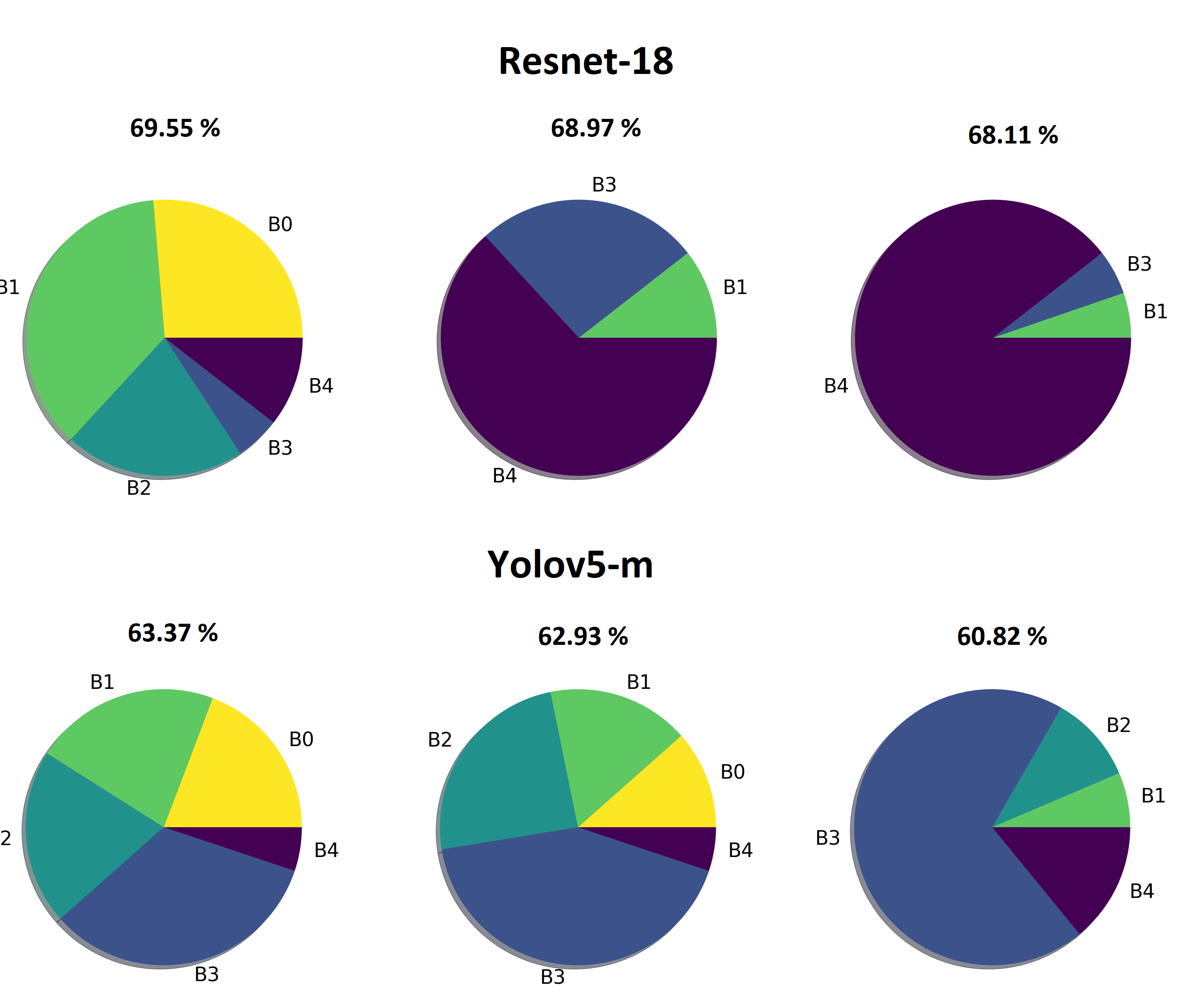
Figure 8: Base utilization for various accuracy constraints shows algorithmic adaptation—ResNet-18 prefers smaller bases for modest accuracy loss, Yolov5-m skews to larger bases.
Comparisons with State-of-the-Art
The architecture is directly compared to established ASIC and RISC-V designs. While RISC-V coprocessor-based and vector extension designs achieve high utilization, they incur non-negligible control/area overheads and are less efficient under dynamic precision scaling. Notably, the proposed solution’s mCore overhead is consistently under 5–9% of total power, compared to ≥15% for some flexible dataflow engines.
Strong results are noted for layer-fusion operations for depthwise–pointwise convolutions, with explicit architectural support for inter-layer dataflow and resource partitioning, which improves throughput and utilization in MobileNet-like workloads.
Implications and Future Directions
This work empirically validates that combining a minimal, ML-tailored ISA with reconfigurable lightweight cores and fine-grained dynamic precision can close the programmability--efficiency gap in AI accelerators. By making the ISA data representation agnostic, architectural instantiations can natively explore alternative numerics (e.g., RNS, fixed/floating point, or log-domain) with near-zero software refactoring.
For future research, prospects include (1) further specialization of mCores for ultra-low-power edge regimes, (2) expansion to other alternative numerics (e.g., Posit, LNS), and (3) automated high-level-to-ISA compilation frameworks for efficient model deployment.
Conclusion
This architecture demonstrates that it is feasible to deliver both high efficiency and flexibility in deep learning acceleration by means of representation-agnostic, extensible instruction sets, dynamic precision, and intelligent hardware partitioning. The substantiated 1.2× end-to-end efficiency advantage over comparable FXP and programmable accelerators is underpinned by empirical validation on leading DNN models, with practical implications for next-generation edge AI and adaptable inference hardware.