Entanglement of excited states after measurements in conformal field theory
Published 5 Jul 2026 in hep-th and cond-mat.stat-mech | (2607.04268v1)
Abstract: We study the entanglement of low-energy excited states after a fixed-outcome projective measurement on a spatial interval in a (1+1)-dimensional conformal field theory (CFT). The post-selected measurement outcome is represented by a slit carrying a conformal boundary condition, while excited states are introduced by operator insertions in the Euclidean path integral. After mapping the replicated slit geometry to a disk, the excited-state contribution to the post-measurement Rényi entropy is expressed as a normalized boundary-CFT correlation function. We apply this framework to the compact free boson CFT. For the chiral current excitation, the relevant ratios are given by current hafnians. We also study coherent superpositions of J and Jˉ, and of conjugate compact vertex operators. In the conjugate-vertex case, the ordinary-cylinder second Rényi ratio is independent of the relative phase, whereas the finite-slit post-measurement ratio contains phase-sensitive interference terms. Finally, we describe free-fermion and multi-Slater determinant methods for testing these predictions in the critical XX chain.
The paper presents a rigorous BCFT framework using the slit cylinder geometry to compute post-measurement entanglement of excited states in 1+1D critical systems.
It derives explicit formulas for Rényi entropy corrections through normalized multi-point boundary correlators, validated by lattice results on the XX chain.
The study reveals that measurement-induced boundaries expose coherent phase sensitivity, enabling observation of interference effects previously hidden in global states.
Entanglement of Excited States After Measurements in Conformal Field Theory
Framework and Geometric Structure
This work establishes a rigorous conformal field theory (CFT) formalism for computing the post-measurement entanglement of low-energy excited states, following a fixed local projective measurement in 1+1D critical systems. The key geometric object is the "slit cylinder," generated by interpreting the measured spatial interval as a slit with a boundary condition determined by the infrared flow of the measurement outcome. The entanglement between the remaining degrees of freedom (in particular, for an interval adjacent to the slit) is analyzed for both ground and excited states.
The general CFT formula for post-measurement Rényi entropies of such excited states—produced by operator insertions at Euclidean past and future—is derived as a normalized multi-point boundary CFT correlator on an n-sheeted covering space with a slit boundary. The uniformization maps the branched slit geometry to a disk, facilitating analytic calculations and explicit separation of geometric and operator content. Excited states created by coherent superpositions, even with different chiralities or vertex charges, are also addressed, requiring careful treatment of branch and phase conventions, especially under conformal maps.
Explicit Results for Compact Free Boson CFT
Specialization to the compact free boson CFT allows for closed expressions for the excited-state corrections to the post-measurement entanglement.
Chiral Current Excitations
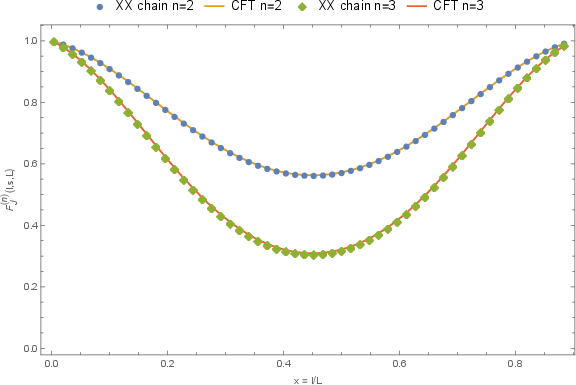
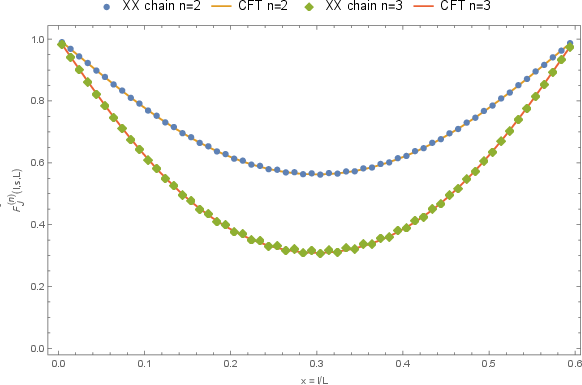
For excitations created by the chiral currents J=∂ϕ and Jˉ=∂ˉϕˉ, the relevant normalized post-measurement correlation functions reduce to combinatorial hafnians of two-point disk correlators, yielding explicit formulas for the second and third Rényi entropy corrections:
FJ,a(2)=2561(ρ+ρ−1+14)2,ρ=η−η+
FJ,a(3)=811(ρ+ρ−1+7)2
Here η± are disk coordinates encoding the geometry of the slit and entangling interval.
Figure 1: Numerical check of the post-measurement current-excitation ratios in the XX chain, demonstrating quantitative agreement between lattice Slater determinant calculations and the CFT hafnian predictions for different slit-to-system ratios.
Coherent Superpositions and Phase Sensitivity
The framework is extended to coherent superpositions, such as left-right current superpositions ∣Ψ1⟩=p∣J⟩+eiθ1−p∣Jˉ⟩, and superpositions of conjugate vertex operators (Umklapp states in the XX chain). In these cases, the post-measurement correction is given by a phase-sensitive sum of boundary multi-point correlation functions, which, crucially, exhibit explicit dependence on the relative phaseθ when the measurement-induced boundary breaks the chirality or charge sectors.
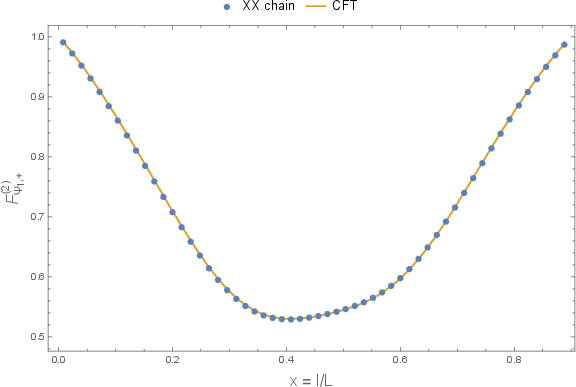
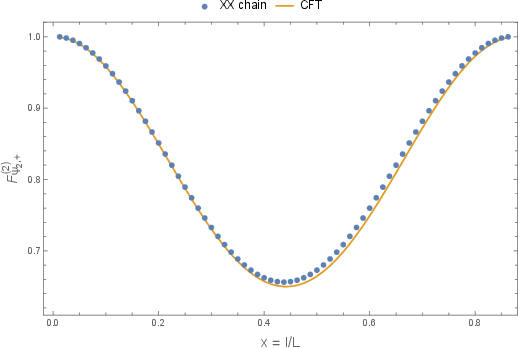
For the vertex superposition ∣Ψ2⟩=p∣V+⟩+eiθ1−p∣V−⟩ (where V± are conjugate vertex operators), the ratio J=∂ϕ0 entering the second Rényi entropy depends critically on both geometry and J=∂ϕ1 for a finite slit. In the unmeasured case (no slit), all phase-dependent terms vanish due to charge neutrality in the standard CFT cylinder geometry.
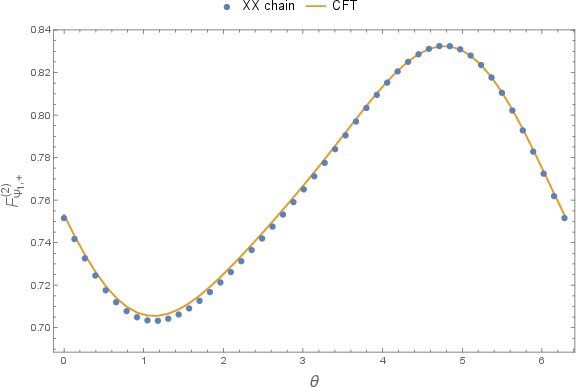
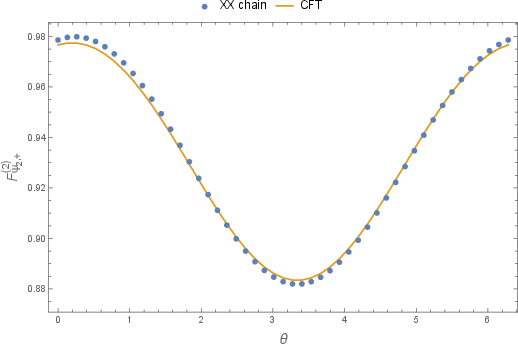
The post-measurement boundary thus renders the superposition phase observable in the reduced entanglement spectrum—an effect invisible in the unmeasured global state.
Figure 2: Post-measurement second Rényi ratios for J=∂ϕ2 superpositions in the XX chain: symbols denote multi-Slater determinant lattice calculations; solid lines are CFT predictions. The left panel scans subsystem size; right panel scans relative phase, confirming phase-sensitive interference.
Figure 3: Conjugate vertex superposition, phase scan: numerical XX-chain and analytic CFT results verify phase-dependent post-measurement entanglement, absent in the unmeasured case.
Lattice Validation: Critical XX Chain
The theoretical predictions are validated by explicit lattice calculations for the critical XX chain at half filling. For single Slater determinants (ground or current-excited states), conditional free-fermion correlation matrices are employed to compute the post-measurement entanglement entropy. For coherent superpositions (which are not Gaussian), a multi-Slater determinant method is employed, leveraging an exact determinant formula for the trace of powers of the reduced density matrix of such states, including all interference sectors.
Quantitative agreement with CFT predictions is demonstrated for all cases in both geometric and phase dependence.
Theoretical and Practical Implications
The results provide a comprehensive analytic and numerical methodology to quantify how local measurements alter the entanglement structure, not only for ground states but also for generic low-energy excited and superposed states within critical systems. The work establishes:
That measurement-induced boundaries in CFT can make coherent phase information operationally accessible via entanglement observables, even when standard global measures are phase-blind.
That interference effects in excited superpositions can be unambiguously probed in the post-measurement entanglement spectrum.
These insights have potential applications in measurement-induced critical phenomena, quantum information protocols exploiting measurement-generated boundaries, and in studying nonequilibrium quantum dynamics involving local measurements (including quantum quenches with measurement). Extension to Born-averaged (random-outcome-averaged) measurement-induced entanglement or more exotic boundary conditions (e.g., in topological phases) is an important and open direction.
Conclusion
This work constructs a robust BCFT framework for post-measurement entanglement of excited states, explicitly solves cases in the compact boson, and demonstrates nontrivial measurement-induced phase sensitivity confirmed by critical spin chain numerics. The methods and physical phenomena uncovered—especially the activation of phase-sensitive entanglement sectors through measurement—define a precise and fruitful bridge between quantum measurement, boundary CFT, and many-body entanglement (2607.04268).