- The paper reports the first experimental demonstration of logical genuine multipartite entanglement using cross-code lattice surgery between a [4,2,2] surface code and a [8,3,2] color code.
- It details the preparation and certification of logical GHZ and non-stabilizer CCZ states, with measured fidelities exceeding both entanglement and magic-state thresholds.
- The work introduces a fault-tolerant merge-split protocol leveraging complementary transversal gates to enable universal logical rotations, paving the way for scalable quantum architectures.
Genuine Multipartite Entanglement between Logical Qubits via Cross-Code Lattice Surgery
Overview and Motivation
Fault-tolerant quantum computing demands the construction of complex, highly entangled logical states across encoded qubits while maintaining protection against errors. Achieving a universal gate set for such encoded logical qubits is fundamentally constrained: no single stabilizer code can offer transversal, fault-tolerant implementations of all necessary gates due to the Eastin–Knill theorem. This work reports the first experimental realization of logical genuine multipartite entanglement (GME) between logical qubits encoded in distinct quantum error-correcting (QEC) codes, connected via cross-code lattice surgery. The approach leverages the complementary transversal gate properties provided by a [[4,2,2]] surface code (SC) and a [[8,3,2]] 3D color code (CC), both realized on a trapped-ion platform. The experimental results establish not only logical-GHZ state preparation but also synthesis and certification of non-Clifford, non-stabilizer GME (specifically, a logical ∣CCZ⟩ state), and universal logical rotations, all conducted with numerically strong fidelities that cross theoretical entanglement and magic-state thresholds. The results rigorously validate protocols that underpin heterogeneously coded, universal, fault-tolerant architectures.
Background: Lattice Surgery and Code Complementarity
Achieving universal, fault-tolerant quantum computation relies upon combining codes and protocols such that the resultant logical gate set is universal and physically accessible. Surface codes are robust against local errors and allow transversal Clifford operations (notably, logical Hadamards), whereas 3D color codes admit transversal implementations of non-Clifford gates, such as CCZ. Cross-code lattice surgery acts as a teleportation and entanglement primitive, allowing one to gauge logical operators across code blocks, thus inheriting the complementary transversal gates of each code and enabling non-trivial logical-state manipulation.
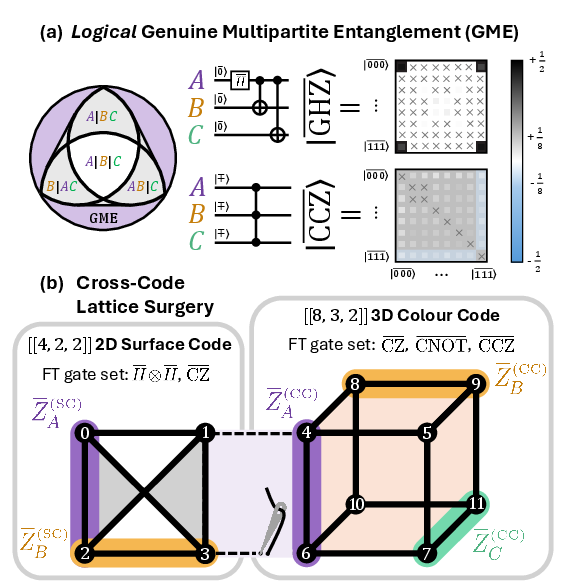
Figure 1: Logical genuine multipartite entanglement (GME) schematic for three parties, and code combination for cross-code lattice surgery.
Importantly, lattice surgery merges and splits can be realized fault-tolerantly—the protocol in this work employs smooth merges (joint logical ZZ measurements) between the [[4,2,2]] SC and the [[8,3,2]] CC to establish the merged [[12,4,2]] code block.
Experimental Implementation
Code Realizations and Fault-Tolerant Preparation
A [[4,2,2]] surface code encodes two logical qubits using four physical ions, optimized for transversal logical Hadamard gates and code-space SWAPs. The [[8,3,2]] 3D color code encodes three logical qubits, supports transversal Clifford and non-Clifford ([[8,3,2]]0) gates, and is realized with error-detecting, flag-based circuit methodologies:
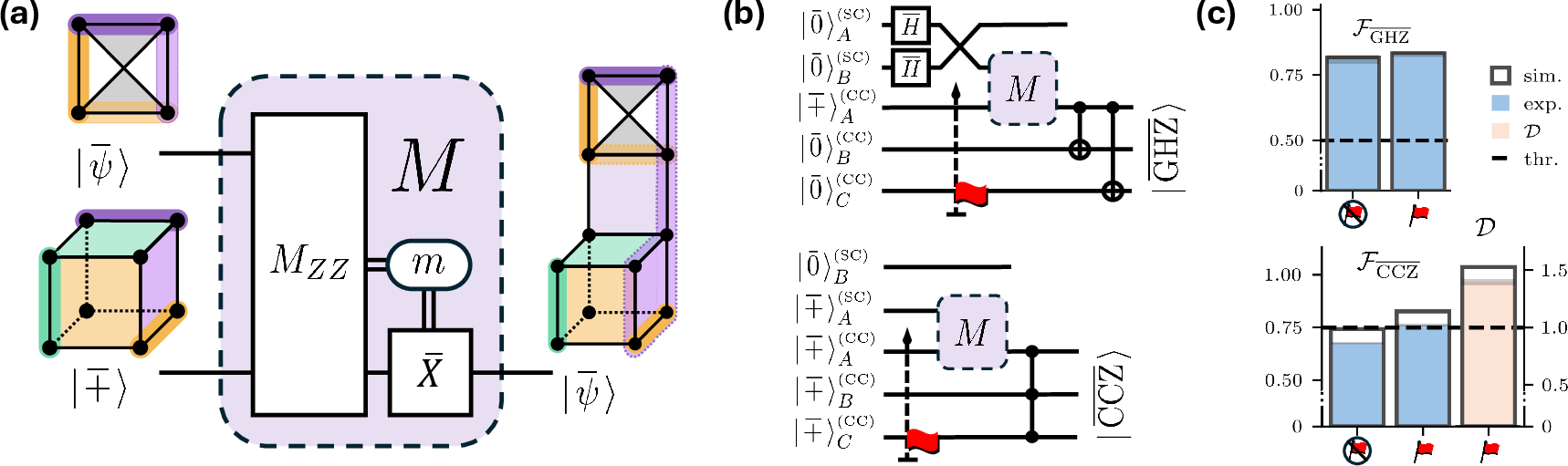
Figure 2: Schematic of code blocks, lattice surgery, and measured GME/fidelity outcomes for GHZ and CCZ logical states, including flag-based error detection.
Physical qubits are manipulated using a high-fidelity trapped-ion system with all-to-all connectivity, supporting arbitrary single- and two-qubit gates through native Mølmer–Sørensen interactions and individual addressing. Logical state initialization for both code blocks utilizes minimal-depth Clifford encoders, and flagged auxiliary qubits are employed to guarantee that potentially dangerous correlated errors are detected and can be postselected away, thus preserving fault tolerance at distance-two.
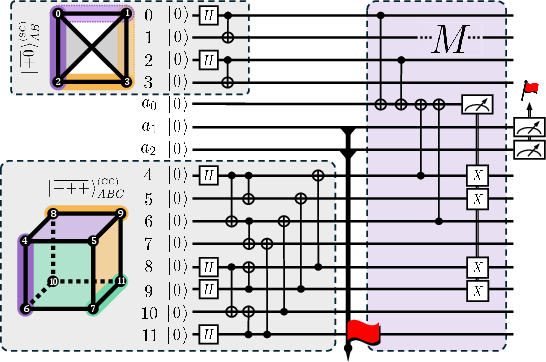
Figure 3: Physical encoding and merging circuit layout, illustrating the arrangement for flagged color-code initialization and subsequent lattice surgery.
Cross-Code Lattice Surgery Protocols
The logical [[8,3,2]]1 lattice surgery merges the [[8,3,2]]2 logical qubit from the SC with the [[8,3,2]]3 qubit from the CC, creating the merged code. Logical operators for other qubits are preserved as in the original codes, and the protocol is bidirectional, so splitting returns the logical state to the original code blocks.
Importantly, this protocol enables logical-level manipulation that draws upon the transversal gates of both codes, enabled by the measurement-conditional structure of the merge-split sequence. The merged [[8,3,2]]4 code thus supports the full universal gate set required for algorithmic and benchmarking tasks.
Experimental Results
Logical GHZ State Preparation and Verification
A three-logical-qubit GHZ state ([[8,3,2]]5) is generated on the merged code by applying the transversal logical Hadamard on the SC, followed by lattice surgery merge with the CC, and logical CNOT gate realizations (using relabeling on the hardware).
Rigorous certification of GME employs fidelity witnesses computed via logical Pauli tomography spanning the relevant generator set (with explicit formulae detailed in the paper). With fault-tolerant initialization using flag qubits, experimental fidelity is [[8,3,2]]6, exceeding the GME threshold ([[8,3,2]]7) by more than 18 standard deviations, in strong concordance with depolarizing-noise numerical simulations.
Non-Stabilizer Logical Magic-State Preparation
A non-Clifford, non-stabilizer GME state ([[8,3,2]]8, the logical hypergraph magic state) is prepared by applying the transversal [[8,3,2]]9 gate—possible only via color-code transversality—after the codes are merged and initialized as above.
The state is certified both as GME (∣CCZ⟩0) and as a non-stabilizer resource (∣CCZ⟩1, measured via the stabilizer norm), with the experiment yielding ∣CCZ⟩2 (exceeding the GME threshold by one standard deviation) and ∣CCZ⟩3, more than ∣CCZ⟩4 above the stabilizer bound. This is, to knowledge, the first report of measured logical magic-state fidelity for encoded CCZ resource states.
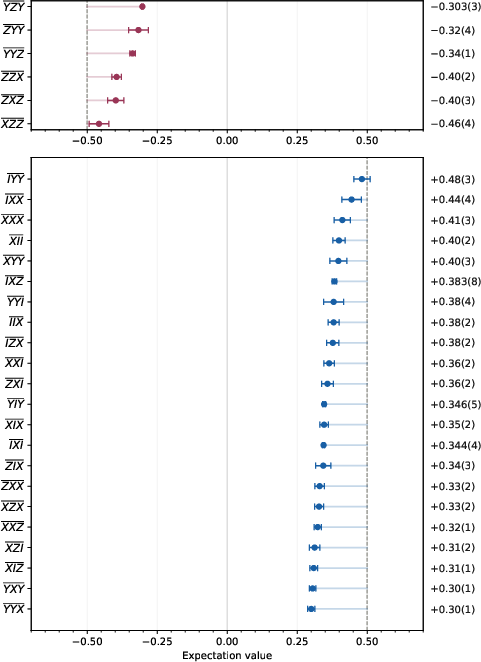
Figure 4: Logical Pauli decomposition for the ∣CCZ⟩5 state after cross-code lattice surgery.
Universal Logical Rotations via Lattice Surgery
To demonstrate universality, arbitrary angle ∣CCZ⟩6 rotations are synthesized through a teleportation-based logical rotation gadget, leveraging resource states and sequential logical operations across the two code blocks, including lattice surgery mediated transfer, transversal ∣CCZ⟩7, and a logical Hadamard.
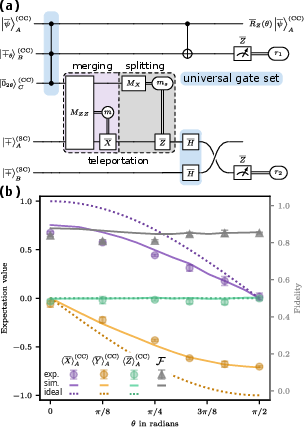
Figure 5: Circuit structure and logical expectation values for the ∣CCZ⟩8 rotation gadget, with measured fidelity vs. angle.
Experimental state fidelities for these logical rotations average ∣CCZ⟩9 post-selection, with phase tracking and measurement outcomes consistent with both ideal and noisy simulation predictions.
Implications for Fault-Tolerant Architectures
These demonstrations instantiate a flexible, fault-tolerant, code-heterogeneous quantum computing architecture where the complementarity of codes is leveraged for universality. The cross-code lattice surgery primitive enables distributed logical state synthesis, non-Clifford resource generation in situ, and state teleportation. Compared to single-code strategies dependent on magic-state factories or code-switching, cross-code lattice surgery avoids significant resource overhead and allows protocols well-suited for near-term and architecturally modular implementations.
Crucially, with all but the CCZ0 gate extensible to higher code distances (via longer boundaries and scalable flag-based fault tolerance), this approach offers a trajectory toward heterogeneously coded quantum computers with practical overhead and robust universality—pending future advances in scalable codes with transversal non-Clifford gates (e.g., stacked 3D surface or gauge color codes).
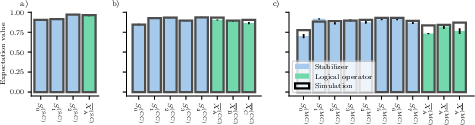
Figure 6: Logical stabilizer and CCZ1 operator expectation values for state preparation across codes, confirming correct initialization and merge logic.
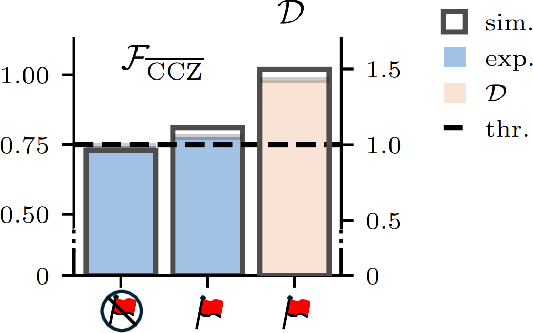
Figure 7: Merged code fidelity and non-stabilizer witness under alternative code initialization, illustrating protocol generality and code replacement impact.
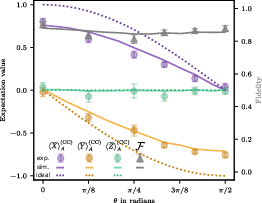
Figure 8: Logical expectation values and fidelities for arbitrary single-qubit rotation via cross-code lattice surgery.
Conclusion
This work provides the first experimental certification of logical genuine multipartite entanglement and logical magic states via cross-code lattice surgery, utilizing complementary transversal gates of CCZ2 and CCZ3 codes on a trapped-ion processor. The protocols systematically address the limitations of transversal universality in single codes by leveraging code complementarity, and achieve fidelity levels that robustly violate entanglement and magic-state thresholds. The merge primitive and associated toolbox form a blueprint adaptable to future scalable codes, establishing the methodology as a foundation for code-heterogeneous, fault-tolerant architectures. Prospects for future work include scaling to higher code distances, extending merge operations across more complex memory-processor boundaries, and systematic characterization of merge-fidelity accumulation in multi-cycle computation.

