- The paper introduces a hybrid architecture combining tetrahedral and H-tetrahedral color codes to enable an almost-universal set of transversal quantum gates.
- It demonstrates a pieceably fault-tolerant, round-robin CZ protocol that achieves p_L ~ p^2 scaling, effectively mitigating single-fault errors.
- The work significantly lowers overhead by leveraging transversal magic-state operations and aligning well with scalable hardware designs like neutral-atom quantum processors.
Complementary 3D Color Codes for Transversal Quantum Logic
Introduction
Transversal logical gates remain the backbone of fault-tolerant (FT) quantum computation due to their intrinsic error-suppression properties—each physical qubit is acted upon independently, limiting the spread of errors during gate operation. However, the Eastin–Knill theorem precludes a universal transversal gate set within a single quantum error-correcting code (QECC), necessitating more complex strategies for universal FT computation. The work “Complementary 3D color codes for transversal quantum logic” (2607.05107) presents a hybrid architecture utilizing the 3D tetrahedral color code and its Hadamard-transformed variant, enabling an almost-universal set of transversal gates and introducing an efficient, pieceably fault-tolerant (pFT) construction to complete universality with minimized overhead.
Hybrid Architecture: Tetrahedral and H-Tetrahedral Codes
The tetrahedral color code ([[15,1,3]]) is a 3D topological code supporting transverse Clifford and certain non-Clifford logical gates. Its Hadamard transform, the H-tetrahedral code, interchanges X and Z stabilizer support, thereby rotating the axis of native transversal rotation. Within this combined architecture:
- Tetrahedral Code: Supports transversal T (Z-axis π/4 rotation).
- H-Tetrahedral Code: Supports transversal TX (X-axis π/4 rotation, via Hadamard conjugation).
Both codes are related by a bitwise Hadamard transformation, which allows logical switching between encodings.
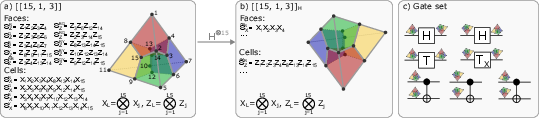
Figure 1: The [[15,1,3]] code and its Hadamard-transformed version, showing the stabilizer support structure in each.
Transversal gates available within each code are not universal—key limitations arise because certain logical operations (e.g., Hadamard in the tetrahedral code) do not preserve the codespace, though they map the logical operators correctly. Importantly, the hybrid architecture enables a transversal one-way CNOT from the tetrahedral code (control) to the H-tetrahedral code (target), but not vice versa.
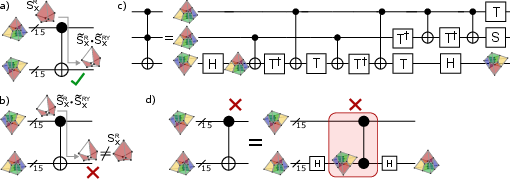
Figure 2: Transversal operations in the hybrid architecture, highlighting the structure and directionality of allowed CNOT gates.
This directionality stems from stabilizer propagation properties: only in the original-to-H-tetrahedral direction do stabilizers map correctly between codespaces. The architecture also admits certain transversal multi-qubit gates, notably a Toffoli (when both controls are in tetrahedral codes and the target in an H-tetrahedral code).
Completing Universality: Pieceably Fault-Tolerant Entangling Gates
The hybrid code architecture enables most—but not all—gates to be executed transversally. To achieve universality, the missing CNOT direction must be implemented. The solution exploits pieceable fault tolerance, specifically a round-robin construction for a logical controlled-X0 (CZ) between two H-tetrahedral codes.
The round-robin protocol consists of X1 layers of transversal CZ gates between specific subsets of qubits (where X2 is the effective distance for X3-errors), interleaved with strategically-placed syndrome extractions to correct any error propagation due to intermediate faults.
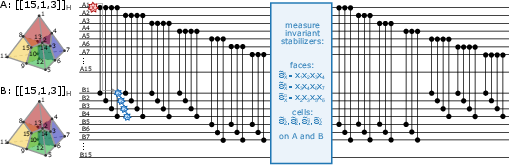
Figure 3: Round-robin CZ gate protocol applied to the rotated tetrahedral H-tetrahedral codes.
Invariant stabilizers—those unaltered throughout the protocol—are extracted mid-circuit, ensuring the propagation of high-weight errors can be tracked and corrected after the final syndrome extraction round. Notably, this intermediate extraction only requires a subset of the full stabilizer set, reducing resource overhead.
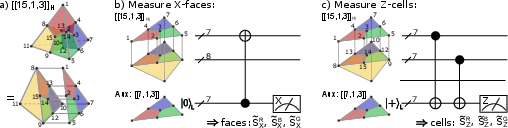
Figure 4: Fault-tolerant stabilizer extraction procedure utilizing stacked 2D color codes, reducing ancilla resource requirements.
The use of 2D color code logical ancillas for Steane-type syndrome extraction further compresses the overhead compared to traditional 3D color code ancilla usage.
Numerical simulation confirms that the logical X4 constructed via the round-robin, pFT protocol achieves the expected X5 scaling, validating the correction of all single-fault events across various logical input states.
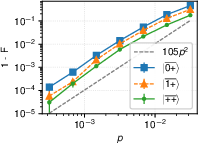
Figure 5: Logical state fidelities showing the performance of the fault-tolerant round-robin X6 gate.
While the logical infidelity of the round-robin gate is slightly higher than an ideal transversal CNOT (by nearly an order of magnitude under pessimistic assumptions), the protocol remains well within the requirements for FT computation and is fully generic to arbitrary code distance.
Regarding scaling, the protocol's complexity grows as X7, but operational overhead is mitigated by both reduced syndrome extraction rounds and the reuse of simple 2D code ancillas.
Theoretical and Practical Implications
This hybrid code architecture fundamentally shifts the overhead landscape in fault-tolerant quantum algorithms:
- Transversal Magic and Most Entangling Gates: Most non-Clifford (magic-generating) and entangling gates remain transversal, minimizing the need for resource-intensive ancillary protocols (e.g., magic state distillation/injection or frequent code switching).
- Compact Overhead on Universality Completion: Only a single entangling gate orientation/direction necessitates a round-robin, pFT protocol, substantially lowering non-transversal operation rates compared to alternatives.
- Hardware Synergy: The highly parallel structure of transversal operations aligns naturally with next-generation architectures (e.g., neutral-atom quantum processors), which can execute these layers simultaneously, further reducing circuit depth and latency.
Additionally, the resource calculus is more favorable than architectures reliant on frequent magic-state protocols—QEC cycles can be scheduled less densely, with optimization potential in the balance between code distance, error rate, and QEC frequency.
Future Directions
Several open questions and next steps are clear:
- Optimal QEC Scheduling: Determining the optimal placement and frequency of QEC cycles to minimize logical failure rate and maximize algorithmic throughput.
- Resource Comparison: Quantitative evaluation versus magic-state distillation, cultivation, and code switching at scale, possibly incorporating biased noise models or hardware-specific gate error characterizations.
- Compiler Development: Algorithms that leverage the hybrid's transversal-only regions, minimizing non-transversal gate invocation, and mapping FT quantum circuits accordingly.
- Decoding Techniques: Exploring enhanced decoders exploiting the code’s layered 2D/3D structure.
- Hardware Co-Design: Customizing the protocol to architectures with native parallelism and rapid qubit rearrangement, particularly neutral-atom and segmented ion trap platforms.
Conclusion
The proposal of complementary 3D color code encodings unified by transversal and pieceably fault-tolerant operations opens new avenues in the minimization of overhead for universal fault-tolerant quantum computing. This work demonstrates that by judiciously combining code variants and exploiting their complementary transversal gates, one can approach universality with transversal gates alone and introduce non-transversal operations only sparingly, localizing resource overheads. The resulting architecture merits further exploration in both software compilation strategies and hardware implementation, especially as larger coherent quantum systems become available.