Where Thermodynamics Meets Geometry: Critical-Radius Coincidences in Confining-NED Black Holes with Barrow Entropy
Published 5 Jul 2026 in gr-qc and hep-th | (2607.04173v1)
Abstract: We study a static, spherically symmetric black hole obtained from Einstein gravity coupled to a nonlinear electrodynamics model with a quark--antiquark confinement interaction. The metric extends Reissner--Nordström by a logarithmic correction controlled by ζ, modifying both horizon structure and the near-singularity regime. The Hamilton--Jacobi tunneling method for Dirac fermions yields the Hawking temperature; the ζ-dependent terms suppress the small-horizon divergence and signal a remnant. Quantum-gravitational fluctuations are incorporated through Barrow entropy with deformation index Δ. Within the extended phase space we compute the internal energy, free energy, pressure, heat capacity, isothermal compressibility, and Joule--Thomson coefficient. The heat capacity locates Δ-dependent stability regions; the compressibility stays negative across the domain analysed here, marking a mechanically rigid phase with no van der Waals criticality in this branch. The central result is a quadruple coincidence: the peak Hawking temperature, the heat-capacity divergence, the Joule--Thomson inversion, and the zero of the radial tidal force all sit at one radius r⋆ defined by $A''(r_\star)=0$, while the extremal horizon and the angular tidal-force zero coincide via $A'(r_h)=0$. These reduce the full critical-point analysis to two scalar equations on A(r). Geometric tidal accelerations are mapped against the thermodynamic critical curves. Event Horizon Telescope observations of Sgr~A* translate into a constraint ζ≲0.7 at Q/M=0.5, leaving a finite window open. The confinement term induces observable corrections to geodesic deviation.
The paper identifies a coincidence of critical radii where thermodynamic singularities, such as heat capacity divergence and Joule–Thomson inversion, align with geometric features like tidal force peaks.
It employs a modified Reissner–Nordström metric with logarithmic corrections that model quark–antiquark confinement and incorporates quantum gravitational effects via Barrow entropy.
Key implications include predicting observable signatures in photon-sphere properties and providing constraints for horizon-scale imaging of black hole critical phenomena.
Critical-Radius Coincidences in Confining-NED Black Holes with Barrow Entropy
Introduction
The paper develops a comprehensive analysis of static, spherically symmetric black holes generated by Einstein gravity coupled to nonlinear electrodynamics (NED) of a confinement type, with a particular focus on the logarithmic deformation parameter ζ modeling quark–antiquark confinement. In addition to standard thermodynamic investigation, the framework incorporates quantum-gravitational horizon fluctuations via Barrow entropy, parameterized by a deformation index Δ. A distinctive aspect of this work is the revealed algebraic coincidence of thermodynamic and geometric critical radii in this class of spacetimes, and the direct connection to tidal forces and observable photon sphere properties.
Confining NED Geometry and Metric Deformation
The underlying black hole solution extends the standard Reissner–Nordström (RN) metric by a logarithmic correction, controlled by the parameter ζ, which introduces a confinement effect analogous to nonabelian gauge dynamics. The metric function A(r) for the solution is:
A(r)=1−r2M+r2Q2−3r4QQζlnr
where M is the ADM mass and Q is the electric charge. This correction modifies the horizon structure and regularizes the near-singularity regime.
Quantum Tunneling and Hawking Temperature
Hawking emission is derived via the Hamilton–Jacobi tunneling method for Dirac fermions. The surface gravity relation is recovered without ambiguity, and the emission temperature is given by:
TH=4πA′(rh)
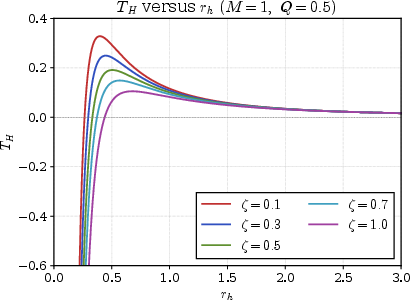
where rh designates the horizon. The key finding is that the logarithmic ζ-dependent terms in Δ0 suppress the usual small-horizon divergence of Δ1, favoring the appearance of a black hole remnant.
Figure 1: Hawking temperatureΔ2 as a function of the horizon radius Δ3 for various values of Δ4; the emission peak coincides with the critical radius Δ5.
As Δ6 increases, the temperature maximum shifts to larger Δ7 and the amplitude decreases, pointing to a more massive, longer-lived remnant, as evidenced by modulation of the endpoint mass and peak temperature.
Barrow Entropy and Extended Thermodynamic Potentials
Quantum-gravitational fluctuations of the event horizon are incorporated through Barrow entropy:
Δ8
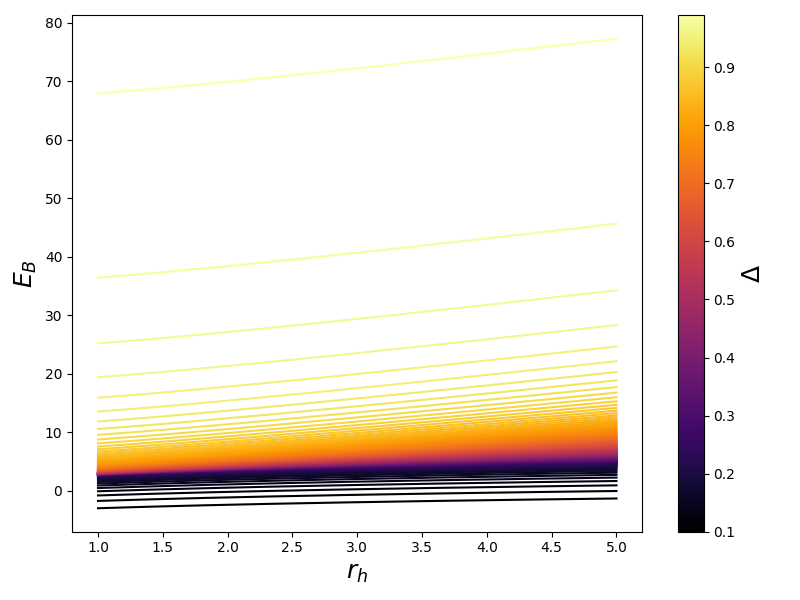
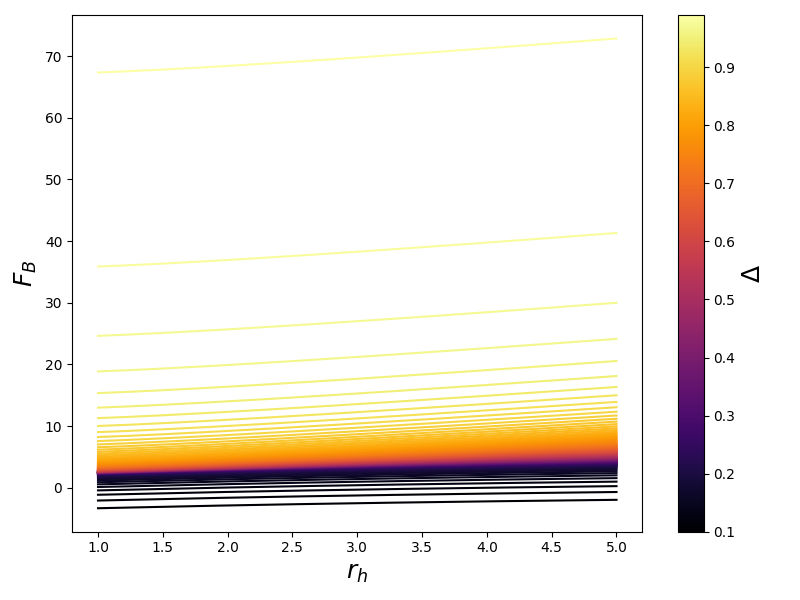
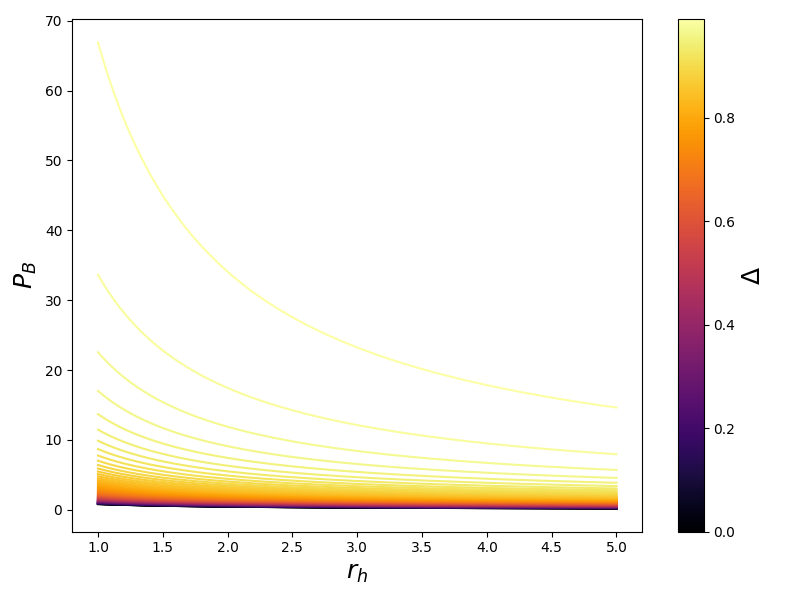
where Δ9. All core thermodynamic potentials—internal energy ζ0, Helmholtz free energy ζ1, pressure ζ2, heat capacity ζ3, isothermal compressibility ζ4, and the Joule–Thomson coefficient ζ5—are explicitly computed with both ζ6 and ζ7 dependencies.
Figure 2: Internal energy ζ8 as a function of ζ9 at fixed A(r)0, A(r)1, and A(r)2 for varying A(r)3.
Barrow deformation increases the effective heat storage capacity. For all thermodynamic variables, the quantum (A(r)4) corrections become negligible at large A(r)5, where semiclassical Bekenstein–Hawking thermodynamics is restored.
Figure 3: Helmholtz free energy A(r)6 against A(r)7 for selected A(r)8, illustrating monotonic behavior and absence of first-order phase transition.
Figure 4: Pressure A(r)9 as a function of A(r)=1−r2M+r2Q2−3r4QQζlnr0 for different Barrow indices A(r)=1−r2M+r2Q2−3r4QQζlnr1.
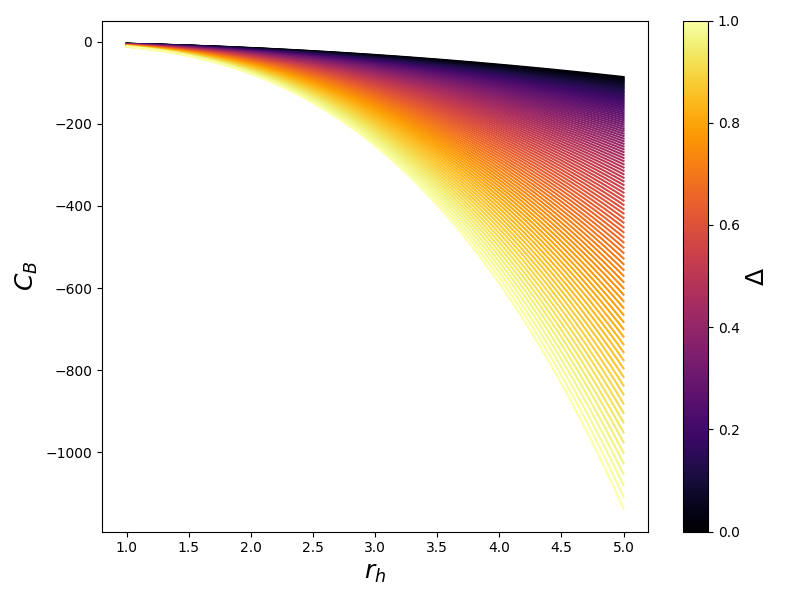
The heat capacity A(r)=1−r2M+r2Q2−3r4QQζlnr2, given by Barrow-modified expressions, encodes the phase structure: stability, divergence loci, and transition points.
Figure 5: Heat capacity A(r)=1−r2M+r2Q2−3r4QQζlnr3 as a function of A(r)=1−r2M+r2Q2−3r4QQζlnr4 for multiple A(r)=1−r2M+r2Q2−3r4QQζlnr5, showing the transition from unstable to stable regimes.
Joule–Thomson and Compressibility
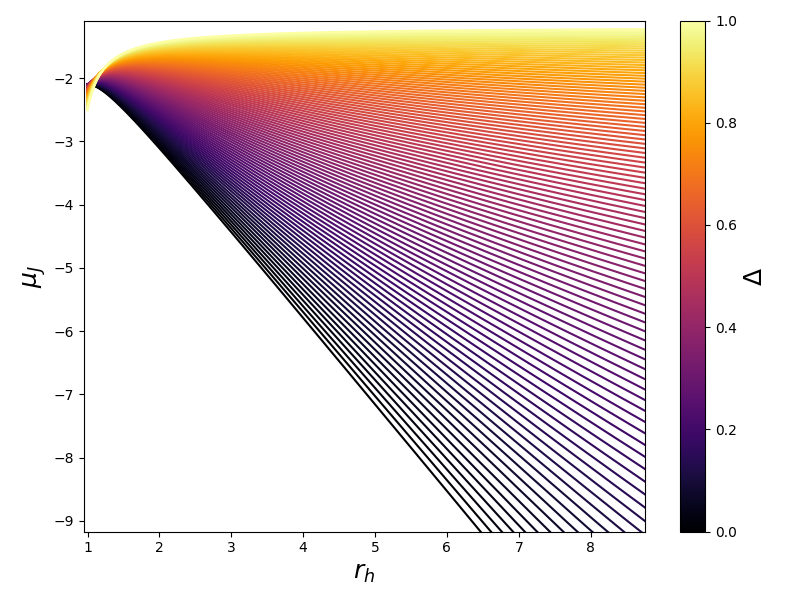
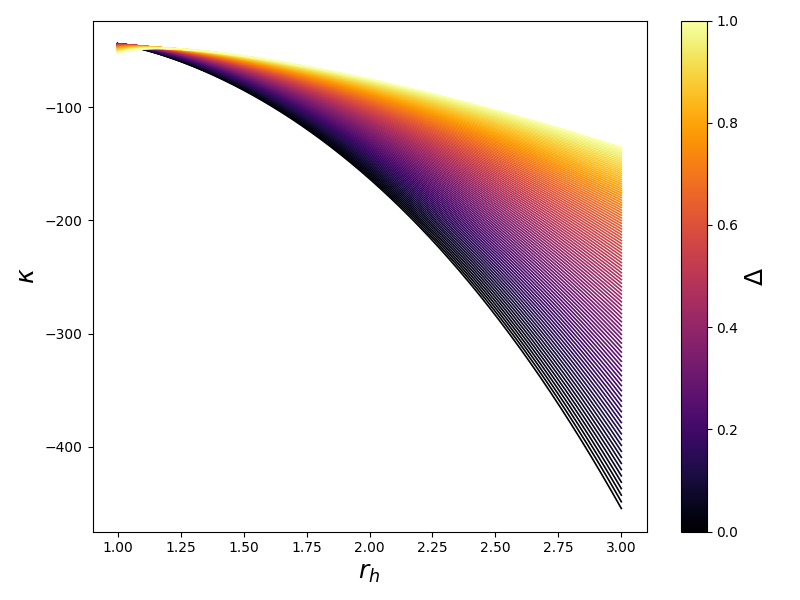
The Joule–Thomson coefficient A(r)=1−r2M+r2Q2−3r4QQζlnr6 exhibits sign changes marking thermodynamic inversion points that coincide precisely with the second-order phase transition (heat capacity divergence). The isothermal compressibility A(r)=1−r2M+r2Q2−3r4QQζlnr7 remains negative for all analyzed parameters, indicating mechanical rigidity and suppression of van der Waals-like criticality.
Figure 6: Joule–Thomson coefficient A(r)=1−r2M+r2Q2−3r4QQζlnr8 vs. A(r)=1−r2M+r2Q2−3r4QQζlnr9, with inversion points tracking M0 divergence.
Figure 7: Isothermal compressibility M1 vs. M2; M3 is always negative, supporting the absence of mechanical instability.
Critical-Radius Coincidences and Scalar Reductions
A central analytical result is the identification of quadruple and pairwise coincidence of critical radii. The following four physically independent phenomena all occur at the same radius M4 determined by M5:
Maximum of Hawking temperature
Divergence of heat capacity
Joule–Thomson inversion
Zero-crossing of radial tidal force
Similarly, the extremal horizon (M6) and angular tidal-force zero coincide at M7.
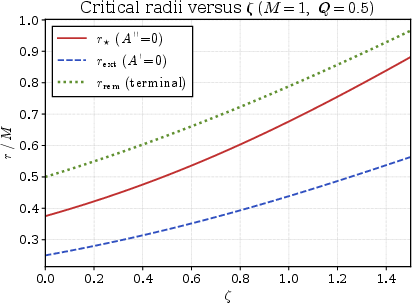
Figure 8: The three characteristic radii—unified critical radius M8, extremal horizon M9, and remnant radius Q0—as functions of Q1.
The ordering Q2 and the nearly linear dependence on Q3 is clear. The remnant mass increases by up to Q4 compared to the extremal RN value at maximal confinement.
Geodesic Deviation and Tidal Forces
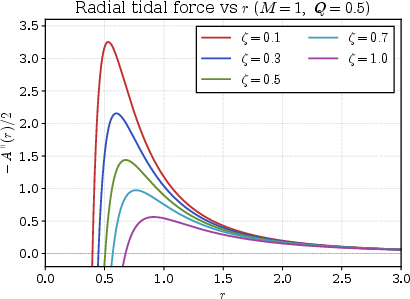
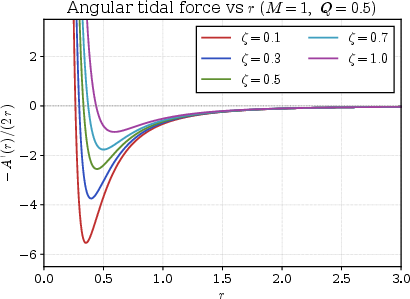
The geometric nature of the critical points is established by radial and angular tidal accelerations, computed in the orthonormal frame of infalling observers. The radial acceleration Q5 peaks at Q6, while the angular component Q7 vanishes at the extremal horizon.
Figure 9: Radial tidal acceleration Q8 vs. Q9 for varying TH=4πA′(rh)0; the peak occurs at TH=4πA′(rh)1.
Figure 10: Angular tidal acceleration TH=4πA′(rh)2 vs. TH=4πA′(rh)3; zero-crossing matches the extremal horizon.
This correspondence aligns thermodynamic phase structure with concrete, observer-measurable geometric features.
Observational Consequences
The CNED correction influences photon-sphere and shadow observables. The photon-sphere radius TH=4πA′(rh)4 and the corresponding shadow size TH=4πA′(rh)5 both increase with TH=4πA′(rh)6, producing an effect TH=4πA′(rh)7 in the relevant parameter regime. Event Horizon Telescope measurements of Sgr~A* constrain TH=4πA′(rh)8 at TH=4πA′(rh)9.
This links the phase and geometric criticalities to potential constraints via current or future horizon-scale interferometry and quasi-periodic oscillation data.
Theoretical Implications and Outlook
The algebraic collapse of thermodynamic and geometric criticalities to two equations—rh0 and rh1—uniquely characterizes the extended confining-NED class, irrespective of the detailed entropy framework (Barrow, R\'enyi, Sharma–Mittal, Tsallis-Cirto). The effect of Barrow (fractal) deformation is mainly to alter the mechanical and thermal response, not the location of critical phenomena.
Future directions include generalization to axisymmetric/rotating black holes and evaluation of quasinormal spectra to connect observable ringdown to the critical topology. The sensitivity of shadow features to rh2 motivates targeted astrophysical analyses as data quality from next-generation horizon-scale facilities improves.
Conclusion
This work provides a detailed mapping between the thermodynamic, quantum, and geometric structures of confining-NED black holes with Barrow entropy. The coincidence of critical radii for diverse physical effects reduces the analysis to the properties of the metric function and its derivatives, setting a structure that is both computationally expedient and physically transparent. The predicted observable signatures and their quantitative connection to the confinement parameter support the viability of using horizon-scale imaging to probe strong-field quantum and nonabelian corrections to GR backgrounds.
Essay based on "Where Thermodynamics Meets Geometry: Critical-Radius Coincidences in Confining-NED Black Holes with Barrow Entropy" (2607.04173).
“Emergent Mind helps me see which AI papers have caught fire online.”
Philip
Creator, AI Explained on YouTube
Sign up for free to explore the frontiers of research
Discover trending papers, chat with arXiv, and track the latest research shaping the future of science and technology.Discover trending papers, chat with arXiv, and more.