- The paper introduces a universal five-stage meta-pipeline and an LMO-based geometric paradigm to unify diverse optimizer update mechanisms.
- It categorizes over one hundred optimizers into five families with multi-objective effect annotations, showing that no single optimizer excels in all aspects.
- It benchmarks 24 optimizers across language and vision tasks, revealing trade-offs in quality, runtime, memory, and stability to inform practical selection.
Survey, Taxonomy, and Evaluation of Modern Optimizers: An Expert Synthesis
Framework Overview and Motivation
"OmniOpt: Taxonomy, Geometry, and Benchmarking of Modern Optimizers" (2607.04033) aims to unify, systematize, and empirically ground the burgeoning field of deep learning optimizers—especially those targeting LLMs. Recognizing that optimizer mechanisms, names, and empirical claims have outpaced cohesive theoretical and taxonomic analysis, this work introduces a process- and geometry-aligned framework: a five-stage meta-pipeline, a norm-constrained geometric lens via Linear Minimization Oracles (LMOs), a dual-dimension taxonomy, and a multi-objective, cross-domain benchmark.
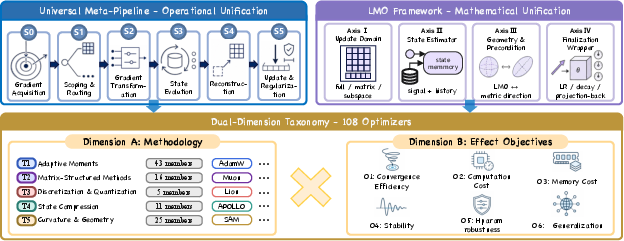
Figure 1: The paper’s survey and benchmarking protocol: meta-pipeline and LMO decomposition → mechanism and effect taxonomy → large-scale benchmark.
The core abstraction is a universal meta-pipeline that disentangles five update stages: parameter routing, gradient transformation, state evolution, update reconstruction, and finalization. Notably, most optimizers are modifications at only one or two stages—other stages default to identity. This operational view directly exposes mechanisms, locates their interventions, and clarifies when optimizer compositions are feasible versus when explicit ordering or precedence is necessary.
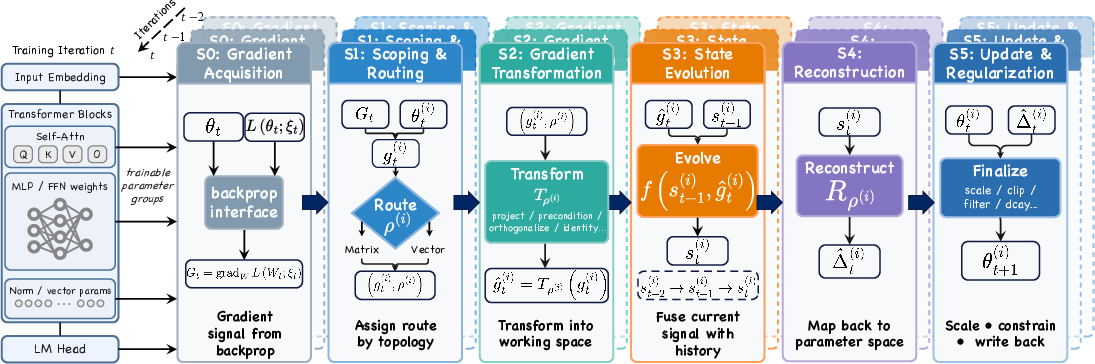
Figure 3: The five-stage meta-pipeline, explicitly routing the stochastic signal through routing, transformation, state, reconstruction, and finalization.
Complementing the meta-pipeline is the LMO-driven geometric paradigm. All optimizer update directions can be recast as solutions to norm ball LMOs, offering a universal language for sign, spectral, Kronecker, or preconditioned updates. The authors identify a four-axis decomposition for each optimizer: update domain (e.g., matrix or subspace), state estimator (e.g., momentum, curvature proxy), geometry/precondition operator (e.g., spectral normalization, Kronecker factorization), and finalization/wrapper. This abstraction effectively unifies discrete sign methods, spectral orthogonalization, subspace projection, and classical adaptive or Newton-like updates.
Dual Taxonomy: Mechanism and Effect
Dimension A (methodological/family taxonomy) groups over one hundred optimizers into five non-overlapping families:
- T1: Element-wise adaptive moment and scalar control
- T2: Matrix-level structural methods (e.g., Muon, Shampoo, SOAP, GaLore)
- T3: Discretization and directional quantization (e.g., Lion, SignSGD)
- T4: State compression and structural aggregation (e.g., AdaFactor, APOLLO)
- T5: Curvature-aware or geometric regularization (e.g., Sophia, SAM, AdamP, LAMB)
Each optimizer receives a primary family label based on the dominant non-identity mechanism. All mapping is aligned with meta-pipeline staging and the four axes.
Dimension B (effect-objective taxonomy) annotates each optimizer with possible targets: O1 (convergence), O2 (per-step compute), O3 (memory), O4 (stability), O5 (hyperparameter robustness), O6 (generalization). This encourages evaluation as a multi-objective Pareto problem—eschewing single-number leaderboards and protocol-dependent, non-replicable claims.
Benchmark Design and Methodology
The benchmark evaluates 24 representative optimizers across T1–T5 on both language modeling and vision settings:
- Stage 1: Broad C4/short-context screening over four model scales (60M–1B) with tightly controlled optimizer tuning, following a strict controlled-variable principle (only optimizer hyperparameters tuned).
- Stage 2: Transfer to long-context, high-quality FineWeb-Edu data (32k tokens), four transformer/linear-attention architectures, and further evaluation on CIFAR100 across CNN, ViT, and MetaFormer backbones. This isolates cross-architecture and context-length sensitivity.
- Metrics: Multi-objective: quality (PPL, downstream Reasoning accuracy), per-step runtime, optimizer state memory, gradient-norm stability, LR robustness, and cross-scenario transfer.
- Auxiliary Analyses: Mechanistic ablation (e.g., Muon), effective-rank and protocol sensitivity, gradient-norm dynamics, and local hyperparameter robustness probing.
Strong Empirical and Contradictory Claims
The paper’s empirical findings are highly nuanced, with strong, sometimes counterintuitive conclusions:
- No universal best optimizer exists: Rank orderings, and even Pareto frontiers, systematically cross with context length, model scale, architecture, and protocol.
- Short-context memory-efficient “winners” (e.g., APOLLO) degrade sharply at long context: Aggressive state compression is rank-bounded and context-dependent.
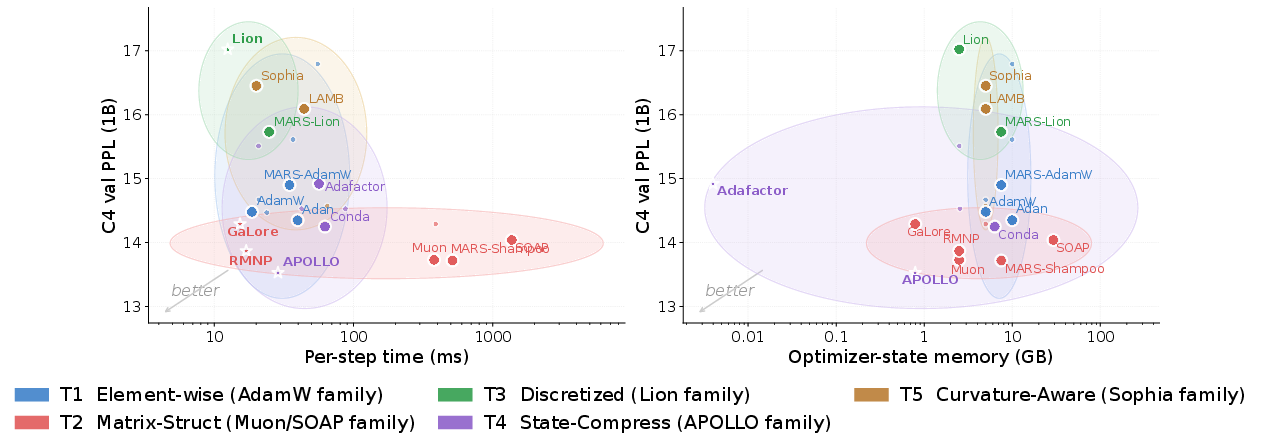
Figure 2: 1B-stage Pareto frontiers: Optimizer state memory and quality occupy orthogonally distinct frontiers; no method dominates all axes.
- Quality-oriented matrix-structured methods (SOAP, Muon) outperform in generalization and cross-architecture transfer but at prohibitive per-step and memory cost; lighter T2 variants (RMNP) achieve practical trade-offs.
- T1 Adam-style element-wise adaptivity is robust, interpretable, but not optimal in any specific extreme (quality, memory, compute), yet should remain the default reference for its baseline stability.
- Sign/Lion-based directions (T3) have flat learning-rate sensitivity and low state cost but are quality-inferior to T1/T2 and not robust at scale or across tasks*.
- Curvature-aware/geometry-regularized methods (T5) are only competitive under narrow regimes, often failing to overcome tuning and cost overheads in large-model LLM regimes.
- Gradient-norm stability and learning-rate robustness are not reliably predicted by tuned quality: Completion status (converged/final PPL) is a poor proxy for underlying dynamical stability.
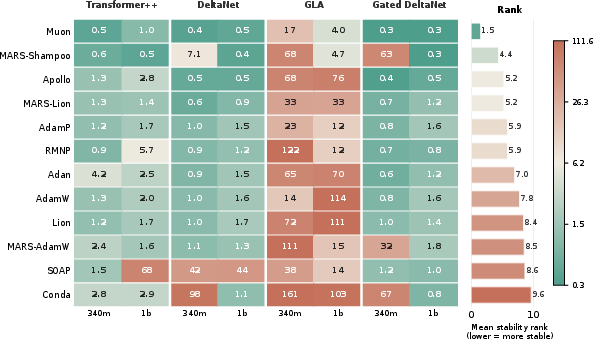
Figure 6: Cross-architecture gradient-norm stability (lower GNormCV = smoother/robuster updates) exposes substantial volatility not observed in final PPL.
- Optimizer-mechanism compositions are fundamentally local: Mechanisms at disjoint meta-pipeline or four-axis stages are reliably stackable (e.g., MARS variance reduction with AdamW, Lion, or SOAP), but two strong S2 constraints (e.g., spectral and subspace) may interfere and require careful ordering.
- Mechanistic ablation validates key insights: For instance, Muon's Newton–Schulz orthogonalization is the irreplaceable quality carrier; scaling and Nesterov variants are beneficial only when placed after spectral normalization.
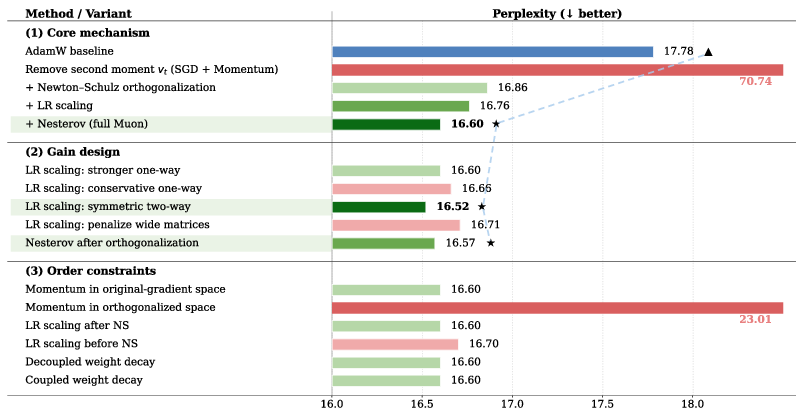
Figure 8: Muon ablation study, showing where quality originates—NS orthogonalization—vs. where auxiliary gains or orderings matter.
Implications and Theoretical Perspective
Theoretical implications: The operational coordinate system provided—explicit meta-pipeline stages and four-axis coordinates—permits precise mechanistic attributions, composition predictions, and serves as a diagnostic instrument for both empirical and theoretical optimizer research. The LMO-based unification demonstrates that “direction geometry,” rather than name- or formula-based family groupings, is the essential axis for understanding and designing optimizers, especially when scaling into new architectures or regimes.
Practical implications: For practitioners, optimizer selection should be constraint-driven: start with AdamW for stability and schedule calibration. Move to RMNP or SOAP as quality or generalization ceiling when runtime/memory permit. Use memory-efficient state compression (T4) only with context-length and effective-rank diagnostics. Geometry-rich directions (Muon, SOAP) are promising but must be validated for each model topology and data regime.
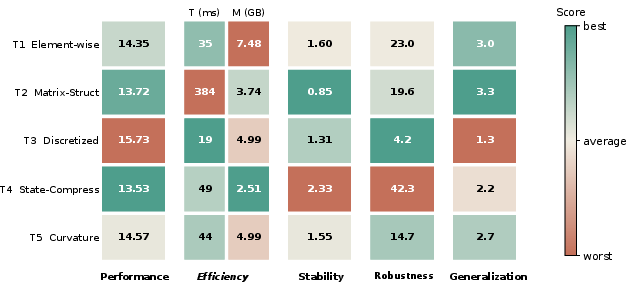
Figure 10: Family-level effect profile across O1–O6 for all T-families; performance, cost, stability, robustness, and transfer trade off in systematically different directions.
Future research directions: The study maps a concrete agenda: develop diagnostic metrics (e.g., compression-loss predictors, effective-rank adaptation), architecture-aware optimizer design (adaptive choice of geometry from data), protocol-matched evaluation, automated compositional optimizer search, and stable/efficient, low-cost curvature estimation.
Conclusion
OmniOpt (2607.04033) delivers a technically rigorous, operationally actionable taxonomy and geometry for modern optimizers. Its framework powers both fair empirical benchmarking and systematic mechanism-aware optimizer design. The strongest findings emphasize that, in optimizer selection, "single best" does not exist; instead, mechanism, architecture, data, and constraint must be matched. The composability, transfer, and failures documented here underscore the necessity of coordinated evaluation and theory. Importantly, the paper establishes not a final leaderboard, but an extensible coordinate system for ongoing research and deployment.
References: See (2607.04033) and citations therein for primary algorithm sources, recent LLM optimizer benchmarks, compositional and geometric theory, and state-of-the-art empirical protocols.

