Local Gaussian Correlation in the Tails: A Scarcity Diagnostic, an Optimal Local Bandwidth, and the Limits of Adaptivity
Published 4 Jul 2026 in stat.ME and q-fin.ST | (2607.03888v1)
Abstract: Local Gaussian correlation (LGC) measures dependence locally, making it a natural tool for tail dependence and financial contagion, but its estimates degrade in the joint tails, where they are most needed. Location-adaptive bandwidths have been tried for LGC and found inferior to a single global bandwidth; we explain why, and map the regime in which adaptivity does help. First, a diagnostic: across heavy-tailed data-generating processes the parametric marginal pre-transform is inert (it changes the integrated error only in the fourth decimal), while the binding constraint is the local effective sample size, with the replication dispersion following a Fisher variance floor sd ~ (1 - rho2)/sqrt(eff_n). Second, theory: specializing the Hjort-Jones local-likelihood asymptotics to the bivariate Gaussian family that LGC fits, we derive the first location-specific AMISE-optimal bandwidth for LGC, b*(x) proportional to [(1 - rho2)2 / (f beta2)]1/6 n-1/6, and validate its bias expansion directly (bias proportional to b2 beta, R2 approximately 0.9, slope-to-beta correlation 0.80). Third, a regime map: a Monte Carlo across dependence strengths shows the adaptive rule beats the global plug-in only at moderate dependence with curved surfaces. At weak dependence there is no curvature to exploit; at strong dependence finite-sample bias from the steep surface dominates, and adaptivity performs substantially worse, with an error that grows in the sample size. This explains the field's experience that global bandwidths are hard to beat, and locates the exception. Fourth, application: on volatility-filtered equity returns the adaptive estimator yields more stable tail-dependence surfaces under resampling. The message is cautionary: the binding constraint on tail LGC is data scarcity, not bandwidth placement, and no bandwidth, however optimal, can recover information the data do not contain.
The paper introduces a diagnostic for tail data scarcity and shows that marginal pre-transformations have negligible impact on LGC estimation, emphasizing variance limitations.
It derives an AMISE-optimal local bandwidth formulation that adapts to local density and dependence, indicating benefits only in moderate dependence settings.
Empirical simulations and financial applications confirm that adaptive bandwidths improve stability in sparse tail regions, while global selectors prevail in strong dependence.
Local Gaussian Correlation in Data Tails: Scarcity, Variance Floors, and Adaptive Bandwidths
Overview
This paper delivers a rigorous analysis of the limits and potentials of the Local Gaussian Correlation (LGC) estimator in capturing local dependence structure, with an explicit focus on the performance in joint data tails—a regime of central concern in financial contagion and tail risk analysis. The study advances the field in three main directions: a detailed diagnostic of tail data scarcity, the derivation of a local AMISE-optimal bandwidth for LGC, and a precise map of when location adaptivity is—and is not—worthwhile. Through both theory and empirical simulation, the work isolates strong yet measured claims regarding variance-dominated errors, the inertness of marginal transformations, and the narrow window in which adaptive smoothing rules yield performance gains. Practical implications are cemented through a real-market application on volatility-filtered equity pairs.
Inertness of Marginal Pre-Transformation
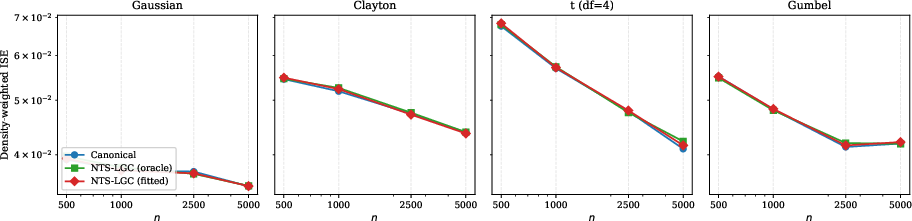
A prevailing intuition in financial econometrics is that heavy-tailed marginal models, when fit prior to LGC estimation, should provide tangible benefits in the estimation of local dependence, particularly in tail regions. However, this hypothesis is contradicted by the empirical findings: marginal pre-transformation, whether empirical, oracle (true distribution), or parametric (model-based fit), produces indistinguishable integrated squared error (ISE) performance—agreements to the fourth decimal across all copulas and sample sizes considered.
Figure 1: The three estimators, differing only by marginal transformation, yield overlapping density-weighted ISE curves across copulas, confirming the negligible impact of marginal choice.
This compelling result, repeatedly corroborated even under substantial skew, consolidates the notion that the lever for improving LGC estimation does not reside in marginal transformation. Local dependence is a copula property, and marginal adjustment, even in the presence of heavy tails, contributes at most trivial estimation noise.
Scarcity Diagnostic and Fisher Variance Floor
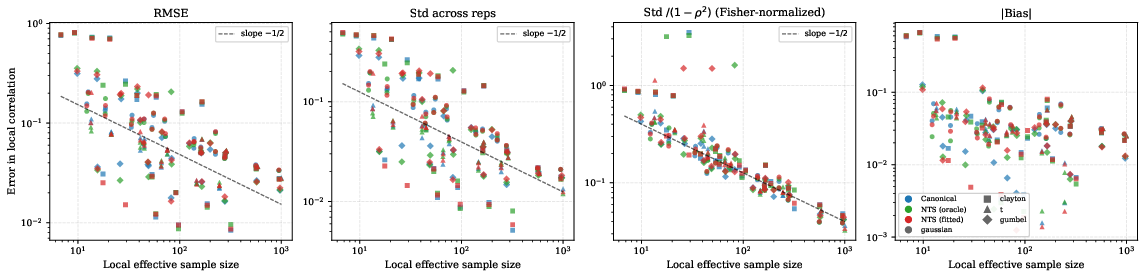
The primary bottleneck for LGC estimation in the tails is shown to be local data scarcity. The authors formalize this via the notion of the local effective sample size eff(x), which quantifies the number of observations meaningfully contributing to the local fit. Error analysis demonstrates that neither estimator architecture nor marginal selection governs tail region error. Instead, the replication dispersion strictly adheres to a Fisher variance floor:
sd≈eff1−ρ2
This relationship is empirically validated; regressing the log of normalized standard deviation on log effective sample size yields a slope close to −1/2. The implication is that, away from sharply structured sparse corners (where bias dominates), most error is irreducible variance due to sample scarcity.
Figure 2: RMSE and replication standard deviation for LGC error tightly collapse against local effective sample size, illustrating the regime where variance dominates and only increases in eff yield error reduction.
AMISE-Optimal Local Bandwidth
The theoretical centerpiece is the derivation of a plug-in, location-specific, AMISE-optimal bandwidth for LGC. Adapting the Hjort–Jones local likelihood machinery, the optimal bandwidth at a location x is given by:
b⋆(x)∝[f(x)β(x)2(1−ρ(x)2)2]1/6n−1/6
Here, f(x) is the local density, and β(x) encodes curvature and density-drift contributions through the Laplacian of the local-correlation surface and gradient interactions. This bandwidth narrows in dense or highly dependent regions (exploiting low variance), but widens in sparse regions to buy down variance at the cost of local bias.
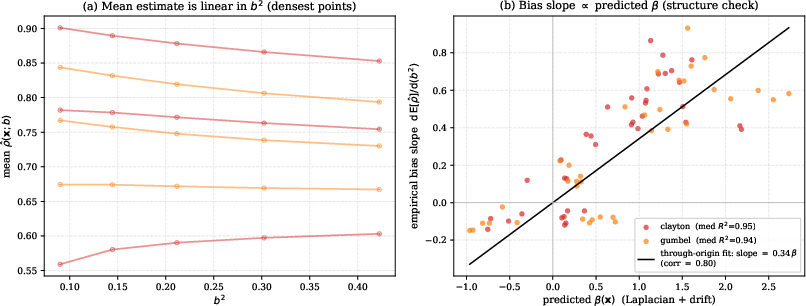
The bias expansion underpinning this formula is numerically validated, with high linearity between mean estimation error and b2, and bias slopes strongly correlated with predicted β(x).
Figure 3: Validation of bias expansion showing high sd≈eff1−ρ20 between empirical bias slopes and predicted sd≈eff1−ρ21, confirming the theoretical AMISE-optimal bandwidth derivation.
Regimes of Applicability for Adaptive Bandwidth
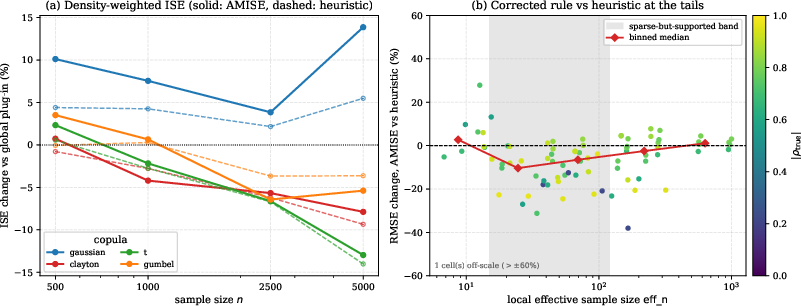
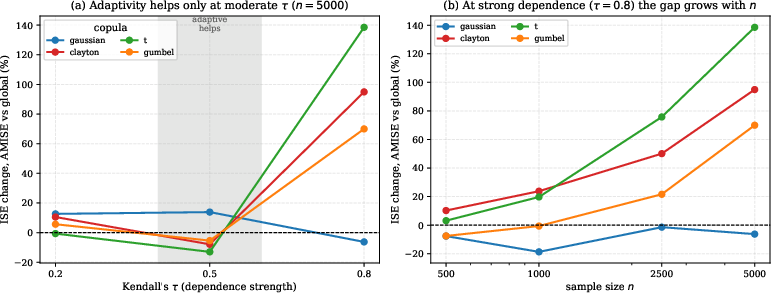
A comprehensive suite of Monte Carlo simulations reveals that adaptive, location-specific bandwidths only outperform the traditional global plug-in selector within a narrow but practically relevant regime: moderate dependence with curved copula surfaces. In weak dependence, the local surface is nearly flat, so varying bandwidths only add variance. In strong dependence, finite-sample bias dominates—the aggressive bandwidth narrowing in dense regions and compensatory widening elsewhere induces error that grows with increased sample size, an irreparable bias signature.
Figure 4: RMSE improvement of adaptive over heuristic bandwidths clustered in the sparse-but-supported regime, confirming the theory-predicted gain of adaptivity only under moderate dependence and adequate local sampling.
Figure 5: ISE change of adaptive versus global bandwidth across dependence strength (Kendall’s tau), highlighting the narrow region near moderate dependence (sd≈eff1−ρ22) where adaptivity is beneficial, and the marked deficit at strong dependence.
Real-World Application: Financial Contagion and Tail Stability
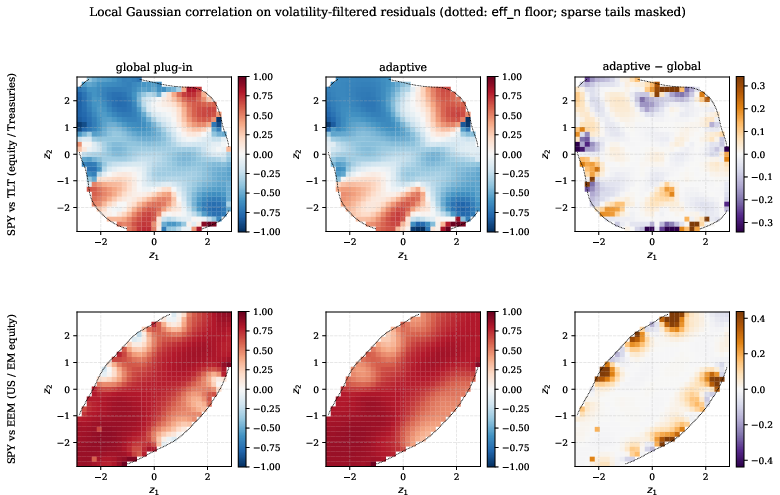
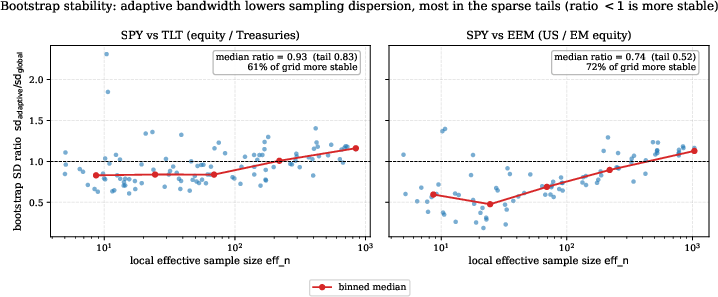
Applying both global and adaptive LGC estimators to volatility-filtered returns of SPY/TLT and SPY/EEM demonstrates that although adaptive smoothing alters tail surface estimates, the most robust and quantifiable benefit is in the stability of estimation under resampling, particularly in data-starved tails. Bootstrap standard deviation ratios (adaptive over global) confirm consistently higher stability for the adaptive estimator in the regime of sparse sd≈eff1−ρ23.
Figure 6: LGC surfaces for real filtered returns, global versus adaptive, with the difference highlighting tail resolution and sample size regime.
Figure 7: Bootstrap SD ratios (adaptive/global) as a function of local effective sample size; the strongest stability gain from adaptivity is seen in the sparsest tail regions.
It is emphasized that, absent a known ground truth, accuracy improvement in real-data tails cannot be established from this analysis, especially given that in high-dependence settings, increased stability may reflect over-smoothing rather than true error reduction.
Theoretical and Practical Implications
The findings have several consequences for both theory and practice:
Bandwidth Allocation Is Not a Panacea: In the tails, variance reduction via bandwidth expansion is strictly bounded by underlying data scarcity; marginal modelling and estimator choice have negligible influence.
Adaptive Bandwidth’s Regime Is Narrow: Only moderate-dependence, well-sampled but sufficiently curved surfaces benefit from adaptive smoothing; in all other settings, especially strong dependence, global bandwidths prevail.
Future Directions: A need remains for a bandwidth selection criterion that is robust across all dependence strengths, possibly by integrating over regions or incorporating a more nuanced sd≈eff1−ρ24-aware bound. Extensions to higher dimensions and analytic bias characterizations are identified as open problems.
Conclusion
This work offers a quantitatively grounded diagnostic and methodological roadmap for the application of LGC in the tails, providing the first validated AMISE-optimal local bandwidth and demonstrating, both in simulation and in empirical data, the strict limits imposed by data scarcity. Bandwidth adaptivity is shown to be effective only within specific, tightly characterized regimes, and variance, not bias, places an inescapable boundary on what nonparametric local dependence estimation can achieve in tail regions. The paper sets a new standard for both methodological clarity and nuanced interpretation in the analysis of local dependence in financial and heavy-tailed data.