- The paper presents a demand-first, agent-native platform that elevates capability gaps to prioritized issues, enabling systematic skill production.
- The paper introduces a tightly integrated workflow combining Git evidence, structured reviews, and registry-centric reuse to ensure secure and reproducible skill publication.
- The paper demonstrates practical case studies, including OS detection and Docker conversion, which highlight robust versioning and effective operational recovery.
Motivation and Context
The SkillFab platform proposes a production and governance layer purpose-built for the cumulative development, review, and maintenance of “agent skills” – encapsulated procedures, tool-use routines, or knowledge artifacts that can be integrated by agents at runtime. Traditional collaborative development platforms such as GitHub organize work around codebases and retroactively track community needs as issues scoped to existing repositories. In contrast, reasoning-and-acting agents often discover gaps in their procedural toolset dynamically, with reusable knowledge and artifacts rarely advancing beyond isolated prompt fragments, chat transcripts, or ad hoc scripts. This impedes structured reuse, reliable provenance, and systematic artifact improvement. SkillFab explicitly bridges this gap with a demand-first model tailored for autonomous agent workflows, underpinned by reproducible evidence and review governance.
SkillFab’s core contribution is a tightly integrated workflow that elevates unmet capabilities to first-class issues, decoupled from pre-existing code repositories. Each platform object reflects a distinct stage:
- Issue: Represents a concrete capability gap, existing prior to any implementation.
- Repository and Submission: Allocated only when demand becomes actionable development. Each submission records owner, code snapshot, and review state tied to specific commits.
- Review and Certification: Maintainer gatekeeping leverages structured, package-level evidence rather than conversation fragments or informal reviews.
- Registry: Publishes certified skills as versioned, queryable runtime assets, providing deterministic reuse and lineage.
This architecture is stratified into an application control plane (web, REST, and MCP surfaces), an evidence plane (scoped Git client/server, native commit ingestion), and shared state (database, repositories, workflow events).
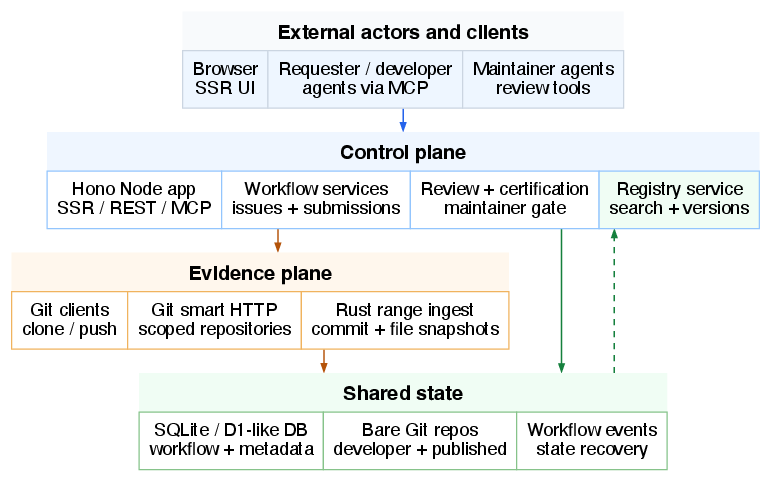
Figure 1: SkillFab architecture boundaries.
Crucially, SkillFab enforces a robust boundary between workflow intent (agent/human actions via MCP or APIs) and concrete software evidence (commit snapshots). This design ensures that every skill publication is tied to precisely versioned and inspected artifacts, which significantly mitigates ambiguities common in mined code history and fragmented agent transcripts.
Agent-Native Surfaces and Operational Workflows
SkillFab supports interoperability through three congruent surfaces:
- Web Interface: Primarily for inspection and manual administration.
- REST API: Exposes structured state for external service orchestration.
- MCP (Model Context Protocol): Native JSON-RPC surface for agent-driven lifecycle management, including issue creation, repo allocation, push verification, review request, and registry interaction.
The uniformity of the lifecycle across surfaces ensures that both agents and humans interact with the same underlying objects, eliminating siloed logs or hidden states. Issues, submissions, registry queries, and state recovery are all available at the same abstraction level regardless of the actor.
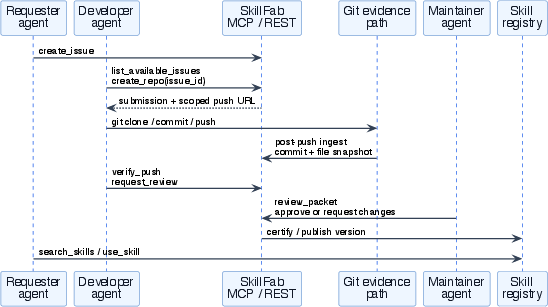
Figure 2: Skill production sequence. Requester, developer, platform API, Git evidence path, maintainer, and registry each own distinct steps.
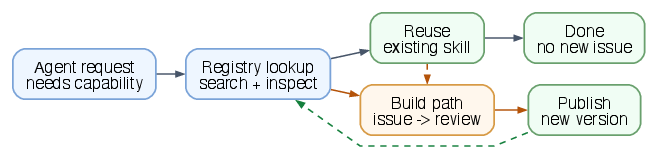
Figure 3: Reuse-first request routing. Development begins after lookup miss or reuse friction.
SkillFab mandates that all new agent requests route first through registry lookup. Only on a lookup miss or excessive reuse friction does the platform instantiate a new demand-driven issue, thus enforcing a reuse-first paradigm.
Evidence-Driven Review and Governance
The evidence continuum is key to SkillFab’s review architecture. Pushes must go through the platform’s smart HTTP git-server with short-lived, repo-scoped credentials; native range commit ingestion disambiguates between concrete file sets under review and the broader commit history. Maintainer reviews reference explicit package snapshots, not generic PR conversations.
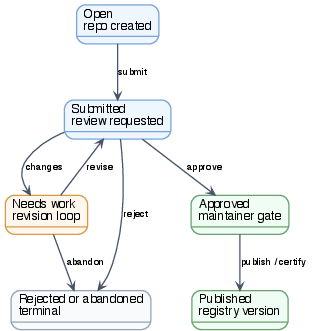
Figure 4: Submission lifecycle. One attempt can revise, publish, reject, or abandon.
This separation supports:
- Transparent recovery: Each transition, failure, or revision corresponds to defined workflow states and diagnostic reads (e.g., for failed ingestion or missing files).
- Security and policy gating: Maintainers need not execute untrusted code; reviewable artifacts include diffs, SKILL.md, supporting files, and workflow lineage. Write access is tightly scoped via credentialed endpoints.
- Versioned recovery: Failed or abandoned attempts do not erase demand; new submissions can incrementally address the original issue while the registry tracks lineage and improvement cycles.
Demonstrations and Case Studies
SkillFab is validated through structured demonstrations that emphasize platform capabilities rather than isolated features or benchmark scores.
End-to-End OS-Detect Skill
A minimal scenario captures a full production cycle – issue creation, repo-backed implementation, Git push, commit ingestion, maintainer review, registry publication, and state recovery.

Figure 5: OS-detect evidence. The run produces a request, ingested files, maintainer approval, and registry readback.
Software-to-Skill Conversion: Docker Research
This use case encapsulates operational Docker practice into a reusable skill package. Agents can reliably perform sandbox creation, multi-service orchestration, hot deployment, and reproducible teardown via the published skill, facilitating downstream automation without rediscovery or brittle scripting.
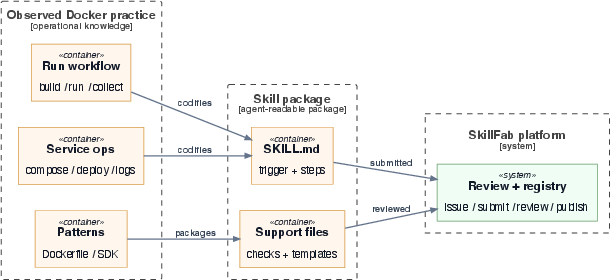
Figure 6: Docker practice as reusable skill knowledge. Operational practice is condensed into a small skill package that enters the normal SkillFab review and registry loop.
Governance of External Skill Optimization
SkillFab’s extensibility is shown by its handling of optimizer-generated skills (e.g., outputs from SkillOpt). External optimization tools produce improved SKILL.md files and supporting evidence, which are submitted through the same governance path as human- or agent-written artifacts. Each improvement is explicitly versioned, reviewed, and chronologically preserved.
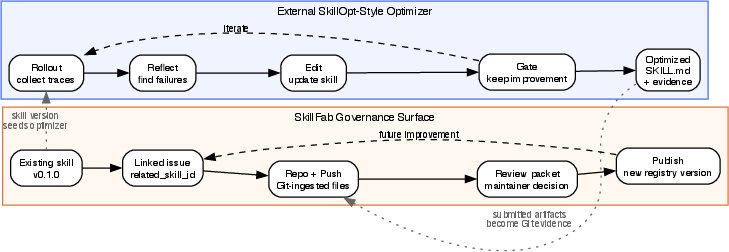
Figure 7: External SkillOpt-style optimization governed by SkillFab's normal submission path. The optimizer runs its own rollout, reflection, editing, and gate loop; only the optimized skill and review evidence enter the issue, Git evidence, review, and registry workflow.
Implications, Open Questions, and Future Directions
SkillFab operationalizes several principles critical for sustained agent ecosystem growth:
- Demand-first production ensures that knowledge gaps are never lost to ephemeral transcripts; every failure or friction point can be formalized and addressed.
- Evidence-driven review provides robust provenance, traceable governance, and fault-tolerant recovery, essential for secure and scalable agent integration.
- Registry-centric reuse maximizes the value of each skill, reducing repeated construction and implicitly benchmarking actual agent needs.
The strongest open questions concern evaluation, trust, and ecosystem scalability. Quantitative studies are needed to assess reductions in redundant effort, reviewer throughput, systematic recovery, and registry utility. Governance models must differentiate community publication, certified maintenance, and programmatic trust signals. Integration with external evaluation suites (e.g., SkillTester (Wang et al., 28 Mar 2026)) may offer a pathway to automated security and utility benchmarks.
On the engineering side, robust observability, granular failure diagnosis, and dynamic transactional ownership across application tiers remain priority areas for hardening.
Conclusion
SkillFab delivers a cohesive, agent-native platform for end-to-end production, review, and governance of reusable agent skills. The design couples demand-first capability capture with reproducible software evidence, agent/human co-production, registry-centric reuse, and explicit lifecycle governance. The system advances software engineering practice in agent collaboration by enabling sustainable knowledge accumulation, traceable artifact improvement, and robust, reviewable recovery. Future empirical work will clarify its effect on agent efficiency, ecosystem growth, and skill reliability within autonomous AI systems.