- The paper demonstrates the FCC-ee's ability to exclude vector-like leptons in the electron-philic channel with nearly degenerate mass spectra using a shape-based analysis.
- It combines Monte Carlo simulations with staged event selection and focuses on missing transverse energy and angular correlations to suppress standard model backgrounds.
- Exclusion limits extend up to 74.6–110 GeV for VLLs depending on ΔM scenarios and Yukawa couplings, offering a robust probe for BSM lepton portal dark matter.
Search for Vector-Like Leptons Decaying into Electron and Missing Transverse Energy in e+e− Collisions at 240 GeV FCC-ee
Theoretical Motivation and Model Framework
The analysis investigates scenarios beyond the Standard Model (BSM), focusing on the lepton portal dark matter (LPDM) model that addresses the particle nature of dark matter via collider signatures. In this framework, a scalar dark matter candidate (χ), singlet under the SM gauge group, interacts exclusively through Yukawa couplings (λLi) with vector-like leptons (VLLs, denoted as L) that form electroweak doublets. To avoid lepton flavor violation, couplings are flavor-specific; this study concentrates on the electron-philic (λL1) case.
Key theoretical parameters include:
- VLL mass (ML),
- Scalar dark matter mass (Mχ),
- Yukawa coupling (λL),
- Mass splitting ΔM=ML−Mχ.
The stability of χ is ensured by an additional χ0 or χ1 symmetry.
VLL pair production occurs via both χ2-channel (mediated by χ3) and χ4-channel (mediated by χ5) processes, as depicted in the Feynman diagrams.
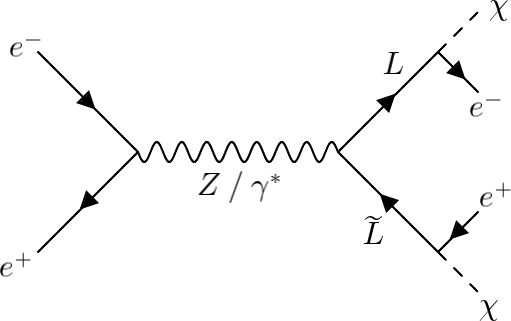
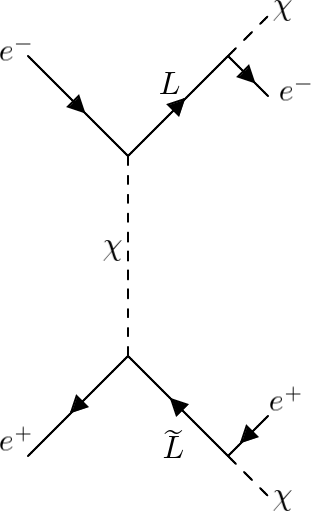
Figure 1: Feynman diagrams for vector-like lepton pair production via (a) χ6-channel and (b) χ7-channel, followed by decay into electrons and dark matter.
The χ8-channel's importance increases with larger χ9, making it relevant for the cross-section calculations. This study benchmarks two narrow mass splitting scenarios: λLi0 GeV and λLi1 GeV.
FCC-ee Simulation Setup and Signal Characterization
Monte Carlo event generation is performed at λLi2 GeV, the Higgs factory running point of the FCC-ee, and with a projected integrated luminosity of λLi3 abλLi4.
The main SM backgrounds involve processes yielding electron pairs and missing energy, dominantly λLi5, λLi6, λLi7, λLi8, and to a negligible extent, λLi9 (the latter excluded due to tiny cross-sections at this energy).
Signal characteristics post-decay involve opposite-sign dielectron pairs and missing transverse energy (L0) from the undetected L1. The L2 distribution reflects the compressed spectrum—especially for small L3—making discrimination from SM backgrounds challenging.
The dependence of the VLL signal cross-section on L4 for varying L5 and L6 is shown in
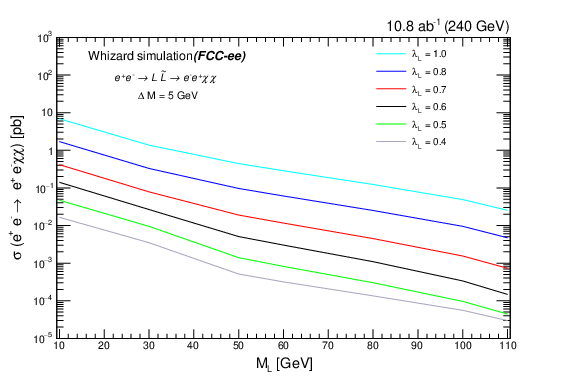
Figure 2: Signal cross-section as a function of L7 for various L8 values with L9 GeV.
Production cross-sections are significantly enhanced for large λL10 due to the dominance of λL11-channel processes.
Event Selection and Background Suppression
The analysis employs a staged event selection:
- Pre-selection: Both electrons must satisfy λL12 GeV, λL13, and an electromagnetic-to-hadronic energy deposit ratio λL14.
- Final selection: Tighter kinematic requirements on:
- Relative λL15 misalignment between dielectrons and λL16 (λL17),
- Angular separation λL18,
- Three-dimensional angular correlation λL19(AngleML0) ML1.
The ML2 spectrum for SM backgrounds and several signal ML3 hypotheses, before and after final selection, is shown for both ML4 and ML5 GeV.
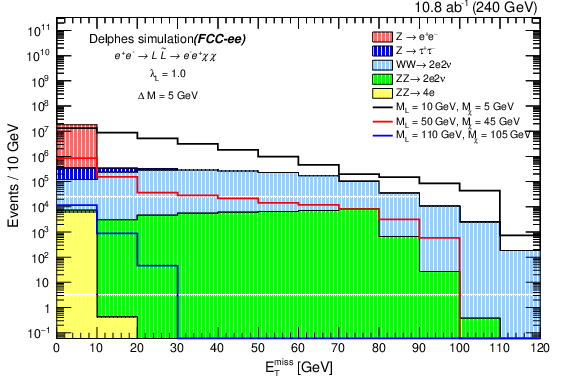
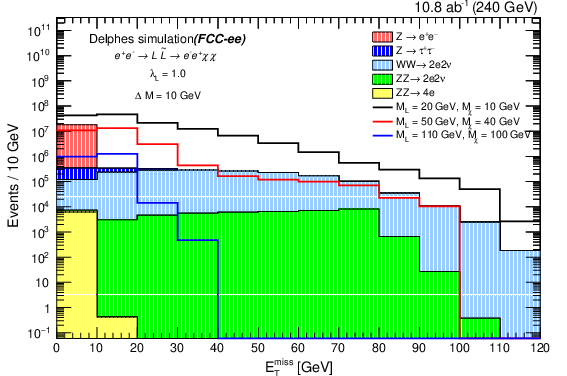
Figure 3: Measured missing transverse energy spectrum post-preselection for SM backgrounds and VLL signals with ML6 GeV (a) and ML7 GeV (b).
After final selection, additional key discriminants include the ML8 ratio, dielectron ML9, and the Mχ0(AngleMχ1) variable.
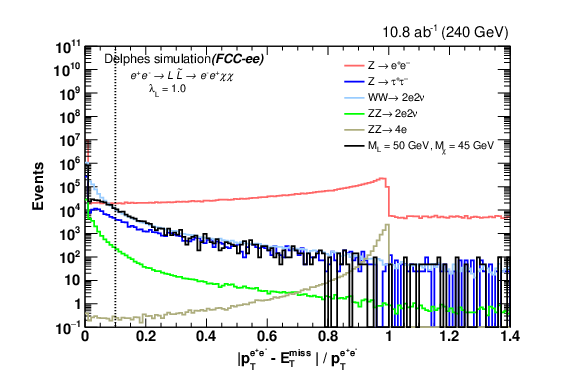
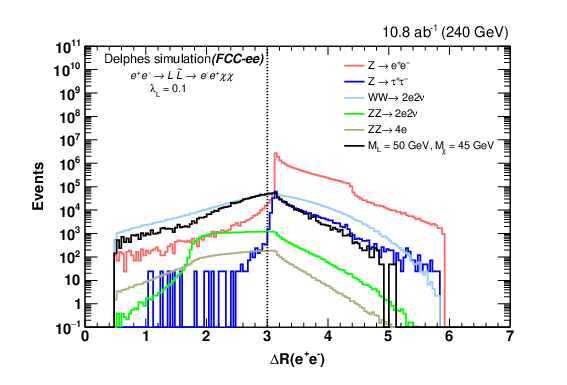
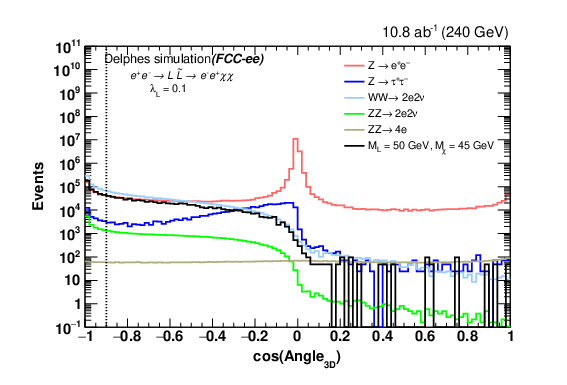
Figure 4: Distributions for Mχ2, Mχ3, and Mχ4(AngleMχ5) for signal and backgrounds with cut values indicated.
The "N–1" efficiency plots (efficiency for each variable after applying all other cuts) confirm that background events are robustly suppressed in the relevant Mχ6 regime.
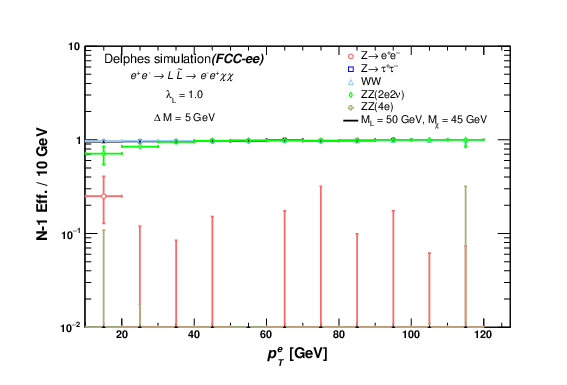
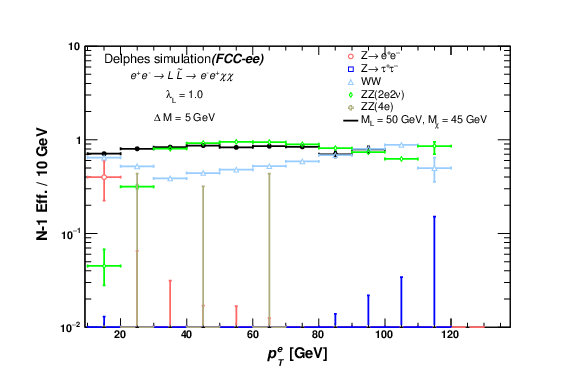
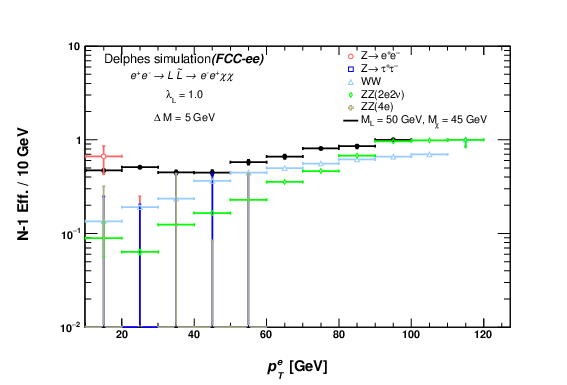
Figure 5: N–1 efficiency distributions versus leading electron Mχ7 for selection variables, for signal (Mχ8 GeV) and backgrounds.
Statistical Analysis and Exclusion Limits
A shape-based analysis using Mχ9 distributions allows interpretation in terms of 95% confidence level (CL) exclusion limits. For λL0 and λL1 GeV, vector-like leptons with masses from 10 to 74.6 GeV are excluded. For λL2 GeV and λL3, λL4 exclusion extends up to 110 GeV. The cross-section limits as a function of λL5 for selected λL6 values are shown below.
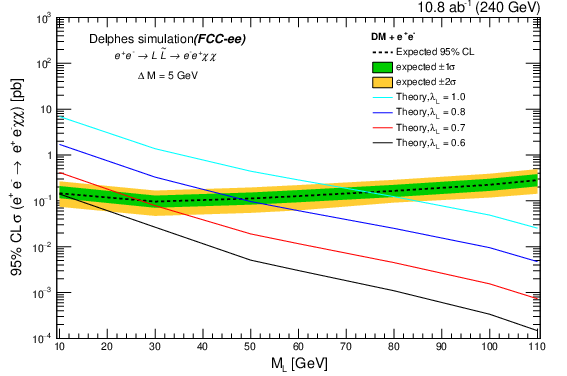
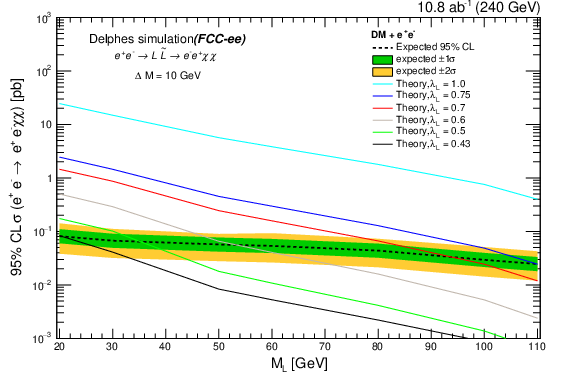
Figure 6: 95% CL limit on expected VLL production cross-section as a function of λL7, with several λL8 values and λL9 GeV (a) and ΔM=ML−Mχ0 GeV (b).
The exclusion in the ΔM=ML−Mχ1–ΔM=ML−Mχ2 parameter plane is explicitly demonstrated.
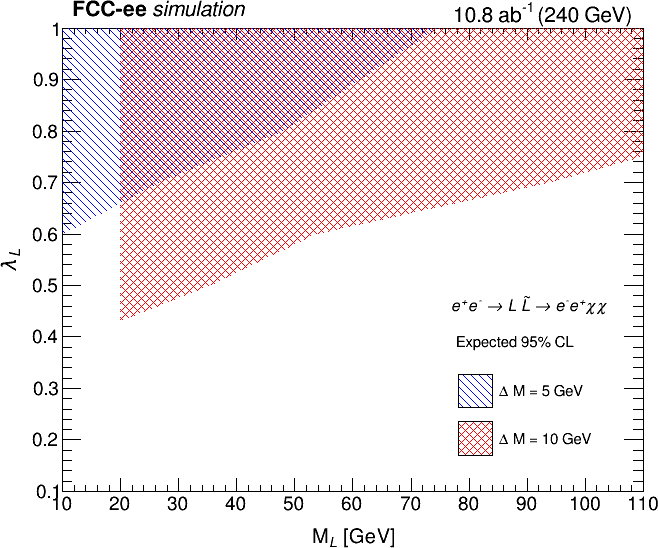
Figure 7: 95% CL exclusion contours in the ΔM=ML−Mχ3–ΔM=ML−Mχ4 plane for ΔM=ML−Mχ5 and ΔM=ML−Mχ6 GeV at ΔM=ML−Mχ7 GeV.
The FCC-ee sensitivity notably diminishes for lower ΔM=ML−Mχ8 (below ΔM=ML−Mχ9 for χ0 GeV, χ1 for χ2 GeV).
Practical and Theoretical Implications
This work shows that the FCC-ee, in its anticipated Run I configuration, can extend coverage to VLL scenarios with nearly degenerate spectra—regions that are largely inaccessible to hadron colliders like the LHC due to overwhelming SM backgrounds and limited kinematic reach. This is particularly relevant for models with χ3–χ4 GeV.
The analysis sets strict exclusion limits on VLL masses in the electron-philic scenario. Extensions to the muon-philic channel should yield similar sensitivity, given equivalent reconstruction performance, but tau-philic modes remain more challenging due to the complex tau signatures.
Future directions include:
- Extending analyses to tau-philic scenarios with advanced reconstruction and ML-based discriminators,
- Incorporating systematic uncertainties correlated across detector subsystems,
- Exploring different FCC-ee running energies for broader mass reach,
- Extending phenomenological studies for alternative dark sector mediators and signatures.
Conclusion
A detailed simulation-based search for electron-philic vector-like leptons decaying into χ5 at the FCC-ee demonstrates robust sensitivity for compressed mass spectrum scenarios. For Yukawa couplings χ6 and small χ7, vector-like leptons up to 74.6–110 GeV can be excluded depending on χ8. This complements existing LHC constraints and indicates the FCC-ee's uniqueness in probing lepton-portal dark sectors characterized by soft visible decay products and substantial missing energy. These results inform both the design of future lepton collider search strategies and the parameter space for BSM models incorporating vector-like matter.

