- The paper introduces a hierarchical memory system that decouples real-time control and high-level reasoning using Executor, Sentry, and Planner.
- The approach achieves a 90% success rate on complex tasks while reducing planner API calls by up to 3x through active memory management.
- Cross-modal memory and explicit Add/Update/Delete operations ensure robust, consistent long-horizon performance in non-Markovian environments.
HiMe: Hierarchical Embodied Memory for Long-Horizon Vision-Language-Action Control
Vision-Language-Action (VLA) models have demonstrated strong manipulation capabilities in robotic domains with large-scale pretraining, but are fundamentally limited in long-horizon and non-Markovian settings where global context, memory retention, and reasoning are required. The main bottleneck is the frequency-competence paradox: high-capacity vision-language planners are unable to operate at the real-time frequencies required for physical control, while low-latency controllers lack sufficient reasoning and memory. Prior attempts either augment VLA policies with memory banks of limited scale or periodically retrain high-level planners, but both approaches suffer from noisy context, catastrophic forgetting, and inefficiency.
The HiMe framework addresses this architectural misalignment by explicitly decoupling embodied intelligence into three temporally-granular functional layers: a high-frequency Executor for fine-grained actuation, a Sentry for transient working memory and progress monitoring, and a Planner for episodic memory and long-horizon reasoning. The system is augmented with cross-modal semantic schemas and active management protocols to ensure memory plasticity and alignment in highly dynamic, user-driven tasks.
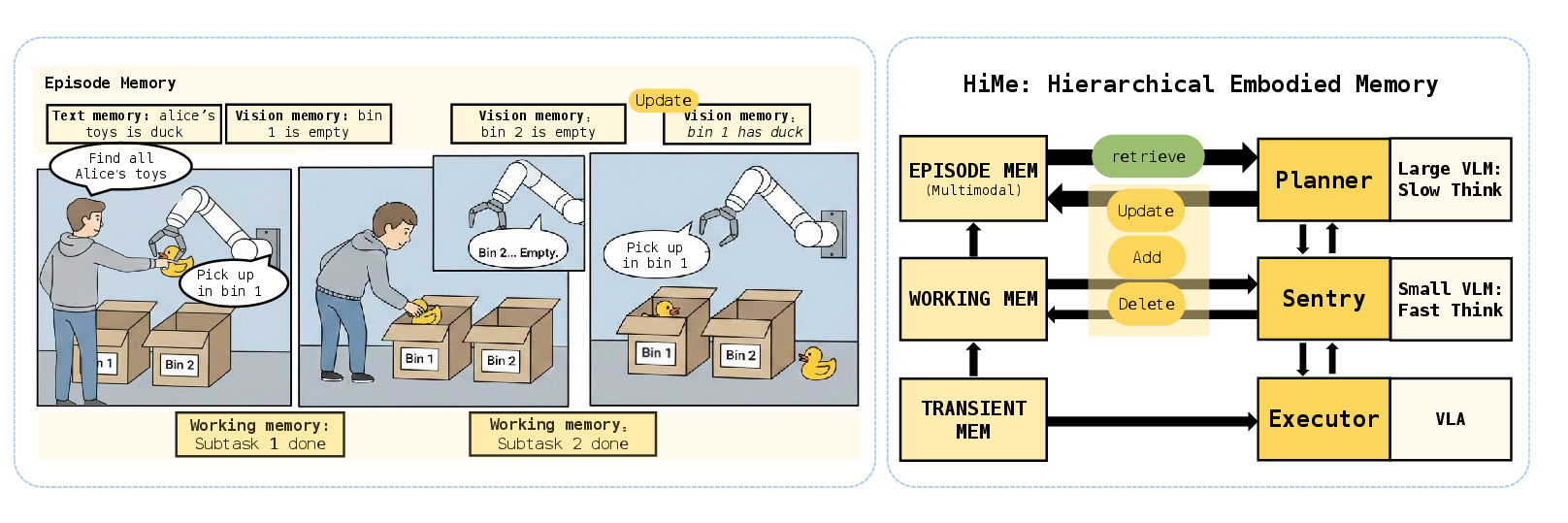
Figure 1: Overview of HiMe and the motivating example for task-relevant multimodal memory maintenance across long-horizon subtasks.
Architecture and Hierarchical Memory Design
The core architectural innovation in HiMe is the hierarchical decomposition of control and memory:
This hierarchy enables amortized reasoning, ensures that critical strategic context is maintained, and provides robustness against the limitations of fixed-context VLM policies. The memory backend utilizes semantic embeddings and vectorized retrieval, facilitating data-efficient memory query and manipulation.
Experimental Evaluation and Ablations
Three tabletop manipulation tasks were designed: Object Search (active inspection, belief updating), Counting (persistent semantic and progress tracking), and Rearrangement (long-term spatial recall). The evaluation protocol precisely measures task progress, planner invocation count, and memory retrieval efficacy over 20 trials per task and method.
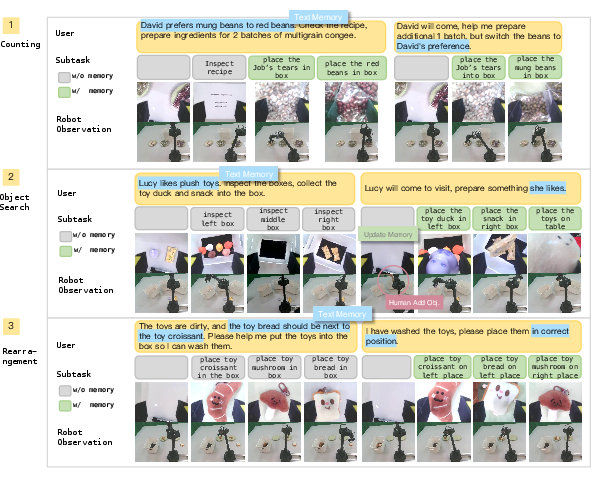
Figure 3: Task suite used for evaluation, covering dynamic inspection, long-horizon counting, and preference-driven rearrangement.
HiMe achieves a 90% average success rate, outperforming all baselines, including transient memory, flat memory, and Sentry-only variants. Crucially, its performance closely approaches the human oracle in high-level subtask specification, validating the effectiveness of structured, actively-managed memory. The Sentry mechanism enhances task consistency by reducing erratic task switching and enables high data quality for memory consolidation.
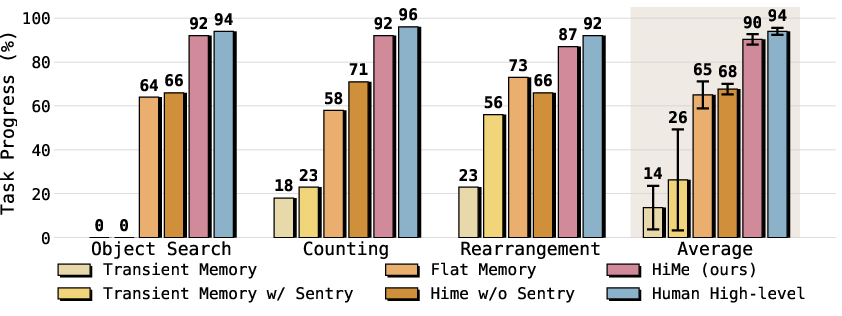
Figure 4: HiMe outperforms transient, Sentry, and flat memory baselines in long-horizon manipulation, bridging the gap to the human oracle.
Modality ablations further demonstrate that cross-modal memory (image + text) yields superior performance: image-only memory performs better in spatial tasks, text-only in semantic reasoning, but neither achieves the level of interleaved memory.
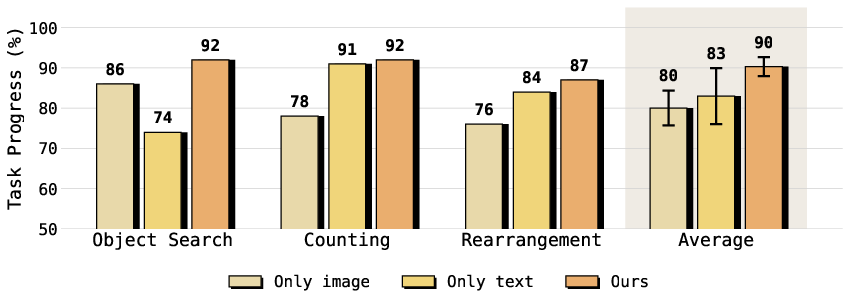
Figure 5: Ablation confirms necessity of cross-modal memory: interleaving image/text achieves generalization across spatial and semantic tasks.
Memory management ablations confirm the necessity of active protocols. FIFO and passive accumulation are consistently inferior; even unconstrained history fails to match actively curated memory, with the latter maintaining concise, consistent context and eliminating obsolete entries.
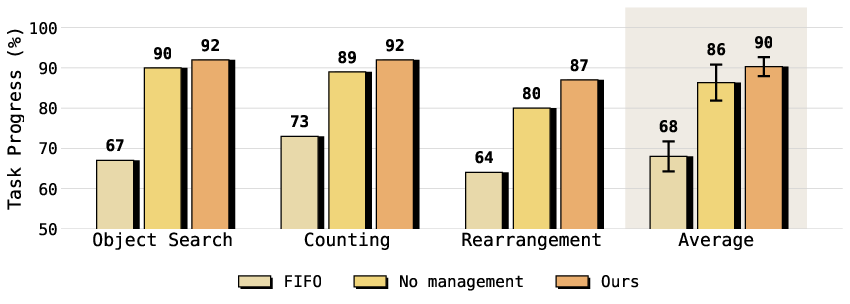
Figure 6: Memory management ablation: explicit Add/Update/Delete enables higher task progress across all tasks by avoiding obsolete or redundant states.
Real-World Deployment and Scalability
HiMe was instantiated on a WidowX-250 robotic platform with dual-camera input and task objects. The Executor was fine-tuned from π0.5 (trained on DROID), the Planner uses GPT-4o or Qwen3-VL-30B, and the Sentry uses Qwen3-VL-8B for online monitoring, ensuring both grounding and reasoning capacity. Real-robot experiments validate HiMe's robustness, real-time execution compatibility, and extendability to open-source planners.
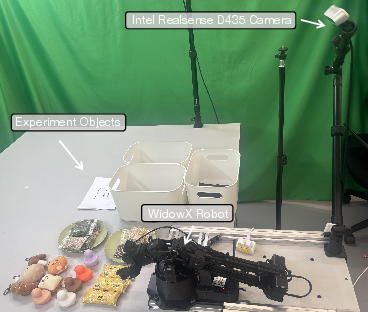
Figure 7: Real-world experimental setup with robot arm, cameras, workspace, and storage containers.
Additional experiments confirm scalability: task success rates decrease with increasing horizon, highlighting the challenge of memory maintenance; Planner latency is decoupled from high-frequency control, and local deployment is feasible.
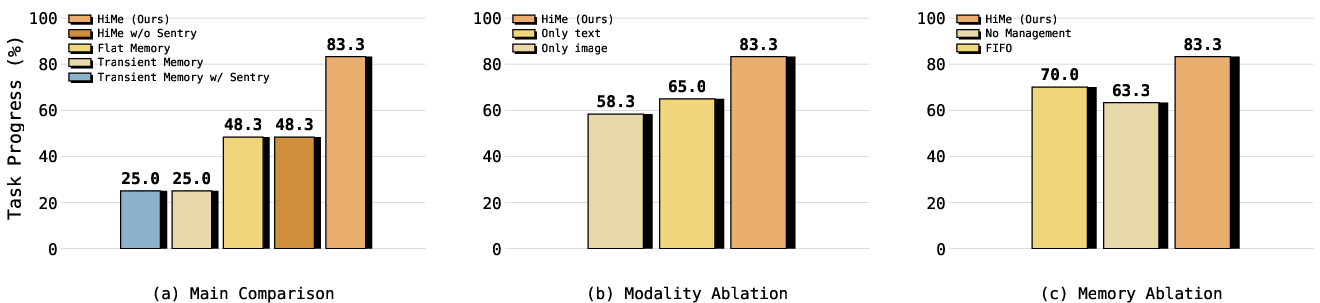
Figure 8: Qwen3-VL-30B open-source Planner matches main results: HiMe remains highest-performing across modality and memory ablations.
Analysis and Key Results
- Efficiency: HiMe reduces Planner API calls by up to 3x compared to flat memory; memory hit rates remain above 94%, minimizing redundant exploration and latency.
- Consistency: Active memory management prevents catastrophic forgetting, ensures reliable context retrieval, and improves long-horizon reasoning.
- Plasticity: Explicit Add/Update/Delete operations allow self-correction under evolving user preferences and environment changes.
- Modality Alignment: Cross-modal semantic schemata enable both spatial grounding and complex logic integration.
- Empirical Upper Bound: HiMe nearly matches human-level high-level planning, given fixed Executor capacity.
Implications and Future Directions
HiMe's approach to hierarchical embodied memory allows practitioners to resolve the real-time reasoning bottleneck without sacrificing context breadth or computational efficiency. Architecturally, it enables robotic agents to operate in persistently non-Markovian domains, adapt to user-driven environmental changes, and maintain consistent internal representations across extensive action horizons.
Practical implications include:
- Modular deployment of memory-enabled agents in service and assistive robotics.
- Plug-and-play compatibility with open-source planners and local serving.
- Extension to larger, more dexterous manipulation domains as demonstrated by current baselines.
Theoretically, HiMe represents a shift from passive, transient memory models to dynamically-managed, multimodal knowledge systems. This offers a pathway to autonomous, adaptation-capable agents that can maintain high-level semantic consistency and learn from evolving interaction histories.
Further research is warranted in:
- Integrating the framework with LLM-driven multi-agent orchestration.
- Scaling to diverse, real-world environments and more complex physical primitives.
- Benchmarking against standard simulation tasks to systematically characterize long-horizon capabilities.
Conclusion
HiMe establishes a principled solution to the frequency-competence paradox in long-horizon VLA control by formalizing hierarchical memory separation and active management. Empirical results validate substantial gains in task completion rate, efficiency, and robustness. The cross-modal memory and active management components are indispensable for maintaining consistent, concise, and adaptive internal knowledge in non-Markovian settings. This architecture will underpin further advances in memory-centric embodied agents, both in research and practical robotic deployments.
Figure 1: Overview of HiMe: hierarchical separation of fast execution and memory-driven reasoning for long-horizon subtasks.
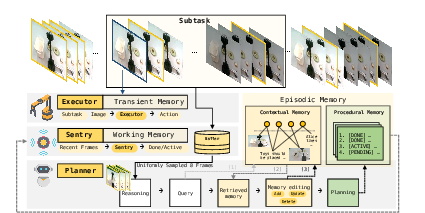
Figure 2: HiMe architecture: closed-loop system with Executor, Sentry trigger, and Planner memory consolidation.
Figure 3: Task suite for evaluation including inspection, counting, and rearrangement.
Figure 4: HiMe main results: achieves 90% task progress and matches human high-level planning.
Figure 5: Ablation of modality: cross-modal memory outperforms text- and image-only variants.
Figure 6: Ablation of management: active memory yields higher progress compared to FIFO and passive accumulation.
Figure 7: Real-world experimental deployment with robotic manipulators and workspace.
Figure 8: Additional experiments using Qwen3-VL-30B: consistent superiority of HiMe across baselines.