- The paper demonstrates that human-driven narratives lead to significantly higher donations compared to data-driven or mixed approaches.
- It employs a preregistered, between-subject survey with 460 participants to compare the efficacy of narrative strategies on affective responses.
- The mediation analysis reveals that emotional upset partially drives donation behavior, highlighting challenges in using mixed narratives.
Evaluating Affective Objectives: Statistical Numbing in Data Visualization
Introduction
"Evaluating Affective Objectives: Statistical Numbing in Data Visualization" (2607.03445) presents an empirical investigation into the role of narrative design strategies—data-driven, human-driven, and mixed—in achieving affective outcomes through data visualizations. The study is primarily motivated by robust psychological literature on statistical numbing and the identifiable victim effect, which consistently demonstrate attenuated emotional responses and less prosocial behavior as the scale of need is abstracted into statistics.
Background and Theoretical Framework
Affective visualizations, particularly anthropographics, are increasingly considered by advocacy organizations aiming to elicit compassion and actionable prosocial engagement rather than solely convey analytical information. Prior work has suggested that techniques focusing on "putting a face to the data" or representing individual victims are more effective at evoking affect than aggregate representations. However, empirical evidence of the efficacy of anthropographics and affective data designs has often shown only marginal effects on real-world prosocial outcomes.
The authors ground their analysis within the framework of affective learning objectives, highlighting the critical separation between cognitive (e.g., recall, analysis) and affective (e.g., empathy, action) aims, and arguing for systematic empirical validation of visualization designs against the explicitly stated affective objectives.
Experimental Design
The experimental study utilizes a two-part, preregistered, between-subjects survey (Figure 1) with 460 valid participants, randomized to view one of three video narratives concerning the humanitarian crisis in Somalia. The three narrative strategies are:
- Data-Driven Narrative: Presentation of statistical data and visualizations emphasizing the scale and scope of the crisis.
- Human-Driven Narrative: Personal stories and photographs of individuals affected, devoid of aggregate statistical summarization.
- Mixed Narrative: Sequential integration of data-driven and human-driven segments.
The primary behavioral measure is participants' willingness to donate a portion of their experimental compensation to Somalia, enabling assessment of actual (not hypothetical) prosocial action.
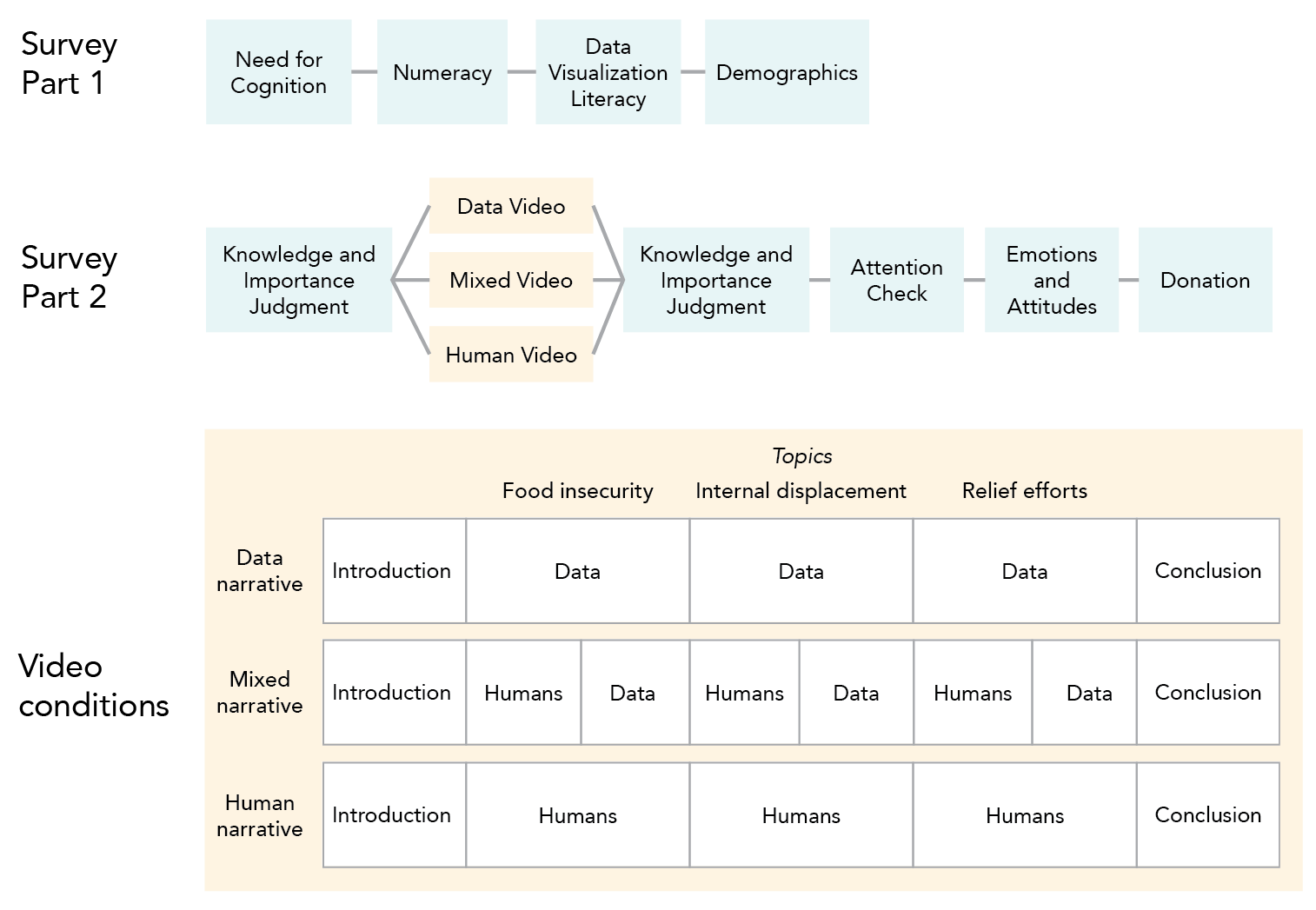
Figure 1: Diagram of the experimental study structure, highlighting random assignment to narrative types and key measured outcomes.
Results
Demographics
Participants were diverse in gender, age, educational level, and economic status (Figure 2).
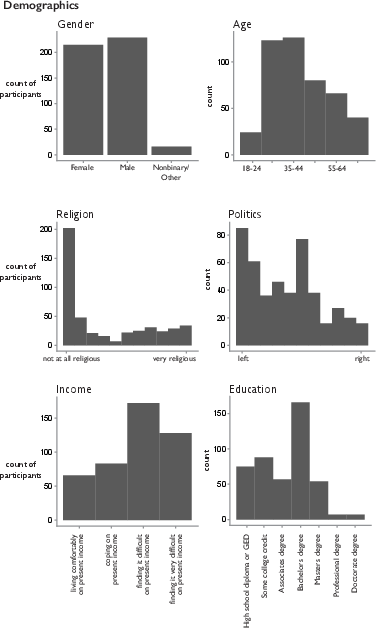
Figure 2: Demographic distribution summary for study participants.
Prosocial Feelings
Five affective self-report measures were collected post-narrative: upset, sympathy, closeness, moral responsibility, and efficacy. Ratings indicated highest sympathy overall, with lesser mean values for upset, moral responsibility, closeness, and efficacy (Figure 3). Regression analysis revealed only "upset" was significantly higher in the human-driven condition compared to data-driven; no robust effects emerged across other measures.
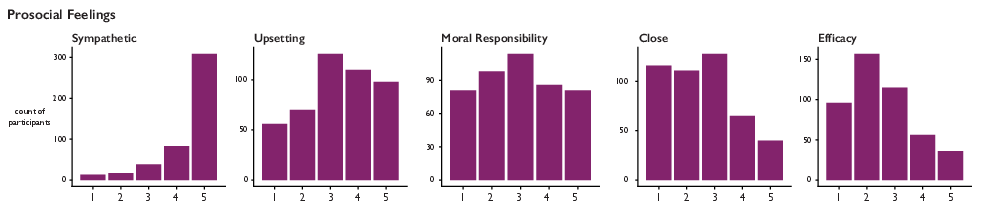
Figure 3: Distribution of prosocial feelings (1 = not at all, 5 = very much), favoring sympathy across groups.
Donation Behavior
Analysis of actual donations revealed that the human-driven narrative elicited the highest average donations ($M = $1.02),thedata−drivennarrativeamoderateamount(M = $0.86),andthe<strong>mixednarrativeledtothelowestdonations</strong>(M = $0.75).Thedifferencebetweenhumanandmixednarrativeswasstatisticallysignificant(ANOVAp = 0.004$ followed by Tukey HSD pairwise post hoc; see Figure 4).</p>
<p>Contradicting prevalent design intuition, <strong>mixed (50/50) presentations were not additive or intermediate but instead underperformed both "pure" strategies</strong>.
<img src="https://images.emergentmind.com/paper-images/2607-03445/donations.png" alt="Figure 4" title="" class="markdown-image" loading="lazy">
<p class="figure-caption">Figure 4: Proportion of participants donating all, some, or none of their compensation by narrative condition.</p></p>
<h3 class='paper-heading' id='mediation-analysis'>Mediation Analysis</h3>
<p>A mediation model established that self-reported upset partially mediated the pathway from narrative condition to donation amount. The mediation effect was statistically significant for data-driven narratives (indirect effect $p < 0.05$) but not for the mixed narrative. The direct effect of the mixed narrative on reducing donations remained significant even after controlling for "upset." Detailed coefficients are illustrated in Figure 5.
<img src="https://images.emergentmind.com/paper-images/2607-03445/mediation.png" alt="Figure 5" title="" class="markdown-image" loading="lazy">
<p class="figure-caption">Figure 5: Mediation analysis model coefficients; only the pathway through "upset" for data narrative is statistically significant ($p < 0.05$).
Secondary analyses found no effect of participants' numeracy, data visualization literacy, or need for cognition on donation behavior, undermining the hypothesis that individual analytic aptitude moderates the affective or prosocial impact of data presentations.
Discussion
The results robustly reinforce core findings from psychological literature on statistical and compassion numbing: as crisis narratives become more aggregated and abstracted—as in typical data visualization practice—affective engagement and behavioral donation decrease. Human-driven narratives, especially those foregrounding individual stories and photographs, are empirically the most effective at eliciting prosocial action.
Critically, the commonly held belief among designers that mixing data and human interest elements would offer a "best of both worlds" was not supported; the mixed narrative condition systematically underperformed, resulting in lower donations than even purely statistical or purely personal approaches. The authors propose that cognitive complexity, message dilution, or repeated switching between narrative modes may attenuate emotional impact or engender confusion, warranting further investigation into sequential versus integrative mixed methods.
Another substantial contribution is empirical validation using real behavioral choice (actual donations) rather than hypothetical self-report measures, as well as analytic attention to mediation pathways between emotion and behavior.
The findings also emphasize that cognitive impact (knowledge, importance ratings, numeracy) is not the primary determinant of prosocial response in affect-driven advocacy; affective impact dominates.
Implications
For practitioners designing visualizations or narratives with explicit affective goals, the study underscores the necessity of systematic validation against real affective and behavioral metrics, not merely intuition or established design paradigms. Data visualization is not uniformly effective at fostering empathy or motivating action—indeed, under certain configurations, it may lead to affective disengagement and suppress helping behavior.
On a theoretical level, the work challenges the anthropographic/affective visualization literature to re-examine combinations and sequencing of narrative elements and to consider cognitive load and emotional coherence more deeply in future experimental work.
Future directions should involve (a) further dissecting the components and blending strategies of mixed narrative formats, (b) exploring how real-world, web-based, or interactive experiences modulate affective outcomes, and (c) more granular mapping between design dimensions (granularity, specificity, narrative mode) and downstream behavioral outcomes.
Conclusion
This study makes a strong empirical case that, for affective objectives such as increasing prosocial behaviors, standard data visualizations are often outperformed by strategies emphasizing individual narratives and photography. Combining data-driven and human-driven content does not necessarily yield an affective or behavioral advantage and may weaken overall efficacy. Affective objectives in visualization design require explicit, data-driven evaluation; reliance on designer intuition or cognitive design paradigms alone is insufficient. These findings should direct future research and practice toward hypothesis-driven, empirical validation of narrative strategies and their interactions with audience psychology.