- The paper demonstrates that episodic framing intensifies negative emotional responses more than thematic framing in mass shooting data visualizations.
- The experiment used a preregistered, between-subjects design with 800 participants to measure pre- and post-exposure emotions with validated scales.
- Despite strong emotional effects in episodic conditions, framing did not directly alter policy support, indicating indirect mediation via emotions.
Emotional Impact of Thematic Versus Episodic Framing in Visualization Text
Background and Motivation
The influence of textual framing in data visualizations, particularly the emotional and attitudinal responses it elicits, has been underexplored despite well-established effects of framing in political communication and journalism. Two dominant strategies—episodic framing, which foregrounds specific, concrete events, and thematic framing, which abstracts and contextualizes data as societal trends—have distinct emotional and persuasive impacts in textual media. However, their comparative roles in the context of data visualization remain insufficiently understood. This work addresses this gap by empirically investigating how these framing techniques, when applied to visualizations of U.S. mass shooting data, differentially affect emotional valence and policy attitudes.
Experimental Methodology
A preregistered, between-subjects online experiment (N=800) was conducted, systematically varying only the textual framing accompanying otherwise identical bar charts showing annual fatalities and incidents of U.S. mass shootings from 2001 to 2024. Three framing conditions were used:
Emotional valence was measured pre- and post-exposure using the Self-Assessment Manikin scale, and support for gun control policies was measured via a Likert scale. The study design enables direct assessment of the causal effects of text-driven framing on emotion and attitudes, as well as mediation analysis linking changes in emotion to changes in policy support.
Major Findings
Emotional Valence
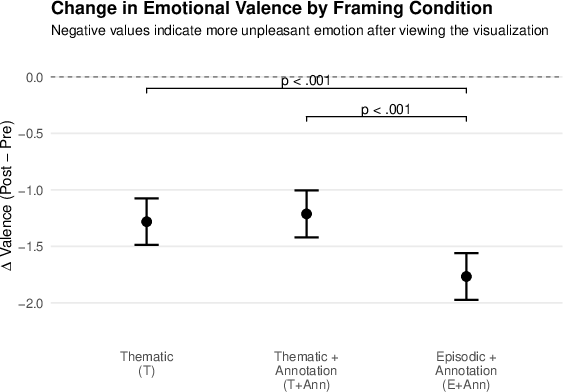
Across all conditions, exposure to the mass shooting visualization elicited a negative shift in emotional valence. The decrease was significantly greatest in the episodic (E+Ann) condition (Δ=−1.77), followed by thematic plus annotation (T+Ann, Δ=−1.21) and thematic only (T, Δ=−1.28). Statistical contrasts confirmed that E+Ann elicited substantially more negative emotion than both T and T+Ann (both p<.001), whereas T and T+Ann did not significantly differ (p=.64).
(Figure 2)
Figure 2: Estimated change in emotional valence by framing condition. Negative values correspond to more unpleasant emotional responses; significant planned contrasts are annotated.
Policy Attitudes
Textual framing did not significantly affect post-exposure support for gun control after controlling for baseline support (F(2,771)=1.46, p=.23). Adjusted means were nearly identical across conditions, and all planned contrasts were non-significant (p>.10).
A bootstrapped mediation model demonstrated a significant indirect effect: increased negative emotion under episodic framing predicted higher support for gun control, despite the absence of a direct framing effect on policy attitudes (ind2=0.013, Δ=−1.770). The direct effect of framing on attitudes remained non-significant.
Manipulation Checks
- Participants reliably perceived the intended episodic-to-thematic hierarchy (Δ=−1.771).
- Annotations were salient in T+Ann and E+Ann.
- Episodic framing was perceived as more advocacy-oriented (pro-gun control).
Interpretation and Theoretical Implications
The results provide robust evidence that episodic textual framing within data visualizations triggers significantly stronger negative affective responses compared to thematic approaches. This is theoretically aligned with findings in political communication, where episodic narratives act as focal points for emotional engagement and may intensify affective arousal more than aggregate trend descriptions.
However, the lack of direct persuasive effects on policy attitudes, even in the presence of strong emotional responses, underscores the attitudinal inertia observed in highly polarized or identity-laden issues such as gun policy. The mediation pathway—whereby negative affect manifests as incremental attitudinal shifts—suggests that emotional engagement may serve as a necessary but not sufficient condition for attitude change, particularly for single-exposure interventions.
The finding that annotation alone, without an episodic title, does not enhance emotional response, clarifies that the most proximal layer of framing (the title) is the primary determinant of affective reaction within the context of static data visualizations.
Practical Implications for Visualization Design
- Episodic framing increases emotional engagement: For communicative or advocacy-driven visualizations where emotional resonance is a goal, foregrounding specific events in titles is an effective, measurable technique.
- Editorial tradeoffs: Emphasizing salient individual events risks privileging selected narratives, possibly distorting audience perception of issue prevalence or neutrality.
- Design for perceived neutrality: In contexts prioritizing credibility or impartiality, minimizing episodic elements in textual framing is advisable.
- Emotion–attitude coupling is indirect: Designers aiming to influence attitudes may need to explicitly connect evoked emotion to desired policy outcomes, potentially via enriched narratives or follow-up interventions.
Limitations and Future Directions
Primary limitations include the exclusive focus on a singular, emotionally charged domain (U.S. mass shootings) and the operationalization of framing via static titles and brief annotations without visual framing manipulation. Future work should explore:
- Cross-domain generalization: Testing in less affective or differently polarized topics.
- Finer-grained framing decompositions: Isolating the contribution of titles and annotations separately or in combination.
- Interaction with visual framing: Joint manipulation of visual and textual features to parse their interactive effects.
- Diverse annotation types: Systematic exploration of annotation function, placement, and granularity.
Conclusion
This study rigorously demonstrates that episodic framing in visualization text intensifies negative emotional response, which, in turn, has a measurable but indirect effect on policy attitudes. While direct persuasive effects are muted in single-exposure settings on entrenched issues, the findings delineate clear editorial and affective tradeoffs in communication-focused data visualization. Selective use of episodic framing offers a lever for emotional engagement but should be balanced against potential impacts on audience perceptions of neutrality and narrative focus. Future advances will require nuanced disentanglement of textual and visual framing variables across broader domains and design contexts.