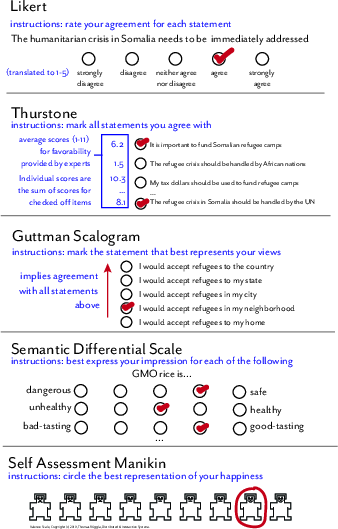
- The paper presents a taxonomy-driven framework that systematically aligns affective learning objectives with robust assessment methods.
- It employs comparative case studies across narrative designs to measure shifts in cognition, attitude, and donation behavior.
- The findings challenge blended human-data approaches, highlighting the superior impact of human-centric visualization on behavioral outcomes.
Assessing Affective Learning Objectives in Communicative Visualization Design
Introduction
This paper, “Assessing Affective Objectives for Communicative Visualizations” (2604.01183), addresses the persistent methodological gap in evaluating affective learning objectives (LOs) in communicative visualization. While the construction and assessment of cognitive objectives in visualization are well-supported by mature frameworks and established assessment tools, affective objectives—those aimed at modifying appraisals, attitudes, values, or behaviors—lack systematic evaluative rigor. This study delineates a taxonomy-driven framework that supports selection and implementation of robust affective assessment methods, addressing the theoretical, practical, and empirical complexities of measuring affective outcomes in visualization. The authors further validate their approach through a case study in humanitarian advocacy, contrasting design interventions and their effectiveness in shaping affective responses and behaviors.
Theoretical Framework for Affective Learning Objectives
The authors posit that articulating clear LOs for communicative visualizations provides operational leverage for both design and evaluative processes. Departing from traditional affective taxonomies (e.g., Krathwohl et al.), the framework here is grounded in the “the viewer will [verb] [noun]” paradigm, providing a fine-grained mapping between affective verbs (Observe, Position, Strengthen, Connect, Behave) and knowledge dimensions (Appraisals, Attitudes, Values, Value Systems). This structure enables the systematic alignment of assessment instruments with target affective constructs. Crucially, the framework distinguishes between fleeting emotion and enduring belief change, restricting the affective domain to constructs that can be learned and exhibit population-level variance.
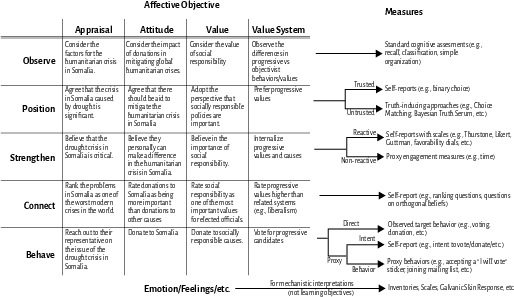
Figure 1: Taxonomy grid for affective learning objectives, with representative objectives and candidate measures aligned by verb and belief dimension.
Methodology for Selecting and Constructing Affective Assessments
The paper advances three core criteria for affective assessment selection in visualization design: timeliness (cost-efficient, scalable), actionability (ability to inform design choice between alternatives), and validity (construct, content, and predictive). The authors survey assessment paradigms from related fields—education, advocacy, psychology, economics—and structure their applicability in relation to the LO taxonomy. For each verb class:
The framework also addresses the limitations of emotion-centric measures, emphasizing that visualizations rarely produce persistent affect change through emotion alone—a stance supported by experimental literature on compassion fade, pseudo-inefficacy, and statistical numbing.
Case Study: Humanitarian Crisis Advocacy
The application of the framework is demonstrated through a pragmatic case study, simulating collaboration with UN OCHA on advocacy videos addressing the Somali humanitarian crisis. Five affective LOs (spanning appraisal, attitude, agency, responsibility, and donation behavior) are identified and mapped to corresponding assessment instruments: factual recall, attitudinal self-reports, validated agency and responsibility scales, and direct donation behavior via incentivized choice.
Three experimental video designs are compared:
- Data-Narrative: Emphasizes quantitative evidence and conventional data visualizations.
- Human-Narrative: Leverages photographic and narrative storytelling centered on individuals.
- Mixed-Narrative: Integrates both data and human elements (anthropographics).
Each design is tested using between-subjects experiments on Prolific, with a substantial n=502.
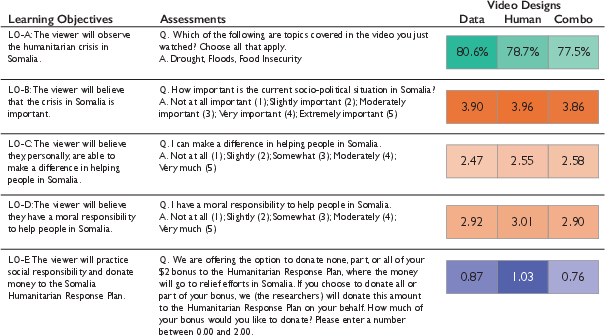
Figure 3: Schematic of the case study experimental design, mapping each assessed affective objective to a corresponding quantitative instrument across three video interventions.
Key Results
- Cognitive and Attitudinal Objectives (LO-A to LO-D): All designs produce comparable recall and attitudinal shifts (e.g., mean post-intervention importance ratings; mean responsibility and agency).
- Behavioral Objective (LO-E): The human-narrative video elicits the highest mean donations (\$1.03 out of a possible \$2.00), the mixed video the lowest (\$0.76), with data-narrative intermediate (\$0.87). This effect size, while contextually modest, is nontrivial in the highly capped incentive context, indicating substantive implications for scaling in applied advocacy.
Notably, the combination (mixed) approach underperforms both individual strategies in eliciting donation—a result that contradicts prior intuition regarding benefit-hybridization via anthropographics or multi-modal narratives.

Figure 4: Advocacy imagery contrasting emotive human-centric content (left) with data-driven visualization of the scale and geography of the Somali crisis (right).
Practical and Theoretical Implications
This study underscores both the necessity and feasibility of systematic affective assessment in visualization design. The methodology demystifies affective objectives and advances actionable protocols beyond anecdotal or intuition-driven design decisions. Practical implications are immediate for advocacy organizations, non-profits, and public communication: outcome-optimizing design should be driven by empirically validated affective objectives and instrumented, comparative assessment—even when the majority of design alternatives yield weakly differentiated cognitive effects, behaviorally-relevant divergence can be substantial and counterintuitive.
Theoretically, the findings challenge assumptions about the additive value of blended human-data presentation and reinforce primacy effects of pathos-based (human-centric) storytelling for behavioral mobilization, consistent with scholarship on statistical numbing and the identifiable victim effect.
Directions for Future Research
Three main avenues are suggested:
- Expansion of this evaluative framework to interactive or longitudinal contexts, where engagement-based proxies or repeated exposure may mediate affective outcomes.
- Development of more sensitive and context-specific affective instruments, including unobtrusive behavioral measures and incentivized truth-inducing self-reports.
- Investigation of heterogeneous audience effects (e.g., prior beliefs, numeracy, domain knowledge) to adapt design and assessment in a demographically targeted fashion.
Conclusion
This work establishes a rigorous, taxonomy-driven framework for articulating and assessing affective learning objectives in communicative visualizations. Through a transparent mapping of affective verbs and belief dimensions to actionable, valid assessment paradigms, and substantiated by evidence from an ecologically valid advocacy case study, the paper provides critical methodological infrastructure for designers seeking to empirically optimize affective and behavioral impact. The findings reaffirm that intuitive design decisions are insufficient—systematic assessment is imperative for consequential communicative outcomes in affective visualization.