- The paper demonstrates that disorder (via sulfur vacancies) in WS2–graphene bilayers induces quantum chaos by promoting intervalley mixing and ergodicity.
- It employs ab initio GW-BSE methods to analyze spectral statistics, revealing a crossover from Poisson to GUE behavior as energy increases.
- Findings connect universal Porter–Thomas oscillator strength distributions to experimentally measurable optical signatures in chaotic excitonic regimes.
Many-Body Quantum Chaos in First-Principles Excitonic Spectra
Introduction
This work demonstrates the emergence of many-body quantum chaos within ab initio excitonic spectra of two-dimensional van der Waals heterostructures, specifically WS2-graphene bilayers, using first-principles GW–Bethe-Salpeter equation (GW-BSE) approaches. The focus is on identifying random matrix theory (RMT) universality in spectral fluctuations and establishing a direct connection to energy-resolved experimental observables. The study analyzes both pristine and vacancy-disordered samples, examining the crossover from regular dynamics to fully developed chaos, the effect of symmetries (notably valley symmetry), and the role of disorder in promoting ergodicity.
Spectral Statistics and the Onset of Chaos
The analysis of consecutive level spacing ratios, ⟨r⟩, as a function of excitonic energy provides a robust indicator of the crossover from integrable to chaotic behavior.
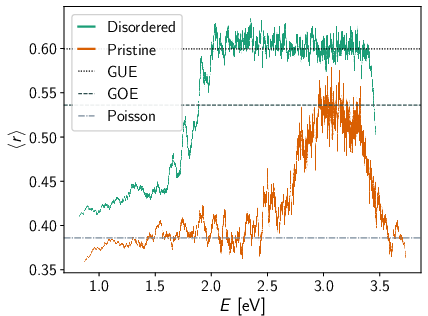
Figure 1: Average adjacent level spacing ratio ⟨r⟩ over 1000-level windows for pristine (orange) and disordered (green) WS2-graphene; theoretical Poisson (black dotted), GOE (dark grey dashed), and GUE (light grey dash-dotted) limits indicated.
Both pristine and disordered systems display Poisson-like statistics at low energies, characteristic of uncorrelated, localized exciton states. As energy increases, the disordered system rapidly develops level repulsion, saturating at the GUE limit (⟨r⟩≃0.603), while the pristine system only transiently approaches the GOE limit (⟨r⟩≃0.53), with a much narrower plateau. This establishes that disorder—modeled here via sulfur vacancies—acts as a catalyst for quantum chaos, promoting intervalley mixing and effective time-reversal symmetry breaking, and driving the system into a fully ergodic regime.
Hamiltonian Symmetries, Valley Mixing, and Non-Ergodicity
In the absence of disorder, the WS2-graphene spectrum displays persistent signatures of “incomplete” chaos, with an underlying approximate valley symmetry preventing full spectral mixing and ergodicity, despite the inclusion of spin–orbit coupling. The introduction of lattice disorder via vacancy-induced flat bands compresses the many-body configuration space and dramatically increases the density of intervalley-coupled electron-hole excitations. This facilitates stronger K-point mixing in the exciton Hilbert space, and the system attains the universal GUE statistics associated with complex quantum chaotic dynamics at high energies.
Eigenstate Fluctuations: Porter-Thomas Statistics
The statistical distribution of normalized dipolar (oscillator) strengths D/⟨D⟩ provides an eigenvector-sensitive indicator of quantum chaos, independent from spectral spacing measures.
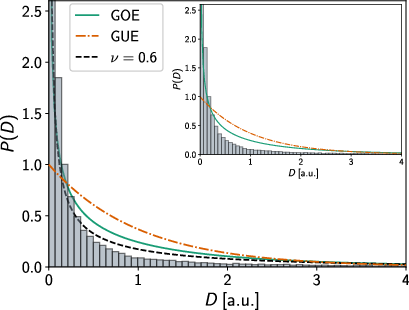
Figure 2: Normalized dipolar strength D/⟨D⟩ for the pristine system. The main panel is from E∈[3.15,3.3] eV; inset: ⟨r⟩0 eV. Universal Porter–Thomas distributions for GOE (⟨r⟩1) and GUE (⟨r⟩2) are contrasted.
In the pristine system, the empirical distributions deviate from both GOE and GUE Porter–Thomas forms, with best-fit ⟨r⟩3 even at the highest energies. This is consistent with incomplete wavefunction randomization.
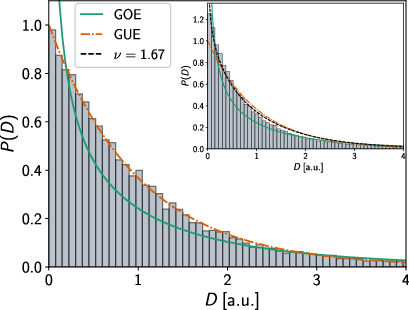
Figure 3: Normalized dipolar strength ⟨r⟩4 for the lattice disordered system. Main: ⟨r⟩5 eV, exhibiting quantum chaos. Inset: ⟨r⟩6 eV, showing more regular behavior.
For the disordered case, the Porter–Thomas ⟨r⟩7 parameter transitions from sub-GOE values at low ⟨r⟩8 to ⟨r⟩9 in the high-energy, fully chaotic regime, validating energy-resolved ergodicity induced by disorder. This crossover is quantitatively tracked:
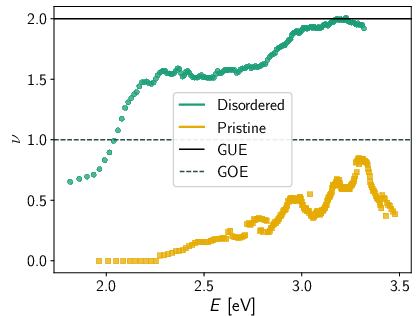
Figure 4: Energy dependence of the Porter–Thomas fitting parameter ⟨r⟩0 for disordered (green) and pristine (orange) cases. GUE (⟨r⟩1) and GOE (⟨r⟩2) values indicated.
The pristine system never reaches ⟨r⟩3, confirming a regime where level repulsion does not guarantee full ergodicity in wavefunction statistics.
Long-Range Correlations and Thouless Energy
To capture long-range spectral rigidity, the power spectrum of the cumulative fluctuation ⟨r⟩4 is evaluated and compared to RMT predictions, extracting the system’s Thouless energy and associated timescales for ergodization.
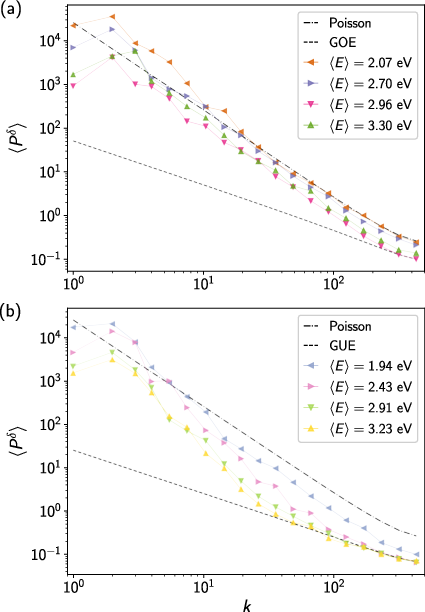
Figure 5: Log-averaged power spectrum of the cumulative fluctuation ⟨r⟩5 for (a) pristine and (b) lattice-disordered systems at varying mean exciton energy. Dashed lines: RMT GOE/GUE/Poisson reference.
The pristine system's power spectrum generally tracks the Poisson distribution, only approaching GOE behavior for large ⟨r⟩6 (short distances). For the disordered sample in the ergodic window, a crossover to the GUE prediction is observed even for small ⟨r⟩7, indicating the development of long-range spectral correlations. From the separation scale ⟨r⟩8, the Thouless energy ⟨r⟩9 and time 20 are extracted. For the most chaotic regimes, 21 approaches 22–23 ps, consistent with fast valley-mixing dynamics and signalable in ultrafast optical experiments.
Experimental and Theoretical Implications
The universality of Porter–Thomas oscillator strength distributions in the fully chaotic regime provides an unambiguous bridge between theoretical quantum chaos diagnostics and experimentally measurable optical absorption fluctuations (“Ericson fluctuations”). The energy-selective nature of the ergodic-chaotic regime, as well as its disorder tunability and spectroscopic detectability, positions atomically engineered excitonic platforms as controlled settings for probing ergodicity breakdowns, symmetry effects, and the interplay between symmetry, hybridization, and many-body interactions.
On the practical side, the findings suggest optical spectroscopies can reveal signatures of many-body quantum chaos in real materials, enabling disorder and layer-alignment engineering to control quantum thermalization, eigenstate structure, and ergodicity—potentially impacting quantum information scrambling, decoherence, and dynamics in 2D platforms.
Conclusions
This study establishes that ab initio excitonic many-body Hamiltonians in 2D vdW heterostructures can exhibit robust, energy- and disorder-tunable quantum chaos characterized by RMT universality classes. The onset of full spectral and eigenstate ergodicity—driven by disorder-induced intervalley mixing that breaks residual symmetries—is directly connected to universal Porter–Thomas statistics of experimentally accessible dipole strengths and is manifested in long-range spectral rigidity. These results open new directions for the controlled study of quantum chaos, thermalization, and ergodicity transitions in realistic quantum materials.