Controlling many-body quantum chaos in a dissipative optical cavity
Published 5 Jul 2026 in quant-ph, cond-mat.dis-nn, and cond-mat.quant-gas | (2607.04455v1)
Abstract: Cavity quantum electrodynamics (QED) with ultracold fermions provides a promising platform for realizing many-body quantum chaos through disordered, photon-mediated long-range interactions. Such setups are inherently open and are therefore subject to dissipation arising from cavity photon loss and atomic spontaneous emission. In this article, we study the driven-dissipative dynamics of a typical cavity QED setting including controllable disorder and long-range interactions. We find that the two dissipation sources have qualitatively different structures. Cavity loss reduces to a single dephasing channel, whereas spontaneous emission in the experimentally relevant regime generates a collection of nonlocal dephasing channels. Cavity-induced dephasing preserves signatures distinguishing integrable from chaotic Hamiltonian dynamics in observables that depend linearly on the density matrix, while spontaneous emission suppresses these signatures. By contrast, quantities that probe the structure of the many-body state, such as the entanglement entropy, are strongly affected by both dissipation mechanisms. Assuming experimentally realistic parameters, we derive quantitative constraints for the observation and control of many-body quantum chaos in cavity-QED platforms.
The paper demonstrates that engineered disorder and modulated dissipation enable simulation of SYK-like chaos in ultracold fermionic systems.
It elucidates how distinct decoherence channels—collective cavity loss versus high-rank spontaneous emission—affect observable chaos signatures and entanglement.
Monte Carlo quantum trajectory simulations reveal that linear observables maintain integrability/chaos distinction under low cavity loss, while entanglement growth is severely suppressed by dissipation.
Controlling Many-Body Quantum Chaos in a Dissipative Optical Cavity
Introduction and Experimental Framework
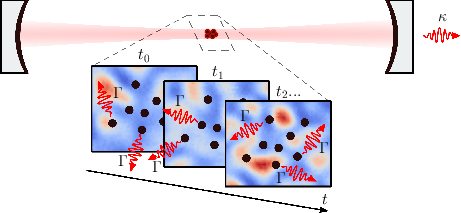
The study presents a theoretical and numerical analysis of chaotic and integrable dynamics in an ultracold fermionic gas embedded within a high-finesse optical cavity subject to two inherently different dissipative processes: photon leakage (cavity loss) and atom-light spontaneous emission. This system, schematically illustrated in Figure 1, is constructed to realize paradigmatic quantum chaotic dynamics akin to the Sachdev-Ye-Kitaev (SYK) model through engineered disorder and photon-mediated long-range interactions.
Figure 1: A high-finesse optical cavity couples to a cloud of driven ultracold fermionic atoms under a time-dependent speckle potential, enabling a tunable quantum chaotic many-body system with cavity dissipation (rate κ) and atomic spontaneous emission (rate Γ).
Within this setup, the presence of open-system effects—primarily photon loss from the cavity and atomic spontaneous emission—competes directly with the coherent many-body quantum evolution. The work rigorously delineates how these two decoherence mechanisms impact accessible chaos signatures, entanglement growth, and constraints for the observation and manipulation of quantum chaos in cavity QED-based quantum simulators.
Model, Effective Hamiltonians, and Dissipative Channels
The system comprises N fermionic modes in a 2D harmonic trap, where motional eigenstates act as orbitals, coupled via the cavity field. In the dispersive regime with large detuning, this results in an effective Hamiltonian,
H^eff=−Δc14Δa2Ω2Ωd2jk∑gjkc^j†c^k2,
where disorder is imposed by the spatial profile of a projected speckle pattern.
Importantly, this effective two-body interaction is of low rank, precluding many-body quantum chaos unless temporally modulated disorder is introduced. To circumvent this, the authors employ a "fermionic random quantum circuit" (f-RQC) protocol, periodically switching disorder patterns such that the unitary evolution is akin to that of SYK-class models for a closed, dissipationless system.
The theoretical core distinguishes the structure and effect of decoherence channels:
Cavity loss (κ): After eliminating the cavity in the dispersive regime, results in a single collective dephasing channel, essentially a low-rank Lindblad dissipator.
Spontaneous emission (Γ): Away from the Lamb-Dicke limit (η∼1), leads to an extensive, high-rank set of nonlocal dephasing channels via photon recoil, encoding complex intra-manifold heating and rapid decoherence.
The competition of these timescales (E,κeff,Γeff) and their dependence on key parameters, including atomic cooperativity (C=Ω2/κΓ), is analyzed in depth.
Quantum Many-Body Dynamics: Integrability, Chaos, and the Role of Dissipation
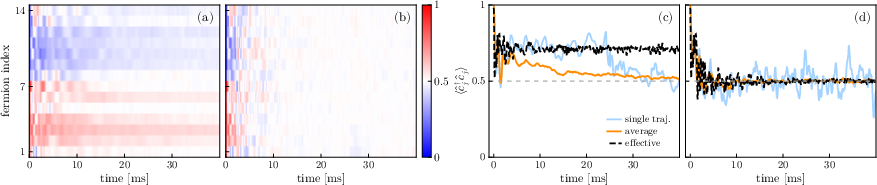
Through Monte Carlo quantum trajectory simulations, the work tracks fermionic mode populations, scrutinizing how integrable (static disorder) and chaotic (f-RQC) regimes manifest under realistic open-system conditions.
Figure 2: Averaged dynamics of the fermionic populations for N=14 modes at half-filling, contrasting static disorder (integrable) and f-RQC (chaotic) protocols under combined dissipation.
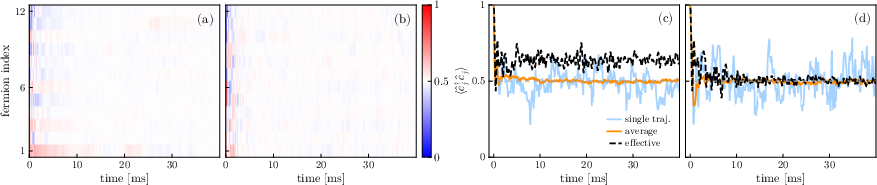
With cavity dissipation dominant (Γ0), linear observables such as fermionic densities retain signatures distinguishing integrable dynamics (persistent memory of initial state, nonthermal populations) from chaotic (thermalization to half-filling). In single quantum trajectories, however, large fluctuations emerge and fingerprints of chaos are suppressed. As spontaneous emission becomes dominant (Γ1), even the ensemble-averaged observables lose any integrability/chaos distinction due to the high-rank, nonlocal character of spontaneous emission-induced dephasing, as depicted in Figure 3.
Figure 3: At increased detuning, the system, regardless of the underlying Hamiltonian complexity, loses the distinction between integrable and chaotic regimes because of dominant spontaneous emission.
This dichotomy is explained analytically: cavity-induced dephasing, by virtue of being a single collective channel, maintains a low-rank dissipator structure akin to the non-chaotic effective Hamiltonian, thus preserving linear observable distinctions. Spontaneous emission, however, introduces high-rank dephasing analogous to the random tensor structure of SYK Hamiltonians, rapidly destroying quantum coherence and operator distinction.
Entanglement Entropy and Monitored Many-Body Dynamics
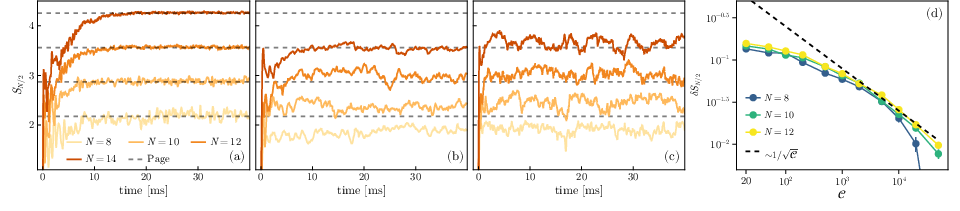
The behavior of entanglement entropyΓ2 for a half-system bipartition offers a sensitive diagnostic for quantum chaos and thermalization. Simulations demonstrate that in the absence of dissipation, the f-RQC protocol attains the Page value expected for maximally chaotic states. In stark contrast, even moderate levels of cavity loss or spontaneous emission substantially suppress accessible entanglement, limiting Γ3 well below the Page threshold Figure 4.
This observation is interpreted via the theory of monitored quantum dynamics: both dissipation channels act as measurement processes, continuously projecting the system and extracting information, thereby impeding the growth of subsystem entropy. The impact is more pronounced for spontaneous emission, where the underlying high-rank structure does not preserve integrable/chaotic distinctions, in contrast to cavity-only dissipation.
The scaling analysis of the entanglement deficit with cooperativity Γ4 (Figure 4(d)) reveals that approaching the chaotic, maximally entangled regime with Γ5 error necessitates Γ6, far beyond current cavity QED capabilities.
Supplemental: Spontaneous Emission Structure, Lamb-Dicke Regime, and Trap Effects
The supporting analysis clarifies that in the Lamb-Dicke regime (Γ7), spontaneous emission reverts to a low-rank, collective process similar to cavity loss, and thus is far less detrimental to chaos observability. However, for typical experimental values (Γ8), the destructive proliferation of decoherence channels is unavoidable.
Further, the inclusion of the harmonic trapping potential Γ9 demonstrates that large trap frequencies, especially for light atomic species or tight confinement, can freeze dynamics and obscure chaos regardless of the underlying interaction protocol. Engineering flatter traps or optical lattices with narrow intra-manifold level spacing and large inter-band gaps is suggested as an optimal route for minimizing both trap-induced integrability and spontaneous emission-induced heating.
Implications and Outlook
This analysis establishes concrete, quantitative constraints for realizing many-body quantum chaos in driven-dissipative cavity QED architectures. Practically, it provides guidance for experimentalists targeting thermodynamic and transport signatures of chaos, indicating that linear quantities remain the most robust against current dissipation levels, whereas entanglement and nonlinear diagnostics remain out of reach for foreseeable cooperativities.
From a more general theoretical perspective, the results demonstrate that dissipation can fundamentally alter the accessible phenomenology of quantum chaotic systems, effectively reshaping the monitoring environment and decoherence landscape. The distinction between low-rank and high-rank dissipators sets a framework for future studies of open-system quantum simulation, monitored dynamics, and the design of measurement-induced phase transitions.
Conclusion
The work presents a stringent evaluation of the feasibility and limitations of simulating many-body quantum chaos in ultracold fermion-cavity QED systems. The analysis distinguishes the fundamentally different roles played by cavity loss and spontaneous emission in degrading chaos signatures and entanglement, identifies robust observable regimes, and delineates the hardware parameters required for progress. The insights extend to broader topics in open quantum systems, monitored entanglement, and experimental quantum simulation design, motivating further investigation into reservoir engineering and optimal trap geometries for next-generation quantum many-body platforms.