- The paper introduces a lifecycle framework for duplicate detection, resolution, and prevention that reduces predicate redundancy by up to 30% in RKGs.
- It employs a hierarchical detection pipeline combining lexical, semantic, and ontological analyses with embedding-based similarity to accurately identify duplicates.
- The framework integrates real-time prevention measures and curator-driven validation to improve import workflows and overall graph quality.
Addressing Predicate Redundancy in Research Knowledge Graphs: Duplicate Detection, Resolution, and Prevention
Predicate-level redundancy in Research Knowledge Graphs (RKGs) represents a significant barrier to semantic conciseness and data quality, driven primarily by weakly enforced schemas and the open world assumption inherent to large, crowdsourced systems such as the Open Research Knowledge Graph (ORKG). Unlike entity duplication, which can often be mapped to external authorities, predicate duplication leads to fragmentation of relation semantics, propagation of redundant triples, impaired query recall, and decreased interpretability. The paper articulates the necessity of treating predicate redundancy as a first-class data quality issue, noting that up to 30% of predicates in the ORKG are likely redundant. This redundancy is traced to both interface shortcomings and decentralized user behaviors—repeated creation of similar predicates, identifier/label conflation, and lack of standardization in predicate design.
Framework: Detection, Resolution, and Prevention
The proposed framework formalizes predicate redundancy management as a lifecycle process comprising three interdependent components: Duplicate Detection (DD), Duplicate Resolution (DR), and Duplicate Prevention (DP).
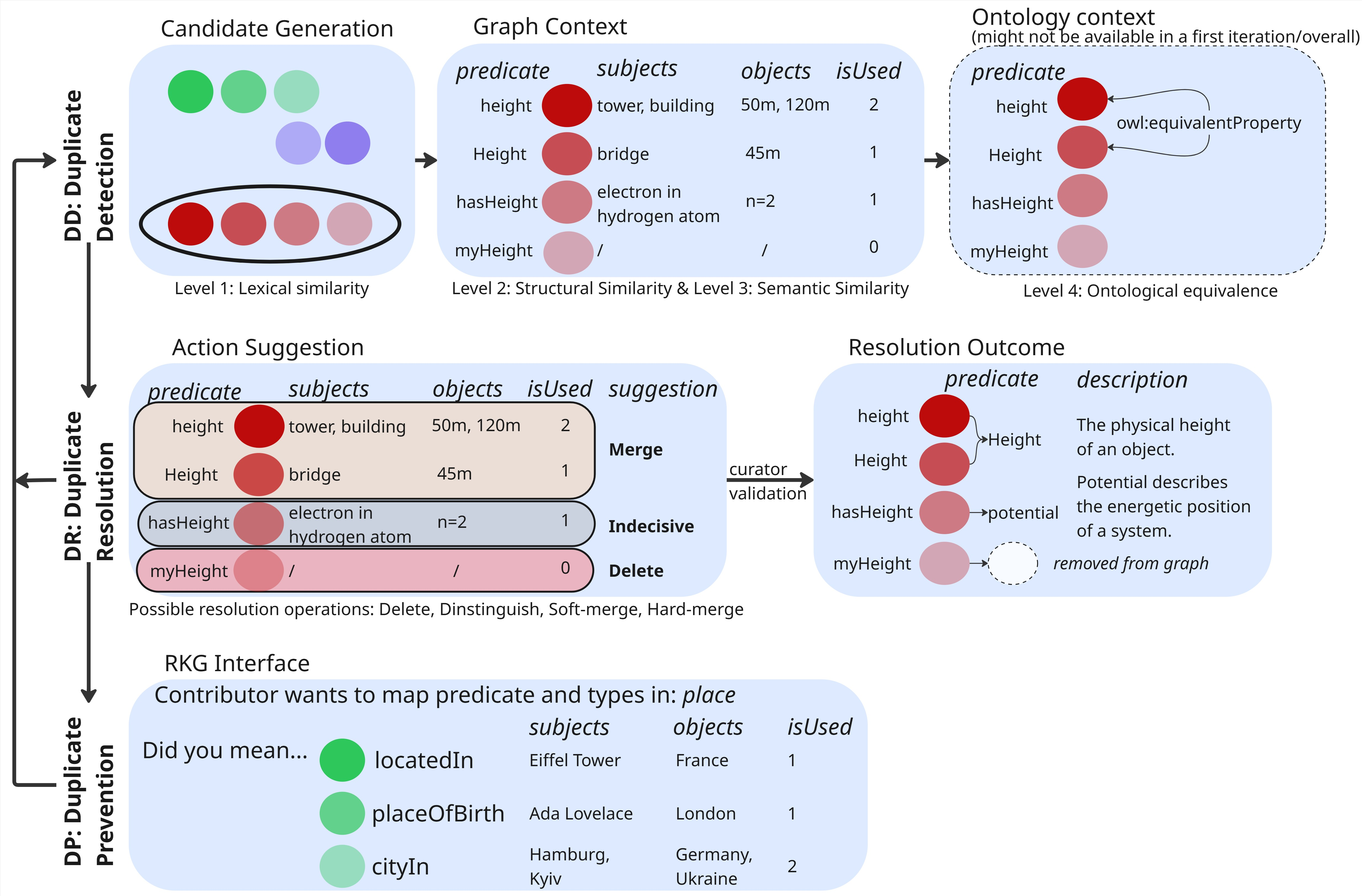
Figure 1: Framework for Duplicate Predicate Detection, Resolution, and Prevention. Detection uses stepwise similarity levels, resolution is guided by extensional usage and human validation, prevention is integrated into RKG import pipelines.
Detection is modeled as a filtering pipeline with increasing evidentiary strength, beginning with lexical/URI similarity (high recall, low precision) and progressing to structural, semantic, and finally ontological equivalence (e.g., formal property axioms). Each phase leverages progressively richer context (usage statistics, provenance, subject/object types, and explicit equivalence relations such as OWL equivalentProperty). This hierarchical decomposition supports practical curation, allowing high-throughput candidate screening followed by focused, curator-driven refinement.
Resolution actions range from deletion (for unused or orphaned predicates), through distinguishing (disambiguation of polysemous cases), to merge (soft: adding equivalence assertions; hard: canonicalization and replacement in all statements). The merge decision is context-sensitive and contingent upon evidence from both extensional graph usage and human validation.
Prevention targets source factors: weak autocomplete for predicate reuse, insufficient documentation, and noise from external imports. The framework advocates for embedding-based similarity search, real-time suggestions, and usage analytics at creation/ingestion points to close the loop on redundancy before large-scale proliferation.
System Implementation
Instantiation is demonstrated via substantial architectural extension of the ORKG curation platform SciKGDash. The detection pipeline is built atop Sentence Transformers for embedding predicate label/description text, k-nearest neighbor graphs, and Louvain community detection to aggregate candidates. Thresholds (k=50, cosine similarity 0.65 for graph construction, 0.8 for fine-grained suggestions) are chosen to balance recall/precision, while explicit lexical deduplication ensures high coverage.
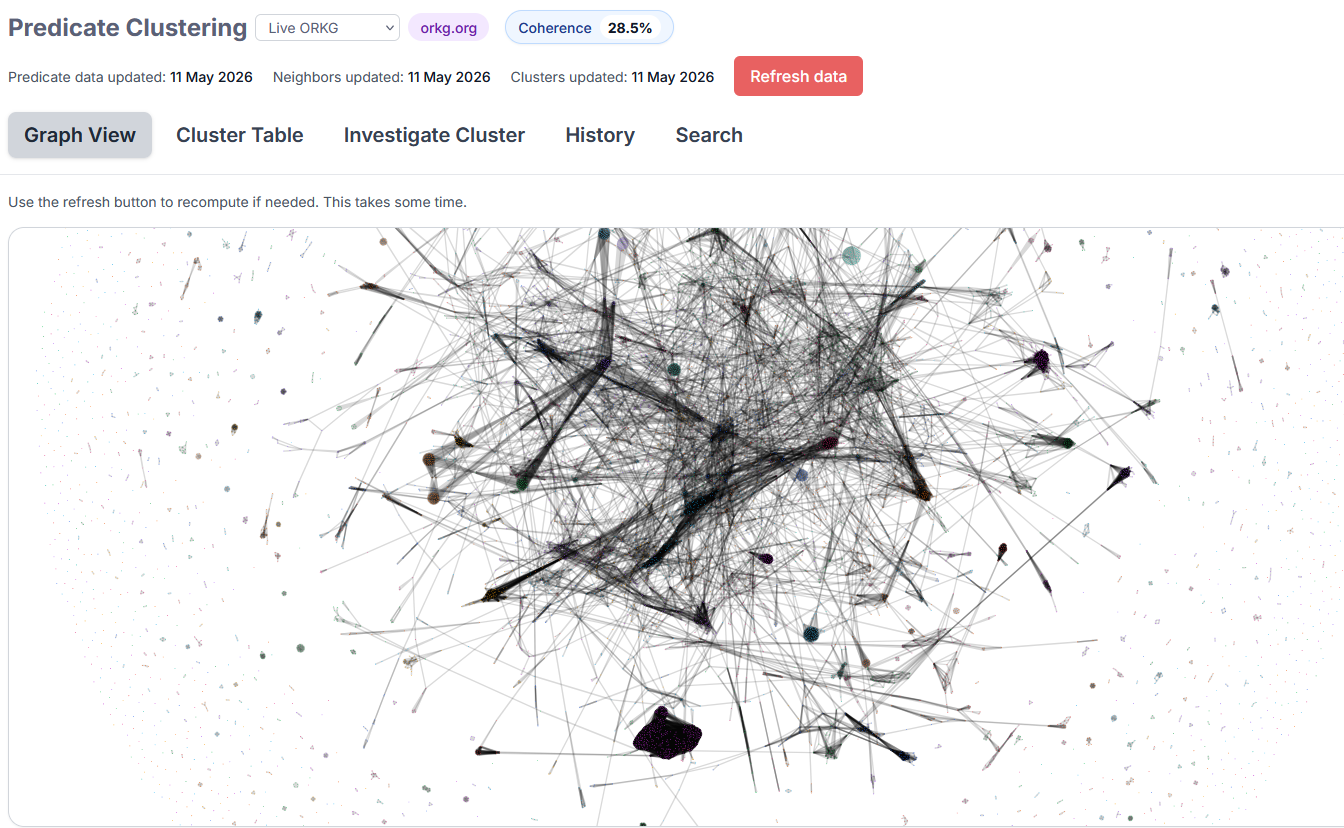
Figure 2: Initial graph view of the k-nearest neighbor (k=50) similarity graph (cosine similarity of 0.65) and its coherence score. Nodes represent predicates, edges indicate high semantic similarity, and clusters group potential duplicates.
Curators are provided with interactive cluster-based inspection, usage analytics, and embedded heuristic suggestions, facilitating efficient navigation of high-redundancy clusters. Advanced embedding and partitioning yield merge and delete candidate groups with higher confidence and minimize ambiguous, unproductive manual curation.
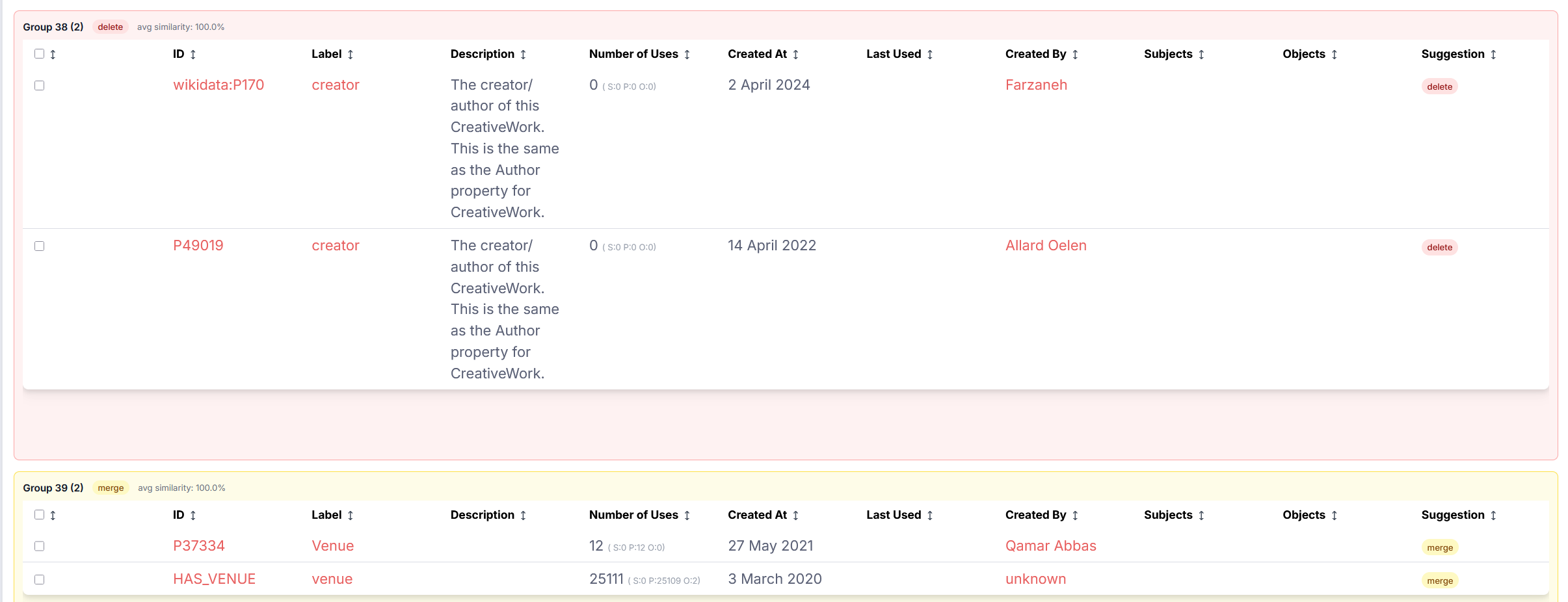
Figure 3: Advanced suggestions with finer-grained groups based on contextual embeddings and higher similarity threshold (0.8) for a merge and a delete group.
Integration with the ORKG backend is ongoing, with plans to migrate search and suggestion infrastructure to scalable vector indices and system-wide embedding support. The framework’s design permits deployment on live graph data with safe experimentation, minimizing risk to critical production content.
Empirical Evaluation
Quantitative analysis over 13,457 predicates in the ORKG instance reveals:
- 3,837 predicate clusters identified; 2,769 are singletons,
- 1,989 predicates (14.8%) are unused,
- 2,044 predicates (15.2%) are redundant merge candidates,
- Aggregate 30% potentially removable.
Cluster size distributions are highly skewed, marked by many small clusters but a minority of extremely large ones (up to size 477). Qualitative cluster analysis uncovers several high-impact error modes:
- Repeated creation by single users: Massive clusters formed by interface-accelerated self-copying,
- Label/ID confusion: Large clusters with no true semantic relatedness, yet visually indistinguishable due to interface-induced ID pollution,
- Lack of standard canonical forms: Loosely connected clusters of semantically similar, but not necessarily duplicative, predicates—requiring contextual curation.
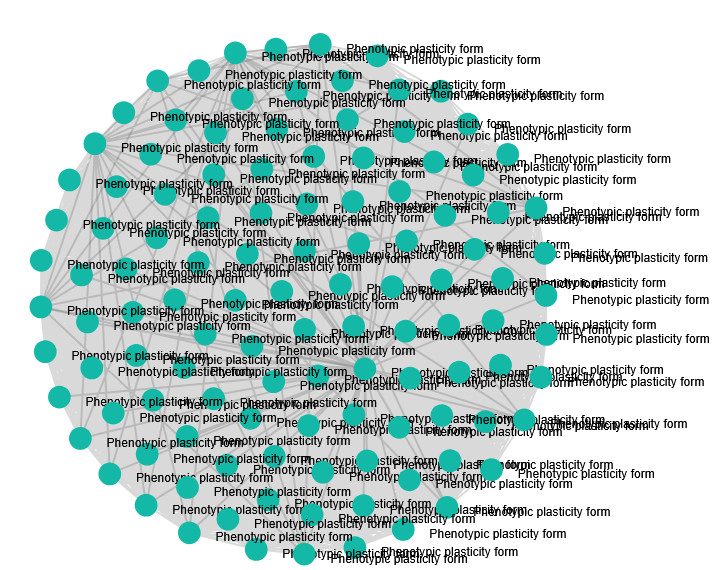
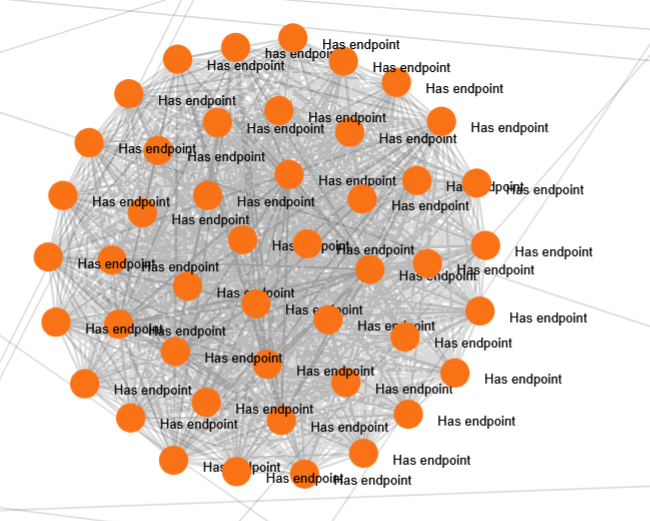
Figure 4: Phenotypic plasticity form cluster (size 115) – typical results of user-induced repeated predicate creation.
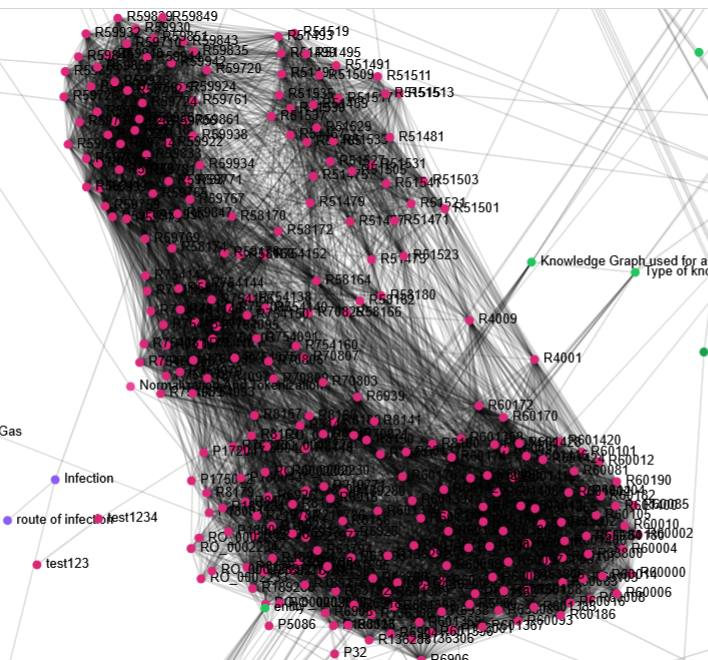
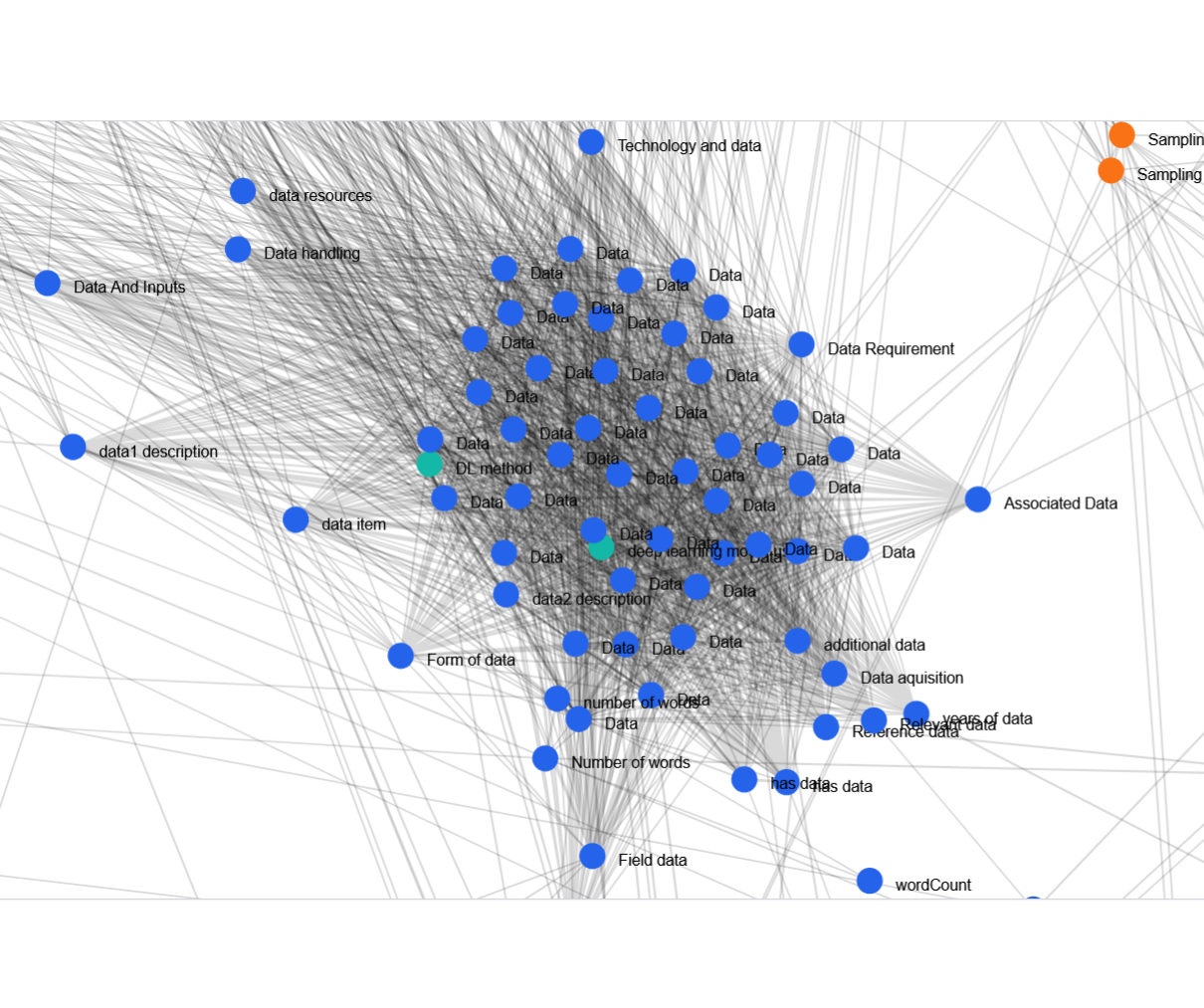
Figure 5: Cluster containing IDs instead of labels (size 312) – artifact of identifier confusion in the interface.
Results validate the framework’s capacity to surface high-redundancy areas, provide actionable curation recommendations, and prioritize interface modifications. Despite automated suggestions, final redundancy claims require expert human attestation, particularly for structurally similar but contextually distinct predicates.
Implications and Limitations
The framework substantiates the claim that predicate level quality assurance is currently underserved in both research and deployed RKGs. It demonstrates that large efficiency and usability improvements are achievable by integrating embedding-based, context-aware detection and curator-facing tools. The adoption of such methods can facilitate downstream tasks such as schema alignment, entity deduplication, and improved retrieval effectiveness—amplifying the leverage of human curation.
Limitations include the dependency on completeness and accuracy of textual metadata, embedding robustness, cluster threshold selection, and inability for fully automated, context-free predicate merging. As in many other data curation pipelines, false positives/negatives remain difficult to fully eliminate due to the inherent fuzziness of graph semantics and usage patterns. Furthermore, cross-cluster relations and semantic drift are not wholly addressable by current clustering paradigms.
Future Developments
Proposed advancements involve integrating approximate nearest neighbor search (for scalability), testing alternative partitioning algorithms such as Leiden for higher clustering fidelity, and incorporating explicit domain/range/statistical usage information as additional features for improved semantic distinction. LLMs are identified as potential augmentation tools for predicate label suggestion, contextual description generation, and user-facing explainability in curation interfaces. Epidermal integration of DP into live creation workflows remains critical for sustainable closure of the redundancy loop.
Cross-system generalizability will require empirical validation on other RKGs and adaptation for systems with more rigid schemas or explicit ontologies.
Conclusion
This work establishes predicate deduplication as an essential, addressable data quality frontier for RKGs and provides a robust, operationalizable framework encompassing detection, resolution, and prevention. Empirical evaluation in ORKG demonstrates substantial practical value with direct implications for both curatorial workflow enhancement and system-level quality improvement. The introduced strategies, while currently bounded by interface and embedding performance, offer a path toward fully integrated, proactive, and explainable predicate management—an essential step in scaling high-quality machine-actionable knowledge infrastructures.
Reference: "Addressing Predicate Redundancy in Research Knowledge Graphs: Duplicate Detection, Resolution, and Prevention" (2607.03197)