Pre-Strings Lectures on Artificial Intelligence
Abstract: These notes are based on six lectures given over three days at the Pre-Strings 2026 school in Shanghai. Day 1 develops neural network essentials, organized around the expressivity, statistics, and dynamics of neural networks, presented with a field-theoretic lens. Day 2 develops a neural network approach to field theory (NN-FT), in which a field theory is defined by a network architecture and a density on its parameters, and surveys recent results. Examples include a universality theorem, a neural network realization of Liouville theory, famous string amplitudes, topological sectors and the Kosterlitz-Thouless transition, Ward identities and anomalies, and a new derivation of the critical dimension of the bosonic string. Day 3 turns the lens around and covers applied AI for string theory: agentic workflows that are changing how the other techniques are implemented, physics-informed neural networks and Calabi-Yau metrics, reinforcement learning and search in the string landscape and in knot theory, and interpretable supervised learning with an eye towards conjecture generation.
Paper Prompts
Sign up for free to create and run prompts on this paper using GPT-5.
Top Community Prompts
Explain it Like I'm 14
Overview
This paper is a set of lecture notes from a three-day mini-course about AI and physics. It has two big goals:
- to explain how neural networks work using ideas from physics, and
- to show how AI can both describe parts of physics (even field theory and string theory) and help physicists do research.
The notes also give context about the last two years of AI progress: new “reasoning” AI systems that think step-by-step and AI “agents” that can plan, use tools, and work for hours or days on a task.
What questions does the paper ask?
The lectures center around three simple but deep questions about neural networks (NNs):
- How powerful are neural networks? (Expressivity)
- What do neural networks look like “on average” when you consider many random initializations? (Statistics)
- How do neural networks change while learning? (Dynamics)
Then the notes flip the view:
- Can we build a field theory out of a neural network and its parameter distribution?
- How can modern AI (including agents) practically help solve physics and string theory problems?
How does the paper approach these questions?
The lectures use a “field-theoretic lens,” which means they borrow ideas and tools from theoretical physics (like correlation functions and symmetries) to understand neural networks. Here is the approach by day.
Day 1: Neural Network Essentials
- Expressivity (how powerful a NN is)
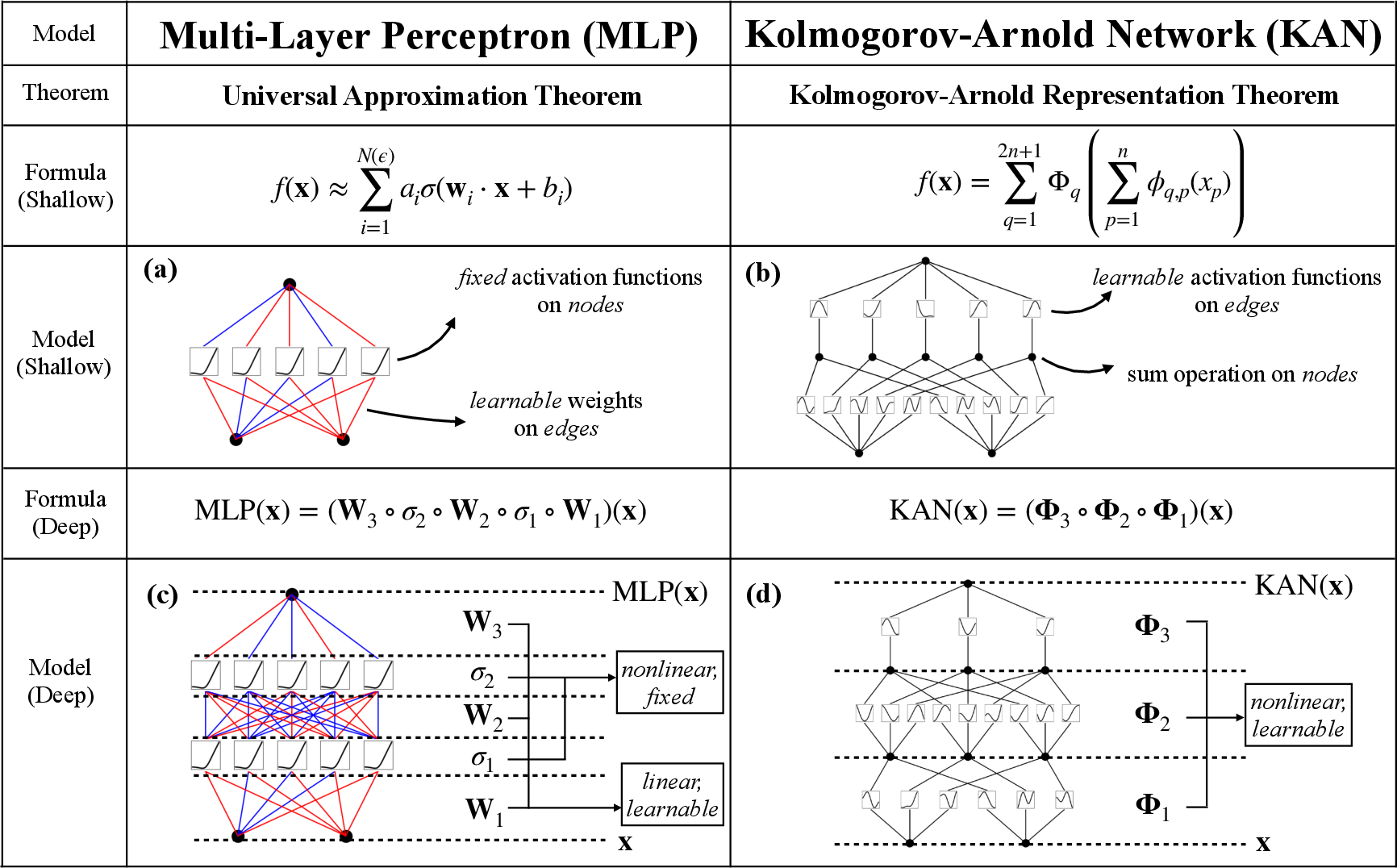
- Universal Approximation Theorem: with enough “hidden units,” even a simple neural network can approximate any continuous function pretty well. Think of building any shape using lots of tiny Lego bricks.
- Kolmogorov–Arnold idea: any multi-input function can be built from a clever mix of one-input functions and addition. This led to KANs (Kolmogorov–Arnold Networks), which learn the little one-variable functions on the “edges” of the network. They can be more interpretable because you can see and sometimes write down the functions they learn.
- Transformers and attention: language comes as a sequence (not a fixed-size vector), so transformers use attention to let each word “look at” other words to understand context (e.g., “bank” near “river” means something different than “bank” near “deposit”). With positional info, transformers can, in principle, approximate any sequence-to-sequence function. Also, letting models think step-by-step (generate and read their own intermediate tokens) boosts what they can express—more “thinking time” buys more power.
- Statistics (what an ensemble of NNs looks like)
- Instead of studying one random network, the notes study averages over many initializations—like asking what the “crowd average” says rather than a single voice. These averages are called correlation functions.
- NNGP (Neural Network Gaussian Process): as width (number of hidden units) goes to infinity, a wide class of networks behaves like a Gaussian process. In everyday terms: a huge network at initialization behaves like a smooth random function whose wiggles are fully described by a simple two-point “kernel.”
- Finite width means non-Gaussian corrections. The smaller the network, the more “interactions” (non-Gaussian behavior) you get; these fade as the network gets wider.
- Symmetries: if you build your network and parameter distributions carefully, the ensemble can have exact symmetries (like rotation and translation invariance). That lets you design networks with known, nice statistical properties.
- Concrete examples: the notes give simple, computable networks that:
- are rotationally and translationally invariant by construction,
- have exactly known two-point functions (how outputs at two inputs are related),
- and even reproduce the propagator of a free scalar field —showing a direct bridge between network ensembles and classic field theory.
- Dynamics (how NNs learn over time)
- Gradient descent is written in function space, revealing the Neural Tangent Kernel (NTK): this kernel tells you how errors at training points push the function to change at test points.
- In the infinite-width “lazy” regime, the NTK freezes—it becomes fixed at its initial value. Then training is exactly solvable and equivalent to kernel regression (a classical method). You can write down the final predictor in closed form.
- Upside: beautiful math and exact solutions. Downside: because the kernel is frozen, the network doesn’t truly learn new internal features—its internal representations barely move. Real deep learning usually needs feature learning, so the notes discuss scaling choices needed to go beyond this lazy limit.
Day 2: Neural Networks as Field Theories (NN-FT)
The idea: define a field theory by choosing a network architecture plus a probability distribution on its parameters. Then:
- The “action” and “correlators” (field theory concepts) come from the network ensemble.
- The notes survey recent results showing this approach can reproduce or illuminate:
- universality theorems,
- Liouville theory,
- famous string amplitudes,
- topological sectors and the Kosterlitz–Thouless transition,
- Ward identities and anomalies,
- and even a new derivation of the critical dimension of the bosonic string.
You can think of this as a two-way bridge: physics tools help explain neural networks, and neural networks help construct and study physics.
Day 3: Applied AI for String Theory
The notes turn to practical AI tools for physics:
- Agentic workflows: AI systems that plan, call tools, run code, and coordinate subagents. These are speeding up research.
- Physics-informed neural networks (PINNs) for studying difficult geometry problems like Calabi–Yau metrics (important in string theory).
- Reinforcement learning (RL) to search huge “landscapes” in string theory and classify knots.
- Interpretable models (like KANs) to help generate and test mathematical conjectures—since you can sometimes read off exact formulas from what the model learned.
What are the main findings and why do they matter?
Here are key takeaways explained in everyday language:
- Wide networks are predictable at initialization (NNGP): when networks get extremely wide, their random starting behavior becomes simple and fully described by a kernel (two-point function). This helps us understand and control how big models behave before training.
- Exact training in the “lazy” limit (NTK): if the network is wide enough, training behaves exactly like a classic method (kernel regression) with a known kernel. This gives closed-form solutions for what the model will predict after training.
- Feature learning needs going beyond the lazy limit: real deep learning power comes from changing internal features. The notes discuss how to set scaling so features actually evolve, addressing a major limitation of the NTK picture.
- Building symmetry into networks pays off: by designing networks with built-in symmetries (like rotations and translations), you can get better sample efficiency and even match field-theory behaviors. This is useful for data with physical structure (e.g., images, molecules, lattices).
- Transformers can, in principle, learn any sequence mapping; reasoning adds power: attention lets models read context; positional information lets them handle order; and letting them think step-by-step increases what they can express. This explains large recent jumps in AI reasoning.
- Neural networks can realize known field theories: the notes give explicit network constructions that reproduce objects like the free scalar field’s propagator. This strengthens the NN–field theory bridge and sets the stage for Day 2’s deeper results (Liouville, string amplitudes, KT transition, anomalies, critical dimension).
- AI agents are changing research practice: agents that think, act, and use tools can discover new math or algorithms and help physicists explore complex spaces faster and more reliably.
These findings matter because they:
- give a unifying language between machine learning and theoretical physics,
- provide exact tools to analyze and predict NN behavior,
- suggest principled ways to design better architectures,
- and open new routes to doing physics with AI assistance.
What is the impact and why should we care?
- For AI: Physics-style thinking offers clean, predictive theories of neural networks. That can guide the design of architectures (e.g., symmetry-aware networks) and training regimes (e.g., beyond-lazy scaling for feature learning).
- For physics and math: Neural networks aren’t just tools; they can define and study field theories, reproduce known results, and even suggest new derivations (like the bosonic string’s critical dimension). Interpretable models like KANs can help humans see patterns and form testable conjectures.
- For scientific workflows: Reasoning models and agents lower the cost of experiments, calculations, and literature search. They can act like tireless junior collaborators, speeding up progress while humans keep responsibility for correctness and insight.
Big picture: the lectures argue that AI and physics are converging in a productive way—AI gives new methods for discovery, and physics gives a firm framework to understand and improve AI.
Knowledge Gaps
Knowledge gaps, limitations, and open questions
Based on the paper’s scope and results, the following concrete gaps and open questions remain for future work:
- Universal approximation in practice: quantitative, constructive bounds on width/depth required for specific function classes and dimensions; sample complexity and approximation–generalization trade-offs.
- Optimization gap in UAT/Kolmogorov–Arnold settings: conditions under which gradient-based training finds the guaranteed approximants; convergence guarantees or counterexamples.
- Kolmogorov–Arnold networks (KANs): theory of sample/parameter efficiency relative to MLPs; stability and regularization of learnable univariate activations; scalability to high-dimensional inputs; generalization under noisy labels; computational overhead and basis-function choices.
- Transformer expressivity beyond single-pass: formal characterization of expressivity gains as a function of chain-of-thought length; minimal reasoning-length requirements for canonical algorithmic tasks; limits imposed by finite context windows and fixed depth.
- Attention “gauge” redundancy (W_Q→RW_Q, W_K→RW_K): define gauge-invariant observables, analyze possible anomalies, and assess implications for optimization and generalization.
- Mapping from (φ, P(θ)) to an action S[φ]: general existence/uniqueness conditions; constructive procedures beyond Gaussian limits; ambiguity classes and equivalence under reparameterizations.
- Designing P(θ) for target (non-Gaussian) field theories: systematic ways to engineer higher connected correlators at finite N; controlled resummations beyond 1/N; validation against known interacting theories.
- NNGP limits in modern architectures: impact of weight sharing, normalization layers, and non-i.i.d. initializations on Gaussianity; empirical tests of NNGP predictions in large-scale transformers/CNNs.
- Independence-breaking effects: taxonomy and quantitative predictions for correlators when parameters are correlated (e.g., tied weights, pretraining-induced correlations, layer norm), including how interactions scale with depth and width.
- Euclidean-invariant nets with spectrum shaping: principled selection of F(·) to realize desired propagators across momenta while maintaining trainability and sampleability; constraints from realizability and numerical stability.
- Gauss-net vs. Cos-net: origin and consequences of translation non-invariance in Gauss-net 4-point functions; generic strategies to enforce full Euclidean invariance at finite N without sacrificing expressivity.
- Scalar-net (free scalar field): rigorous control of UV cutoff and continuum limit (Λ→∞); renormalization procedures; extension to interacting theories (e.g., φ4) with verifiable critical behavior and comparison to lattice results.
- Ensemble symmetries under training: how evolving P_t(θ) under optimization preserves/breaks global symmetries; role of data distributions and augmentation in symmetry realization; conditions for spontaneous symmetry breaking in NN ensembles and its detection via correlators.
- NTK beyond the lazy regime: complete scaling prescriptions (initialization, learning rate, depth, optimizer) that provably yield nontrivial feature learning; closed-form or approximate descriptions of time-varying NTKs.
- Exactly solvable dynamics beyond MSE: extensions to cross-entropy and other losses, label noise, weight decay/regularization, mini-batch SGD noise, and adaptive optimizers (e.g., Adam); solvable or perturbative frameworks.
- Finite-N dynamics: systematic 1/N expansions connecting non-Gaussian correlators to training trajectories; practical estimators for finite-N corrections and their effect on generalization.
- NTK and generalization: conditions under which frozen-NTK predictions correlate with test error on real data; characterization of failure modes where fixed kernels mispredict generalization.
- Depth/residuals and dynamic kernels: theory and measurement methodologies for NTK drift in deep residual networks; dependence on depth, normalization, and activation choices.
- Parameter–function duality during training: does an effective time-dependent action S_t[φ] exist as P_t(θ) evolves; can its flow be characterized (e.g., as an RG-like equation); how to compute or estimate S_t[φ] from data.
- Bridging discrete sequences and continuum fields: rigorous mappings from token sequences to field-theoretic objects used in the statistics/formalism; limits of continuum approximations for discrete transformers.
- Ward identities and anomalies in NN-FT (Day 2 claims): explicit parameter-space vs. function-space derivations, conditions for consistency, and robustness to architectural perturbations.
- NN realizations of Liouville/strings (Day 2 claims): precise architectural/density conditions that reproduce these theories; uniqueness/degeneracy of the mapping; sensitivity to hyperparameters and finite-N effects.
- Extension of NN-FT to Lorentzian signature and gauge fields: treatment of constraints, gauge fixing/BRST symmetry, and causality; numerical algorithms for correlator extraction in these settings.
- Practical inversion (correlators → action): robust numerical methods to recover S[φ] from measured correlators in complex architectures; error bounds and stability diagnostics.
- Validation at scale: protocols and tooling to measure correlators (including higher-point) and NTK evolution in trillion-parameter models; sampling efficiency and reproducibility.
- Agentic workflows (Day 3): quantitative correctness and reproducibility metrics; standardized verification (e.g., Lean) and failure analyses for AI-assisted proofs and derivations.
- Physics-informed NNs for Calabi–Yau metrics: error certification, convergence guarantees, and scalability across moduli spaces; comparison to best-known numerical methods.
- RL for landscape/knot search: principled reward shaping, exploration guarantees in sparse/structured spaces, and benchmarks with ground truth; sample efficiency and robustness.
- Interpretable models for conjecture generation: criteria to avoid spurious patterns; pipelines to extract minimal symbolic forms (e.g., from KANs) with certificates and uncertainty quantification.
- Data/code availability for the exemplars (Gauss-net, Cos-net, Scalar-net): open datasets, reference implementations, and sensitivity analyses to hyperparameters for reproducible validation.
Practical Applications
Overview
Based on the paper’s findings and methods—especially the ensemble/field-theoretic view of neural networks (NNGP/NTK), symmetry-aware architectures (Euclidean-invariant nets, equivariant flows), interpretable models (Kolmogorov–Arnold Networks, KANs), transformer reasoning and agentic workflows, and the Neural Network–Field Theory (NN-FT) program—the following applications translate into actionable use cases across industry, academia, policy, and daily life.
Immediate Applications
These applications can be deployed with current methods and tooling, often by adapting existing libraries (e.g., PyTorch/JAX, PINN frameworks, equivariant networks, modern LLM agents).
- Symmetry-aware neural architectures for data with known invariances
- Sectors: robotics (pose estimation), healthcare (3D medical imaging), materials/chemistry (molecular property prediction), geoscience (seismic), physics simulation
- What: Use Euclidean-invariant/covariant layers and group-equivariant networks to bake in rotations/translations; apply “spectrum shaping” (choosing F in Euclidean-invariant nets) to impose desired power spectra
- Tools/workflows: E(3)-equivariant CNNs/GNNs, steerable CNNs, EGNNs; the paper’s cosine/Euclidean layers as drop-in modules
- Assumptions/dependencies: Data-generation process respects the symmetries; careful initialization and parameter densities; benchmarking for finite-width effects
- Kernel regression baselines and training diagnostics via NTK/NNGP
- Sectors: software/ML platforms, AutoML, scientific ML, small-data settings
- What: Compute frozen NTK to (i) run exact kernel regression for small datasets; (ii) predict training dynamics and generalization before training full models
- Tools/workflows: NTK calculators (e.g., neural-tangents in JAX), Gram matrix inversion for |D| small/medium
- Assumptions/dependencies: Infinite-width approximation quality; computational cost O(|D|3) for kernel solves; possible mismatch in highly non-linear/feature-learning regimes
- Uncertainty quantification and calibrated predictions from NNGP correspondence
- Sectors: healthcare (diagnostics), energy (forecasting), finance (risk), autonomous systems (safety)
- What: Use GP posteriors implied by wide-network limits for calibrated uncertainty; deploy GP-inspired ensembling as guardrails
- Tools/workflows: NNGP kernel estimation; GP inference; conformal prediction layered on GP outputs
- Assumptions/dependencies: Initialization and width must match GP assumptions; finite-width corrections may be needed; distribution shift handling
- Interpretable modeling and symbolic regression with KANs
- Sectors: engineering (control/forecasting), scientific discovery, finance (model risk/compliance), manufacturing (quality)
- What: Train KANs and “snap” learned univariate activations to closed-form expressions for interpretable laws/conjectures
- Tools/workflows: KAN layers with spline/polynomial bases; coupling to CAS (e.g., SymPy) and sparsity/regularization
- Assumptions/dependencies: Good noise control; sufficient data coverage; symbolic fitting and human validation
- Agentic research workflows for long-horizon technical tasks
- Sectors: academia/R&D, software, legal/patents, biotech (in silico pipelines)
- What: Chain-of-thought + tool-calling agents that search literature, run code, orchestrate sub-agents, self-critique, and maintain reports over multi-hour/day tasks
- Tools/workflows: ReAct-style agents, safe tool sandboxes, experiment runners, retrieval augmented generation (RAG), evaluations
- Assumptions/dependencies: Reliable reasoning models; tool permissioning and auditability; hallucination and error detection
- Reinforcement learning for search in large discrete/structured spaces
- Sectors: chip design (layout/placement), logistics (scheduling), drug discovery, materials design
- What: Adapt RL/agent search used for the string landscape/knot theory to navigate combinatorial design spaces with structured rewards
- Tools/workflows: RL agents (policy gradients, evolutionary strategies), surrogate models, constraint solvers
- Assumptions/dependencies: High-quality simulators or proxy objectives; reward shaping; compute for exploration
- Physics-informed neural networks (PINNs) for PDE-constrained problems
- Sectors: energy (CFD for turbines/batteries), climate (subgrid / PDE emulation), aerospace (aeroelasticity), civil engineering (structural PDEs)
- What: Use PINNs (e.g., as with Calabi–Yau metrics) to approximate solutions, uncertainty bounds, and inverse problems
- Tools/workflows: PINN libraries (DeepXDE, JAX/PyTorch + AD), multi-physics coupling, adaptive sampling
- Assumptions/dependencies: Correct PDEs/boundaries; stiffness and multi-scale handling; compute budget; validation vs. traditional solvers
- Transformer design and regularization informed by attention “gauge” redundancy
- Sectors: software/ML infra, NLP/vision model optimization
- What: Recognize WQ→RWQ, WK→RWK invariance to propose parameter tying, reduced parameterizations, or priors; improve stability/efficiency
- Tools/workflows: Linear-algebraic constraints, weight-tying schemes, meta-parameterization
- Assumptions/dependencies: Careful empirical validation; compatibility with training dynamics and optimization
- Equivariant normalizing flows for efficient sampling (e.g., lattice fields)
- Sectors: high-energy physics, statistical physics, Bayesian inference with symmetries
- What: Use SU(N)-equivariant flows and related constructs to sample from complex distributions faster than MCMC
- Tools/workflows: Equivariant flow architectures, hybrid MCMC/flow pipelines
- Assumptions/dependencies: Symmetry identification; hyperparameter tuning; correctness diagnostics
- Conjecture generation pipelines for science and mathematics
- Sectors: academia; education
- What: Supervised learning to detect patterns; KAN-based symbolic extraction; agentic literature matching; proof-assistant checks
- Tools/workflows: Data curation, KAN symbolic fitting, interfaces to Lean/Coq for verification
- Assumptions/dependencies: Clean datasets; formalization coverage; human-in-the-loop peer review
- Daily-life productivity and education enhancements from reasoning models
- Sectors: daily life, education, enterprise knowledge work
- What: Personalized study plans with chain-of-thought tutoring; agents for documentation/code migration; verifiable math solutions
- Tools/workflows: LLM agents with sandboxed execution and step-by-step verification; classroom dashboards
- Assumptions/dependencies: Safety and privacy; content accuracy; age-appropriate scaffolding
Long-Term Applications
These require further research, scaling, or ecosystem development (theory, tooling, standards, or compute).
- Neural Network–Field Theory (NN-FT) as a general engine for QFT/string computations
- Sectors: academia (theoretical/high-energy/condensed matter physics)
- What: Define field theories via (architecture, parameter density); compute correlators, amplitudes; study topological sectors, KT transitions; analyze Ward identities and anomalies with NN machinery
- Tools/workflows: NN-FT libraries that auto-derive S[ϕ] from (ϕ,P(θ)); Monte Carlo/MCMC and variational hybrids; spectrum-shaped input layers
- Assumptions/dependencies: Robust mappings from parameter ensembles to actions beyond Gaussian limits; scalability; numerical stability; community validation against known results
- Targeted non-Gaussian model design for interacting theories and complex simulators
- Sectors: physics simulation, materials science, climate, econometrics
- What: Engineer finite-width corrections and independence-breaking to match desired interaction structures in learned surrogates
- Tools/workflows: Controlled finite-width ensembles; correlator matching; hybrid physics–ML solvers
- Assumptions/dependencies: Reliable extraction of connected correlators; stability/regularization; interpretability for deployment
- Topological phase/defect detection and control with NN-FT
- Sectors: materials and condensed matter
- What: Use learned Ward identities and NN-FT correlators to detect and classify topological phases/defects and KT-like transitions from experimental/simulation data
- Tools/workflows: NN-FT diagnostics integrated with microscopy/x-ray/neutron data streams
- Assumptions/dependencies: Validated mappings between learned correlators and physical phases; robust uncertainty quantification
- Policy and certification frameworks built on symmetry and ensemble guarantees
- Sectors: policy/regulation, autonomous systems, healthcare, finance
- What: Require documented symmetries/equivariances and calibrated uncertainty (e.g., GP-consistent) for high-stakes deployment; verify via test suites inspired by Ward identities
- Tools/workflows: Compliance checklists; automated symmetry/ward-test harnesses; standards for uncertainty reporting
- Assumptions/dependencies: Consensus standards; auditable training pipelines; regulator capacity
- Dynamic reasoning depth “budgeting” for compute-efficient inference
- Sectors: finance (latency-sensitive trading), on-device AI, industrial automation
- What: Controllers that tune chain-of-thought length to trade off accuracy vs. latency, grounded in “reasoning = expressivity” insights
- Tools/workflows: Adaptive halting criteria; verification layers; cost-accuracy schedulers
- Assumptions/dependencies: Reliable intermediate-check mechanisms; robust fallbacks; adversarial resilience
- Domain-specific spectral priors for sensor design and inverse problems
- Sectors: medical imaging (MRI/CT), non-destructive testing, geophysics
- What: Embed measurement physics as spectral priors (spectrum shaping) to design better reconstruction/inverse pipelines
- Tools/workflows: Joint optimization of acquisition protocols and spectrum-shaped networks
- Assumptions/dependencies: Accurate forward models; co-design with hardware; clinical/field validation
- Cross-domain automated discovery (math/physics/materials) with integrated agents and formal methods
- Sectors: academia/R&D, materials and drug discovery
- What: Multi-agent systems that generate hypotheses, run simulations, and produce formal proofs or lab-ready protocols
- Tools/workflows: LLMs + theorem provers + lab robots/simulators + provenance tracking
- Assumptions/dependencies: High-coverage formal libraries; scalable verification; trustworthy autonomy frameworks
- Generalized anomaly detection in learned systems via Ward-like tests
- Sectors: fairness/compliance, safety engineering
- What: Treat invariance violations as “anomalies” to detect bias, spurious correlations, or training pathologies
- Tools/workflows: Symmetry probes; counterfactual tests; group-theoretic testbeds
- Assumptions/dependencies: Correctly specified invariances; tolerance thresholds; domain-specific causal grounding
- String-inspired exploration strategies for ultra-large design spaces
- Sectors: advanced materials, catalysts, bioengineering
- What: Translate RL/search practices from string landscape exploration to real-world design (e.g., property-guided exploration of synthesis spaces)
- Tools/workflows: Surrogate models with constraints, batch RL with active learning, lab-in-the-loop
- Assumptions/dependencies: Fast, faithful simulators or high-throughput labs; robust reward definitions and safety gates
- Long-horizon, auditable research and enterprise copilots
- Sectors: legal/patents, standards drafting, large codebase refactors, regulatory science
- What: Agent teams that work over days/weeks with provenance, citations, sandboxed execution, and formal checks where possible
- Tools/workflows: Project memory, planning agents, verifiers, human oversight dashboards
- Assumptions/dependencies: Governance, IP/privacy controls, stability of reasoning models, clear liability frameworks
Notes on Cross-Cutting Assumptions and Dependencies
- Validity of infinite-width/GP and frozen-NTK approximations depends on architecture, width, task regime, and feature learning; finite-width corrections may be critical.
- Symmetry benefits hinge on correct identification of task symmetries and faithful enforcement in data and architecture.
- Agentic systems require strong guardrails: tool permissioning, sandboxing, provenance logs, and independent verification.
- For PINNs/NN-FT, PDE/QFT well-posedness, correct physics, and robust numerics are essential; computational cost can be significant.
- Interpretability (e.g., KAN-based symbolic forms) benefits from regularization, sparsity, and human-in-the-loop validation.
- Certification/regulatory use requires consensus metrics and standardized test suites for symmetry, uncertainty, and robustness.
Glossary
- action: In field theory, a functional S[ϕ] whose exponential defines the probability density over functions in a path integral; it encodes the dynamics/statistics of a field. Example: "the Feynman path integral, where the density on functions comes from an action ."
- agentic workflows: Automated, looped AI processes where models plan, act with tools, observe, and iterate to complete complex tasks. Example: "agentic workflows that are changing how the other techniques are implemented"
- anomalies: Symmetry violations that arise upon quantization or after integrating over degrees of freedom, captured by modified Ward identities. Example: "Ward identities and anomalies"
- attention: A mechanism that computes context-dependent representations by weighting interactions between tokens via query-key compatibility. Example: "The dominant answer is attention"
- bosonic string: The simplest string theory containing only bosonic degrees of freedom, with a critical spacetime dimension determined by consistency. Example: "a new derivation of the critical dimension of the bosonic string"
- braid words: Algebraic representations of braids as sequences of generators, used for knot-theoretic computations. Example: "transformers reading braid words will classify knots"
- byte-pair encoding: A subword tokenization algorithm that builds a vocabulary by iteratively merging frequent symbol pairs. Example: "(usually subword fragments chosen by a frequency-based scheme such as byte-pair encoding, so common words stay whole while rare ones break into pieces)"
- Calabi-Yau metrics: Ricci-flat Kähler metrics on Calabi–Yau manifolds, central in string compactifications. Example: "physics-informed neural networks and Calabi-Yau metrics"
- Central Limit Theorem: A probabilistic result that sums of many i.i.d. variables tend toward a Gaussian distribution, here applied to sums of neurons to yield GP limits. Example: "This is the Central Limit Theorem in function space"
- convolutional neural networks: Architectures using convolutional layers, often analyzed in wide-channel limits for GP/NTK behavior. Example: "Convolutional Neural Networks, ,"
- correlation functions: Expectation values of products of fields (or model outputs) that characterize statistical dependencies across inputs. Example: "the one-point and two-point correlation functions."
- cross-attention: An attention mechanism where queries attend to keys/values from a different sequence (e.g., decoder attending to encoder outputs). Example: "it is cross-attention."
- Energy Conserving Descent: A physics-inspired optimization method designed to conserve a specific energy-like quantity during training. Example: "Energy Conserving Descent"
- equivariance: A property where model outputs transform predictably under group actions on inputs, preserving symmetry structure. Example: "A classic notion at the level of individual networks is equivariance"
- Einstein summation: Notational convention where repeated indices are summed over implicitly. Example: "Einstein summation is in force throughout this section unless suspended explicitly"
- Euclidean group: The group of rotations and translations in Euclidean space (SO(d) and shifts), underpinning Euclidean invariance. Example: "the full Euclidean group ( rotations and translations)"
- Feynman path integral: A functional integral over fields weighted by the action, defining correlators and partition functions in QFT. Example: "the Feynman path integral"
- free scalar: A non-interacting scalar field theory characterized by a quadratic action and propagator 1/(p²+m²). Example: "This is the free scalar in Euclidean dimensions"
- gauge symmetry: Redundancy in parameterization leading to transformations that leave observable quantities invariant. Example: "reappears as a gauge symmetry"
- Gaussian Process (GP): A distribution over functions fully specified by a mean and covariance function (kernel). Example: "a Gaussian Process (GP),"
- generalized free field theory: A field theory fully determined by its two-point function, with higher connected correlators vanishing. Example: "a generalized free field theory."
- GRPO: A reinforcement learning-from-preferences method (Group Relative Preference Optimization) used in post-training. Example: "such as the GRPO of Day~3"
- kernel regression: A non-parametric method that interpolates training labels using a kernel matrix; the NTK yields its kernel. Example: "This is kernel regression"
- Kolmogorov-Arnold Representation Theorem: A result stating any multivariate continuous function can be represented as sums of univariate functions of sums of univariate functions. Example: "Kolmogorov-Arnold Representation Theorem"
- Kolmogorov-Arnold network (KAN): An architecture inspired by the K-A theorem with learnable univariate functions on edges, promoting interpretability. Example: "Kolmogorov-Arnold network (KAN)"
- Kosterlitz-Thouless transition: A topological phase transition in two dimensions characterized by vortex unbinding. Example: "the Kosterlitz-Thouless transition"
- Liouville theory: A two-dimensional conformal field theory important in quantum gravity and string theory. Example: "a neural network realization of Liouville theory"
- Markov Chain Monte Carlo: A sampling technique that constructs a Markov chain to draw from complex probability distributions. Example: "Markov Chain Monte Carlo"
- multi-head attention: Parallel attention mechanisms (heads) that attend to information in different representation subspaces. Example: "Running such maps in parallel gives multi-head attention;"
- Neural Network / Gaussian Process (NNGP) correspondence: The statement that certain infinite-width networks converge to Gaussian Processes at initialization. Example: "it yields the Neural Network / Gaussian Process (NNGP) correspondence:"
- neural tangent kernel (NTK): A kernel defined by gradients of the network outputs with respect to parameters; governs linearized training dynamics. Example: "neural tangent kernel (NTK)."
- partition function: A generating functional Z[J] whose derivatives w.r.t. sources yield correlation functions. Example: "a partition function"
- positional encodings: Additional input vectors that inject order information into transformers, enabling sequence modeling. Example: "With positional encodings, transformers are universal approximators of continuous sequence-to-sequence functions on a compact domain."
- propagator (momentum-space propagator): The two-point Green’s function in momentum space, often written as 1/(p²+m²) for free fields. Example: "power spectrum (momentum-space propagator)"
- reinforcement learning: Learning paradigm where agents optimize behavior through reward feedback, including for reasoning models. Example: "trained with reinforcement learning on long chains of thought"
- residual connections: Skip connections that add a layer’s input to its output to improve gradient flow and stability. Example: "residual connections"
- self-attention: Attention where queries, keys, and values come from the same sequence, enabling tokens to attend to each other. Example: "Self-attention is precisely this operation"
- softmax: A normalization function that turns scores into a probability distribution over options. Example: "The softmax-normalized compatibility"
- stochastic gradient descent (SGD): An optimization method that uses stochastic estimates of the gradient from mini-batches. Example: "SGD \cite{sgd,perceptron}"
- string amplitudes: Scattering amplitudes computed in string theory, encoding probabilities for string interactions. Example: "famous string amplitudes"
- string landscape: The vast space of consistent string theory vacua with different physical properties. Example: "search in the string landscape"
- topological sectors: Distinct classes of configurations labeled by topological invariants, relevant to phase structure and defects. Example: "topological sectors and the Kosterlitz-Thouless transition"
- transformer: An architecture built from self-attention and feedforward layers with residuals and normalization, dominant in sequence modeling. Example: "the transformer block"
- Universal Approximation Theorem (UAT): Theorem stating that sufficiently wide neural networks can approximate any continuous function on a compact set. Example: "Universal Approximation Theorem (UAT)"
- universality theorem: A result asserting broad, architecture-agnostic expressive capability or common behavior across systems. Example: "a universality theorem"
- unit distance conjecture: Erdős’s conjecture regarding the maximum number of unit distances among n points in the plane. Example: "unit distance conjecture"
- Ward identities: Symmetry-derived relations among correlation functions ensuring conservation laws or constraints. Example: "Ward identities and anomalies"
Collections
Sign up for free to add this paper to one or more collections.

