- The paper introduces a neural network field theory framework that encodes topological sectors directly in its network parameters.
- It successfully models the Berezinskii–Kosterlitz–Thouless transition with precise critical exponents and clear vortex dynamics.
- The study extends the framework to string theory, reproducing T-duality and non-geometric T-fold phenomena through a mixed continuous-discrete ensemble.
Topological Effects in Neural Network Field Theory
Foundations of Neural Network Field Theory
Neural Network Field Theory (NN-FT) is a constructive formalism for quantum field theory in which the architecture and parameter density of a neural network define the statistical ensemble of fields. Rather than representing fields as functionals in the path integral, NN-FT leverages ensembles over network parameters, θ, with architectures ϕθ, such that ϕθ(x) serves as the field at point x. This approach is not limited to variational ansätze; architecture and parameter densities encode locality, symmetry, operator content, and phase structure directly in parameter space.
Correlation functions are computed as expectations over parameter space:
⟨O⟩=∫dθ P(θ) O[ϕθ]
For theories with explicit topological sectors (e.g., winding numbers, vortices), the expectation extends to discrete network parameters:
⟨O⟩=Q∑∫dθ P(θ,Q) O[ϕθ,Q]
Gaussian process limits are realized for wide architectures, enabling free field theory representations. Deviations from this limit or non-Gaussian parameter densities induce interactions. Symmetries are implemented by design in the architecture and/or P(θ). This framework is universal under broad conditions (Ferko et al., 20 Jan 2026).
Topological Sectors: Constructive Representation
The paper introduces explicit topological sector labels as discrete neural network parameters, enabling NN-FT to realize compact boson models and associated phenomena. This mixed continuous-discrete ensemble mirrors the standard field theory sum over topological sectors, providing a unified approach to sampling smooth fluctuations and global topological data.
Two Principal Case Studies
- Berezinskii–Kosterlitz–Thouless (BKT) Transition: A paradigmatic finite-temperature phase transition in two-dimensional U(1) systems. NN-FT realizes both the critical spin-wave line and the vortex proliferation mechanism.
- T-Duality in String Theory: Demonstrates that NN-FT can represent worldsheet string backgrounds and reproduce the invariance under exchange of momentum and winding on S1, including Buscher rules, symmetry enhancement, and non-geometric T-folds.
Berezinskii–Kosterlitz–Thouless Transition via NN-FT
Architecture and Sector Construction
- Spin-wave Sector: Random Fourier Feature (RFF) network, θsw(x), capturing smooth field fluctuations.
- Vortex Sector: Coulomb gas ensemble of vortex-antivortex pairs, sampled with explicit discrete charges.
- Composite Field: ϕθ0.
The spin-wave correlator exhibits power-law decay ϕθ1 below the critical coupling ϕθ2, matching analytic predictions with high numerical precision.
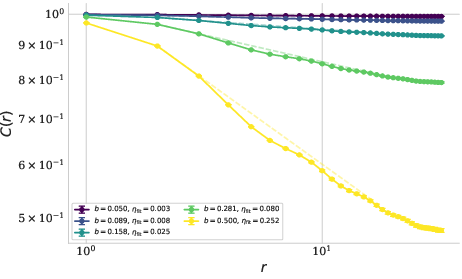
Figure 1: Spin-wave correlator ϕθ3 below ϕθ4, confirming power-law scaling with exponent ϕθ5.
Above ϕθ6, in the pure spin-wave sector, correlations remain power-law due to the Gaussian nature, but the inclusion of vortex sector gives rise to a mass gap and exponential decay.
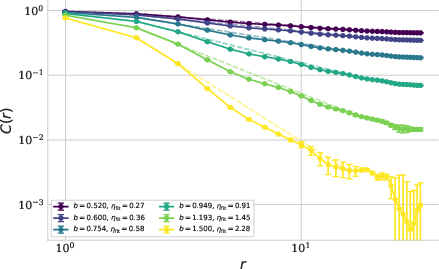
Figure 2: Spin-wave correlator above ϕθ7; RFF sector remains critical, requiring vortex sector for disordering.
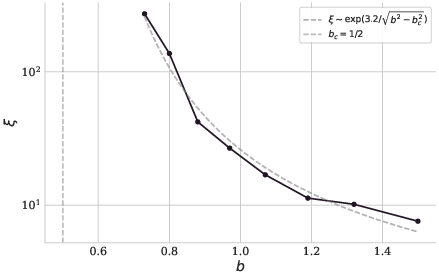
Figure 3: Correlation length ϕθ8 diverges as essential singularity near transition, reflecting BKT physics.
Vortex density ϕθ9 sharply distinguishes the phases:
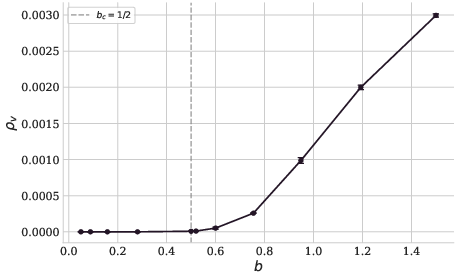
Figure 4: Vortex density ϕθ(x)0 versus ϕθ(x)1, rising steeply above ϕθ(x)2 as vortices unbind.
Spatial representations elucidate the proliferation of vortices:
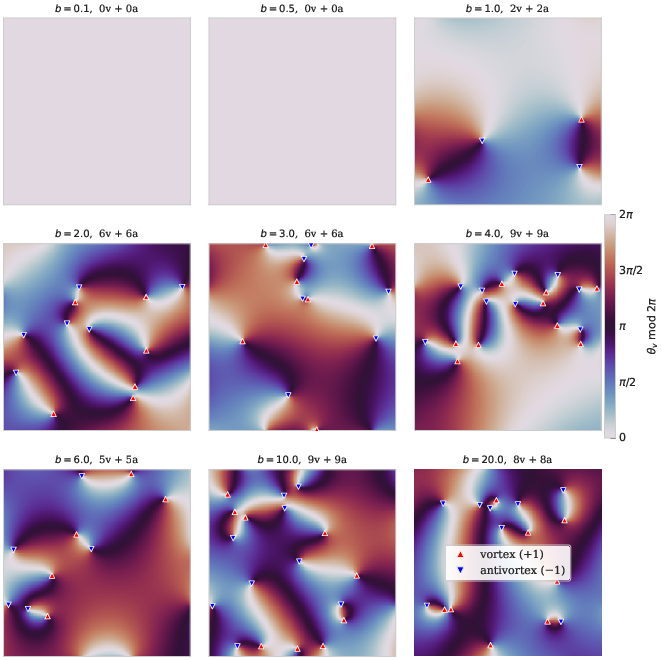
Figure 5: Vortex angle field ϕθ(x)3 captures vortex-antivortex configurations across ϕθ(x)4.
Pair correlations confirm tight binding below ϕθ(x)5 and plasma behavior above:
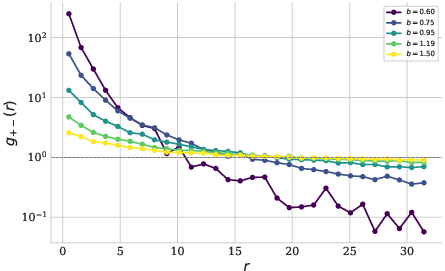
Figure 6: Vortex-antivortex pair correlation ϕθ(x)6; Coulomb attraction dominates at low ϕθ(x)7, transitions to uncorrelated gas.
Spectral estimates of the stiffness ϕθ(x)8 and helicity modulus ϕθ(x)9 track the universal jump and vanishing in the disordered phase:
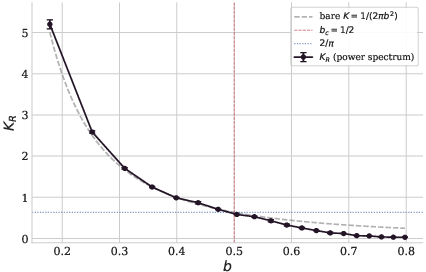
Figure 7: Renormalized stiffness x0 closely follows x1 below x2, drops sharply above due to screening.
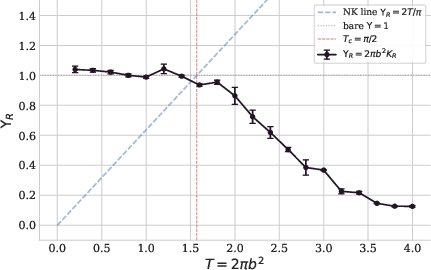
Figure 8: Helicity modulus x3 collapses at x4 and aligns with Nelson-Kosterlitz universal jump.
The NN-FT reproduces:
- Exact critical exponent x5.
- BKT-type essential singularity in x6.
- Universal jump in stiffness.
- Vortex proliferation marks the phase boundary.
T-Duality in NN-FT
Sigma Model Realization
NN-FT architectures represent worldsheet fields x7 as Gaussian processes, supplemented by discrete momentum and winding labels for compact directions. For x8 and x9 backgrounds, sampled compact sectors match the well-known T-duality exchanges.
- Oscillator Modes: Gaussian process sampler matches local fluctuations.
- Compact Zero-Modes: Discrete ⟨O⟩=∫dθ P(θ) O[ϕθ]0 labels represent momentum and winding.
Buscher rules transform sigma model couplings, including metric, ⟨O⟩=∫dθ P(θ) O[ϕθ]1-field, and dilaton, in line with string-theoretic duality.
Operator Structure and Symmetry Enhancement
Chiral vertex operator correlators reproduce compact boson selection rules, two-point functions, and scaling dimensions under duality transformations. At the self-dual radius, the sampled ensemble organizes operators into ⟨O⟩=∫dθ P(θ) O[ϕθ]2 multiplets, placing charged currents at dimension one and confirming enhanced symmetry.
Non-Geometric T-Folds
Patchwise NN-FT constructions with Buscher gluing realize T-fold backgrounds: local torus patches are glued non-geometrically, demonstrating NN-FT's flexibility for non-geometric global identifications.
Implications and Future Directions
Practical and Theoretical Implications
- Parameter Space Encoding: NN-FT accommodates both local field fluctuations and global topological data, providing a universal constructive framework for quantum field theory.
- Phase Structure: Explicit representation of topological quanta enables the study of transitions and dualities inaccessible to purely Gaussian architectures.
- Stringy Dualities: Exact equivalence under T-duality demonstrates the suitability of NN-FT for string theory and compactification studies.
Future Developments
- Intrinsic Topological Sector Learning: Investigating architectures and priors that can dynamically learn topological sectors.
- Extension to Strong/Weak Coupling Dualities: Generalizing the mixed ensemble framework to encompass genuine strong/weak-coupling dualities and nonperturbative phenomena.
- Topological Phases and Gauge Theory: Applying NN-FT to gauge theories, defect sectors, and systems with higher-form symmetries.
- Hybrid Training Schemes: Incorporating gradient-based and genetic algorithms for continuous and discrete parameter sectors.
Conclusion
The paper rigorously demonstrates that neural network field theory, when extended to mixed continuous/discrete parameter ensembles, can faithfully reproduce both dynamical and kinematical topological effects, including the BKT transition and T-duality phenomena. The explicit representation of topological sectors, rather than relying on emergent behavior from unconstrained priors, provides a constructive and robust framework for studying phases and dualities in quantum field theory and string theory. The NN-FT paradigm opens new avenues for systematic exploration of global and nonperturbative effects in field theoretic models and offers promising applications for machine learning architectures that require non-trivial bundle or superselection sector representations.