- The paper presents a novel algorithm that efficiently constructs minimum OS realizations via repelling pairs and medial templates.
- It translates metric constraints into a canonical medial template, yielding uniquely determined planar graphs up to Y-Δ transformations.
- The study offers practical implications for network design, metric compression, and the reconstruction of planar network structures.
The paper "Paths and Intersections: Minimum Realization of Okamura-Seymour Instances" (2607.02883) investigates the structural and algorithmic aspects of the inverse shortest-path realization problem for Okamura-Seymour (OS) metrics. An OS instance corresponds to a planar graph embedded in a disc with terminals constrained to the boundary, capturing a natural family relevant to planar flows, network design, and compression. Given an OS metric D (a metric on a cyclically ordered set T of terminals) satisfying the Kalmanson four-point condition, the goal is to construct a minimum OS realization, i.e., a plane graph (G,T) embedded in the disk with the prescribed terminal order, where G realizes D as its terminal metric using the minimum number of edges.
This problem extends classical distance realization theory, which seeks graph realization for a given metric, by seeking realizations of minimal structural complexity. In the OS context, this is linked to succinct planar representations and the combinatorics of planar flows, and also intersects with ideas from electrical network reconstruction.
Repelling Pairs and Boundary Separations
A central technical construct is the notion of repelling terminal pairs. For a metric D, pairs (s,t) and (u,v) in T repel iff their direct connection is strictly less than any "swapped" pairing, i.e.,
D(s,t)+D(u,v)<max{D(s,u)+D(t,v), D(s,v)+D(t,u)}.
This is a purely metric certificate of forced disjointness: in any shortest path realization, the paths for repelling pairs must be vertex-disjoint. This property is then used to define repelling sets crossing a boundary cut. Given a separation of the disk boundary into two intervals, the maximal size of repelling sets crossing the cut is captured by T0 for boundary references T1.
The main combinatorial result (Theorem 1 in the paper) is that for any OS instance, a necessary and sufficient condition for a T2-good shortest-path structure to exist is that for every chain (sequence of alternating peripheral regions and vertices, ultimately connecting boundary points) and every repelling set crossing it, the chain length lower-bounds the size of the repelling set. This links metric properties directly to the existence of desired path structures.
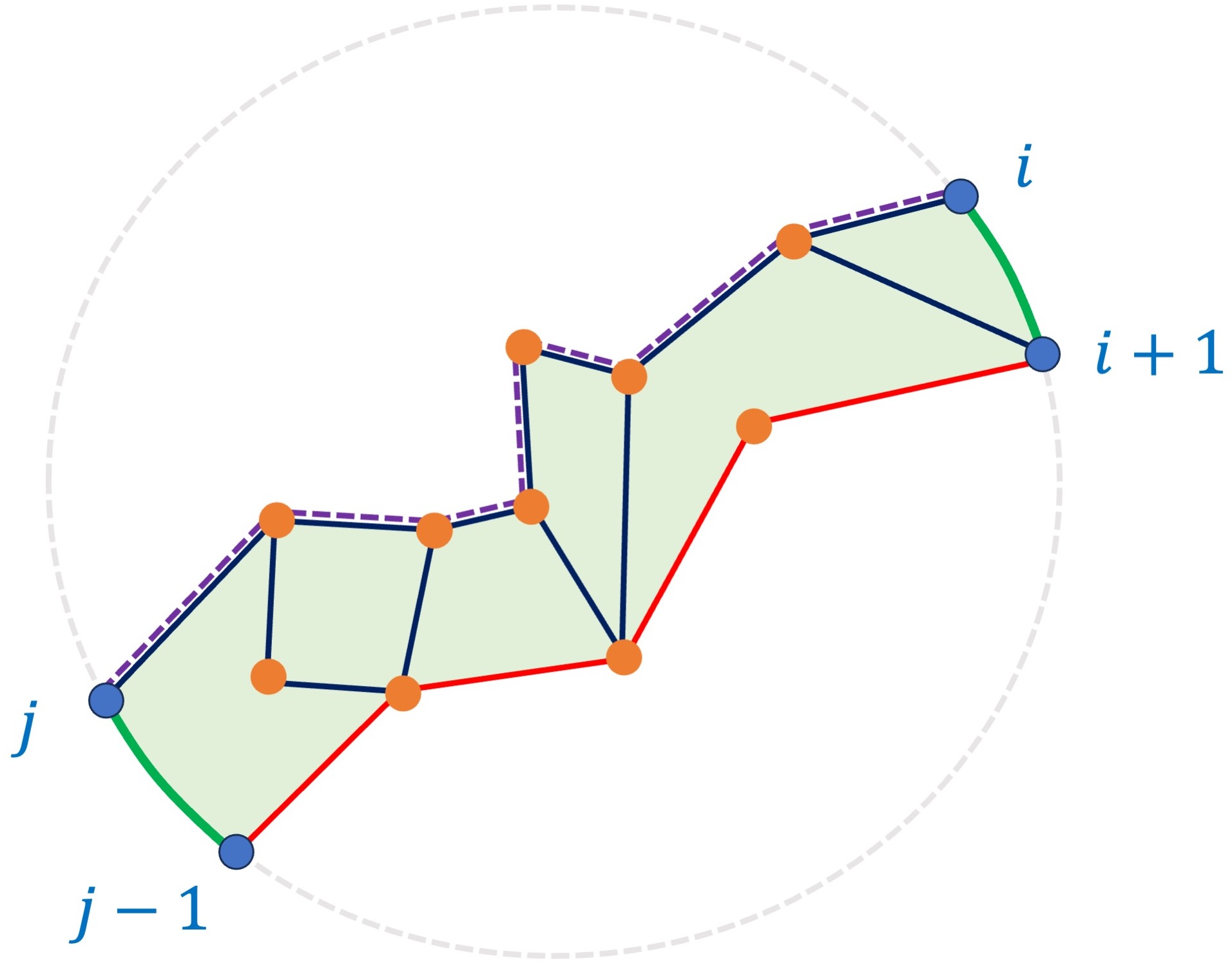
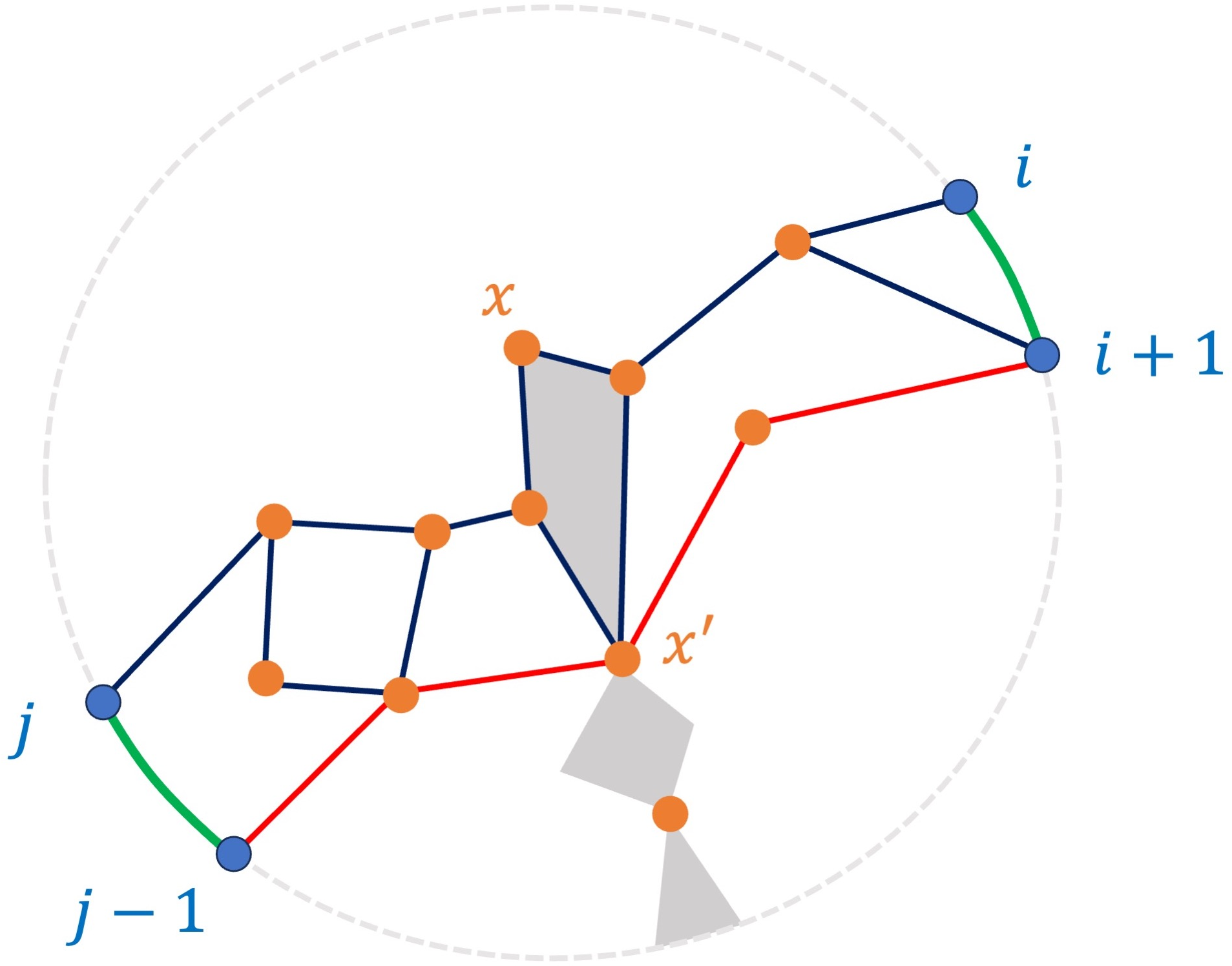
Figure 1: Path T3 construction in the inductive procedure, with supporting chains and regions highlighted.
The realization problem is translated into medial graphs, where the primal graph T4 corresponds to an arrangement of chords (medial chords) on the disk, and the number of edges equates to the number of chord crossings. By formalizing the set T5 of reference points and the set T6 of chord endpoints (alternating along the disk boundary), and encoding the maximal repelling-set sizes T7 and their endpoint-corrected doubles T8, the authors show that there exists a unique canonical perfect matching (the medial template T9) that exactly matches all cut demands with minimal intersection complexity.
This matching can be computed efficiently using finite-difference formulas on cut counts, leveraging the invertibility of the circular cut-incidence matrix. Structural properties such as generalized Monge conditions and uniqueness arise from the metric inequalities, leading to global constraints on the template.
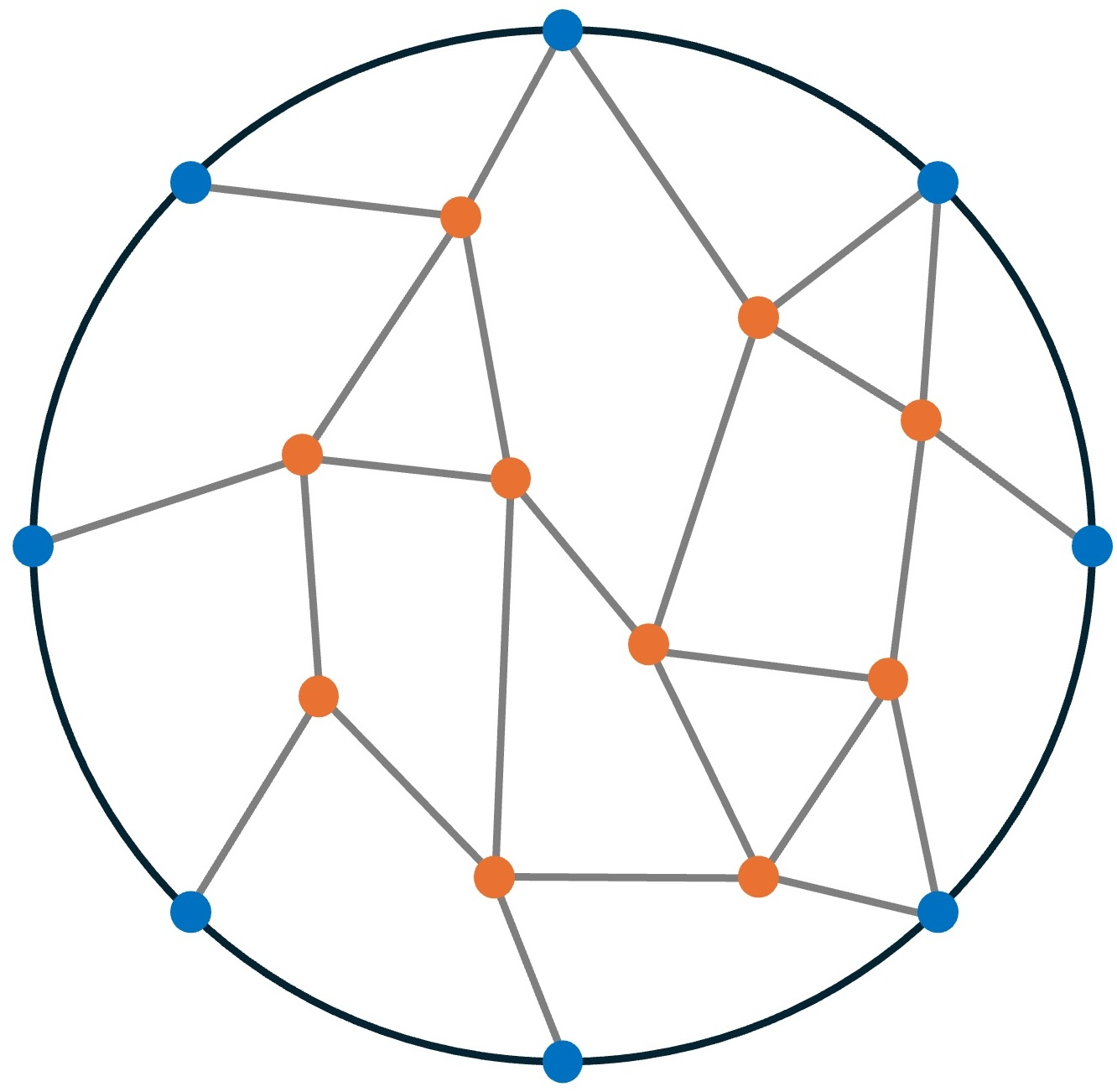
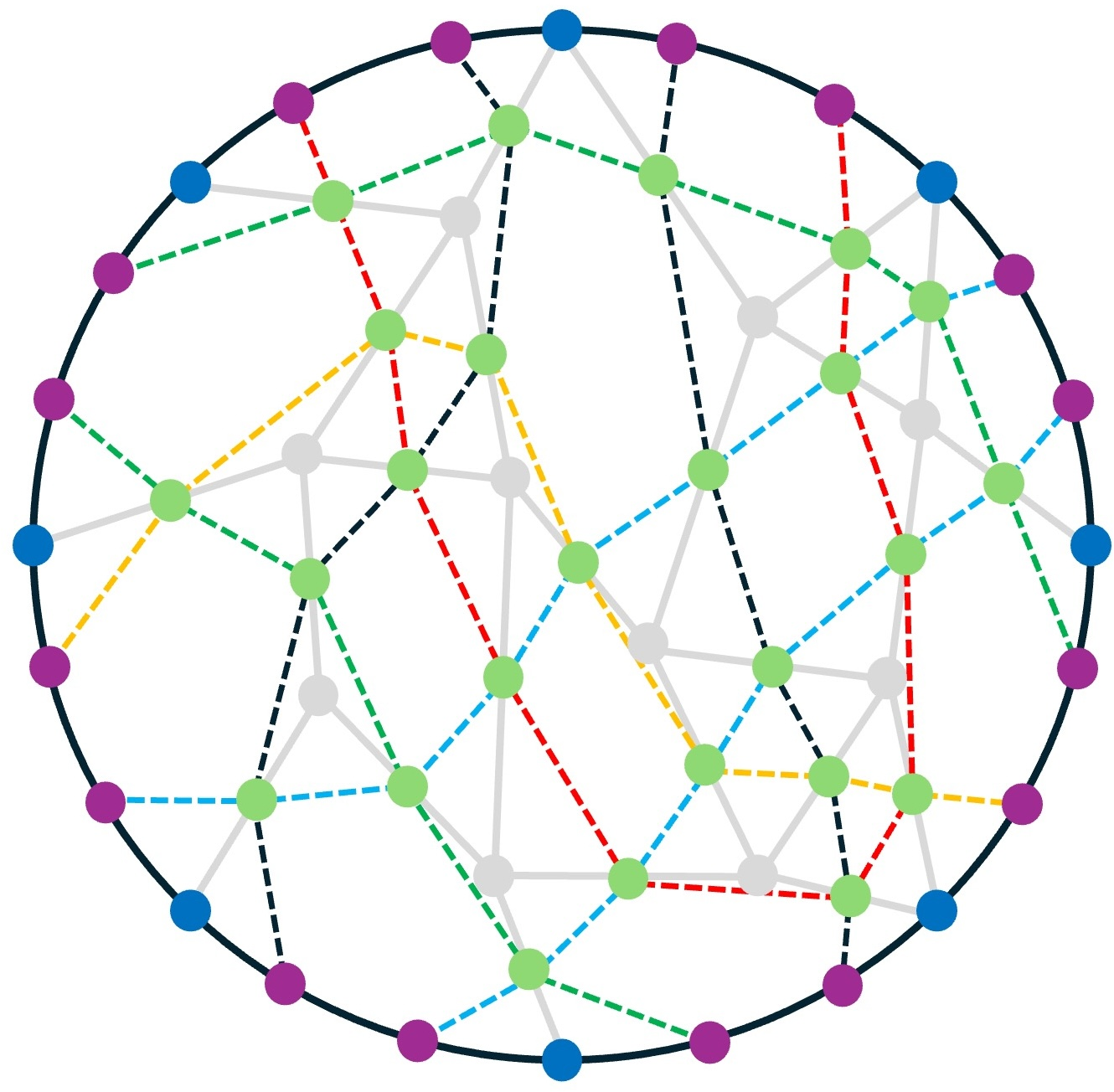
Figure 3: Left: A primal Okamura-Seymour graph with boundary terminals (blue). Right: Its medial graph representation with chords (dashed lines) corresponding to primal edges.
A significant algorithmic outcome is that all minimum OS realizations correspond to primal graphs derived from arrangements of (G,T)0; the graph structure is thus rigidly determined by (G,T)1, modulo (G,T)2-(G,T)3 (star-triangle) transformations, which correspond to local changes preserving the metric.
Existence and Uniqueness Results
The principal constructive theorem states:
Given any OS metric (G,T)4, the underlying graphs of all minimum OS realizations can be efficiently recovered. Moreover, for each such graph structure, one can efficiently compute nonnegative edge lengths realizing (G,T)5.
For every chord arrangement of (G,T)6, the primal graph is a minimum OS realization with edge count equal to the intersection number (G,T)7. While the graph structure is determined by (G,T)8 and is unique up to arrangement, the realizing edge weights for (G,T)9 are not unique in general. The paper provides explicit instances (see Appendix) demonstrating non-uniqueness of edge-length assignments on the minimal graph structure.
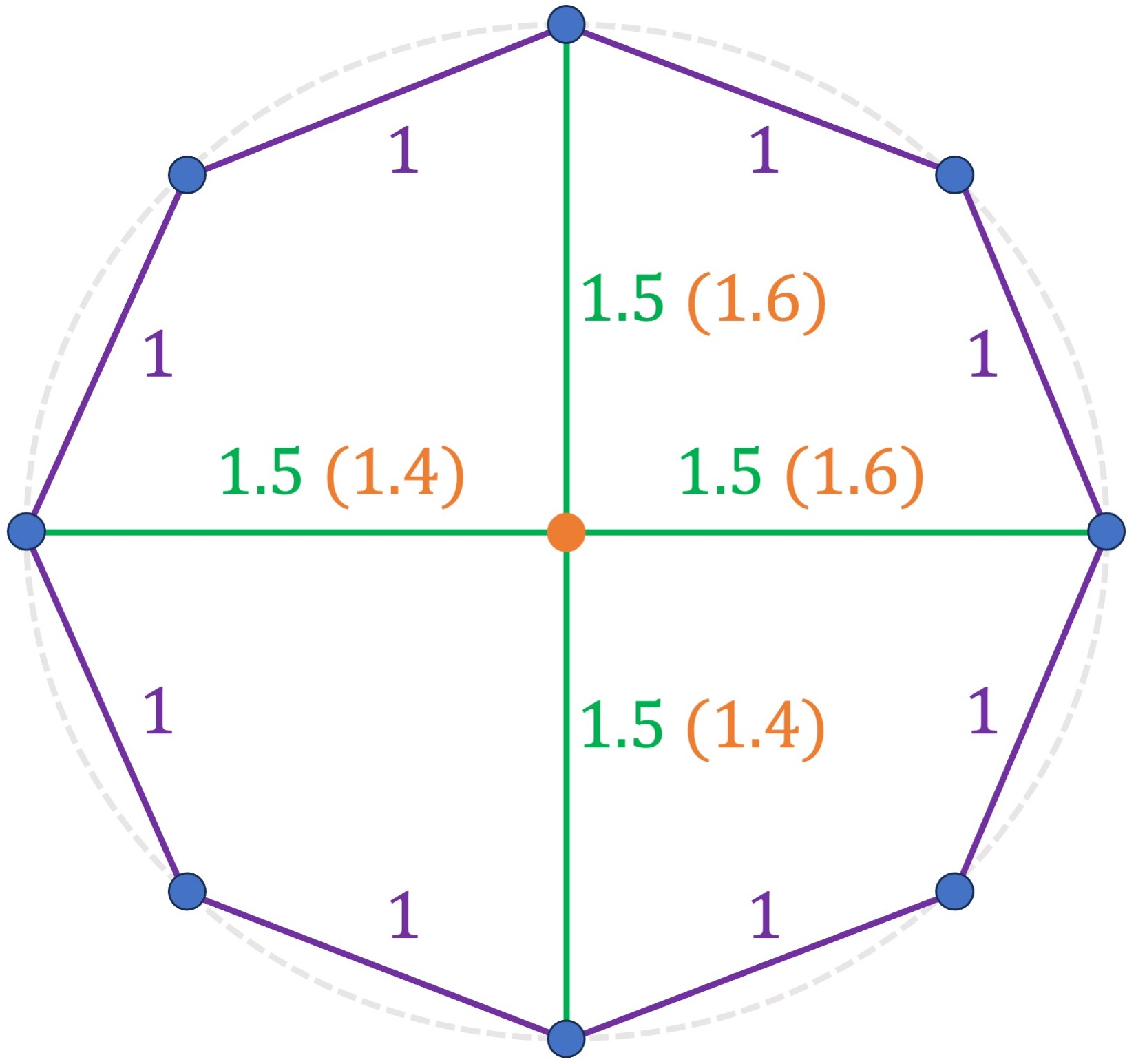
Figure 2: Example of a minimum realization for a specific OS metric; non-uniqueness of edge weights is highlighted (green edges).
Algorithmic Construction
The construction is algorithmically efficient. For each OS metric:
- The cut demands G0 are computed via enumeration of maximal repelling sets.
- The endpoint-corrected cut counts G1 are used to solve for the unique template G2 via finite difference.
- The minimum-primal graphs are generated from arrangements of G3.
- For each generated structure, a G4-good shortest path structure is induced and realizing edge weights are found by solving a corresponding system, using the path structure as prescribed by the repelling set analysis.
Theoretical and Practical Implications
This work advances the understanding of the metric structure of planar graphs with prescribed terminal metrics, providing a complete and efficient characterization of minimum realizations for the OS family. The reduction to a canonical medial template is structurally analogous to the role of critical networks and response matrices in circular planar electrical networks, with the medial template G5 playing a central role in both the feasibility and minimality of realizations. The relationship to G6-G7 moves ensures that all minimal graphs are local equivalence classes under such transformations.
Practically, these results facilitate succinct encoding schemes for planar networks with terminal metrics, and support algorithmic procedures in planar metric compression and network synthesis. The concepts introduced, particularly the interplay of repelling pairs and medial graphs, have potential impact on succinct network representations, graph reconstruction, and planar flow algorithms.
Speculation on Future Directions
- Generalization to surface-embedded graphs beyond the disk.
- Algorithmic refinements to handle weighted cuts and approximate metrics.
- Application of the repelling-pair and medial-template method in network design, particularly in robust and fault-tolerant settings.
- Connections to distance sparsification results and advances in exact/approximate metric compression for planar and minor-free graphs.
Conclusion
This work provides a complete algorithmic and structural solution to the minimum realization problem for Okamura-Seymour terminal metrics, showing that the set of all such minimum planar graphs is captured by the arrangements of a unique medial template derived from G8. The confluence of combinatorial, geometric, and planar-graph techniques yields a new lens on metric realization and compression, with implications extending to planar flows, reconstructive network tomography, and the broader metric embedding literature.
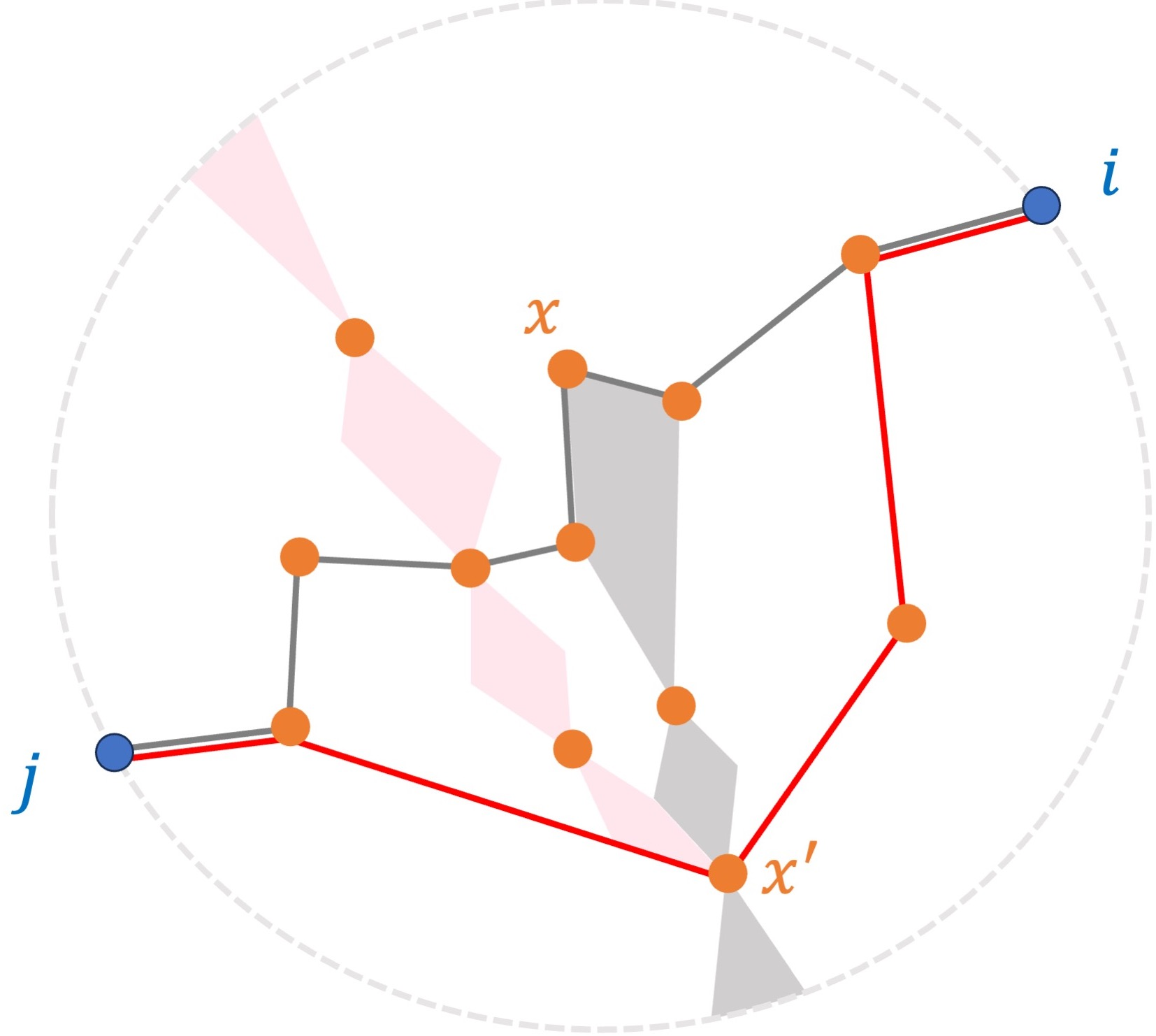
Figure 4: Illustration of chain interactions and path decompositions involved in ensuring the feasibility of repelling path structures across the disk.

