- The paper identifies a major diagnostic gap in eBPF verifiers by revealing that 47% of rejections yield generic errors masking true root causes.
- The proposed bpfix tool reconstructs the lost proof lifecycle from detailed log analysis, effectively localizing error origins with actionable diagnostics.
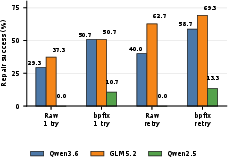
- Empirical evaluation demonstrates bpfix significantly improves repair success in human and LLM-driven workflows, reducing trial-and-error iterations.
Diagnostic Challenges in eBPF Verifier Rejections and the bpfix Solution
Introduction
The increasing integration of eBPF into the Linux kernel has elevated the importance of robust verification for in-kernel safety. Developers must submit programs to a verifier that checks for safety under all possible execution paths. However, when verification fails, the error reporting mechanism is inadequate: the terminal error identifies where verification stopped, not where the proof of safety was lost. This disconnect creates a diagnostic gap, making it costly and unintuitive for developers to repair broken programs. The discussed paper presents a systematic characterization of this gap, introduces a new technique—bpfix—that reconstructs the lost proof’s lifecycle, and demonstrates its efficacy in both human-driven and LLM-driven repair workflows (2607.02748).
Empirical Characterization of Diagnostic Gaps
The paper compiles a comprehensive dataset (bpfix-empirical) of 235 real-world verifier rejection cases, curated from Stack Overflow, GitHub, kernel self-tests, and fix commits, all reproduced across a consistent eBPF toolchain and kernel version. Analysis of this dataset reveals key findings:
- Error reporting is coarse: 47% of rejections return only a generic
EINVAL, and the most common error string template, once normalized, maps to nine distinct root causes.
- Domain specificity of errors: Of 12 root causes for program bugs, 10 are eBPF-specific and require nontrivial domain knowledge to address.
- Non-programmatic sources of errors: 19% of cases stem from toolchain, environment, or verifier idiosyncrasies, not from bugs in the source code.
- Inadequacy of current tooling: The existing tools at most improve log readability but do not address localization of the lost proof required for effective repair.
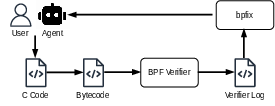
Figure 1: bpfix on a real rejection (Stack Overflow 53136145). The verifier returns one register-level line; from the same log, bpfix reconstructs the discarded proof and localizes the rejection to the point where the required proof was lost, mapping each span back to source.
The bpfix Approach: Proof Lifecycle Reconstruction
bpfix processes the verifier’s per-instruction logs to reconstruct the full lifecycle of the required proof. Its architecture can be decomposed into three primary stages (see Figure 2):
- Log Analysis: Parses per-instruction abstract state updates, normalizing evidence about value types, bounds, and register provenance.
- Proof Reconstruction: Maps the observed terminal error and its context to an explicit proof family (pointer, scalar range, etc.), and tracks the establishment, propagation, and loss of this proof along the execution trace.
- Diagnostic Generation: Produces actionable, Rust-style diagnostics containing a stable error ID, clear identification of the lost proof, code spans, and “help” guidance for repair.
This approach leverages the latent information in the detailed logs (log_level=2) that are otherwise underutilized by existing tools.
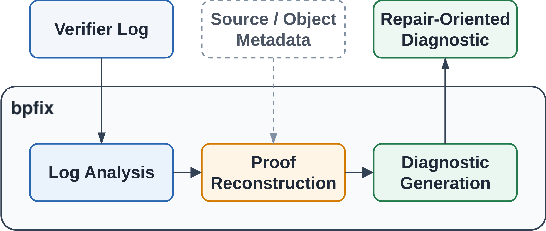
Figure 2: Overview of the bpfix workflow. bpfix analyzes verifier logs, reconstructs the missing proof, and generates a repair-oriented diagnostic.
Evaluation: Diagnostic Value and Model-Assisted Repair
The evaluation consists of two axes: human interpretability (case studies) and LLM-augmented repair using a novel benchmark (bpfix-bench).
Human-Centric Diagnostic Improvements
Case studies demonstrate that bpfix can localize the true origin of rejected proofs, distinguishing between program bugs and toolchain artifacts even when the terminal error is identical. For example, it separately attributes “invalid mem access 'scalar’” errors to developer mistakes or compiler artifacts, guiding the user toward the correct repair locus.
LLM Repair Benchmark: bpfix-bench
bpfix-bench comprises 75 real-world eBPF repair tasks. The benchmark enables analysis of LLM repair performance with and without bpfix localization. Key results include:
Implications and Future Directions
The research demonstrates that the diagnostic gap in eBPF verification is quantified and substantial, emerging not only from limited error granularity but also from domain-specific proof concepts unfamiliar to general developers and models. The bpfix technique addresses this by raising the abstraction of error messages to actionable proof-based diagnostics.
Practical Implications
- Workflow acceleration: bpfix reduces trial-and-error iterations for kernel developers, lowering the “activation energy” of writing and repairing eBPF programs.
- LLM compatibility: Strong improvements in LLM-guided repair suggest that low-level logs, when augmented with proof-specific localization, make eBPF repair amendable to automated approaches.
Theoretical Implications
- Proof-based error localization: Abstracting error diagnosis in terms of lost proof lifecycles is applicable beyond eBPF, potentially benefiting other domains where dynamic log traces encode latent proof information.
- Verifier design: There is an intrinsic value in exposing richer proof artifacts directly from the verifier (as is done in type systems for languages like Rust), which could streamline tool development and debugging.
Future Research
- Verifier instrumentation: Direct integration of proof lifecycle reporting into verifier architectures, minimizing dependence on post-hoc log analysis.
- Expansion to other domains: Application of proof lifecycle reconstruction to other program analysis and verification frameworks.
- LLM co-design: Designing LLM prompting and fine-tuning pipelines tailored to proof-centric diagnostics for kernel and low-level program repair.
Conclusion
The paper systematically dissects the diagnostic gap in eBPF verifier rejections, provides a comprehensive tool for loss localization (bpfix), and demonstrates its value quantitatively both for developers and for LLM-driven repair. Localization of proof loss, rather than terminal errors, is essential for scalable and automated repair of kernel-enforced invariants. The findings motivate ongoing research into generalized proof-centric diagnostics within systems verification.