- The paper establishes a universality theorem showing that the asymptotic distribution of Van Vleck roots in high-order Heun operators depends solely on the leading polynomial coefficient.
- It introduces a finite-band matrix formulation and moment analysis to rigorously describe the exterior Cauchy transform and logarithmic potential of spectral measures.
- A novel WKB approach and the conjectured spectral tree framework provide fresh insights into the mother-body phenomenon and interior spectral structure in complex configurations.
Van Vleck Spectra for High-Order Heun Operators: Universality, Potentials, and Asymptotics
Introduction
This work addresses the spectral geometry of polynomial Van Vleck parameters for high-order analogues of the classical Heun operator—linear differential operators of Fuchs index one. The central object of inquiry is the spectral polynomial Spn, whose roots (Van Vleck parameters) parameterize polynomial eigenfunctions (Stieltjes polynomials) for a class of operators generalizing the Lamé equation. The analysis establishes a comprehensive universality theorem for the asymptotic distribution of these roots and elucidates their exterior potential-theoretic structure, with particular attention to the distinction between unconditional, averaged results and conjectural, tree-like fine structure in the generic complex case.
Main Theoretical Framework
Given a high-order differential operator
DQ=i=1∑kQi(z)dzidi,degQi≤i+1,degQk=k+1,
the focus is on those at most linear polynomials V for which DQ+V admits a polynomial solution of fixed degree n. The associated Van Vleck spectral polynomial is then
Spn(z)=∏j=1n+1(z−zn,j),
with {zn,j} the spectral parameters of interest. These roots are analyzed via root-counting measures μn.
A deterministic, finite-band matrix formulation arises for Spn in terms of truncations of the action of DQ−λn(z−t) on degree-DQ=i=1∑kQi(z)dzidi,degQi≤i+1,degQk=k+1,0 polynomials, yielding substantial technical leverage, especially for asymptotic limits DQ=i=1∑kQi(z)dzidi,degQi≤i+1,degQk=k+1,1.
Finite-Band Universality and Exterior Potentials
A central result is the finite-band moment theorem, which characterizes the normalized power sums of spectral roots: DQ=i=1∑kQi(z)dzidi,degQi≤i+1,degQk=k+1,2
where DQ=i=1∑kQi(z)dzidi,degQi≤i+1,degQk=k+1,3 is the constant term in DQ=i=1∑kQi(z)dzidi,degQi≤i+1,degQk=k+1,4 and DQ=i=1∑kQi(z)dzidi,degQi≤i+1,degQk=k+1,5 are coefficients of the leading polynomial DQ=i=1∑kQi(z)dzidi,degQi≤i+1,degQk=k+1,6.
Crucially, all power sum moments in the limit depend solely on DQ=i=1∑kQi(z)dzidi,degQi≤i+1,degQk=k+1,7, and the influence of non-leading coefficients enters only at lower correction orders, establishing strong spectral universality. This moment structure determines the exterior Cauchy transform and logarithmic potential of the asymptotic measures.
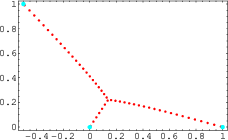
Figure 1: The roots of the spectral polynomial DQ=i=1∑kQi(z)dzidi,degQi≤i+1,degQk=k+1,8 for the fourth-order operator with a generic complex quintic DQ=i=1∑kQi(z)dzidi,degQi≤i+1,degQk=k+1,9.
The finiteness-band determinant representation is exploited to derive locally uniform convergence of the normalized Cauchy transforms V0 and logarithmic potentials V1 to analytic and harmonic functions, respectively, throughout the exterior of the convex hull V2 of zeros of V3. Thus, the exterior field is independent of lower-order perturbations.
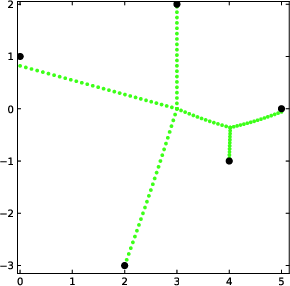
Figure 2: The roots of the spectral polynomial V4 for a second-order operator with a cubic V5. The Van Vleck roots cluster inside the convex hull of the cubic's roots.
Moment Determinacy and Rigidity Results
The determinacy result is sharp: if the roots of V6 asymptotically localize on a compact set V7 of empty interior and connected complement, then the normalized moments uniquely specify the weak limit of V8. In particular, if the roots of V9 are collinear (including the real-rooted case), the limit is a probability measure supported on the segment spanned by those roots, and is again dictated exclusively by DQ+V0.
Asymptotics, Holonomicity, and Picard-Fuchs Equations
The paper establishes that the limiting exterior Cauchy transform DQ+V1 is holonomic in DQ+V2, via creative telescoping on the algebraic integrand arising from the finite-band description. Explicit Picard-Fuchs equations are derived for the so-called WKB periods in the spectral parameter DQ+V3. For DQ+V4 (the first non-classical case), the differential equation is: DQ+V5
admitting explicit comparison with finite-band Cauchy transforms and conjectural spectral trees.
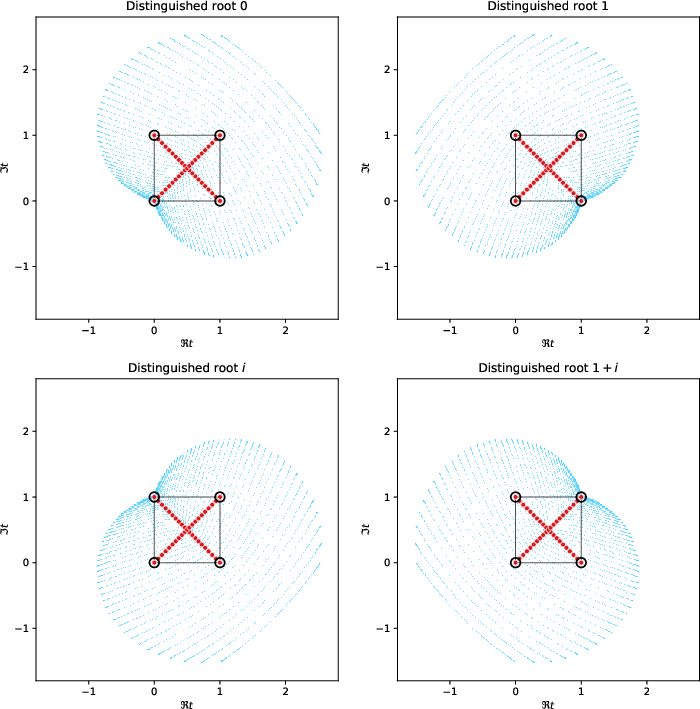
Figure 3: Numerical approximations of four auxiliary averaged measures for DQ+V6 (colored sets), alongside high-precision roots of DQ+V7 and the zeros of DQ+V8.
Mother-Body Phenomenon and the Spectral Tree Conjecture
While the averaged potential and exterior moments are robustly determined, the internal structure of the limiting measure is more subtle in the general complex case. For complex DQ+V9 with simple roots, numerical evidence demonstrates that the Van Vleck roots cluster on a thin, tree-like support connecting the roots of n0, rather than being supported on a two-dimensional region.
The Spectral Tree/Mother-Body Conjecture posits that the limiting measure n1 is the positive mother body of the exterior field generated by the finite-band average—i.e., it is a probability measure on a finite planar tree, uniquely determined by its potential outside n2 and having support inclusive of all roots of n3. This is a sharp and technical refinement of the universality result: the support is in general much smaller than the two-dimensional support of the averaged finite-band measure.
Figure-Based Illustration of the Asymptotics and Mother-Body Tree
Numerical calculations show (Figures 1–3 above) that, for high-degree n4, the Van Vleck roots aggregate on loci forming a tree inside n5, whose leaves are precisely the roots of n6. These figures contrast the spectral root set with the supports of the frozen averaged measures, highlighting the skeletonization (that is, one-dimensional reduction) induced by the genuine spectral measure.
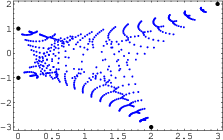
Figure 4: The union of roots of 861 quadratic Van Vleck polynomials for classical Lamé equation, visualizing the rich distributional structure in the non-determinantal case.
WKB Approach and Structural Conjectures
A WKB (semiclassical) analysis is advanced for the geometric structure of the spectral tree. The conjecture is that the support of the spectral measure is characterized by loci where the real parts of certain WKB periods vanish, subject to a positivity (S-property) constraint and quantization condition, leading to the selection of a minimal carrier tree. The approach blends asymptotic analysis, period calculations, and algebraic geometry of differentials over auxiliary Riemann surfaces.
Implications and Directions for Future Work
This framework solidifies a new universality principle for polynomial spectral problems associated with high-order Heun operators: the asymptotic exterior behavior of spectral roots is determined solely by the leading term, up to all finite moments. The nuanced issue of the “interior” (support structure and uniqueness of the mother body) for complex configurations is partially conjectural, with strong evidence for selection of tree-like supports. These results impact both the spectral theory of non-self-adjoint operators and logarithmic potential theory in the complex plane.
The research leaves open rigorous confirmation of uniqueness and positivity for the mother body in the most general settings, as well as a deeper connection between WKB quantization/periods and finite-band moment formulas, particularly in the presence of multiple active cycles and nontrivial support topologies. These questions are compelling from both mathematical and mathematical-physics perspectives.
Conclusion
This paper establishes a detailed, technically robust theory of the asymptotic root distribution for the Van Vleck spectra associated with high-order Heun operators. It demonstrates a strong universality in moments and exterior potential, provides explicit algebraic tools for analysis, and articulates a precise conjectural framework (supported by numerics) for the internal (support) structure of the limiting measures. The interplay of potential theory, spectral asymptotics, and algebraic geometry highlighted here has significant theoretical leverage and sets the stage for further analytic and computational advances in the spectral theory of differential operators (2607.02700).