- The paper introduces universal formulas for the endpoint asymptotics of principal and nonprincipal solutions using spectral ζ-values.
- It constructs minimal order characteristic functions that yield optimal contour integral representations for spectral ζ-functions.
- The work generalizes Liouville–Green approximations and clarifies eigenvalue convergence in truncated singular Sturm–Liouville problems.
Complex Analytic Theory of Sturm–Liouville Operators with Schatten p-Class Resolvents
Introduction and Motivation
This work develops a complex analytic framework for understanding the spectral theory of singular Sturm–Liouville operators whose resolvents inhabit a specific Schatten p-class. The principal motivation arises from spectral ζ-functions associated with self-adjoint extensions of such operators and the need for constructing characteristic (entire) functions of minimal order vanishing at the operator’s eigenvalues. These functions are essential for optimal contour integral representations of ζ-functions and, by extension, for the analytic continuation that underlies many applications in mathematical physics.
The authors address the universal spectral dependence of the blowup/decay rates of solutions to Sturm–Liouville eigenvalue equations, focusing on the asymptotics of principal and nonprincipal solutions at singular endpoints. Their theory rests on entire functions of finite order and leverages Hadamard factorization to clarify the role of the Schatten p-class threshold in determining solution behavior and spectral zeta-analyticity.
Theoretical Foundation and Main Results
The central technical innovation is the establishment of precise universal formulas for the endpoint asymptotics of principal (u) and nonprincipal (v) solutions: ua(z,x)∝ua(0,x)exp{ℓ=1∑pℓzℓζ(ℓ;(x,d))},
va(z,x)∝va(0,x)exp{−ℓ=1∑pℓzℓζ(ℓ;(x,d))},
as x approaches the endpoint, where p0 is the p1-th partial spectral p2-value for the truncated problem.
These asymptotics depend solely on the largest integer p3 for which the operators' resolvents fail to be in the Schatten p4-class, demonstrating a universal and minimal dependence on the regularity of the underlying problem. Notably, no additional smoothness beyond standard p5 for the coefficients is required for these results.
Based on this analysis, the authors construct characteristic functions of minimal growth order for operators with Schatten p6-class resolvents. The construction relies upon careful normalization conditions for the principal and nonprincipal solutions, adapted according to the endpoint classification (limit circle vs. limit point) and the associated spectral sequence’s convergence properties.
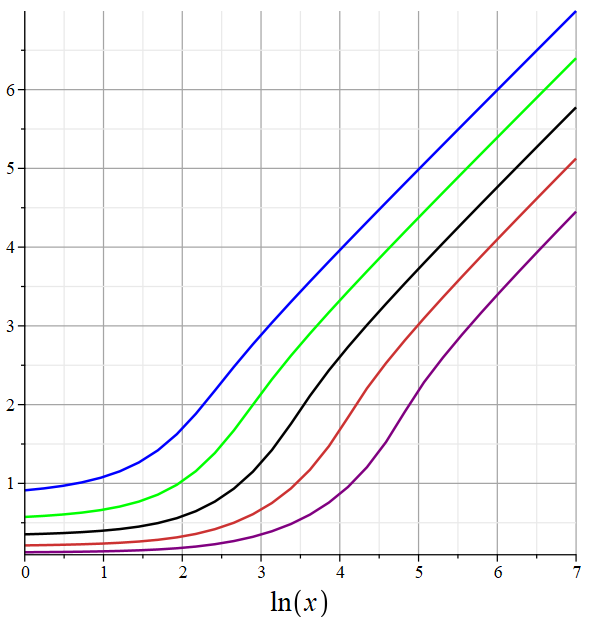
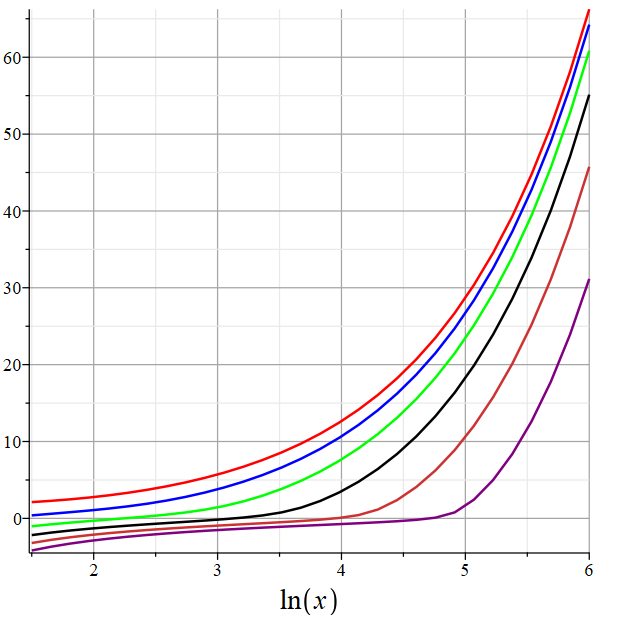
Figure 1: p7 depicting normalized differences in eigenvalue convergence rates under increasing p8 for truncated Laguerre operators, revealing universal dependence on p9 divergence.
A significant consequence is the derivation of optimal contour integral representations for spectral ζ0-functions, generalizing the classical results for regular and quasi-regular Sturm–Liouville problems. These representations are valid for ζ1, with ζ2 being the exponent of convergence for the spectrum, thus maximizing the domain for analytic continuation processes.
Applications and Implications
The theory developed has several substantive applications:
1. Spectral ζ3-functions and Contour Integral Representations
The minimal order characteristic functions yield integral representations of the form: ζ4
where ζ5 is the minimal order characteristic function, and ζ6 is the multiplicity of zero as an eigenvalue. This formula permits optimal analytic continuation, facilitating the study of the pole structure and special values of ζ7-functions in quantum mechanics, spectral geometry, and mathematical physics.
2. Generalization of Liouville–Green (WKB) and Trace Estimates
The universal asymptotic formulas for (non)principal solutions generalize Liouville–Green (WKB) approximations to settings with minimal coefficient regularity, replacing local semiclassical expansions with expressions determined solely by the spectral growth (i.e., Schatten class). Whenever the classic Liouville–Green expansion is valid, the theory recovers it as a special case, but remains valid in considerably broader contexts.
3. Convergence Rates for Eigenvalues of Truncated Problems
The approach elucidates the sharp convergence rates for eigenvalues ζ8 of truncated operators as ζ9 approaches a singular endpoint. The analysis shows that the divergence of partial ζ0-values fully determines the relative convergence for different levels ζ1: ζ2
establishing strong constraints on spectral approximation schemes and their asymptotic performance for numerical and theoretical investigations.
4. Explicit Examples
The universal theory is illustrated with classical equations:
- Airy equation: Characteristic functions and partial ζ3-values are explicitly related to Airy functions, with minimal order ζ4 determined by the Hilbert–Schmidt class nature of the resolvent.
- Harmonic oscillator: Order ζ5 growth (trace class threshold) is reflected in the characteristic function, matching known spectral locations and confirming the theoretical predictions.
- Laguerre operators: Hilbert–Schmidt resolvents with characteristic functions expressed in terms of confluent hypergeometric functions, again capturing the universal dependence of solution asymptotics on the Schatten class parameter ζ6.
Impact and Future Directions
The analytic machinery provided offers a powerful unifying language for a wide array of Sturm–Liouville operators, linking spectral theory, entire function theory, and the geometry of function spaces determined by operator resolvents. The results have implications for:
- Spectral regularization and renormalization in quantum field theory, where analytic continuation of ζ7-functions is pivotal for defining determinants and partition functions.
- Generalized inverse problems and spectral uniqueness, especially in settings lacking classical regularity or where nonstandard endpoint asymptotics prevail.
- Numerical approximation of spectra in singular scenarios, where explicit rates of convergence for eigenvalues of truncated problems can guide the design of efficient computational schemes.
Several open problems remain, particularly the natural construction of nonprincipal solutions of minimal order in non-trace-class settings and the extension of the theory to essential spectrum cases or more general singular operator classes.
Conclusion
This paper provides a comprehensive analytic framework illuminating the interplay between spectral theory, entire function growth, and operator class for singular Sturm–Liouville operators. By demonstrating the primacy of Schatten ζ8-class thresholds in governing both solution asymptotics and spectral ζ9-function analytic structure, the authors open new avenues for rigorous analysis and practical computation in spectral theory and its applications.