- The paper establishes a closed-form finite Guinand–Weil dictionary linking coefficient vectors to admissible band-limited test functions.
- It derives explicit certification bounds for the archimedean tail, precisely controlling eigenvalue discrepancies in finite truncated computations.
- Extensive numerical and symbolic verifications confirm that the quadratic form exactly matches the zero sums of the Riemann zeta function.
Finite Guinand–Weil Dictionary and Archimedean Tail Order: A Detailed Summary
Introduction and Context
This paper addresses finite-dimensional truncations of the Weil quadratic form, a fundamental object in analytic number theory whose positivity is equivalent to the Riemann Hypothesis. The analysis is framed within the spectral techniques developed by Connes and collaborators, which transform the Weil quadratic form into explicit finite Galerkin matrices—constructed via cutoff at a prime c>1 and frequency band N—giving concrete access to the spectrum of Weil positivity in a computable setting. The core contributions are twofold: the establishment of a closed-form finite Guinand–Weil dictionary associating finite coefficient vectors to admissible test functions, and a precise analysis of the archimedean tail, providing rigorous certification bounds on what finite truncations reveal about the underlying limit objects.
Construction of the Finite Dictionary
The first main result is the explicit construction of a finite Guinand–Weil dictionary. Given any real, even coefficient vector v of length N+1, a sequence of explicit transformations yields a band-limited Guinand–Weil test function gv. The transport from v to gv involves: embedding v into symmetric Fourier coefficients; forming a trigonometric polynomial Tv; computing a Volterra kernel Kv; and finally realizing N0 as a compactly supported, entire function with explicitly controlled band, support, and decay properties.
The central theorem establishes that for the associated cutoff-free matrix (i.e., without archimedean truncation), every quadratic form N1—assembled via the finite Connes--van Suijlekom/Connes--Consani--Moscovici explicit constructions—coincides exactly with the sum of N2 over the nontrivial zeros of the Riemann zeta function:
N3
Here, zeros are counted with multiplicity. There is no residual error due to cutoff or band limitation at this level, and every entry of the truncated quadratic form precisely measures such zero sums.
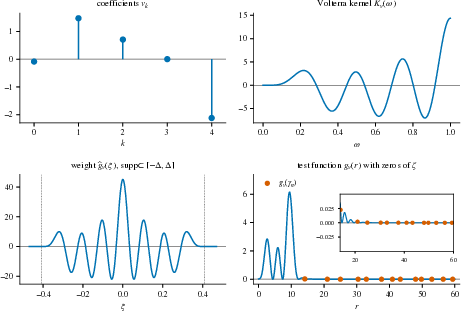
Figure 1: The construction of the dictionary at N4, N5, displaying the coefficient vector N6, the Volterra kernel N7 on N8, the compact Fourier weight N9 on v0, and the induced entire test function v1 with the first ordinates v2 marked.
The mapping v3 is shown to be injective on an explicit v4-dimensional source quotient, with the construction retaining non-collapsing subspaces that are pole-neutral—realizing the finite-dimensional analogue of working orthogonally to the pole in Weil’s approach. Importantly, for pole-neutral or moment-neutral subspaces, one can construct vectors v5 such that the pole term v6 vanishes identically, isolating genuine spectral contributions from the zeros.
Extensive verification is carried out numerically, summing v7 over the first v8 zeros of v9, with residuals at the N+10 scale, and full formal verification via symbolic and interval computation.
Structure and Positivity of the Archimedean Tail
Finite computation of the quadratic form requires an archimedean cutoff N+11 in the continuous part of the Weil explicit formula. The paper gives a second main result: exact analysis of the post-band archimedean tail in terms of a strictly totally positive Cauchy–Stieltjes increment. For N+12 sufficiently large (specifically, N+13), the tail is realized as a rank-two positive-definite Gram increment, with all minors strictly positive—a strong certificate of positivity structure.
As N+14, the difference between the eigenvalues of the finite-truncated matrix N+15 and those of the cutoff-free matrix is bounded above by an explicit budget N+16:
N+17
with
N+18
for large N+19. This provides a two-sided certification rule: finite-gv0 positivity certifies cutoff-free positivity, eigenvalues below gv1 certify a true negative eigenvalue of the full form, and eigenvalues in gv2 remain inconclusive.
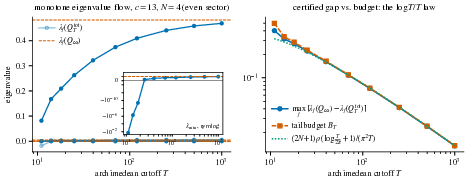
Figure 2: Increasing eigenvalues of gv3 converging to those of the cutoff-free matrix as gv4 increases, with the largest possible gap controlled by gv5.
The analysis reveals the central obstruction to naive numerical certification: the required cutoff gv6 to resolve deep spectral scales grows explosively. For example, to resolve eigenvalues at the gv7 scale for gv8 and gv9, one needs v0 of size v1. The paper asserts that such depth is accessible only through closed-form non-truncated computations, not by brute-force increase of the cutoff.
Worked Example and Numerical Verification
A detailed worked example at v2, v3, for a pole- and moment-neutral vector v4 is presented. The sum v5 evaluated both via the quadratic form and directly as a sum over zeros, matches to v6 decimal digits when the tail correction is included. The verification package accompanying the paper demonstrates both symbolic and numeric checks, confirming dictionary identity across several independent computational routes.
Implications and Theoretical Significance
From a theoretical perspective, the closed-form finite dictionary provides a rigorous finite-dimensional correspondence: explicit finite coefficient vectors map injectively to admissible Guinand–Weil band-limited test functions, and every contracted value of the finite quadratic form coincides with a sum over the zeros of the zeta function with no approximation. The finite source quotient and pole-neutral substructure clarify the structure of the finite truncation, sharpening the spectral reading of Weil positivity.
The archimedean tail analysis has strong implications for computable number theory: it imposes clear arithmetic limitations on the certifiability of spectral positivity in finite computations, quantifies the error budget for finite truncation, and gives an explicit, monotonic certification law for positivity and negativity. The total positivity proven for the tail increment ensures robust control over sign changes and eigenvalue evolution, with direct ties to classical Cauchy kernel theory and stochastic total positivity.
Outlook and Future Directions
The results provide a precise understanding of the strengths and inherent limitations of finite truncations in the context of Weil quadratic forms and the analytic approach to the Riemann Hypothesis. This facilitates both practical certification strategies in computational mathematics and deeper theoretical exploration—including potential generalizations to other L-functions, refinement of computational event calculus, and the analysis of total positivity and operator monotonicity beyond the archimedean term. The computational and symbolic infrastructure established is anticipated to inform further studies on the fine spectral structure and observability of zeros within truncation schemes.
Conclusion
The paper delivers explicit, formally proven finite-dimensional correspondences between truncated Weil quadratic forms and band-limited Guinand–Weil test functions, and a rigorous certification law for the control of the archimedean tail in finite-truncated computations. The results both illuminate the precise information available from finite truncations and set definitive quantitative limits on their reliability for deep spectral analysis, with substantial implications for computational approaches to Weil positivity, the Riemann Hypothesis, and related problems in analytic number theory.
(2607.02828)