- The paper develops a coupled geophysical and engineering model to delineate the chemical rocket escape envelope for rocky exoplanets.
- It demonstrates that a 100-engine clustering limit sets the practical mass ceiling at approximately 11.5 Earth masses for Voyager-class payloads.
- The study validates its model against historical launch vehicles, consistently predicting mass scaling and engine count requirements.
Spacefaring Habitability: Multistage Rocket Optimization and Exoplanetary Constraints
Introduction
This study introduces a rigorous, coupled framework integrating geophysics, atmospheric science, and astronautical engineering to quantify the "spacefaring envelope"—the region in planetary parameter space where chemical rockets can feasibly deliver Voyager-class (1000 kg) payloads to planetary escape velocity. Contrasting with the predominant focus on biological habitability, this work operationalizes spacefaring as a technological axis, motivated by the premise that the emergence of a civilization able to undertake interplanetary exploration is a distinct, quantifiable constraint on planetary environments.
Geophysical Preliminaries
The framework begins by assessing geophysical plausibility—specifically, the conditions necessary for robust mantle convection (parameterized by the Rayleigh number, Ra) and for maintaining a core dynamo (characterized by the magnetic Reynolds number, Rm). These diagnostics use established mass-radius relations for rocky planets and scale Ra and Rm with planetary mass per standard boundary-layer theory.
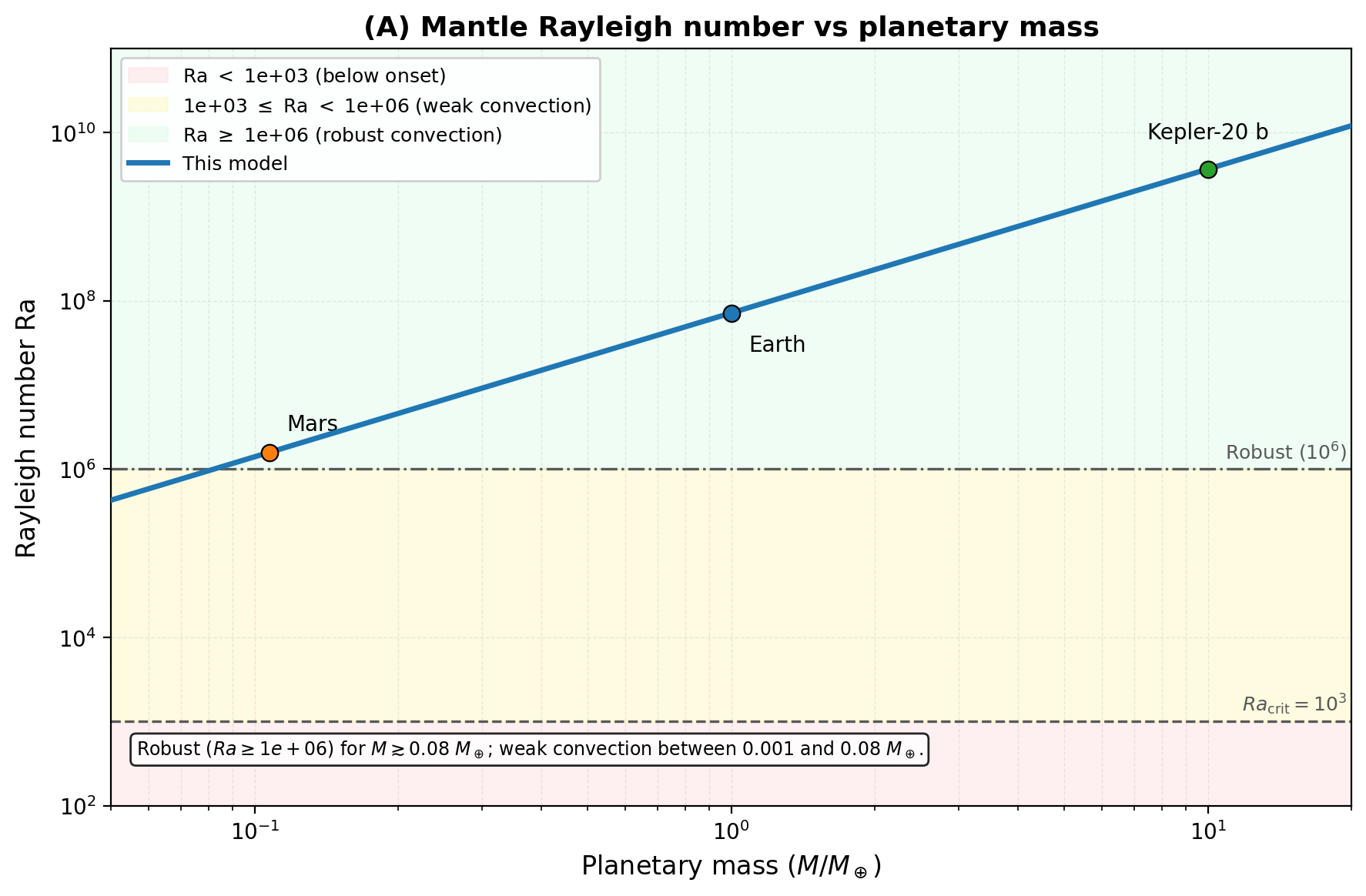
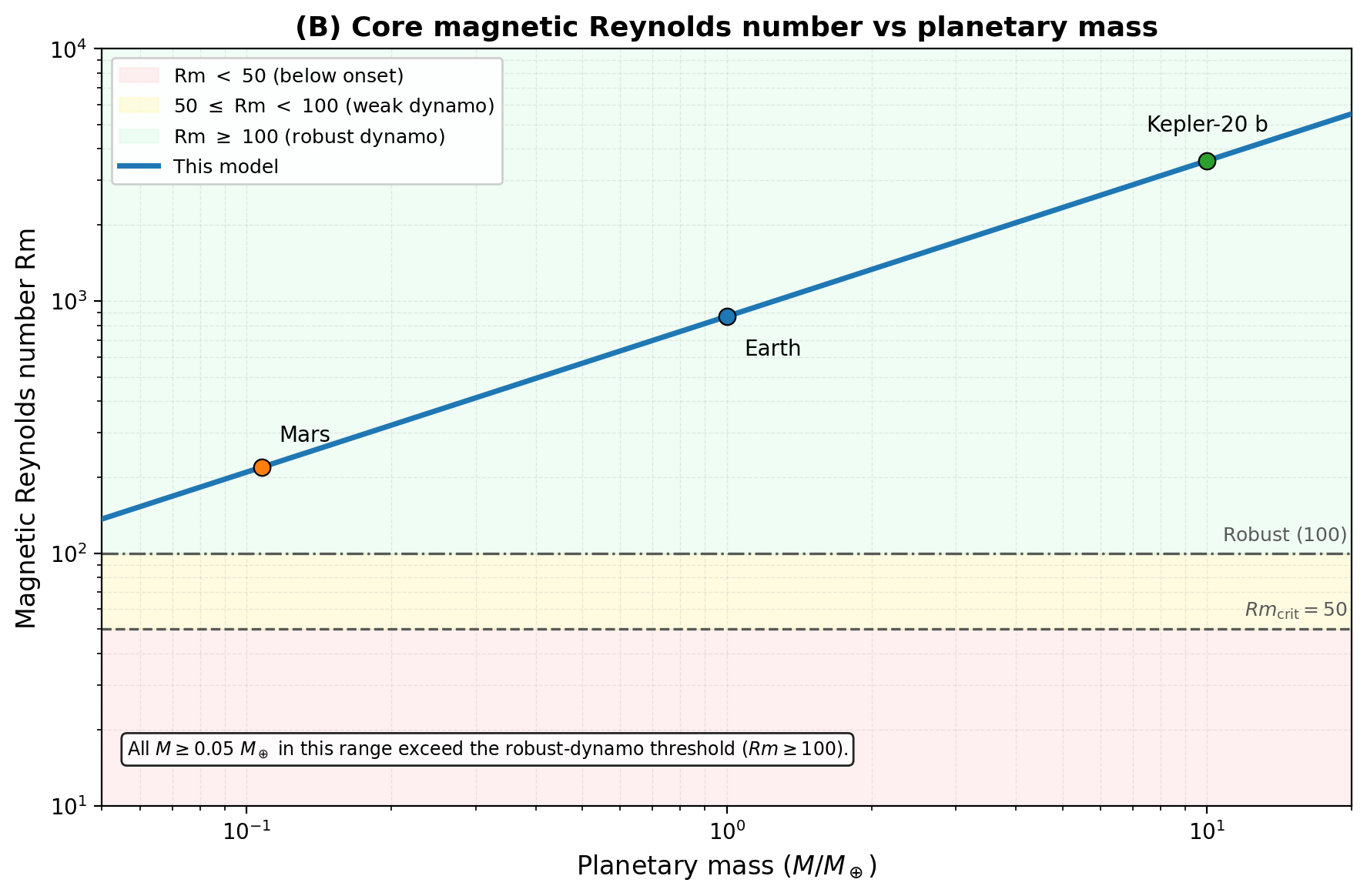
Figure 1: Geophysical constraints as a function of planetary mass: (A) Rayleigh number for mantle convection, (B) core magnetic Reynolds number for dynamo action, showing both remain robust across $0.5$–20M⊕.
Despite the formal calculations, the geophysical metrics do not impose stricter constraints on the spacefaring envelope than the astronautical calculations for the explored mass range. This is underscored by the model's overestimation of Mars’s dynamo and tectonic vigor, highlighting the limitation of mass-only, equilibrium-based diagnostics.
Astronautical Model and Engineering Constraints
The technical core of the analysis is an optimized multistage rocket model, subject to reliability and engineering constraints:
- Staging Optimization: Stage count is selected to minimize reliability-weighted expected launch mass, accounting explicitly for compounded risk due to multistaging (Rmission=Rsn).
- Engineering Constraints: The model includes practical mass and first-stage engine clustering limits, motivated by historical launcher architectures (notably, the Saturn V and contemporary vehicles).
- Δv Budget: The total required velocity increment includes escape speed, gravity losses (via a mass- and gravity-scaling law), and drag losses (computed with a vertical-ascent approximation and atmospheric scale height modeling).
Validation
The model’s predictions are benchmarked against six historical launch vehicles, ranging from Electron to Saturn V, over a spectrum of mission Δv (LEO, TLI, planetary escape). The model robustly reproduces observed mass ratios, total launch mass, and first-stage engine counts.
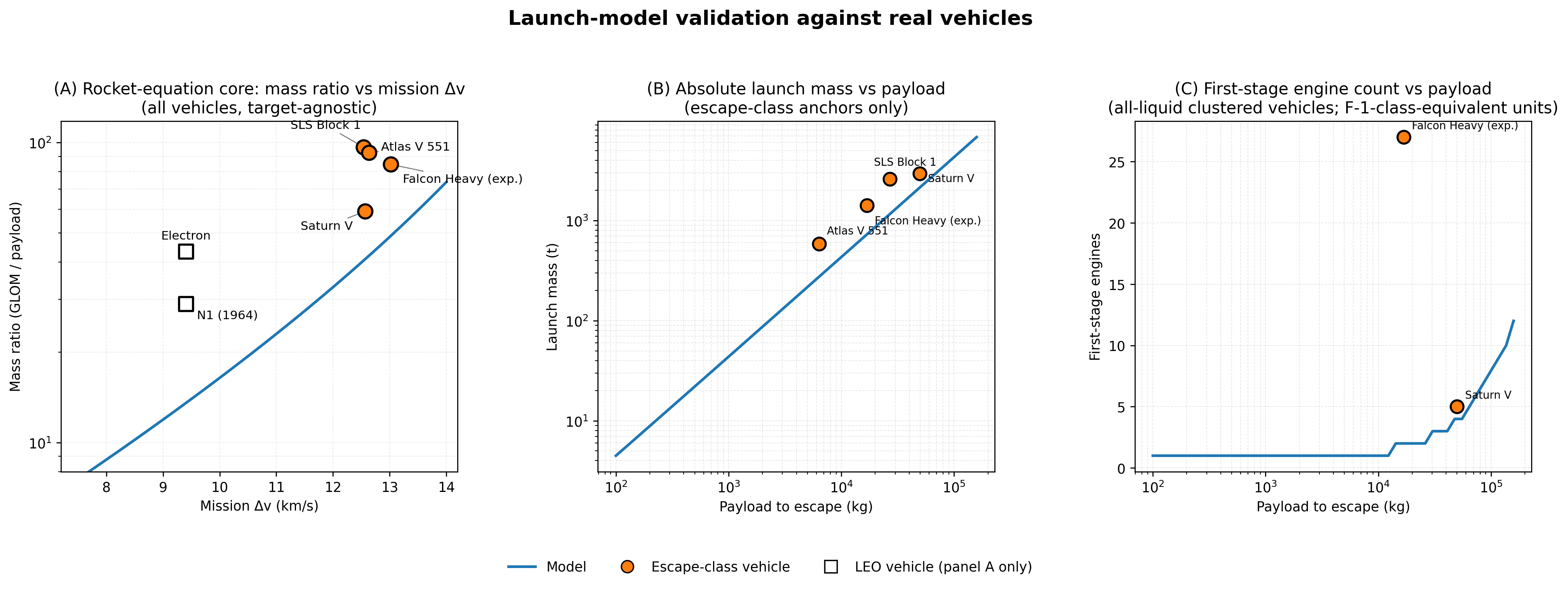
Figure 2: Validation at 1M⊕, comparing (A) mass ratio vs. mission Ra0, (B) absolute launch mass, and (C) first-stage engine count for benchmark vehicles, showing predictive accuracy for the underlying mass-scaling and engine-count models.
Scaling of Launch Requirements with Planetary Properties
Launch Mass Scaling
Launch mass for a Ra1 escape payload scales steeply with planetary mass due to the exponential dependence on Ra2 (from Tsiolkovsky’s equation). Surface pressure (via atmospheric drag) only significantly affects total required mass for low-mass planets (Ra3); at higher masses, gravity dominates.
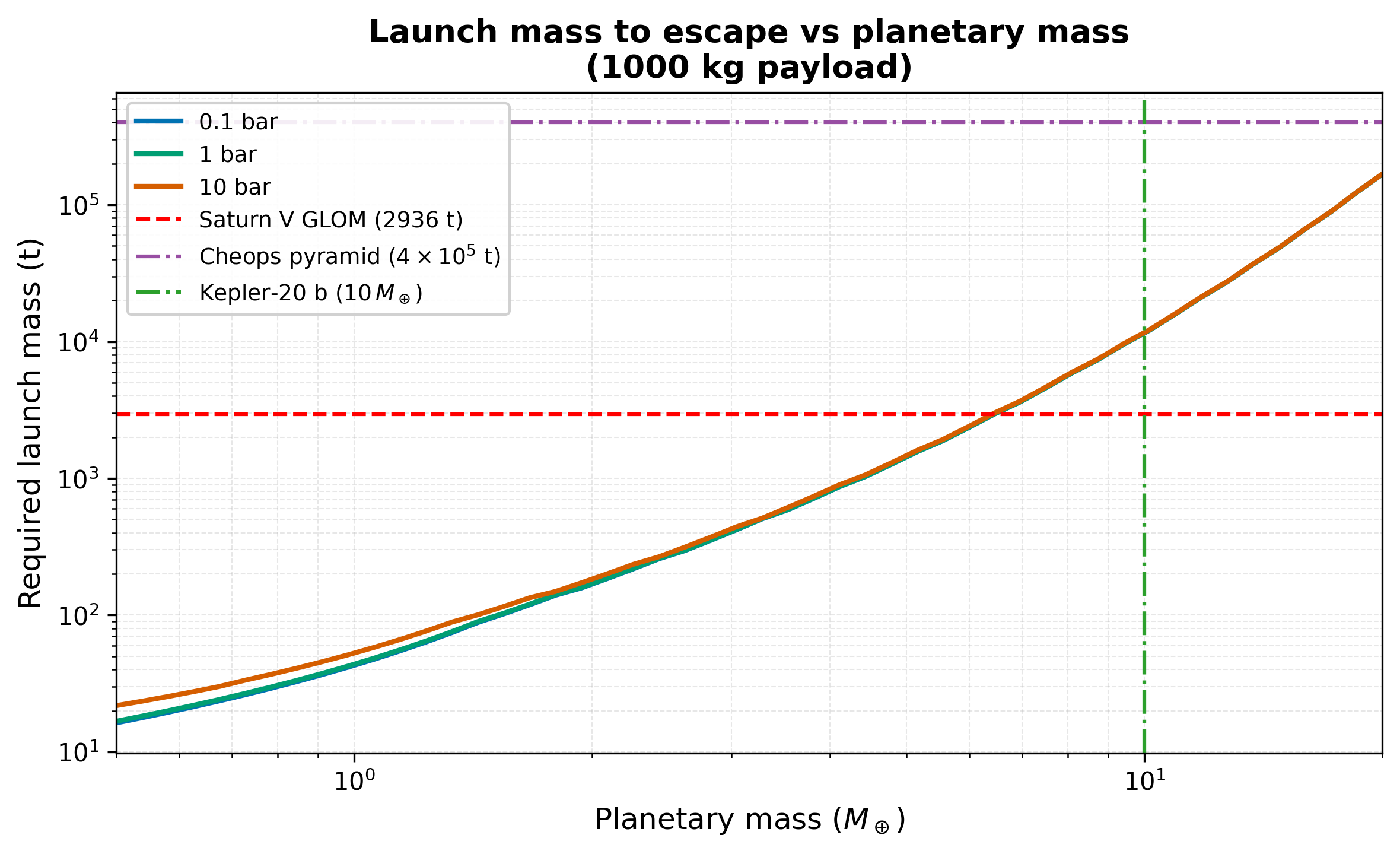
Figure 3: Required gross launch mass for a Ra4 escape payload as a function of planetary mass and atmospheric pressure, illustrating exponential mass scaling and the convergence of curves at high mass where gravity losses dominate.
For example, on a Ra5 body, increasing surface pressure from Ra6 to Ra7 bar raises required launch mass by Ra8, while at Ra9 the shift is only Rm0. For planets heavier than Rm1, all solutions rapidly exceed the Saturn V’s gross takeoff mass, rendering such launches technologically formidable.
Engine Clustering Limit
The final, decisive constraint is first-stage engine count, assumed limited in practice to Rm2 F-1 class engines—the largest clusters observed in hardware or conceptualized in design. The first-stage engine count is almost exclusively a function of planetary gravity and total required launch mass, with atmospheric pressure a minor factor.
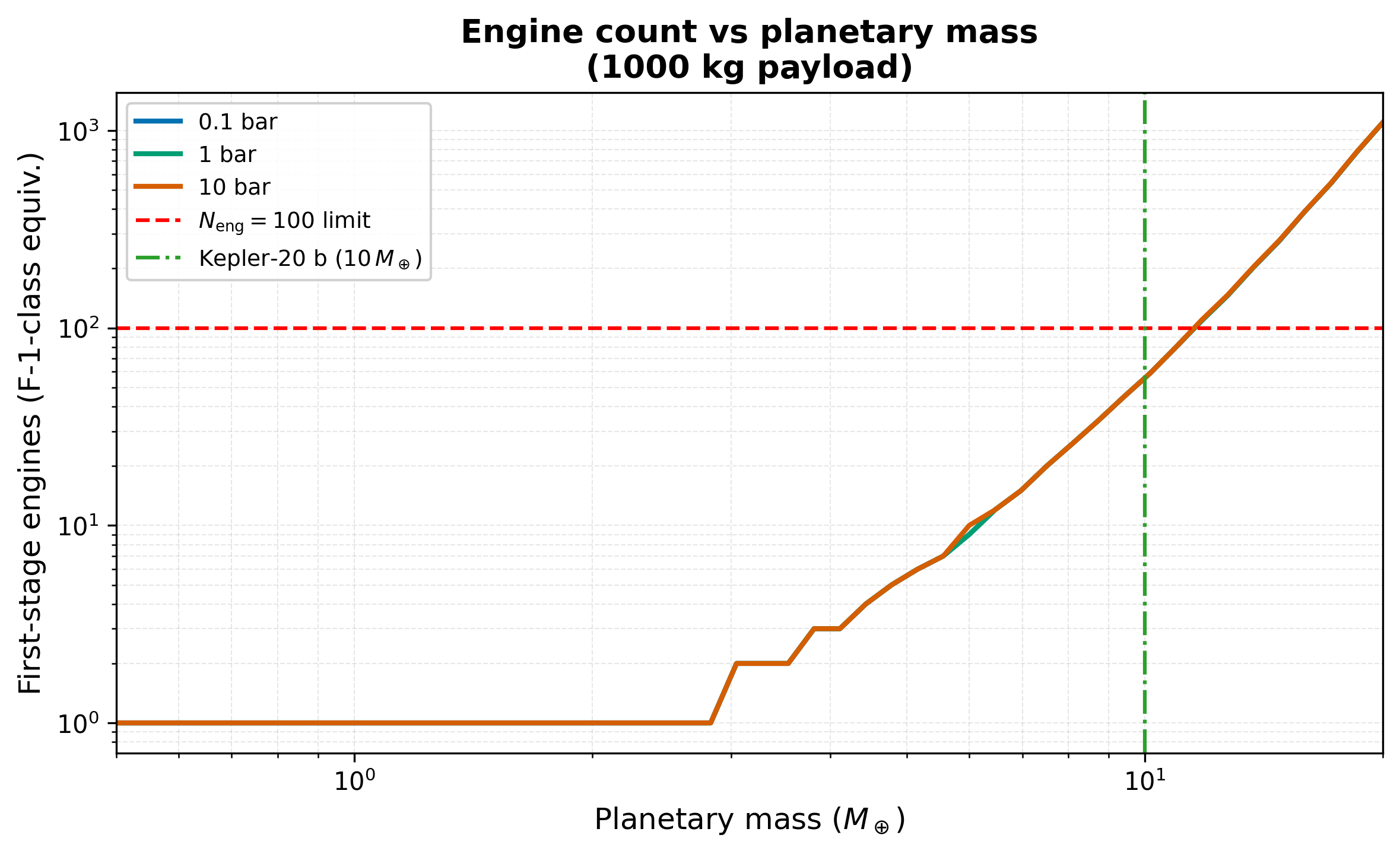
Figure 4: First-stage engine count for a Rm3 escape payload versus planetary mass, with the adopted 100-engine limit crossed near Rm4.
The model’s strong, quantitative finding is that the 100-engine practical ceiling is reached at approximately Rm5 for Earth-like planets, independent of atmospheric pressure. This independently corroborates and sharpens previous order-of-magnitude estimates using single-stage fuel ratio arguments.
Broader Implications and Theoretical Significance
By explicitly enumerating engine requirements and linking them to reliability-optimal multistage architectures, the analysis provides a physically-motivated criterion for delineating which rocky exoplanets are likely to permit chemical-rocket escape for technological civilizations.
Key implications include:
- Gravity as Dominant Constraint: Gravity—and thus planetary mass/radius—sets the decisive boundary for spacefaring capability via chemical propulsion. Atmospheric drag is a design driver only for sub-Earth-mass planets.
- Engineering Clustering as Hard Ceiling: Engine clustering, not fundamental energetics, sets the upper bound for classic chemical rocketry. In practice, the clustering threshold is crossed before "Cheops pyramid" total launch mass limits become active.
- Marginal Role of Geophysics: The parameter space explored indicates that, for Earth-analog compositions, plate tectonics and magnetic dynamos remain plausible up to and slightly beyond the escape ceiling, but details of geodynamic longevity are unresolved in mass-only models.
- No Feasible Chemical Escape for Higher-Mass Super-Earths: For Rm6, the requirements for clustered engines and gross vehicle mass render chemical rocket escape of Voyager-class payloads infeasible under current engineering paradigms.
Prospects for Future Research
The model provides a template for evaluating non-chemical propulsion architectures, e.g., nuclear thermal, electric, or non-rocket launch systems. Refining geophysical models to account for the time evolution of tectonic and dynamo processes, incorporating compositional variation, or considering advanced propulsion physics could sharpen or shift the derived envelope. Systematic assessment across exoplanet catalogs—folding in planetary mass, radius, and atmospheric metrics—can inform searches for technosignatures by flagging those worlds most likely to host spacefaring civilizations.
Conclusion
This work establishes a quantitatively explicit, physically grounded metric for "spacefaring habitability" in rocky exoplanet systems. The results show that, for chemical rocket architectures approaching the practical engineering limits of present-day hardware, only planets with Rm7 permit Voyager-class escape payloads. This spacefaring envelope is set principally by surface gravity and engineering clustering, not atmosphere or geophysics within the explored regimes. These constraints provide clear, falsifiable criteria for evaluating the plausibility of interplanetary capability as a function of planetary properties, with important implications for comparative exoplanetology and technosignature science.