- The paper integrates in situ Mars observations with exoplanet surveys to elucidate volatile loss and climate stabilization processes in sub-Earth planets.
- It employs a comparative planetology framework that benchmarks Mars’ geological and atmospheric evolution to infer habitability criteria.
- The study quantifies detection limits, highlighting challenges in using transit, radial velocity, and imaging methods to reveal Mars analogs.
Mars as an Exoplanet: Planetary-Scale Insights from the Edge of Habitability
Comparative Planetology Framework
The paper "Mars as an Exoplanet: Lessons from a Planet at the Edge of Habitability" (2605.18949) integrates Mars into comparative planetology to derive transferable diagnostics for characterizing sub-Earth, rocky exoplanets. Mars' evolutionary pathway—from early geologic activity and a volatile-rich environment, to its current desiccated, low-atmosphere state—provides a data-rich benchmark for understanding processes such as atmospheric escape, volatile cycling without plate tectonics, CO2 condensation, photochemistry, obliquity dynamics, and magnetospheric evolution. The synthesis of in situ Mars data and exoplanet observational surveys enables a rigorous assessment of how planetary mass, size, and architecture influence long-term habitability, volatile inventory, and climate stability.
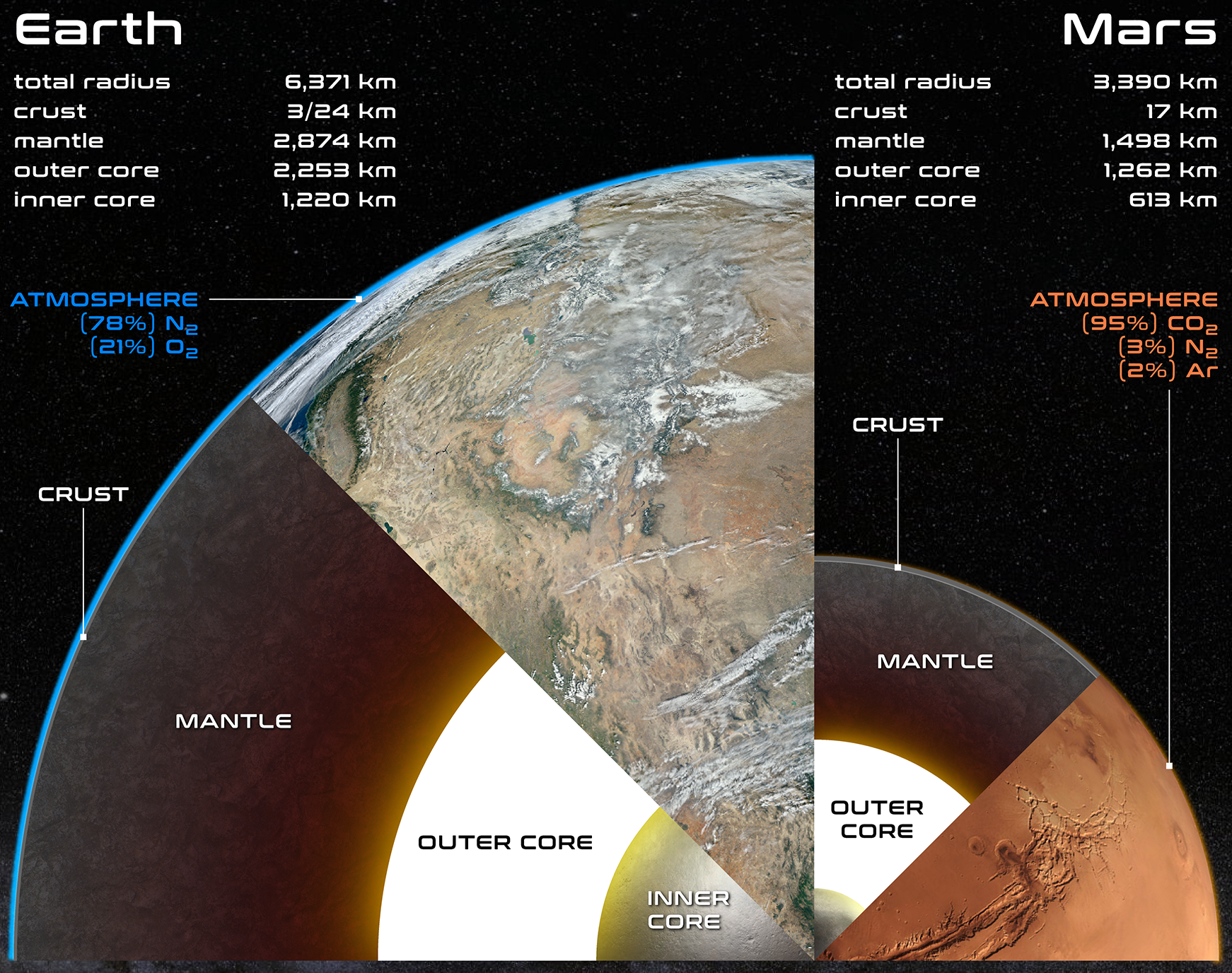
Figure 1: Schematic cross sections of Earth and Mars, highlighting major internal and atmospheric components at matched scales.
Mars Properties in Context
Mars serves as a canonical example of sub-Earth terrestrial planets. Key planetary parameters such as mass (0.107 M⊕), radius (0.53 R⊕), surface gravity (0.38 g⊕), and insolation flux (0.44 F⊕) are directly scalable to low-mass exoplanet analogs. Unlike Earth, Mars lacks plate tectonics and a persistent global magnetic field, which impacts atmospheric retention and escape rates. Geological and paleomagnetic records, along with isotopic measurements (e.g., D/H, 40Ar/36Ar), indicate a rapid early atmospheric loss and the cessation of dynamo activity concurrent with periods of surface habitability. Mars' chaotic obliquity evolution, with excursions from 0∘ to >60∘ on 105–M⊕0 yr timescales, generates order-of-magnitude climate forcing, absent in Earth-moon stabilized systems.
Demographics of Mars Analogs
The occurrence rate and physical characterization of sub-Earth exoplanets remain severely limited by survey selection biases and detection thresholds. Transit and RV surveys preferentially populate high-irradiation, period-short regimes due to geometric and SNR constraints, resulting in underrepresentation of Mars-mass analogs. The manuscript presents mass-radius data for known exoplanets, identifying only 11 confirmed sub-Earth (M⊕1, M⊕2) planets—principally concentrated in tightly-packed, resonant M-dwarf systems.
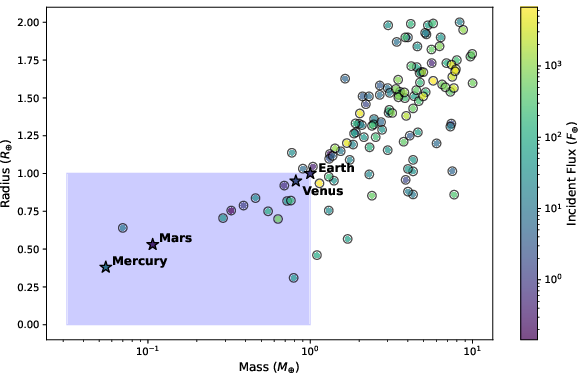
Figure 2: Empirical mass-radius mapping for confirmed exoplanets revealing the scarcity of sub-Earth detections; Solar System terrestrials are overlaid.
Detection and Characterization Limits
Mars analog detection is technically challenging. Transits around late M-dwarfs can achieve photometric depths of M⊕3 ppm, but only at high incident flux and short periods. RV amplitudes for Mars-mass planets at Mars-equivalent flux are as low as M⊕4 mm/s for Sun-like stars, requiring instrumental precisions substantially beyond current EPRV capability. The most feasible RV targets require short-period, low-mass hosts.
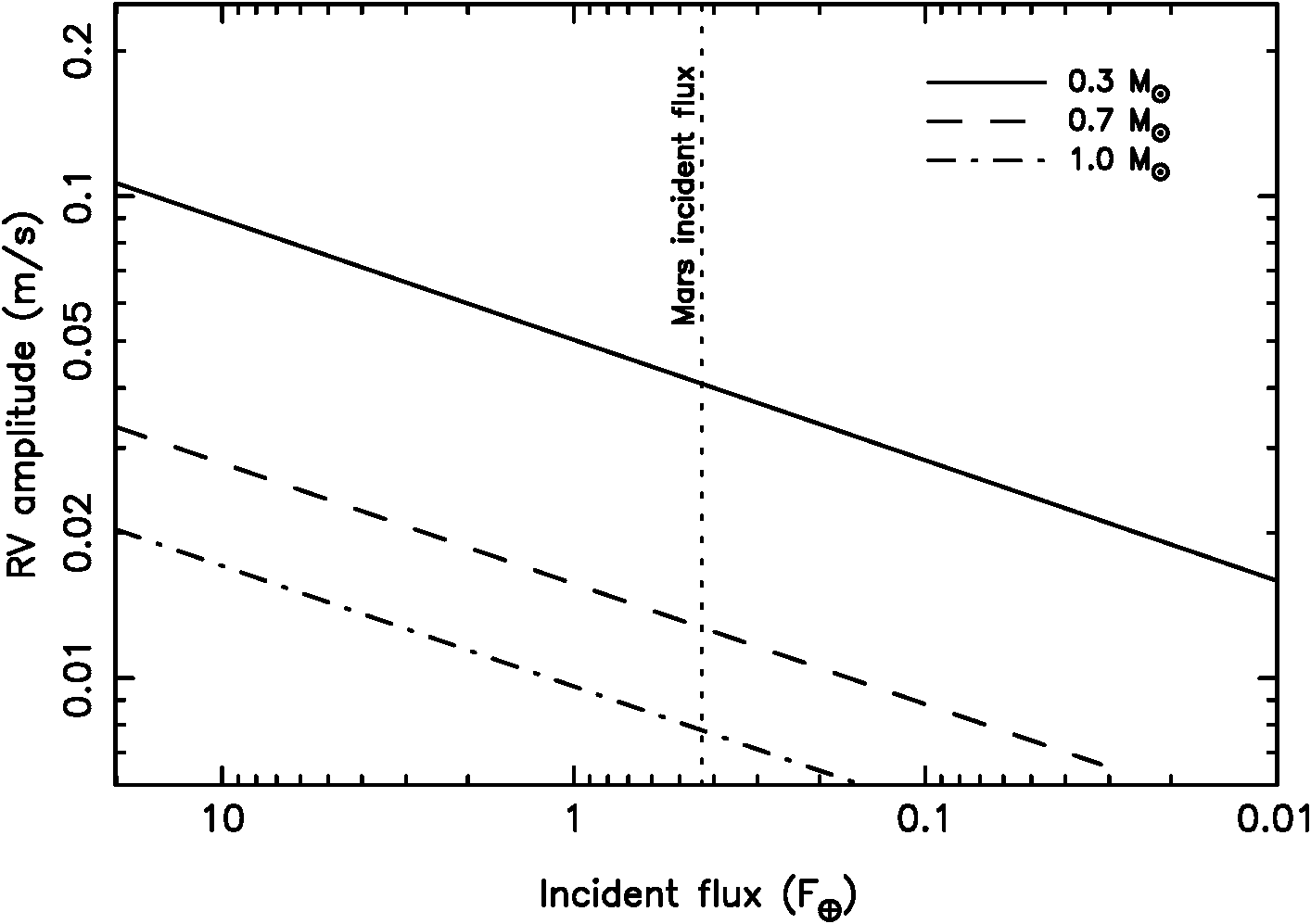
Figure 3: Predicted RV amplitudes for Mars-mass exoplanets as a function of incident flux across stellar types; detection is only plausible for close-in M-dwarf archetypes.
Astrometric and microlensing techniques are limited: the Gaia astrometry noise floor exceeds the expected amplitude by more than two orders of magnitude, and ground-based microlensing remains limited by cadence and blending constraints. The Roman Space Telescope's Galactic Bulge Time-Domain Survey is forecast to reach sensitivity to Mars-mass planets in statistically meaningful numbers, offering future constraints on cold, low-mass exoplanet demographics.
Direct imaging, even at extreme AO and coronagraphic contrast, cannot currently detect Mars analogs due to a reflected light flux ratio (M⊕5) several orders fainter than present instrument floors. Prospects improve marginally for next-generation space-based observatories capable of post-processing to contrasts approaching M⊕6.
Atmospheric and Surface Diagnostics
Atmospheric retrievals for Mars analogs are constrained by tenuous COM⊕7-dominated atmospheres (current Mars: 96.9% COM⊕8, M⊕9 mbar surface pressure), with photochemical cycles buffering CO/O recombination and regulating oxidant budgets. The transmission spectrum simulation demonstrates strong, multi-scale-height COR⊕0 absorption at 2.7 and 4.3 R⊕1m, but transit depth variations remain below R⊕2 for Sun-like hosts, challenging JWST-level direct detection.
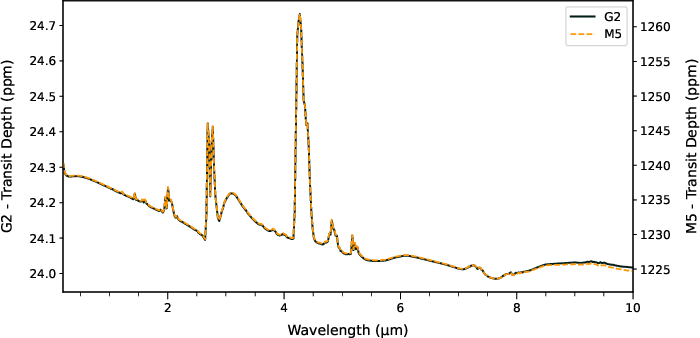
Figure 4: Simulated transmission spectra for Mars analogs around G2 and M5 dwarfs; COR⊕3 bands dominate but are only marginally detectable in transit.
Reflectance spectra, modeled for LUVOIR-class direct imaging at phase angles 0°, 90°, and 135°, encode atmospheric and surface mineralogical features across host spectral types. Phase angle dependence modulates molecular absorption band contrast and overall brightness, permitting compositional retrievals under ideal conditions.
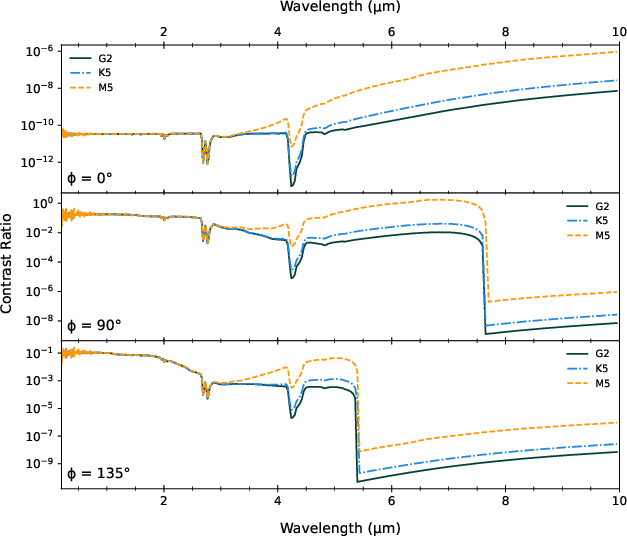
Figure 5: Reflectance spectra illustrating atmospheric and mineral band retrievals as a function of stellar type and planetary phase angle.
Habitability Constraints
The planetary heat budget, degassing history, and atmospheric retention mechanisms critically govern the habitability of Mars-mass exoplanets. Small planets exhibit accelerated cooling and rapid decline in mantle volcanism, limiting long-term outgassing and atmospheric replenishment. Atmospheric escape, driven by early high XUV flux and non-thermal mechanisms (ion pickup, sputtering, photochemical O escape), culls volatiles in R⊕4–R⊕5 yr, especially around active M-dwarfs. Thin COR⊕6 atmospheres are unstable to collapse in cold traps on tidally locked planets unless heat transport and pressure thresholds are exceeded.
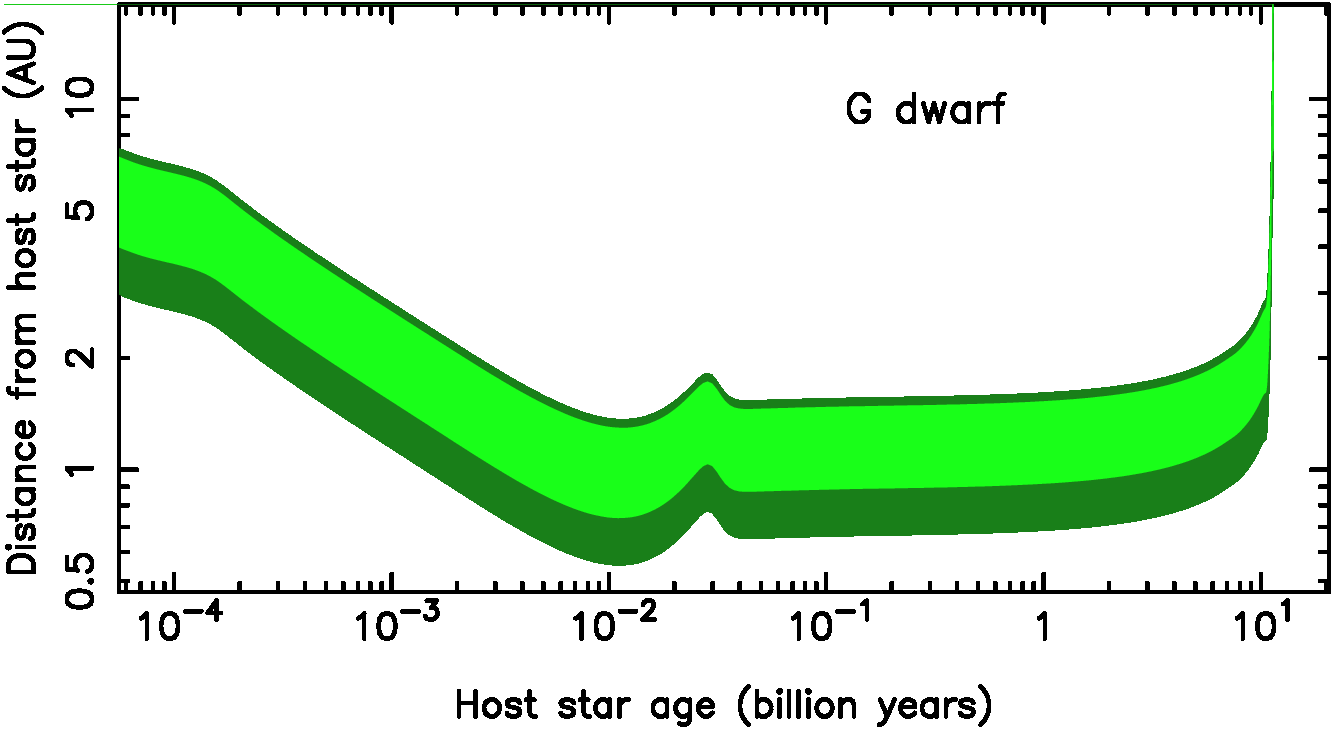
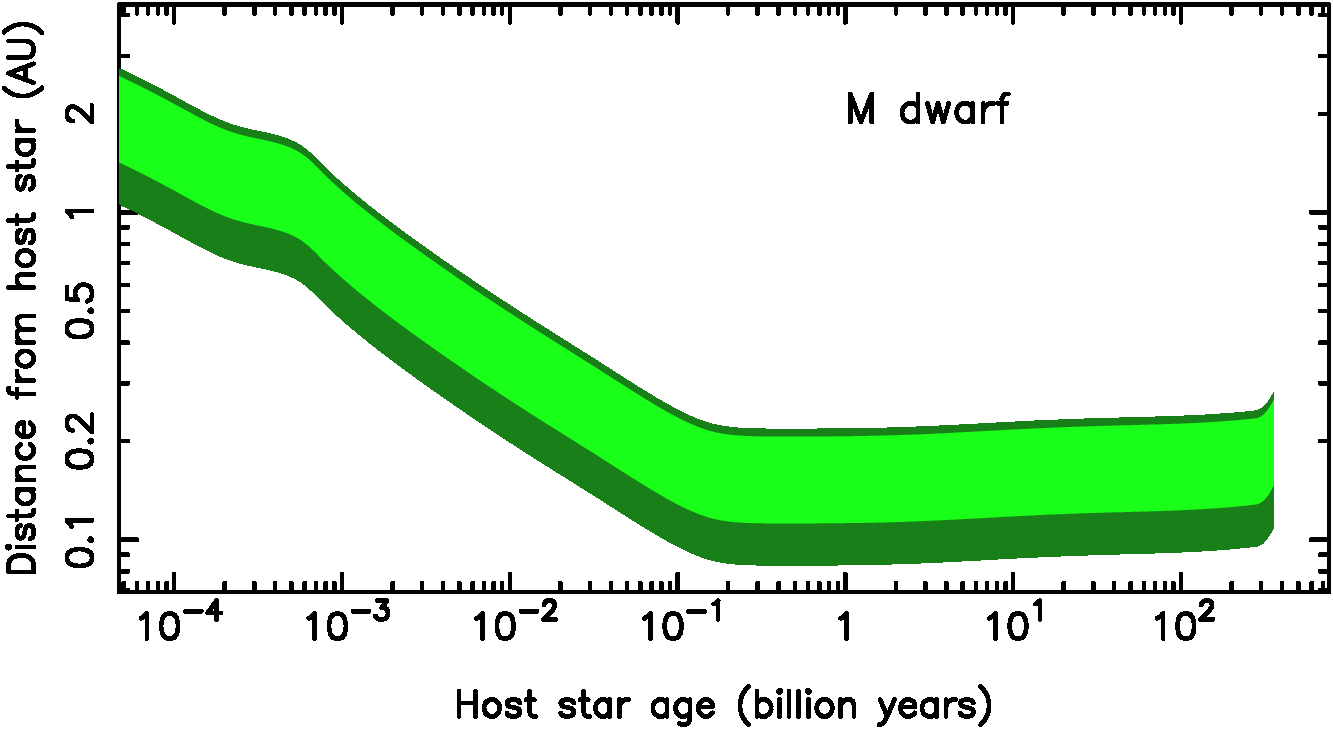
Figure 6: Main-sequence HZ evolution for G and M dwarfs, with CHZ and OHZ bounds for R⊕7 planets; pre-main-sequence timescales are markedly extended for M dwarfs.
Implications for Exoplanetary Interpretation
Mars exemplifies empirical constraints on atmospheric survival, escape-driven desiccation, and the potential for abiotic OR⊕8/OR⊕9 accumulation. Isotopic fractionation and climate feedbacks inform GCM development and retrieval expectations for rocky exoplanets. The observed temporal progression from Noachian habitability, hydrologically active environments, to Amazonian aridity underscores the non-static nature of habitability in sub-Earth mass regimes. The avalanching loss of intrinsic magnetism and plate tectonic inactivity provide cautionary boundary conditions for interpreting biosignature retention and climate stabilization in exoplanetary contexts.
Practical prioritization in Mars exploration directly links to exoplanet characterization goals: isotopic analyses, atmospheric mapping, geomorphological surveys, and cloud microphysics all augment remote sensing interpretation frameworks for terrestrial exoplanets. Mars sample return and continued orbital/in situ measurement programs offer calibration pathways for future exoMars analog atmospheric retrievals.
Conclusion
Mars functions as an indispensable analog for interpreting the physical evolution of small, rocky exoplanets. The integrative modeling and observational data from Mars constrain volatile delivery, loss mechanisms, photochemical cycles, and habitability windows for sub-Earth planets. Key numerical results include the scarcity of confirmed Mars-mass exoplanets, RV sensitivities orders below current capability, and atmospheric transmission/reflection signals at or beneath JWST detection thresholds. Theoretical implications extend to the dynamic range of habitability, mass thresholds for geologic activity, and atmospheric collapse scenarios tied to planetary size and stellar environment. The convergence of Solar System planetary science and exoplanetary exploration is essential for quantifying the diversity, frequency, and longevity of habitable worlds at the edge of atmospheric survival.
Figure 1: Schematic cross sections of Earth and Mars, highlighting major internal and atmospheric components at matched scales.
Figure 2: Empirical mass-radius mapping for confirmed exoplanets revealing the scarcity of sub-Earth detections; Solar System terrestrials are overlaid.
Figure 3: Predicted RV amplitudes for Mars-mass exoplanets as a function of incident flux across stellar types; detection is only plausible for close-in M-dwarf archetypes.
Figure 4: Simulated transmission spectra for Mars analogs around G2 and M5 dwarfs; COg⊕0 bands dominate but are only marginally detectable in transit.
Figure 5: Reflectance spectra illustrating atmospheric and mineral band retrievals as a function of stellar type and planetary phase angle.
Figure 6: Main-sequence HZ evolution for G and M dwarfs, with CHZ and OHZ bounds for g⊕1 planets; pre-main-sequence timescales are markedly extended for M dwarfs.