- The paper introduces Align4D, a modular framework that aligns video and 3D diffusion outputs for coherent X-to-4D generation.
- It employs object distance alignment, motion-geometry joint alignment, and asynchronous optimization to ensure spatial and temporal consistency.
- Empirical results using the X4D dataset demonstrate superior performance across metrics like PSNR, SSIM, and FVD compared to prior methods.
Alignment Is All You Need For X-to-4D Generation: A Technical Analysis
Introduction and Motivation
The paper "Alignment Is All You Need For X-to-4D Generation" (2607.02516) addresses key limitations in arbitrary-modality-to-4D (X-to-4D) content synthesis. While diffusion models have made substantial progress in generating images, videos, and static 3D structures, converting diverse user-specified input modalities (text, image, video, 3D) into coherent, temporally dynamic, and geometrically precise 4D objects remains unsolved. Existing approaches either fixate on a single modality or require labor-intensive dataset construction, and struggle to balance geometric consistency and temporal dynamics. This work introduces Align4D, a generalized modular framework that bypasses the need for end-to-end monolithic models, leveraging pre-trained video and 3D diffusion backbones to condition and align the 4D synthesis process.
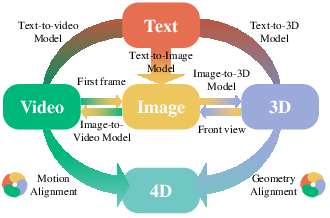
Figure 1: Align4D transforms an arbitrary input into a coherent Video-3D pair by sequentially leveraging multiple off-the-shelf models. Within this X-to-4D generation framework, Align4D focuses on rigorously aligning the 4D object's temporal motion with the video prior and its spatial geometry with the 3D representation, thereby achieving powerful synthesis capabilities.
Framework Overview and Architecture
Align4D dissects the 4D generation process into two orthogonal aspects: geometry (spatial structure) and motion (temporal dynamics). Given any input (text, image, video, 3D), off-the-shelf pretrained diffusion models are independently used to generate a video and a static 3D object. These become synchronized references for aligning the 4D asset in space and time.
The core challenge is reconciling the disparate spatial and temporal priors encoded in separately trained video and 3D models. Align4D introduces three novel alignment mechanisms to resolve this:
- Object Distance Alignment (ODA): Automatic search for the Video-Aligned Object Distance (VAOD) and Multiview-Aligned Object Distance (MAOD) to match the configuration of the 4D asset to the scale and perspective of the two sources.
- Motion-Geometry Joint Alignment (MGJA): Synchronized optimization ensures that front-view renderings over time are consistent with video motion, while multiview geometry aligns with the 3D reference in spatial structure.
- Asynchronous Optimization (AO): Decoupled training of the static scene representation (3D Gaussians) and the deformation network that drives temporal dynamics, mitigating optimization instability and improving convergence.
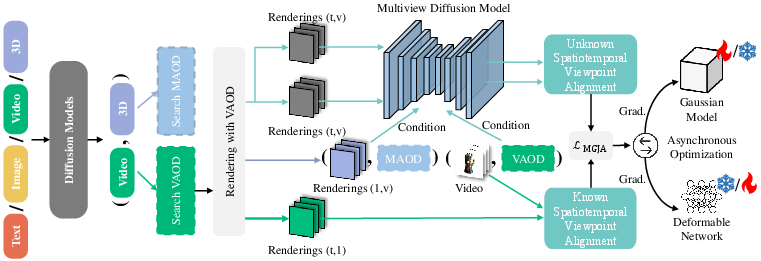
Figure 2: Overview of the Align4D framework. Given arbitrary input modalities, pretrained video and 3D diffusion models are used to construct a unified video–3D pair. Key object distances (VAOD and MAOD) are searched to align the 4D asset with video and multiview priors while ensuring robust joint motion and geometry alignment.
Object Distance Alignment: Theoretical and Practical Foundations
The difficulty in 4D synthesis is in finding spatial correspondences, since the video and 3D generative paths are typically scale-agnostic and rely on independent priors. Align4D formalizes object distance alignment via pinhole camera geometry and empirical search procedures:
- VAOD: The front-view renderings of the 4D object are rendered at varying distances and compared to the reference video frame using MSE; the distance yielding the minimum error is selected.
- MAOD: Orthogonal multiview renderings are evaluated using Score Distillation Sampling (SDS) loss against the multiview diffusion prior. The local minimum of SDS loss—typically at a smaller distance than VAOD—indicates the diffusion model's preferred geometric scale.
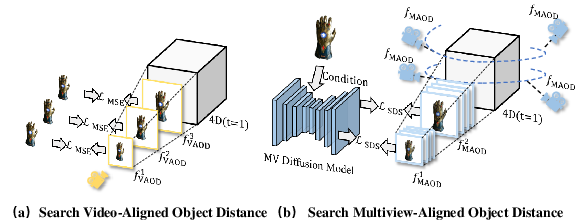
Figure 3: Object distance alignment. (a) VAOD is found by rendering at various distances to minimize LMSE with video frames. (b) MAOD is found by minimizing SDS loss across multiview renders, crucially selected as a local minimum less than VAOD.
The empirical analysis on diffusion timesteps demonstrates that only higher timestep values (e.g., τ≥700) yield consistent and reliable SDS curves for MAOD search, thus reducing erratic minima associated with initial noise or out-of-distribution effects.
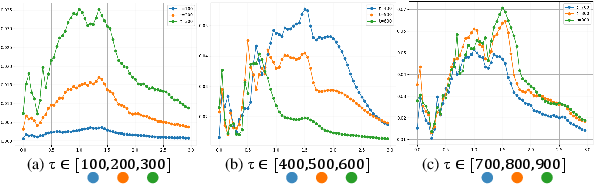
Figure 4: SDS loss versus object distance for different diffusion timesteps τ. Only at large τ values does the local minimum reliably indicate the MAOD suitable for geometric alignment.
Motion-Geometry Joint Alignment and Asynchronous Training
For front-view/known viewpoints, the alignment objective is an MSE over the entire video sequence, ensuring that rendered sequences are temporally coherent and well-matched to the video reference. Incorporation of alpha mask loss further regularizes object boundaries and motion segmentation.
For unknown views, one multiview diffusion model provides both motion and geometry priors. Motion is transferred from front-view videos to arbitrary viewpoints using SDS loss under the VAOD, while geometric fidelity is preserved by enforcing consistency with the 3D object's view-conditioned renderings under MAOD. A temporal weighting balances these losses as the object deviates from its initial configuration.
Asynchronous Optimization (AO) decouples updates to the 3D Gaussian representation and the deformation network, enabling better isolation of structure and motion gradients, and preventing mutual interference which is observed in synchronous setups. Empirically, AO yields faster and more stable loss convergence with lower variance, resulting in more detailed geometric and dynamic output.
X4D Dataset and Benchmarks
The authors introduce the X4D dataset, a large-scale collection of quadruplets (prompt, image, video, 3D) built from generative pipelines and manual curation. This facilitates standardized benchmarking of X-to-4D methods under controlled, multimodal input scenarios. Complementary evaluation uses the Consistent4D dataset, focusing on video-to-4D geometric and motion fidelity.
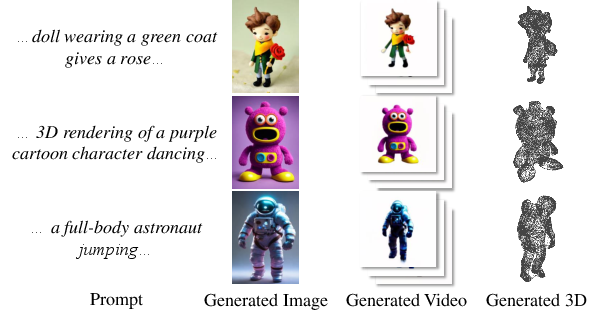
Figure 5: Samples from X4D dataset. Each quadruplet consists of a prompt, a generated image, a generated video, and a generated 3D object, all created by off-the-shelf diffusion models.
Empirical Results and Ablations
Align4D demonstrates robust superiority across standard metrics (PSNR, SSIM, LPIPS, CLIP, FVD) and user studies for appearance, structure, motion, and fidelity. It outperforms prior state-of-the-art single-modal and multi-modal approaches in both quantitative and qualitative regimes. Notably, it also achieves high VBench subject/background/aesthetic/imaging scores, indicating balanced overall quality.
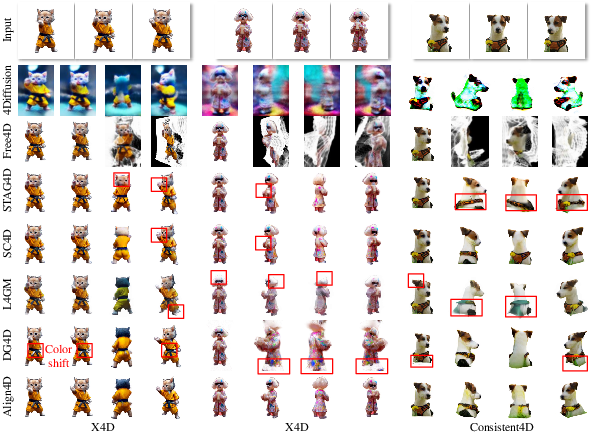
Figure 6: Qualitative comparisons between Align4D and other methods on X4D and Consistent4D datasets, showing superior geometric and temporal consistency.
Ablation studies validate the contribution of each module:
- No ODA: Leads to scale mismatches and blurred boundaries.
- No MGJA: Results in pronounced view-dependent geometric errors.
- No AO: Causes insufficient detail refinement and unstable dynamics.
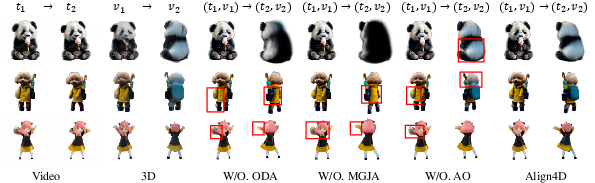
Figure 7: Qualitative ablations highlight that ODA is essential for action and geometry injection, MGJA for multiview-temporal alignment, and AO for detail refinement in 4D generation.
Strong numerical results are reported, with Align4D achieving, for example, SSIM = 0.90 and FVD = 1088.9 on Consistent4D—best among all compared methods. Computational efficiency is also competitive, with ODA search overhead being negligible compared to overall 4D synthesis runtime.
Broader Evaluation: Model, Modality, and Diffusion Compatibility
Align4D's compatibility is verified across various multiview diffusion backbones (e.g., Zero123, ImageDream), as well as with diverse video and 3D content generators (e.g., Kling, MeshyAI, Tripo3D), maintaining consistent output quality. Masks further enhance boundary fidelity, while seed variation produces substantial stylistic diversity with stable semantic control.
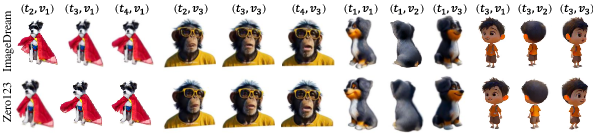
Figure 8: Align4D with different multiview diffusion models confirms framework stability and geometric-temporal consistency in outputs.
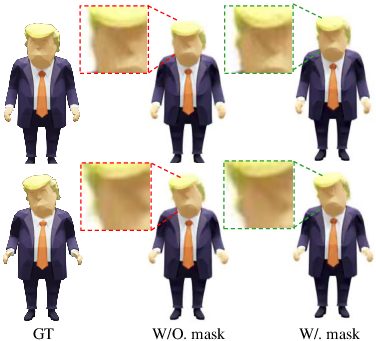
Figure 9: Effect of masks on 4D generation; use of masks enhances fine edge detail in generated outputs.
Failure analysis reveals limitations primarily inherited from deficiencies in upstream diffusion models, e.g., handling of transparent or complex lighting (rapidly flickering neon effects).
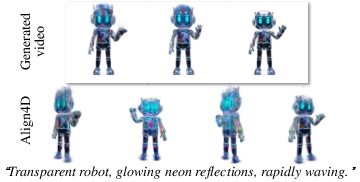
Figure 10: Failure case—limited fine detail for objects with transparent or challenging material properties.
Implications and Future Directions
Practically, Align4D represents a scalable, modular approach to universal 4D synthesis directly conditioned on arbitrary modalities. The object distance alignment paradigm addresses a fundamental challenge in compositional generation under conflicting priors. This enables the construction of flexible, plug-and-play generative pipelines using ensemble pretrained models, accelerating progress toward dynamic content synthesis for AR/VR, digital content creation, and simulation.
Theoretically, the decoupling of motion and geometry and the explicit reconciliation of generative perspectives (video, 3D) reflect a principled direction for multi-prior, multi-modal generative modeling. SDS-based object distance search provides a generalizable mechanism for registerational alignment in the absence of physical scale ground-truth.
The research foreshadows future advances in joint optimization of multi-modal content, including: (1) generalization to open-set generative combinations, (2) improved geometric priors for complex material/lighting, (3) tighter integration with unified, cross-modality trained diffusion architectures, and (4) extension to higher-dimensional scene synthesis.
Conclusion
Align4D establishes a new paradigm for X-to-4D generation by modularly aligning video and 3D priors through robust distance search and joint optimization strategies. Empirical evidence across metrics, datasets, and qualitative scenarios demonstrates clear advantages in appearance, structure, motion, and fidelity over prevailing approaches. The open X4D dataset further provides a foundation for systematic evaluation of future multi-modal, multi-prior 4D generative models. Align4D's architectural flexibility, strong numerical results, and evidence of model generality position it as a reference baseline and toolkit for scalable, high-quality 4D generation.
(2607.02516)