- The paper finds that LLM persona conditioning produces significant personality-color associations for abstract concepts, especially in GPT-4.1-mini.
- The chart idiom experiment shows that task context primarily drives visualization choices, with little effect from persona prompts.
- The study emphasizes the need for robust baselines and multi-model evaluations to correctly interpret synthetic persona signals in design.
When Do LLM Personas Support Visualization Design? A Cross-Model Study of Color Assignment and Chart Choice
Introduction
The use of LLMs "personas"—prompt-based conditioning on Big Five personality profiles—to simulate diverse users is becoming prevalent in visualization design processes. This study interrogates the methodological reliability and interpretive risks of such practice, focusing on whether persona-conditioned outputs reflect true personality-linked preferences or are heavily contingent on model selection and task semantics. Two central tasks are addressed: (1) color assignment to abstract and concrete concepts, and (2) chart idiom preference rankings across different contexts, operationalized with three LLMs (GPT-4o-mini, GPT-4.1-mini, GPT-5-mini) and 43 Big Five profiles.
Experiment 1: Color Assignment and Personality–Color Coupling
The first experiment probes the relationship between persona conditioning and generated color distributions for six concepts—three concrete (Banana, Strawberry, Carrot) and three abstract (Serendipity, Serenity, Chaos)—across three GPT-based LLM variants. Colors sampled per concept-persona-model triplet were analyzed using CIELCH hue histograms, and systematic differences between persona outputs were tested using average Hellinger distance and Mantel permutation tests.
Trait-driven color variation is strongly dependent on model configuration. GPT-4.1-mini exhibits robust personality–color coupling for all concepts (Mantel r=0.12–0.21, p≤0.006), whereas GPT-4o-mini shows no significant effect, and GPT-5-mini displays partial coupling for only two of six concepts. Importantly, persona-induced variance is substantially higher for abstract concepts, where personality explains more hue variance than the model identity itself. For concrete concepts, by contrast, both persona and model effects are diluted by the dominance of default color associations.
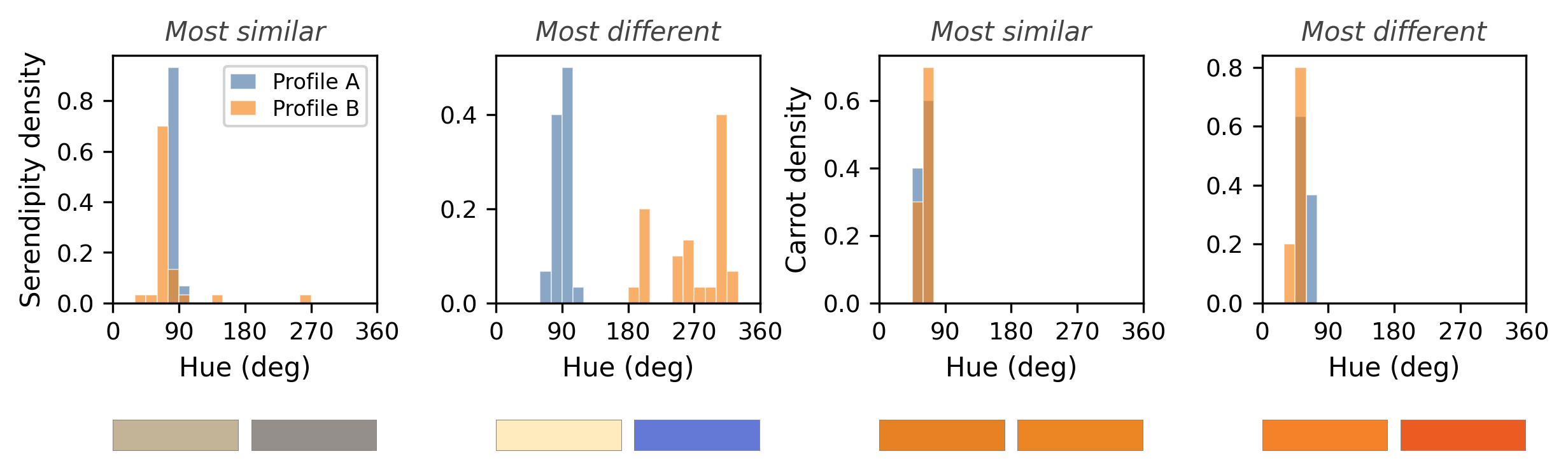
Figure 1: GPT-4.1-mini hue distributions for the most-similar (top) and most-different (bottom) persona pairs on Serendipity (abstract) and Carrot (concrete), illustrating effect magnitude.
This model-dependence challenges any assumption that persona prompts are a stable mechanism for eliciting personality-driven color preferences. Instead, the presence or absence of coupling is as much a property of the model and sampling protocol as of the underlying persona conditioning. The overall between-profile structure disappears in GPT-4o-mini and fluctuates with sampling methodology in GPT-5-mini.
Variance decomposition with two-way ANOVA (model × persona) confirms these results: for abstract concepts, persona accounts for substantially more hue variance (ηpersona2=0.038) than model (ηmodel2=0.008); for concretes, both are marginal (ηpersona2=0.020, ηmodel2=0.015). Residual variance dominates overall.
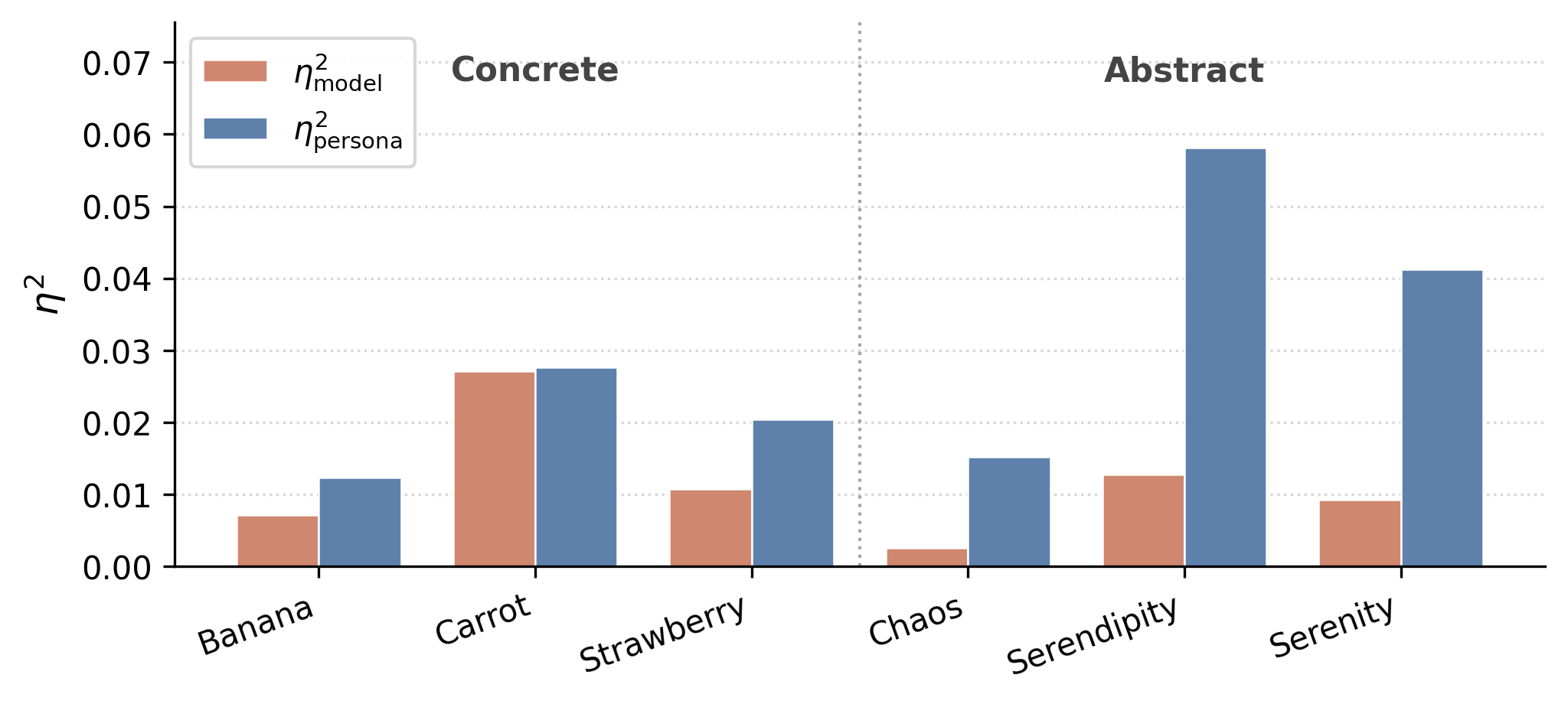
Figure 2: Variance decomposition of hue (HLCH) showing relative contributions of persona and model across abstract and concrete concepts.
Experiment 2: Chart Idiom Preferences and Aggregated Persona Effects
The second experiment investigates whether persona conditioning shifts chart idiom ranking in visualization context selection tasks. Adapting Alves et al.'s chart preference paradigm, 60 persona-conditioned runs rate 12 chart idioms across three task contexts (hierarchy, time series, comparison). Trait-aligned clustering (based on Big Five prototypes) aggregates profiles into three clusters, and preference rankings use multiple voting/counting mechanisms (Majority Vote, IRV, Apriori Support, Borda Count).
Cluster-level aggregation stabilizes idiom rankings for most context-cluster combinations. For all models and all clusters, the preferred idiom for each context is nearly unanimous: Treemap for hierarchy, Line Chart with Points for time series, and Radar Chart for comparison. Ranking stability is exceptionally high for hierarchy and time series (bootstrap stability >97%), with moderate instability in the comparison context for the Emotionally Reactive cluster.
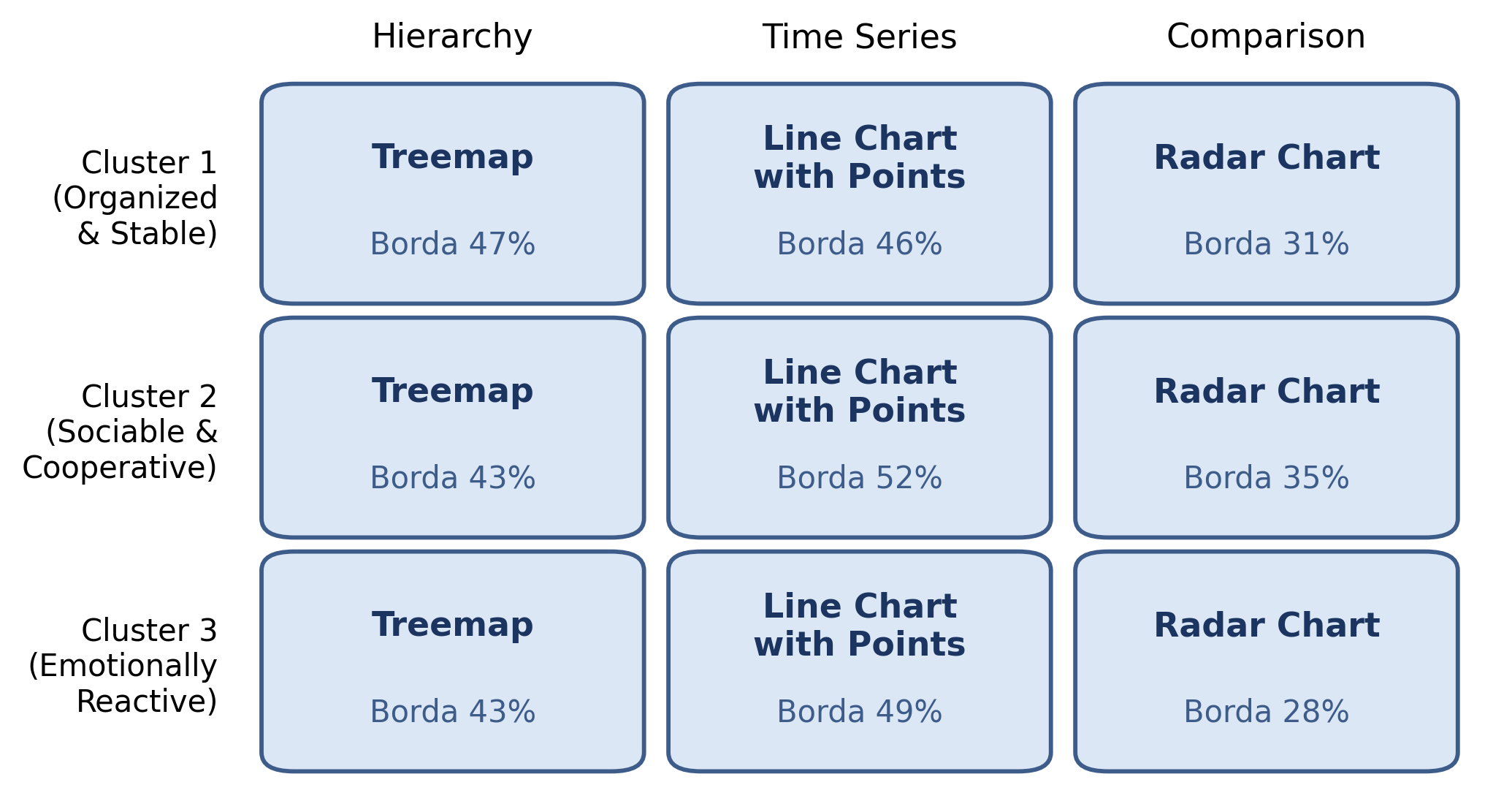
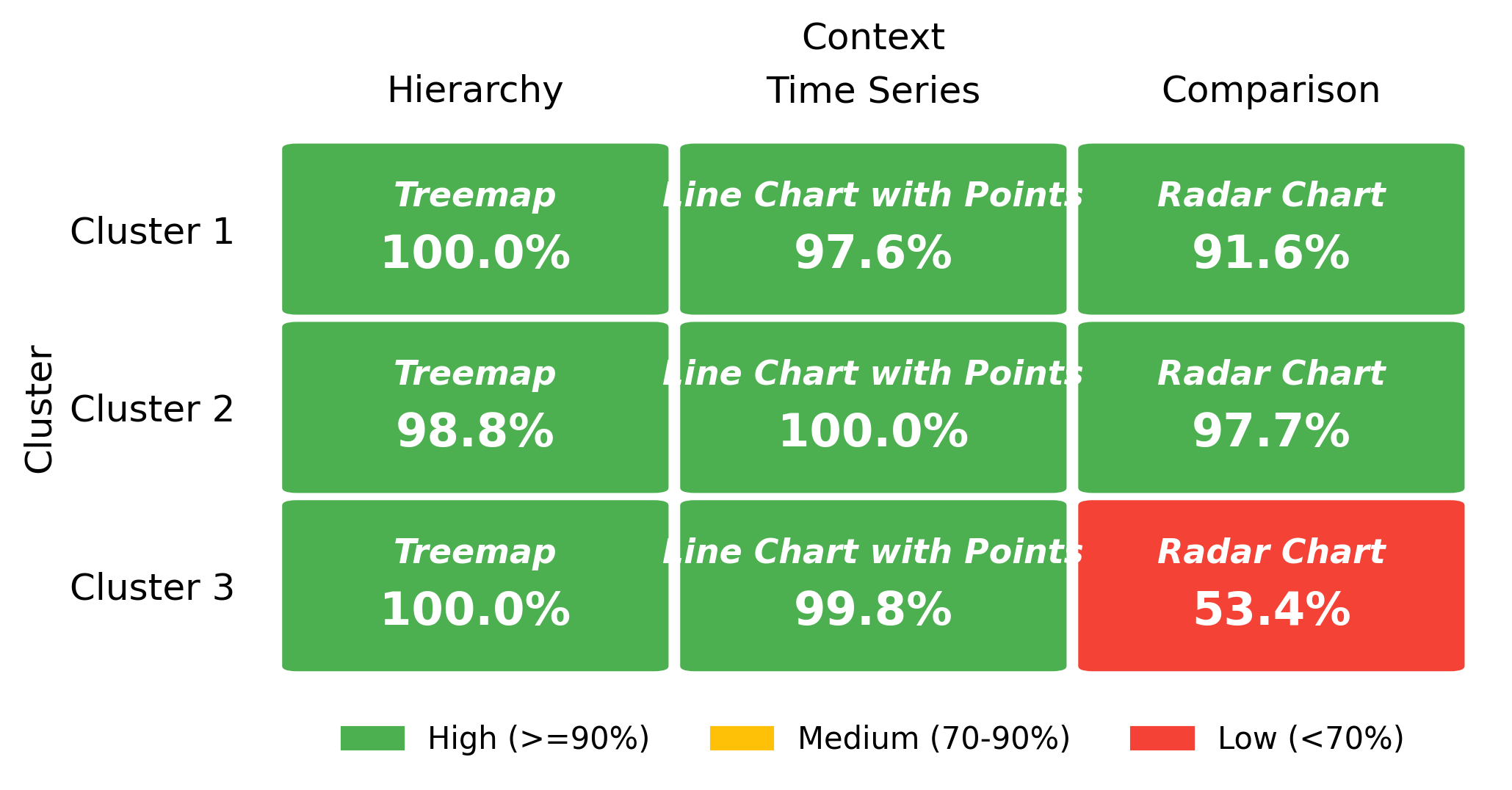
Figure 3: Cluster-based idiom preferences on GPT-4.1-mini, showing (a) Borda rank-1 idiom and within-context share, and (b) bootstrap stability per cluster and context.
However, a no-persona baseline recovers the same top idiom in 8 of 9 (model, context) cells, indicating that the observed rank-1 agreement is primarily driven by task context rather than persona-specific factors. Rating-level modulation—e.g., lower average ratings for the Emotionally Reactive cluster (difference of ~−0.93 on a 7-point scale, pHolm<0.0001)—does not translate into changes in top-idiom selection.
Cross-Model Agreement
Cluster-level idiom preference rankings exhibit substantial cross-model agreement at the top-choice level but more divergence in full ranking order. Unanimous top-idiom selection for all nine cluster-context pairs is observed across all three models. Pairwise Kendall's τ averaging over full 12-idiom rankings is highest for GPT-4o-mini vs. GPT-4.1-mini (p≤0.0060) and lowest for GPT-4.1-mini vs. GPT-5-mini (p≤0.0061).
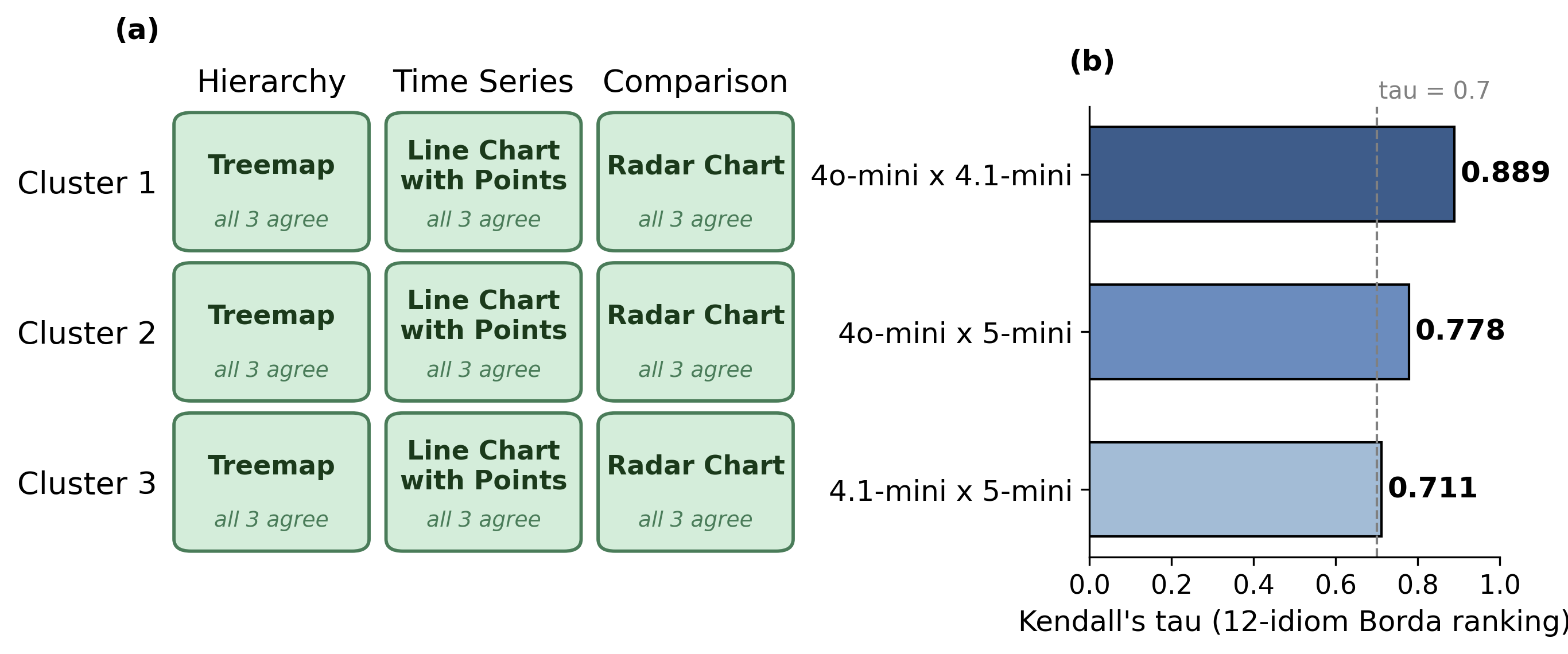
Figure 4: Cross-model agreement on chart preference: (a) Unanimous top idiom across models and clusters. (b) Pairwise Kendall’s p≤0.0062 between complete Borda rankings.
Implications and Future Directions
The findings have several ramifications for the methodological use of LLM personas in visualization research:
- Model Configuration Criticality: Personality-based effects in LLM-driven color and chart-choice tasks are not intrinsic to the prompting method, but depend critically on LLM variant and sampling protocol. Model- or provider-specific artifacts can easily overwhelm or obscure any genuine effect, stressing the necessity for multi-configuration evaluation.
- Task and Concept Dependency: Persona effects are maximized for semantically open (abstract) concepts and are essentially neutralized for stereotypically colored objects. Aggregation at the trait-cluster level reduces variance and amplifies stability, but still mostly reflects context- or task-driven defaults.
- No-Persona Baselines as Essential Controls: Without no-persona baselines, apparent shifts in preference induced by personas may be indistinguishable from context-driven or model-default outcomes. The use of such baselines is mandatory for interpreting any observed differences as personality-linked signals.
- Limitations of Synthetic Participants: LLM personas, under current methodologies and prompt protocols, do not function as direct substitutes for human subjects. While they can expose structured variation, these are exploratory signals requiring further human-in-the-loop validation and calibration before being used for user modeling or design personalization at scale.
Further work should address larger and more heterogeneous concept sets, calibrate against matched human data to disentangle model-specific artifacts, explore psychologically grounded trait-distance metrics, and evaluate robust sampling protocols for newer LLM series.
Conclusion
LLM persona conditioning reveals structured variation in both color assignment and chart idiom preference tasks, but this variation is highly contingent on model configuration, concept type, and the analytic granularity. While cluster-level analysis can stabilize relative idiom rankings, top-choice selection in chart recommendations is primarily context dependent rather than reflectively trait-driven. For empirical visualization research, LLM personas are best leveraged as exploratory probes rather than as proxies for real user diversity. Methodological rigor—including multi-configuration evaluation, careful distinction between abstract/concrete tasks, and strong no-persona baselines—remains essential for responsible use and reporting.

