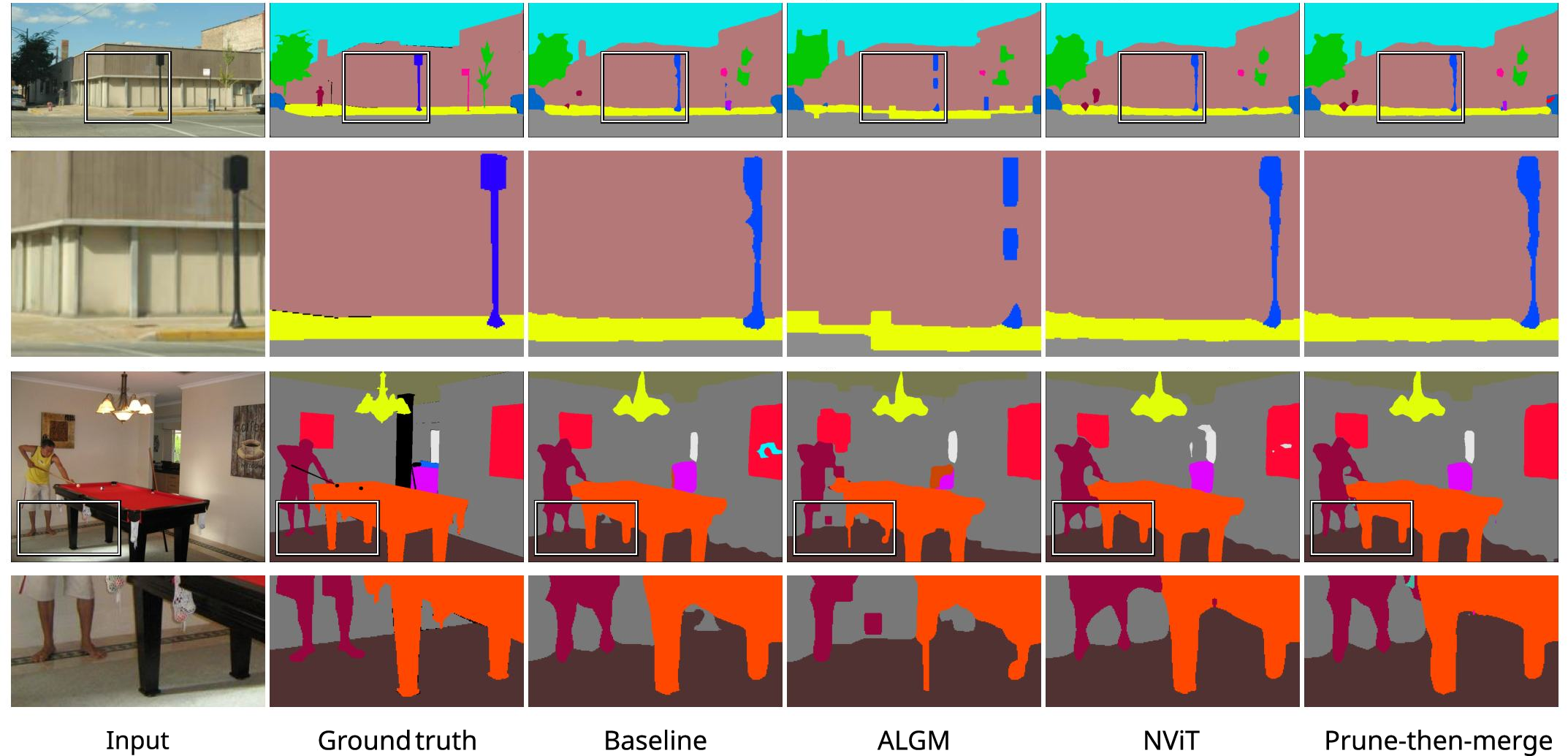
- The paper introduces a unified benchmark comparing token compression and structural pruning for ViT segmentation under aggressive efficiency constraints.
- It demonstrates that mild token compression maintains performance, while aggressive compression sharply degrades mIoU compared to the smoother decline seen with pruning.
- The proposed prune-then-merge pipeline achieves optimal accuracy–robustness trade-offs, offering practical guidelines for deployment-oriented ViT segmentation.
Compression Strategies for Efficient and Robust ViT Semantic Segmentation
Overview
This paper establishes a unified, controlled benchmark to evaluate token compression and structural pruning for Vision Transformer (ViT) semantic segmentation under aggressive efficiency constraints. Segmentation-aware token compression and architectural pruning are compared with matched FLOPs on ADE20K, Cityscapes, and their common corruption variants. Numerical results, effective-rank analysis, and qualitative visualizations reveal that while mild token compression maintains performance, aggressive token removal leads to sharp degradation, particularly in robustness. Structural pruning, by contrast, yields smoother degradation curves. A prune-then-merge (PtM) pipeline combining moderate pruning with token compression achieves superior accuracy–robustness trade-offs at high compression, offering practical guidelines for deployment-oriented ViT segmentation.
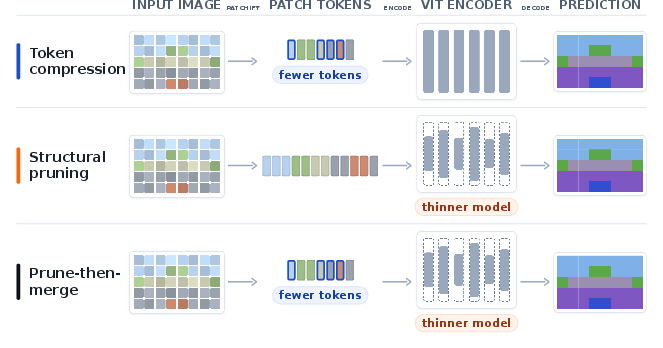
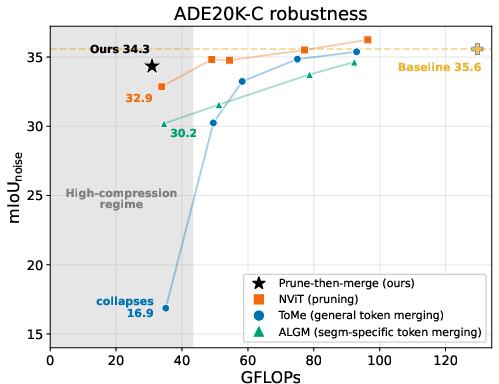
Figure 1: Compression strategies and the robustness-compute trade-off: token compression reduces spatial tokens, structural pruning reduces architectural width, and the prune-then-merge pipeline combines both; right, mIoU-compute robustness on ADE20K-C shows token compression breaking down under severe compression, pruning degrades more gracefully, and PtM dominates at fixed FLOPs.
ViT-based architectures dominate semantic segmentation benchmarks but suffer from extreme computational overhead due to dense token processing and the quadratic complexity of self-attention. Deployment therefore demands aggressive compute reduction via model compression. Two major strategies are:
- Token Compression: Adaptive reduction or merging of tokens, typically by pruning redundant patches or fusing tokens with similar features, e.g., ToMe, CTS, ALGM.
- Structural Pruning: Removal of model components such as heads, channels, or entire layers, yielding permanent model width/capacity reduction, e.g., NViT.
Evaluations previously focused only on low-to-moderate compression, leaving high-compression regime behavior—especially under corrupted inputs—underexplored. Existing work rarely systematically compares these strategies or their combinations within a rigorous, unified protocol.
Unified Benchmark: Protocol and Evaluation
The benchmark utilizes a standardized Segmenter pipeline with DeiT-B as the ViT encoder, optionally pruned or compressed. Compression is exclusively applied to the encoder, ensuring all other settings are held constant across methods. The key comparison axes:
- Token Compression Methods: General-purpose (ToMe), segmentation-aware (CTS, ALGM).
- Structural Pruning: NViT, leveraging global importance criteria.
- Prune-then-Merge (PtM): Token compression atop a moderately pruned NViT.
Performance is evaluated under matched FLOPs across ADE20K and Cityscapes, both on standard and corrupted sets (ADE20K-C/Cityscapes-C). Main metrics are clean mIoUclean and average corrupted mIoUnoise.
Key Findings: Regime-dependent Degradation
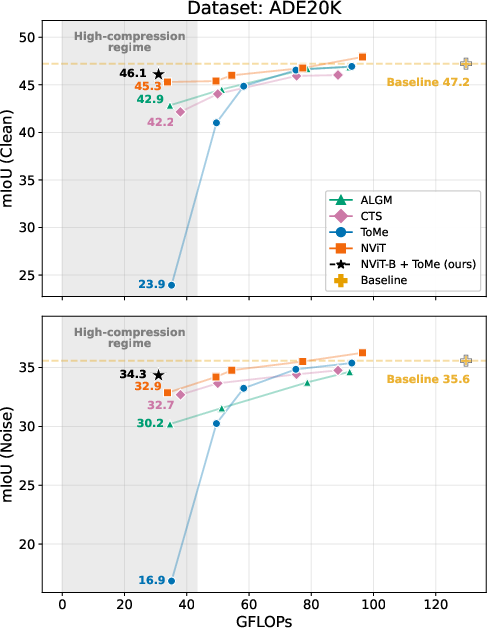
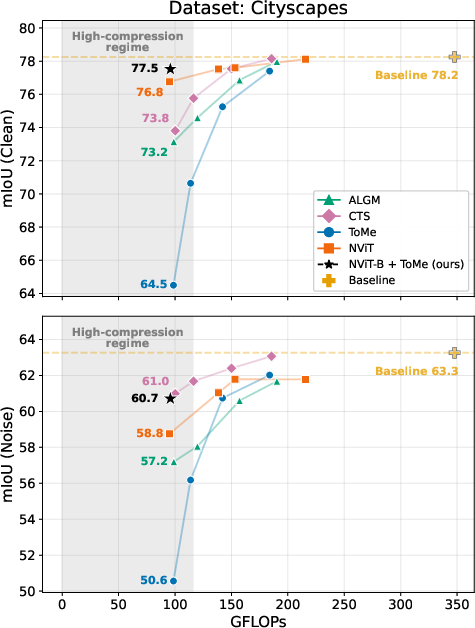
Figure 2: Accuracy-compute trade-offs on ADE20K (left) and Cityscapes (right): mild token compression maintains nearly baseline mIoU, but aggressive token removal results in a sharp performance drop; structural pruning shows steady, more graceful degradation; PtM delivers leading mIoU-robustness at high compression.
Across datasets and corruptions, results are regime-dependent:
- Mild Compression: Segmentation-aware token compression methods (CTS, ALGM) substantially reduce FLOPs (∼1.4–1.9×) with minimal mIoU loss. For instance, CTS/ALGM retain almost all clean and corrupted performance in the mild regime.
- Aggressive Compression: All token compression methods break down, but ToMe (general merging) fails most rapidly, displaying catastrophic mIoU drops (ADE20K → $23.94/16.86$), indicative of severe spatial information loss. Segm.-aware ALGM/CTS degrade less dramatically but still lose significant accuracy and robustness.
- Structural Pruning: NViT achieves consistently smoother degradation, retaining stronger mIoU and robustness under extreme (∼3.8×) compression.
- Prune-then-Merge: PtM dominates at high compression, maintaining higher mIoU and robustness than single-strategy baselines at matched compute.
Failure Analysis: Representation Collapse Under Aggressive Token Compression
The paper probes the failure modes of aggressive token suppression.
Practical Implications and Theoretical Insights
The main implication is that ViT segmentation pipelines contain both architectural and token redundancy, but these axes are not interchangeable—reducing tokens too aggressively destroys semantic integrity, especially when robustness to distributional shift matters. Pruning the model architecture provides a safer, more robust path to high compression.
Combining moderate pruning with moderate token compression—the prune-then-merge strategy—optimally exploits redundancy along both axes, yielding better accuracy and robustness trade-offs at a fixed compute budget.
On the theoretical side, the regime-dependence of robustness implicates information flow preservation and feature diversity as critical qualifiers. Aggressive token compression leads to effective rank collapse, echoing theories of representational capacity and information bottlenecks in deep architectures.
Future Directions
- Cross-Task Extension: The unified benchmark could be adapted to other dense prediction domains such as object detection and panoptic segmentation.
- Hierarchical Transformers: As hierarchical ViTs supplant flat-token architectures for high-resolution tasks, analogous benchmarks assessing multi-stage spatial compression and pruning are needed.
- Compression Co-Design: Algorithmic innovation is needed for joint, perhaps learnable, co-design of pruning and token compression, targeting explicit trade-off objectives of throughput, accuracy, and robustness.
Conclusion
This work establishes that while token compression is effective only up to moderate ratios, overcompression sharply compromises both accuracy and robustness in ViT segmentation. Structural pruning enables stable high-compression performance. The prune-then-merge pipeline leverages the complementarity of both axes, offering a practical and theoretically motivated recipe for deploying robust, efficient segmentation models. The insights motivate principled, co-designed compression approaches and provide a foundation for rigorous analysis of transformer model efficiency and robustness under deployment constraints.
(2607.02237)