- The paper demonstrates that brief, AI-mediated dialogue overcomes engagement aversion and corrects partisan misperceptions.
- Using controlled experiments, the study reveals that stereotype-disconfirming content enhances accurate perception and increases willingness for cross-partisan exchanges.
- Although initial gains in outgroup warmth are significant, effects largely decay within a week, indicating a need for repeated interventions.
Introduction
The erosion of cross-partisan warmth and the rise of affective polarization in the United States constitute persistent barriers to democratic cooperation and social cohesion. While intergroup contact has demonstrated efficacy in prejudice reduction, traditional interventions are limited by low participant willingness and substantial logistical complexity. In "Synthetic Contact with AI Reduces Cross-Partisan Animosity" (2607.02181), Lira Luttges et al. present a multi-study experimental investigation into whether brief, chatbot-mediated dialogue with political outgroup representatives can (i) reduce aversion to engagement, (ii) correct misperceptions, (iii) warm affective attitudes, and (iv) induce behavioral change. The authors evaluate effect durability and address potential risks associated with synthetic dialogue, especially given the known ideological biases of current LLMs.
The initial experimental paradigm quantifies participants' willingness to avoid outgroup dialogue, using a behavioral economic tradeoff between outgroup conversation and an aversive mortality-reflection task. When forced to choose between a three-minute immigration discussion with either a human or an AI outgroup representative versus variable lengths of mortality reflection, participants tolerated significantly less aversive reflection to avoid AI contact than human contact (bot: 5.06 min; human: 9.65 min; d=0.34, p<.001), a result robust across party identification and extremity.
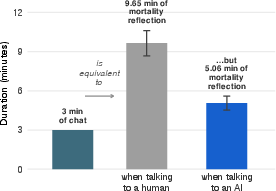
Figure 1: Aversion to outgroup conversation is far lower for an AI than a human partner.
These data demonstrate that synthetic contact may overcome a critical feasibility barrier plaguing conventional cross-partisan interventions—namely, aversion to engagement.
Correction of Outgroup Misperceptions
Baseline cognitive misperceptions were large and asymmetric. Using the GREEN environmental attitude measure, Democrats overestimated Republicans’ opposition to green consumption by d=1.49, enough to invert the apparent modal position from supportive to oppositional. Republicans' misperceptions of Democrats were less pronounced (d=0.24). Notably, LLM bots approximating a median partisan position tended to be more extreme than corresponding human outgroups, yet were closer to truth than participants' initial beliefs, especially for Democrats.
A single ten-minute AI-mediated conversation produced substantial accuracy gains (0.39 on 5-point scale; d=0.46) and a 4.3-point increase in outgroup warmth (d=0.37), with benefit size tightly coupled to baseline misperception magnitude.
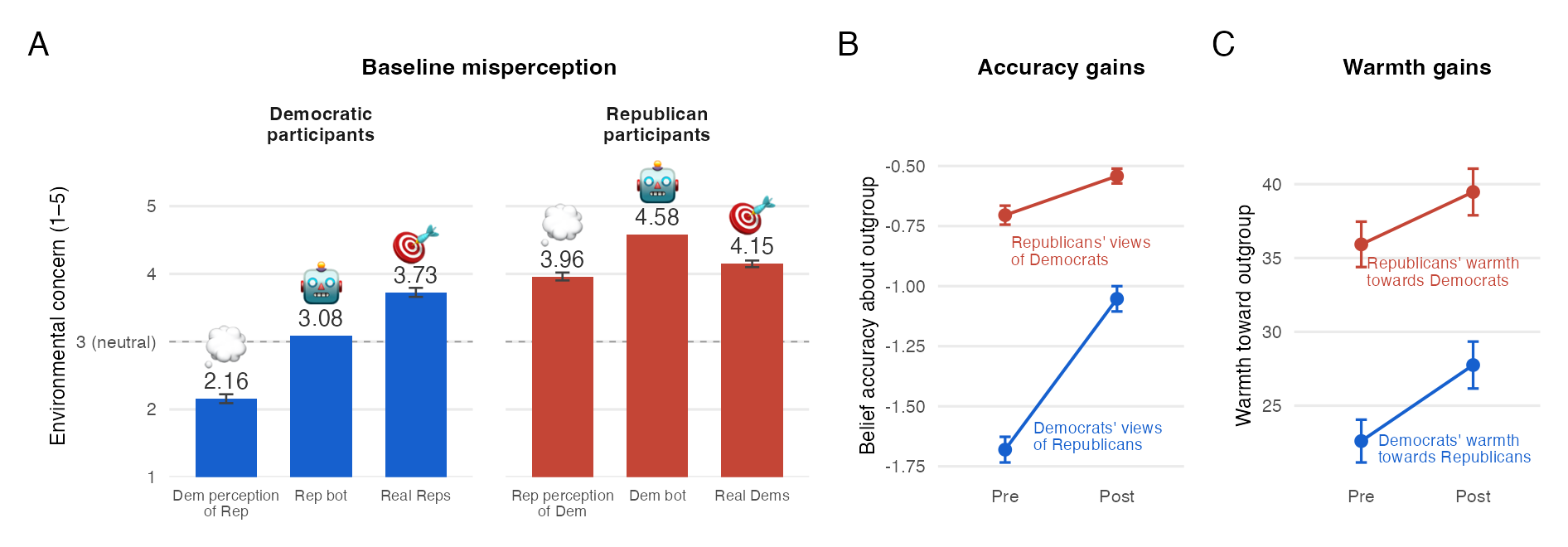
Figure 2: A single ten-minute conversation corrects misperceptions of the outgroup and warms attitudes toward it.
The correction was graded: larger for those starting from greater misalignment (Democrats), smaller otherwise (Republicans).
Causal Isolation and Behavioral Uptake
To isolate the effect of outgroup-specific content from social engagement or generic digital interaction, a three-arm experiment contrasted synthetic contact, a neutral chat (cats vs. dogs), and a non-social control (Space Invaders). Only the outgroup-representative AI elicited significantly higher post-intervention outgroup warmth (d≈0.58 against either control, p<.001). There was no increment due to neutral AI chat or game-based engagement.
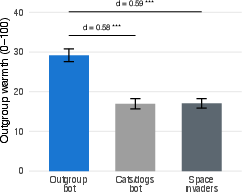
Figure 3: Synthetic contact raised outgroup warmth above both controls.
Crucially, in a subsequent behavioral experiment, participants exposed to outgroup AI dialogue were significantly more likely (OR = 1.33, p=0.025) to select an actual cross-partisan exchange over another aversive task, an effect directionally robust across parties and present with only a five-minute prior intervention.
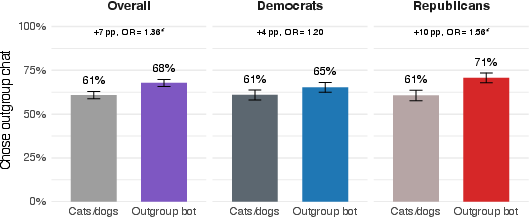
Figure 4: After synthetic contact, more partisans choose a real cross-partisan conversation.
Durability and Moderation of Effects
A sizable immediate effect on outgroup warmth was observed post synthetic contact, but the effect largely decayed after one week (with a pooled d=0.12, p<.0010 for one-week persistence). Crucially, the residual effect concentrated among high-extremity participants, where p<.0011 (p<.0012). The rapid decay parallels other brief interventions targeting polarization and illustrates the challenges of lasting attitude change via single-exposure treatments.
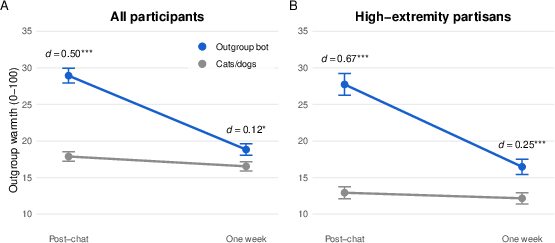
Figure 5: Synthetic contact's effect on outgroup warmth is large immediately, mostly gone within a week, and larger among extreme partisans.
Mechanistic Pathways: Cognitive Primacy over Affective Channels
To adjudicate whether observed attitude change operated primarily through cognitive recalibration or affective engagement, all bot conversations were coded (GPT-5.4-mini) for stereotype-disconfirming substance, informational specificity (cognitive route), as well as empathy and friendliness (affective route). Across all studies, the largest between-condition contrast reflected stereotype-disconfirming content (ΔM up to +2.05, pooled p<.0013 large), rather than affective warmth or empathy.
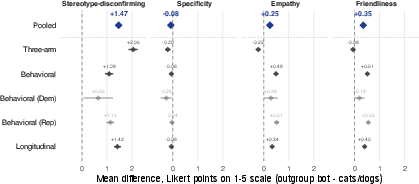
Figure 6: Outgroup bots differ from control bots more in information than in friendliness.
Thus, while face-to-face contact effects are robustly affective-mediated, the synthetic contact effect appears primarily cognitive, achieved via direct correction of misattributed or exaggerated outgroup stances.
Heterogeneity and Content Analyses
Individual-level change in outgroup warmth was right-skewed but broad, with 45–49% of participants in both parties exhibiting positive change. The magnitude of belief updating and warmth gain was directly associated with the semantic proximity of conversation content to key attitude domains, confirming that cognitive engagement—specifically, exposure to stereotype-disconfirming information—was the central mechanism.
(Figure 7 and Figure 8)
Figure 7: Distribution of individual-level change in outgroup warmth (post - pre), by learner party.
Figure 8: Conversation-level bot–item semantic proximity vs. belief accuracy gain, by learner direction. Proximity tracks accuracy gain in DtoR but not in RtoD.
Theoretical and Practical Implications
The finding that synthetic contact is more acceptable, scalable, and immediately efficacious clarifies the potential for LLM-based interventions to increase cross-partisan openness in digital environments. The cognitive route of misperception correction, as opposed to affective mediation, distinguishes AI-driven contact from human-human analogue interventions in the contact hypothesis tradition. The work also demonstrates that imperfect AI calibration does not necessarily entrench misperceptions; “better than baseline” trajectory shifts are sufficient for behavioral and attitudinal modification among those starting from high error.
Nevertheless, the impermanence of effect, concentration of residuals among extremists, and evidence for cognitive (not affective) mediation pose both opportunities and limitations for societal deployment. Scalable, repeated, context-sensitive interventions embedded within digital platforms, news applications, or civic engagement tools may leverage the accessibility and acceptability of AI to offset the rapid decay documented in this paradigm.
Future Directions
Several avenues for extension are clear:
- Repeated and Longitudinal Contact: Investigate if distributed, repeated synthetic contact produces cumulative or more durable reductions in affective polarization, especially in high-exposure digital ecosystems.
- Generalization Beyond U.S. Partisanship: Extend examination to other salient identity divides and policy domains globally.
- Model Calibration: Employ survey-aligned digital twins or dynamic role prompts to minimize residual bias due to model extremity.
- Outcome Multidimensionality: Evaluate broader downstream outcomes—social distance, anti-democratic attitudes, participatory behavior—to map the generalizability of contact effects.
- Adversarial and Malicious Use: Assess consequences (and mitigations) if synthetic contact were to entrench rather than alleviate polarization via adversarial prompt tuning or target-group misrepresentation.
Conclusion
"Synthetic Contact with AI Reduces Cross-Partisan Animosity" (2607.02181) rigorously demonstrates that brief, stereotype-disconfirming AI-mediated dialogues can overcome engagement aversion, correct misperceptions, warm affect, and prompt costly cross-partisan choices—though the effect is transient and cognitively driven. The scalability and accessibility of synthetic contact, especially for individuals most resistant to human intergroup dialogue, highlight the practical significance for attitudinal depolarization strategies online. Future developments hinge on integrating repeated interventions, optimizing LLM calibration, and expanding the scope of outcome measurement to fully leverage the unique mediational routes offered by LLM-driven social contact.