- The paper introduces a formal model for verifiable context governance that guarantees artifact integrity, strict versioning, and deterministic selection for AI agents.
- Empirical results show ContextNest outperforms BM25 and dense retrieval methods by achieving higher pass rates and reduced token costs, effectively mitigating stale-version risks.
- The system integrates a dual-plane governance model combining human oversight with cryptographic proofing to ensure traceability, temporal consistency, and regulatory compliance.
Verifiable Context Governance for Autonomous AI Agents: An Analysis of “ContextNest” (2607.02116)
Introduction and Motivation
The increasing deployment of autonomous AI agents into operational decision-making roles in enterprises necessitates more than data relevance from retrieval pipelines; it demands strong guarantees about the provenance, integrity, and auditability of the context these agents consume. Current retrieval-augmented generation (RAG) architectures focus on semantic relevance but provide no universal framework for durable guarantees concerning versioning, approval status, or consumption traceability. This context governance gap (CGG) exposes organizations to risks such as decision-making on outdated policies, undetectable tampering, or the inability to audit or reconstruct prior states of knowledge. “ContextNest” (2607.02116) introduces a formal model and portable specification for knowledge governance designed for consumption by autonomous agents. It operationalizes principled context governance as an orthogonal substrate beneath retrieval systems.
Architectural Overview
ContextNest introduces a stack-layered approach where the context-governance substrate sits between enterprise knowledge systems and the agent resolution/injection runtime. It consists of typed Markdown documents with structured metadata, deterministic selector grammars, cryptographically hash-chained versioning, explicit stewardship and approval policies, and robust audit tracing. Unlike RAG, which simply retrieves relevant context fragments, ContextNest determines the eligibility, version, stewardship, and integrity of all artifacts consumed by agents, with audit traces linking agent actions to precise knowledge state and provenance.
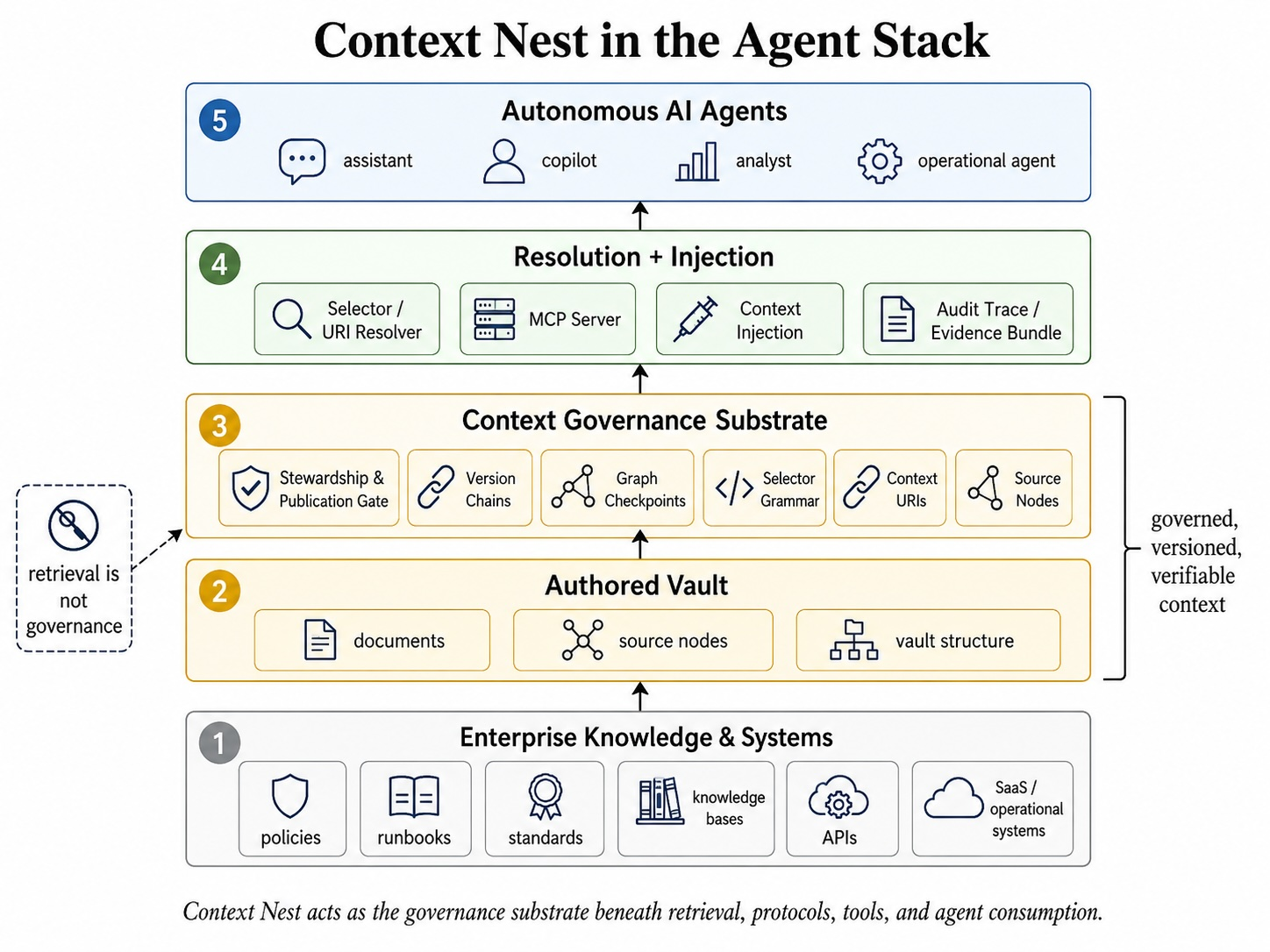
Figure 1: ContextNest in the agent stack. The context-governance substrate sits below agent resolution/injection and provides artifact eligibility, version, stewardship, and integrity guarantees, with retrieval operating only over the governed subset.
Governance workflows in ContextNest feature a two-plane system: a human-governance plane (author–reviewer–publish–checkpoint) establishes the approval and provenance of context artifacts, while a runtime agent-consumption plane performs deterministic resolution, injection, and consumption, logging every context access for auditing.
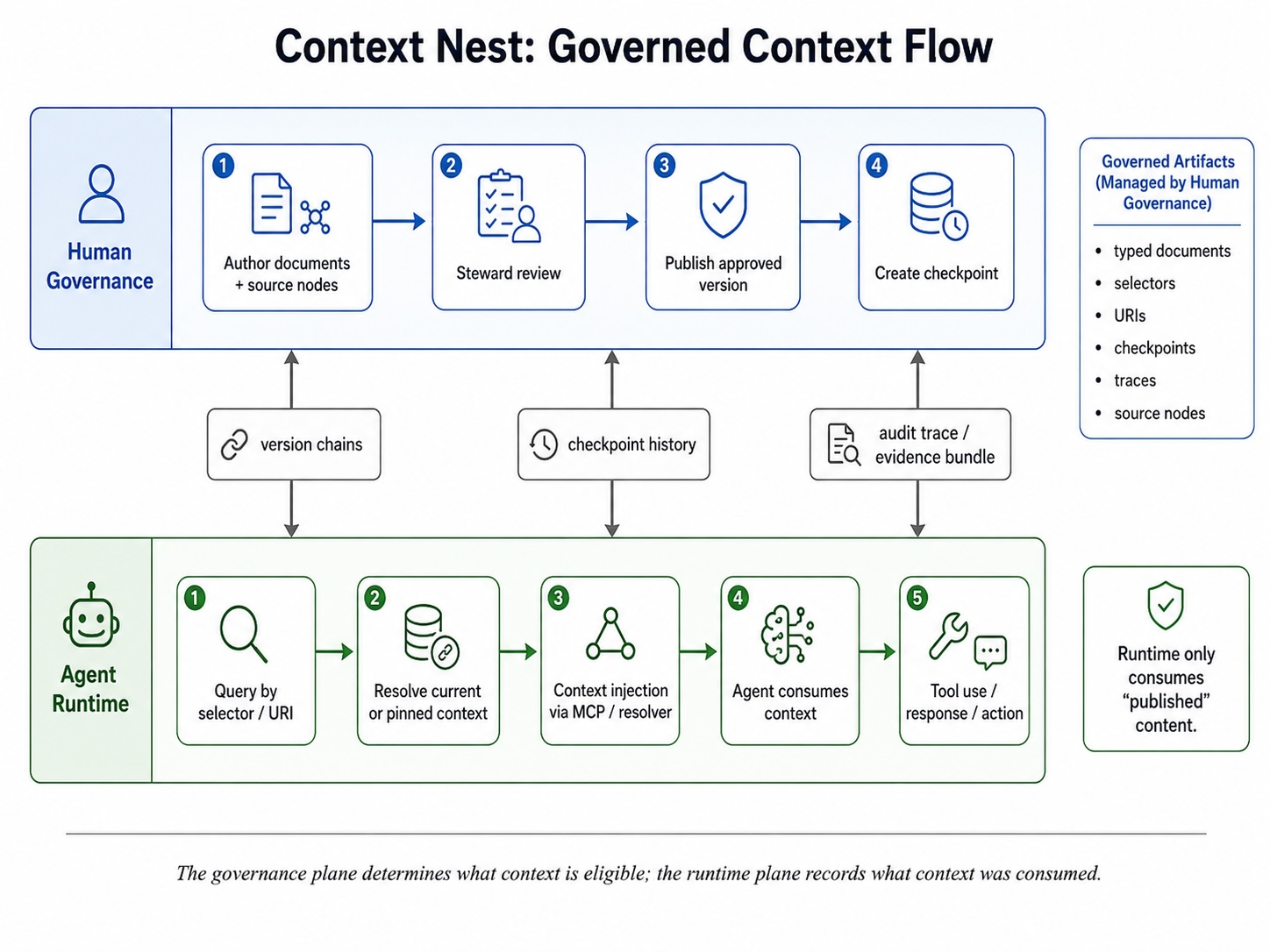
Figure 2: Governed context flow. The human-governance plane produces the approved artifacts, and the runtime agent plane records context consumption, enforced strictly on published content.
Formal Model of Context Governance
ContextNest formalizes context governance as six mutually reinforcing properties:
- Provenance: Authorship and modification details are inseparable from document versions.
- Version Identity: Documents maintain fully ordered, append-only version histories.
- Integrity: Post-publication modifications are cryptographically detectable via hash chains.
- Deterministic Selection: Query evaluation is pure and deterministic with respect to selector and checkpoint.
- Traceability: Every context injection is audit-traced, reconstructing the exact knowledge consumed.
- Temporal Consistency: Full graph is reproducibly reconstructible for any checkpoint.
The combination of SHA-256 hash chains and standardized canonicalization ensures the immutability and tamper-evidence of histories, while checkpoints create point-in-time, cross-document graph consistency. The architecture's threat model explicitly considers adversaries aiming for silent tampering, history rewriting, forged checkpoints, and stale-version induction. Integrity claims are validated under these adversary definitions.
Document Model and Stewardship
Every artifact in a ContextNest vault is a typed, versioned Markdown document with YAML frontmatter capturing metadata such as author, version, status, and chain hashes. Node types—such as ‘document,’ ‘snippet,’ ‘glossary,’ ‘persona,’ ‘source’ (for live data), etc.—enable targeted and type-safe selection. Stewardship is hierarchical: assignments (by document, folder, tag, or vault) specify dedicated reviewers and enforce separation of duties on the publication process. In governed mode, no principal can unilaterally approve their own work, codifying organizational review and approval.
Deterministic Selector Grammar and URI Scheme
ContextNest defines a set-algebraic, pure selector language supporting conjunction, disjunction, negation, and reference expansion via "context packs." Selectors can query on tags, types, status, and addressable URIs, supporting both direct addressing (document at version), set addressing (all documents matching predicates), and delegated/semantic retrieval (search URIs handed off to external RAG pipelines). Direct and set addressing are fully deterministic and audit-traceable, while delegated retrieval is clearly demarcated and subject to reduced guarantees.
Empirical Results: Governance vs. Retrieval
Two empirical experiments are central to the paper:
Stale-Version Attack
A suite of 30 queries tested systems against the risk of returning superseded (stale) document versions. The ContextNest selective approach retrieved only current, published artifacts, while BM25-based retrieval could surface stale or archived material if the index included expanded document histories.
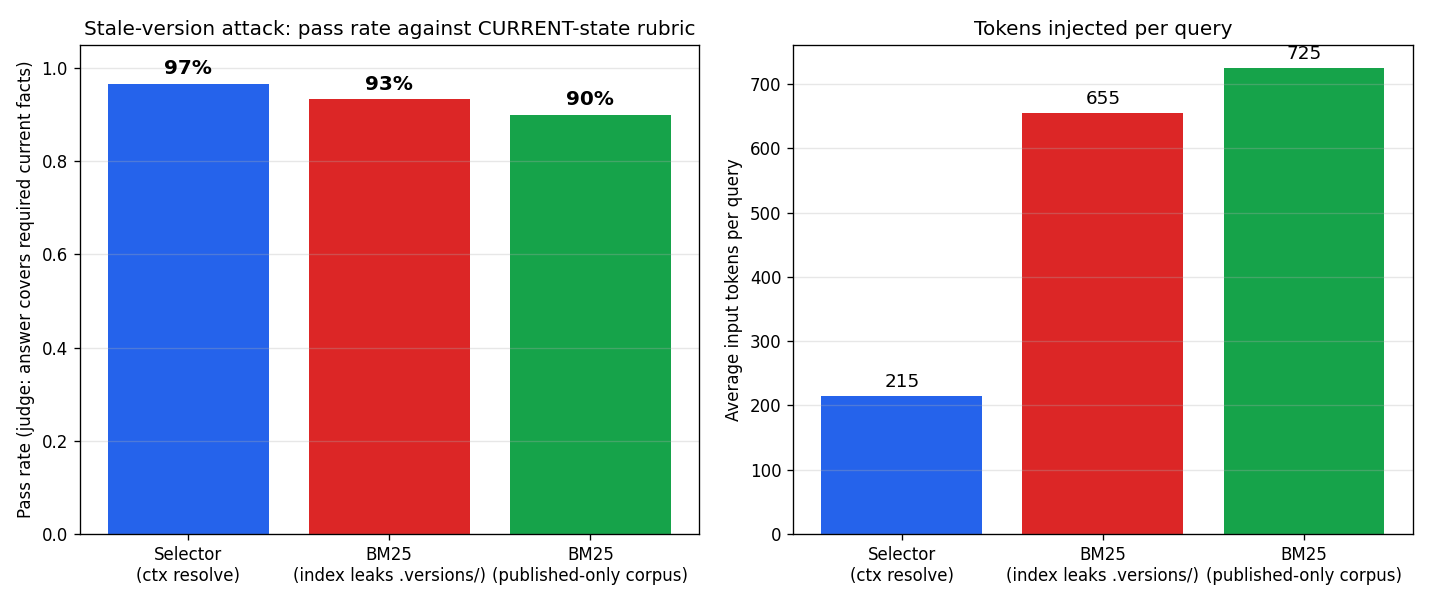
Figure 3: Stale-version attack results. Selector strictly Pareto-dominates BM25 on both pass rate (97% vs. 93–90%) and input-token cost (approximately 1/3 the input token usage).
The two primary BM25 failure modes were (1) stale-version poisoning, where the model provides answers grounded in superseded knowledge, and (2) retrieval miss, where relevant context is lexically underrepresented and thus missed by semantic methods. ContextNest strictly outperformed retrieval approaches with both higher answer-quality pass rates and lower token costs.
Retrieval Determinism
Retrieval determinism was evaluated using repeated queries on a 1,060-document corpus. Selectors and BM25 were perfectly deterministic (Jaccard 1.0), guaranteeing reproducible retrieval state—a precondition for audit and regulatory compliance. Dense+HNSW retrieval exhibited 80% non-determinism (mean Jaccard 0.611, minima as low as 0.21), demonstrating the limits of using embedding-based or approximate-nearest neighbor indices for regulatory and safety-critical pipelines.
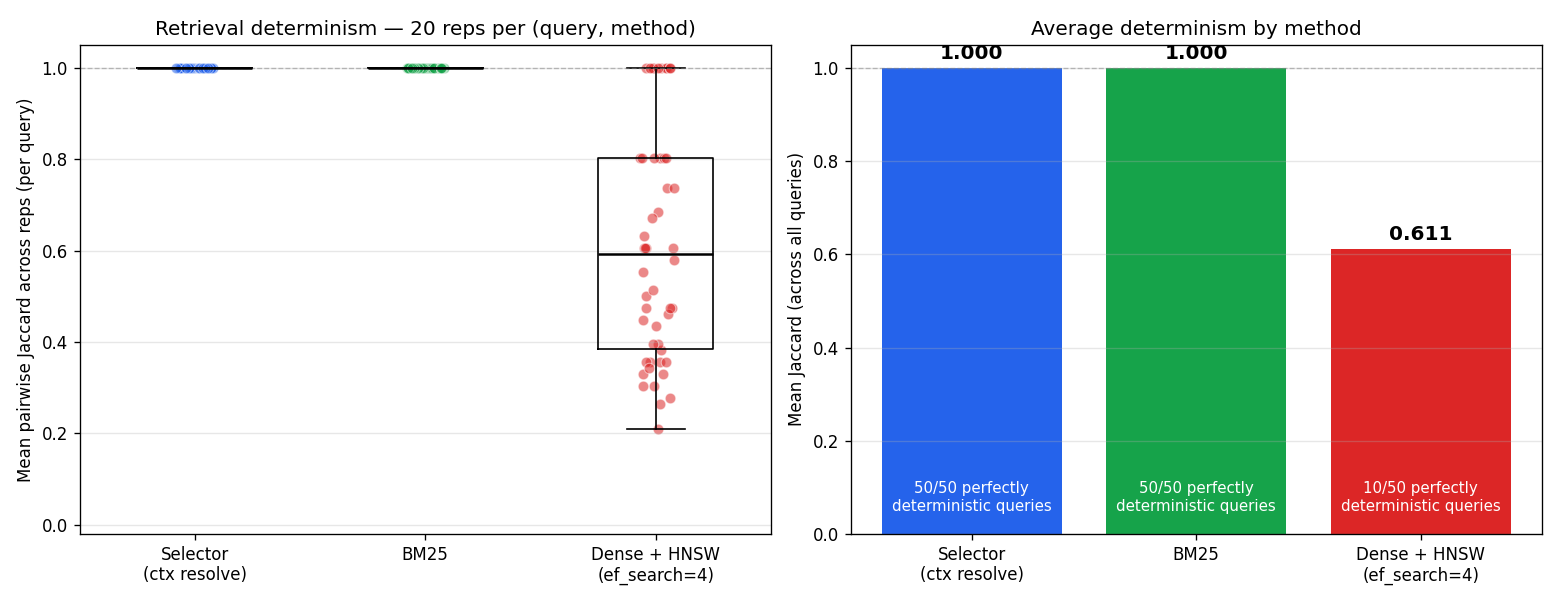
Figure 4: Retrieval determinism across 50 queries × 20 repetitions. Selectors and BM25 are deterministic on all queries; dense+HNSW is non-deterministic on most queries.
Integration, Limitations, and Comparison
ContextNest elegantly composes with RAG: it constrains the eligible search set to the governed, published, and integrity-verified subset, after which semantic search can operate, and every retrieval event is audit-traced. The governance layer is orthogonal; it does not replace retrieval but supplies the guarantees retrieval alone cannot provide.
Limitations include the lack of direct agent identity governance (scoped to future specifications), retrospective-only asset integrity (tampering is detected, not prevented), and coarse granularity of authorship attribution in v1 (document-level, to be refined with piecewise attribution). Real-time multi-user collaboration and federation are acknowledged as areas for additional engineering.
Comparative analysis shows that while knowledge graphs, Git-based data stores, and standard RAG architectures address some aspects such as versioning or provenance, none unify all six context governance properties required for audit-worthy agent inference.
Implications and Future Directions
ContextNest's approach enables enterprises to meet emerging regulatory requirements (e.g., EU AI Act, NIST risk frameworks), support post-hoc audit and dispute resolution, ensure organizational accountability for autonomous agent decisions, and mitigate silent failure modes (e.g., stale-version attacks) not addressed by semantic retrieval quality alone.
Practically, ContextNest vaults are local-directory based, immediately compatible with text-file workflows, and can be layered beneath or alongside RAG systems without retraining or migration risk. The evidence-bundle structure inherent to ContextNest's audit trails facilitates compliance, certification, and market accountability as AI agents move into high-stakes operational domains.
Theoretically, the work closes a long-standing gap in information systems: the systematic realization of artifact-level knowledge governance as a precondition for trustworthy autonomous systems. It revisits and implements principles from three decades of information systems and cognitive apportionment theory at the level of agentic AI knowledge consumption artifacts.
Future work will include agent attestation/identity, piecewise author attribution, governed skill/action artifacts, inter-vault federated protocols, expanded trust/compliance integration, and comprehensive empirical benchmarking.
Conclusion
ContextNest delivers an open specification and reference implementation for principled, cryptographically verifiable context governance in autonomous AI agents, addressing failure modes inherent to retrieval-centric pipelines. By formalizing provenance, version identity, integrity, deterministic selection, traceability, and temporal consistency, it enables organizations to guarantee the eligibility, recency, and auditability of agent-consumed knowledge. Empirical results demonstrate strict Pareto efficiency over conventional sparse and dense retrieval methods in adversarial and deterministic regimes. The approach is positioned to be foundational for enterprise AI safety, compliance, and trust as agentic autonomy becomes increasingly tightly coupled to operational knowledge bases.
Reference:
"ContextNest: Verifiable Context Governance for Autonomous AI Agent" (2607.02116)

